Why Now Is The Most Dangerous Time For Your Savings In 50 Years
Inside Today’s Issue
Editor’s note: Join Porter for his new Ignition Point broadcast this Wednesday and discover how several separate technological forces are fusing to create what Porter calls “the next Mag7.” Secure your seat here.
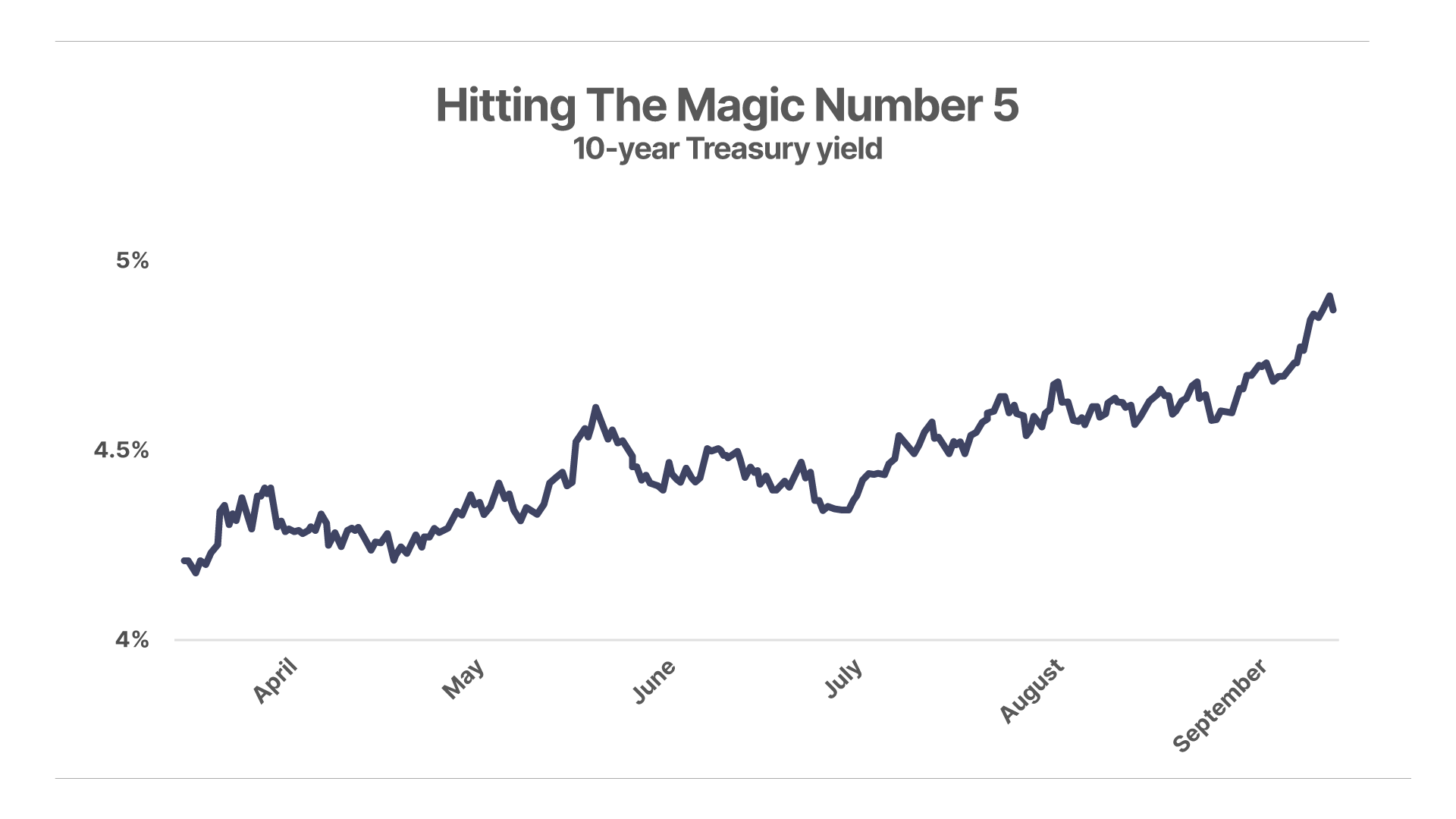
As I’ve been warning could happen since March, yields on the 10-year Treasury bond are now trading above 5%.
The 10-year U.S. Treasury bond yield jumped to 5.005% in the minutes after the August inflation report hit the wire last Friday – the 10-year traded above the 5% level again this morning. Both times, as soon as the yield broke above 5%, there was a massive intervention in the market forcing yields lower. I suspect the Fed is actively suppressing rates. Or it could be the Treasury issuing more short-term bills and buying longer term bonds.
My new book 2029 The End Of America: Why The Age Of Paper Money Is Ending And How To Survive The Coming Global Monetary Reset explains exactly why this is a very dangerous situation, not just for investors, but for our entire country. I write on page 29:
When Powell raised the federal funds rate from zero to 5%, he did not just cool the economy — he tripled the United States government’s annual interest expense. Net interest on the national debt went from $345 billion in October 2020 to $981 billion in October 2025. That is more than the entire defense budget of the United States of America… The next time inflation breaks out — and it will break out, because the structural forces driving it have not been addressed and the monetary expansion of 2020–2022 has not been meaningfully reversed — the Fed will face a choice Paul Volcker never faced: it will have to choose between fighting inflation and keeping the Treasury solvent. It cannot do both. And because no democracy in the history of the human race has ever chosen Treasury-solvency-and-austerity over inflation when the choice was forced upon it in a moment of crisis, the Fed will choose inflation.
What’s happening today — in the markets, with the Iran War, and in our politics — is almost exactly what happened the last time there was a huge, global monetary reset, which was in the early 1970s when the U.S. defaulted on its promise to redeem dollars for gold.
That decision unleashed a new, global fiat monetary regime that’s seen asset prices soar while wages stagnated, destroying the middle class in America. It led to a decade of much higher inflation rates and much higher interest rates from 1971-1981. By the time the 1970s monetary reset was over, long-term rates were 15% annually, high-quality stocks were trading at six times earnings, and the dollar’s purchasing power had fallen by more than 50%.
Could that really happen again? Absolutely.
Last year, the federal government ran a deficit of almost $2 trillion, spending 34% more than it collected. The government, already supporting unprecedented debts, is running a deficit that is 6% of GDP — during peacetime and with full employment!
This hasn’t happened since the 1970s.
And look at our politics. Who reminds you of President Richard Nixon more than President Donald Trump? Trump issued roughly 225 executive orders in the first year of his second term, and, like President Barack Obama (!), is using law enforcement to settle political scores. He’s the most “imperial” president we’ve had since Nixon. (Obama! was the most insufferable.)
The difference between 1971 and today is that the federal government is vastly larger and the spending is even more out of control. Today, all state and local governments combined spend around $3.7 trillion annually. That’s only half of federal outlays: the federal government spends more than the other 50 states, combined.
And then there’s the war.
In October 1973, Egypt and Syria attacked Israel on Yom Kippur. The Arab oil producers answered with an embargo, and oil ran from $3 a barrel to nearly $12 in a matter of weeks. America’s involvement in this war was never about Israel. It was always a war over the dollar. The Saudis had threatened to stop pricing oil in dollars after Nixon broke the gold promise in 1971. The war, and the secret petrodollar arrangement that ended it, kept oil priced in dollars for 50 years and allowed America to run endless trade deficits financed purely with paper money. That deal ended in 2024. And look whose oil industry is being destroyed in this war: Saudi Arabia’s. That’s not a coincidence.
There’s one other major similarity between today and the early 1970s that no one is talking about yet: the urgent need for entitlement reform.
In the 1972 election year, Congress and Nixon gave Social Security recipients a 20% across-the-board benefit increase.
Trump is promising something even bigger in this election: a $5,000 “dividend” for voters if the Republicans win both the Senate and the House.
But it’s the 1972 law that’s the real risk. The Social Security Amendments of 1972 did something no government had done to itself before: it wired future benefits directly to inflation. Starting in 1975, guided by the consumer price index (“CPI”), checks would rise automatically every year. No vote required, ever again.
When inflation ran higher in the late 1970s, one of the main reasons it was so hard to control was because federal spending was mandated to increase alongside inflation. The first automatic cost of living adjustment (“COLA”), in 1975, was 8%. By 1980, it was 14.3%. The government had built a machine that took the very inflation it was causing and fed it straight back into its own largest expense, automatically.
So… what caused the inflationary spiral of the 1970s? A deranged, imperial president who refused to cut spending even when it was obviously out of control, a war in the Middle East that disrupted oil supplies for a decade, and an entitlement system that vastly increased spending, automatically because it was indexed to inflation.
And what do we see today?
The federal government is $40.1 trillion in debt, running close to $2 trillion in annual deficits, and the two fastest-growing line items (Social Security and interest expenses) are linked to inflation. Printing money won’t cure these obligations – it will make them grow faster.
The Strait of Hormuz has effectively been shut for over 100 days, and Houthi attacks on tankers in the Red Sea have added a second front. There’s already been substantial damage to major energy infrastructure, and there’s no end in sight to this conflict. Oil is above $100 a barrel.
The CPI rose 3.4% in August and has been above the 2% rate for 66 consecutive months – more than five years. That’s driving massive increases to Social Security payments, with 2027’s COLA expected to be 3.7%. The program, which has been operating in the red since 2010, currently pays out about $138.4 billion a month, or roughly $1.66 trillion a year, to 71.3 million beneficiaries. A 3.7% COLA adds about $5.1 billion a month to that, or $62 billion more a year. And that’s before counting the roughly 1.5 million new beneficiaries who join the rolls annually.
America’s federal government is a leviathan spiraling toward insolvency with a printing press. You know what it’s going to do. It is going to defraud its creditors.
How? In all kinds of ways. By defaulting on Social Security (yes, that will absolutely, 100% happen). And by resetting the value of our currency much lower, thus making it easier to repay its debts. That’s exactly why long-duration interest rates are going much higher.
That will not be good for equity valuations. It will also not be good for our country. The 1970s were a period of tremendous political violence. And this time will be worse.
If you haven’t yet, now is a very good time to read my book.
It’s available at Amazon.com, both as a paperback and on Kindle. You can also listen to it as an audiobook. It’s only $9.99 (via Kindle). Please read it. And give a copy to someone you love. It’s a thorough guide to protecting your wealth from the coming monetary reset.
P.S. Attentive readers will recall that earlier this year (in March) I suggested that retired investors, or investors who didn’t want to face a lot of volatility this year, should sell the property-and-casualty (P&C) insurance allocation in Porter’s Permanent Portfolio and move those assets to short-term Treasury bills (SHY). Doing so would create a Permanent Portfolio asset allocation that’s ready for higher inflation and higher interest rates: 25% stocks, 25% gold and Bitcoin, and 50% cash. I explained that when the 10-year Treasury yield broke above 5%, I would move our official allocations to match this conservative allocation. I haven’t done that yet, because, so far, the 5% level hasn’t held. When I change our official allocations, I’ll let Complete Investor subscribers know.
Tell me what you think of today’s Daily Journal: porterstansberrydirect@gmail.com
Good investing,
F. Porter Stansberry
Stevenson, Maryland

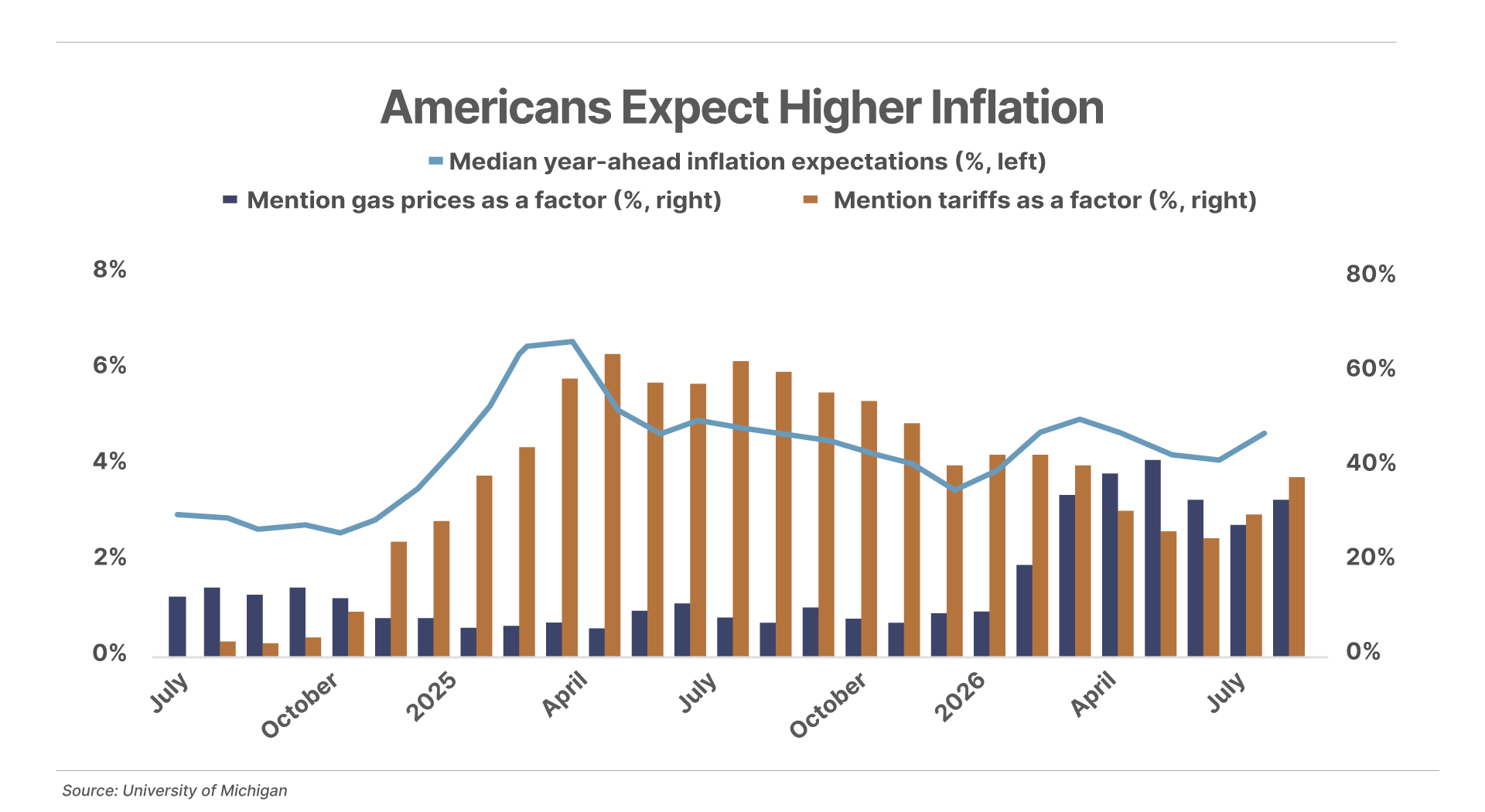
1. Year-ahead inflation expectations jumped to 4.6%… The University of Michigan September survey index is up from 4.0% in August. Roughly 37% of consumers spontaneously named tariffs as a concern, the most since April, while about 30% named prices at the pump. Those are two separate supply shocks landing on the same household budget, and neither is the kind of inflation a central bank can wait out. Markets are pricing in an 81% chance of a rate hike for Wednesday’s Fed meeting.
2. AI leaders push for a pause. Last week, a former researcher for leading AI platform Anthropic made headlines after publicly resigning and warning that the leading frontier labs are racing recklessly toward dangerous “superintelligence.” Over the weekend, AI leaders including OpenAI head Sam Altman, Anthropic CEO Dario Amodei, and X owner Elon Musk called for slowing the pace of AI development. Critics argued that regulations on AI would favor these incumbents at the expense of lower-cost, open-source alternatives that have begun taking market share from OpenAI and Anthropic. The prospect of a slower pace of AI development sparked a sell-off across the data-center supply-chain complex, including the semiconductor sector, which fell by 4% on the news.
3. Trump concedes on crypto ethics, clearing the path for the Clarity Act. Late Sunday, Senate Republicans released what they called the final text of the bill, which would create the first comprehensive federal rulebook for crypto. President Trump reportedly agreed to roughly 80% of a bipartisan ethics proposal from Senators Thom Tillis (R., NC) and Ruben Gallego (D., AZ) that Senate Democrats had demanded for approval. Tomorrow at 2:15 p.m. ET, the Senate votes on cloture, the step that ends debate and lets the bill advance. That takes 60 votes. With at least two of 53 Republicans expected to vote no, about nine Democrats must cross over to support it. Prediction market Kalshi now puts the odds of ultimate passage at close to 50%, up from just 18% before the text came out.
The yield on the benchmark 10-year U.S. Treasury Note briefly touched 5.011% this morning, its highest level since July 2007.
On Friday, Porter wrote in the Daily Journal that AI and tech are essential tools for the success of any business – so much so that in a decade we will no longer think of something being a tech stock since any successful company will have tech to thank for their staying power.
“Everyone Should Read This”
Stephen B. writes:
Every student, every job seeker, every investor, and even philosophers should be exposed to this analysis.
This is an excellent example of inductive reasoning about a process that excels at deductive conclusions. I hope it will be discussed in our educational institutions as guidance about how and where AI can assist humanity. AI is not a competitor for “intelligence” – it does not originate inductive discoveries. It reports deductive conclusions based on existing data bases.
Luke S. writes:
Good, solid article!