The Annual Conference Picks Winners… Again
Inside Today's Issue
- Essay: The 5 Most Promising Ideas
- More Trouble For Oracle (ORCL)
- The AI Build-Out Is Really, Really Big
- AI Supercharges Biotech
- Chart Of The Day… Roivant Sciences (ROIV)
- Today’s Mailbag
The high-tech clap-o-meter strikes again…
With the best analysts on the planet sitting next to him on the stage to help select the most promising stocks presented at The Porter & Co. Annual Conference, Porter instead turned to the audience. “Clap if you think this stock will jump 25% over the next year,” he said.
While he ultimately took the advice of the analysts, the clap-o-meter turned out to be a good indicator. In fact, not one person clapped for the coal stock Thungela Resources (TNGRF).
The Porter & Co. Annual Conference has a history of putting some extraordinary opportunities in front of attendees.
Once a year, Porter brings together top minds in investing to share insights from industry leaders, expert analysts, and special guests. The ideas ranged from gold to cryptocurrencies to biotechnology breakthroughs. The great thing about a Porter & Co. conference is that these sharp-as-knives finance gurus bring their A-game – and keep no secrets, offering the latest recommendations to the audience.
Last year, InvestorPlace analyst Luke Lango pitched Bloom Energy (BE), which has since risen 300%. Past guest speakers put the spotlight on other stocks like Rocket Lab (RKLB) – up 75% – and Roivant Sciences (ROIV) – up 140%. But unless you were there in person, you didn’t get to be part of those conversations.
This year, we wanted to change that. So when the final presenter left the stage on Thursday afternoon, the analysts went back through every major opportunity presented over the previous two days. The presenters served up 48 recommendations to choose from. These are the five ideas that we believe offer the biggest upside from here – results verified by the clap-o-meter!
1. The Alphabet Of Cancer Medicine
Stansberry Research analyst Dave Lashmet presented this idea on Wednesday, September 23, following his meetings earlier this week with the company’s CEO and four clinical trial investigators.
What This Company Does
This company makes drugs that find a tumor and then kill it, using the same molecular address for both jobs. Dave calls this "lightning in a bottle and a zip code." The zip code is a marker that lands on a specific cancer. The lightning is a radioactive isotope. Swap a diagnostic isotope for an alpha or beta emitter and the same drug goes from imaging the tumor to destroying it. That's why he calls it "the alphabet of cancer medicine."
The diagnostic side is already powerful. A clean scan means no tumor, and no tumor means no surgery. The therapeutic side is where the money is.
The company trades at about $5 billion. Dave's view is that a U.S.-listed company with these assets would be worth around $40 billion. He expects a large pharma buyer to emerge within the next year.
2. The Cleanest Way To Own The Qatari LNG Shock
Coal Trader editor Matt Warder walked attendees through the current market environment for energy stocks – focusing on coal and natural gas.
Coal Trader publisher Matt Warder believes the market has already priced in the end of the Strait of Hormuz crisis, and that the people closest to the physical gas supply chain know better. Of the stocks he discussed, he sees this business as the one that can capitalize in the short term.
In March, Iranian missiles struck the Ras Laffan liquefaction facility in Qatar. The attack removed two liquefaction trains totaling about 12.8 million tons per year of liquefied natural gas (“LNG”) capacity. Qatar supplies close to 20% of the world's LNG, and Warder puts the permanent loss at about 3% of global supply. Some 83% of Qatar's LNG goes to Asia, the world's main energy growth market.
Hormuz transits remain about 90% below pre-conflict levels. Warder says the reason is simple: if an oil tanker is attacked, the result is a spill, but if an LNG carrier is attacked, it explodes. Insuring those vessels is close to impossible while the conflict lasts.
By Warder's count, about 74 million tons of LNG are missing from the market on an annualized basis. Incoming U.S. export capacity adds only about 18 million tons per year, and the longer the conflict runs, the less that matters. Half the shortfall has so far been met by drawing down storage, with no plan to refill it.
3. The Opposite Of A Bond
Porter Stansberry kicked off the conference on Wednesday, September 23, and shared with his guests his plans for re-allocating Porter’s Permanent Portfolio – a balanced portfolio product available to subscribers to Complete Investor.
Because of concerns about rising inflation and other macro-economic factors, he added exposure to commodities to the portfolio.
The week before the conference, Porter told readers the 10-year Treasury had crossed 5%, the level he said would trigger an exit from property and casualty insurance. It did. Conservative investors should move to cash, he said. But cash only protects against loss. It doesn't protect against inflation. For investors who share his outlook, he sees this ETF as a better hedge. When inflation rises, commodities perform.
Porter doesn't believe the Federal Reserve will get inflation back near 2%, and he says most Americans don't either. It has been 66 months since inflation was at or below that level – that’s early 2021. Consumers are starting to model 4% or 5%. By Porter's own tracking, inflation is running at 9% to 11%.
If inflation expectations come untethered, he says 10-year yields could go from 5% to 8% or 9% within 18 months. At 5%, a stock trading at 20 times earnings has an equivalent earnings yield of 5%. At 8%, the same math pushes the market multiple down to 12 to 14 times earnings. That's a major drawdown for stocks. It would also hurt property and casualty insurers, whose value is mostly their bond portfolios. Porter puts the odds of this happening in the next 18 to 24 months at 80%.
Porter's answer is to own the opposite of a bond: commodities. When inflation rises, bond prices fall and commodity prices climb. Commodity trading advisors (“CTA”) use trend-following strategies to own the commodities complex. When inflation shifts sharply, their returns rise.
Porter points to history. In 1980, a CTA allocation returned 63%, at a time when the Dow Jones Industrial Average traded at just 6x earnings. A 25% position would have offset a great deal of damage elsewhere in a portfolio.
4. A Soon-To-Be $10 Trillion Business
Both Porter Stansberry and Dave Lashmet extolled the virtues of this Big Pharma company – Porter did so in his presentation that outlined the investment thesis for Porter & Co. Biotechnology newsletter.
This business has a wide portfolio of marketable drugs and is the global leader in the booming market for GLP-1 diabetes and weight-loss drugs.
The GLP-1 weight-loss drug market is highly competitive and is driving the narrative in the pharmaceutical industry at the moment. Its leading injectable diabetes drug has experienced massive growth, with Q1 2026 revenue hitting $8.7 billion, representing a 125% year-over-year (“YOY”) increase. The company projects massive 2026 revenue, driven by massive demand for these obesity drugs.
5. A Blue-Chip Business
Distressed Investing analyst Marty Fridson took the stage to inform readers how he goes about finding distressed debt and distressed equities. He pointed out that the two most recent stock-bond combo recommendations have increased on average about 105%.
This company has been an American icon since the 1950, but spent decades wasting its lead. It sat on technological breakthroughs it never commercialized and lost money on financial services. Today, its bonds trade like they’re headed for bankruptcy. Marty thinks the market has this wrong.
These bonds trade for around $380 per $1,000 of face value. Investors who buy at that price and hold to maturity will return roughly 36% a year.
The company’s turnaround is real. A new CEO has stabilized revenue, increased profitability, and paid down debt. And the company is also buying back its own bonds at deep discounts. In Q1, it retired $101 million of its 2028 bonds for just $45 million. Every discounted repurchase leaves the remaining bondholders better protected.
Trading at under $400, the bond reaches maturity in just over three years, at which point the company will pay holders $1,000 per bond – if they don’t snap up the cheap bonds sooner at a juicy premium to their market value.
Today’s Journal is excerpted from The Big Five Report. To get access to the full report, with company names and ticker symbols, click here.
Tell us what you think of today’s Daily Journal: porterstansberrydirect@gmail.com
Porter & Co.
Stevenson, Maryland
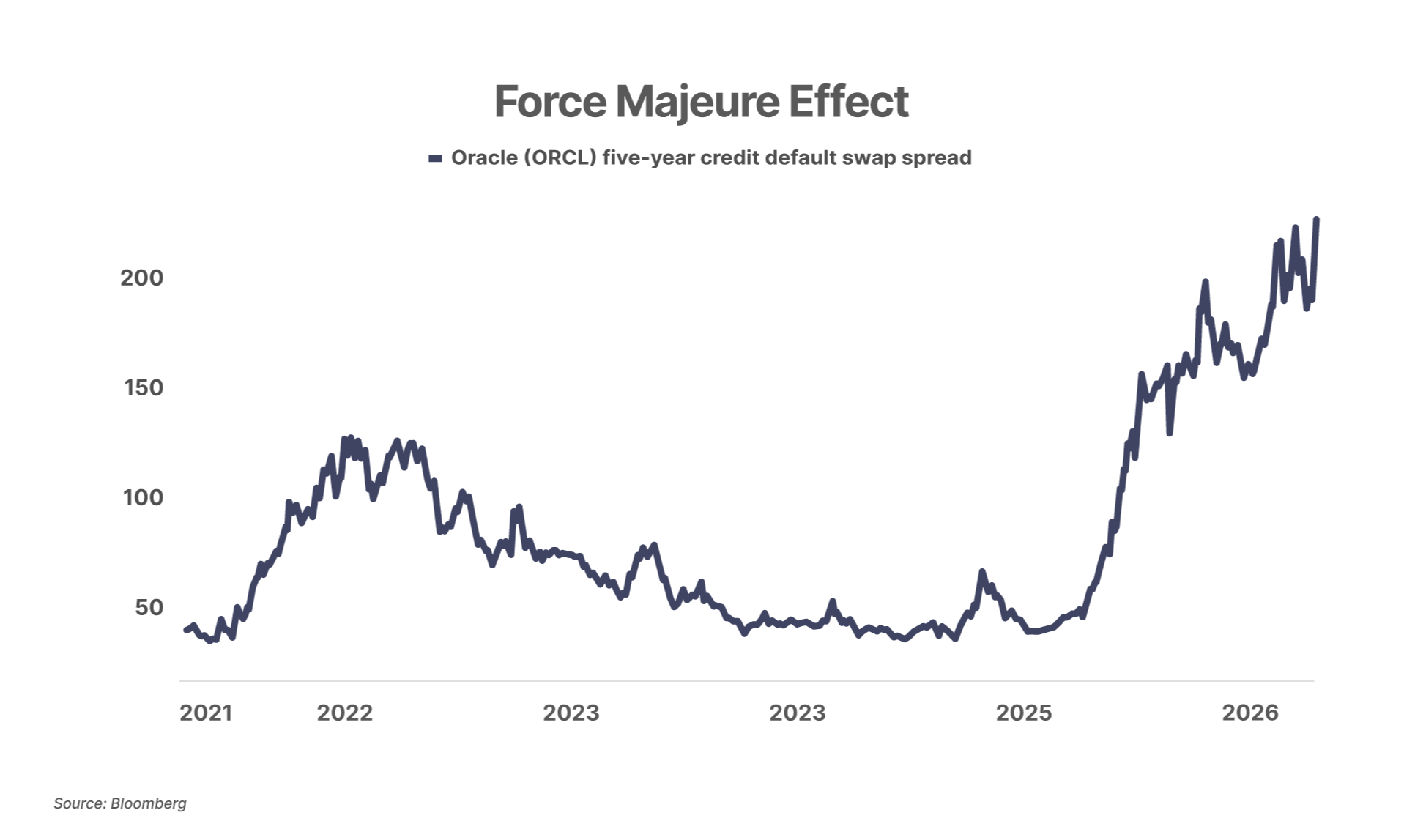
1. Oracle (ORCL) is preparing for a possible delay at its New Mexico AI data center. The tech giant has sent a "force majeure" notice – citing a contract clause that excuses obligations when events beyond a party's control intervene – to the Blue Owl Capital (OWL) unit building Project Jupiter, a campus meant to supply compute to OpenAI. It is designed to draw 2.45 gigawatts, roughly the electricity use of 1.8 million homes. The plan is to generate the power on site from natural gas, but New Mexico's State Land Office has twice rejected the route of the 17.7-mile pipeline meant to deliver it, and the pipeline's start date has slipped to February 2027. Oracle says the project remains on schedule. However, shares fell nearly 5% yesterday before closing down about 3.5%, and the cost of insuring Oracle's bonds in case of default hit a record. Much of Oracle's $664 billion backlog of signed contracts becomes revenue only when sites like this one are operational.
2. A record capex boom. Investment into artificial intelligence (“AI”) is on track to exceed every prior industrial buildout in history. Based on a recent analysis from the Wall Street Journal, AI infrastructure investment could reach $10.3 trillion between 2025 and 2032, averaging 3.6% of GDP per year. By comparison, investment during the railroad boom averaged 2.2% of GDP, while the national highway buildout and telecom boom of the 1990s each averaged 1.1% of GDP. We’ve never seen anything like this in history.
3. AI is already cutting years off drug discovery. McKinsey & Co. pulled every publicly disclosed AI-enabled drug candidate with a reported discovery cycle time – nine assets across seven companies – and compared them against its large-pharma benchmark of 32 to 50 months to market. Every one of the nine drugs came in significantly faster. AI is making the cheapest stage of drug development much cheaper and faster, so the real prize is not the months saved – it is more shots on goal per research dollar.
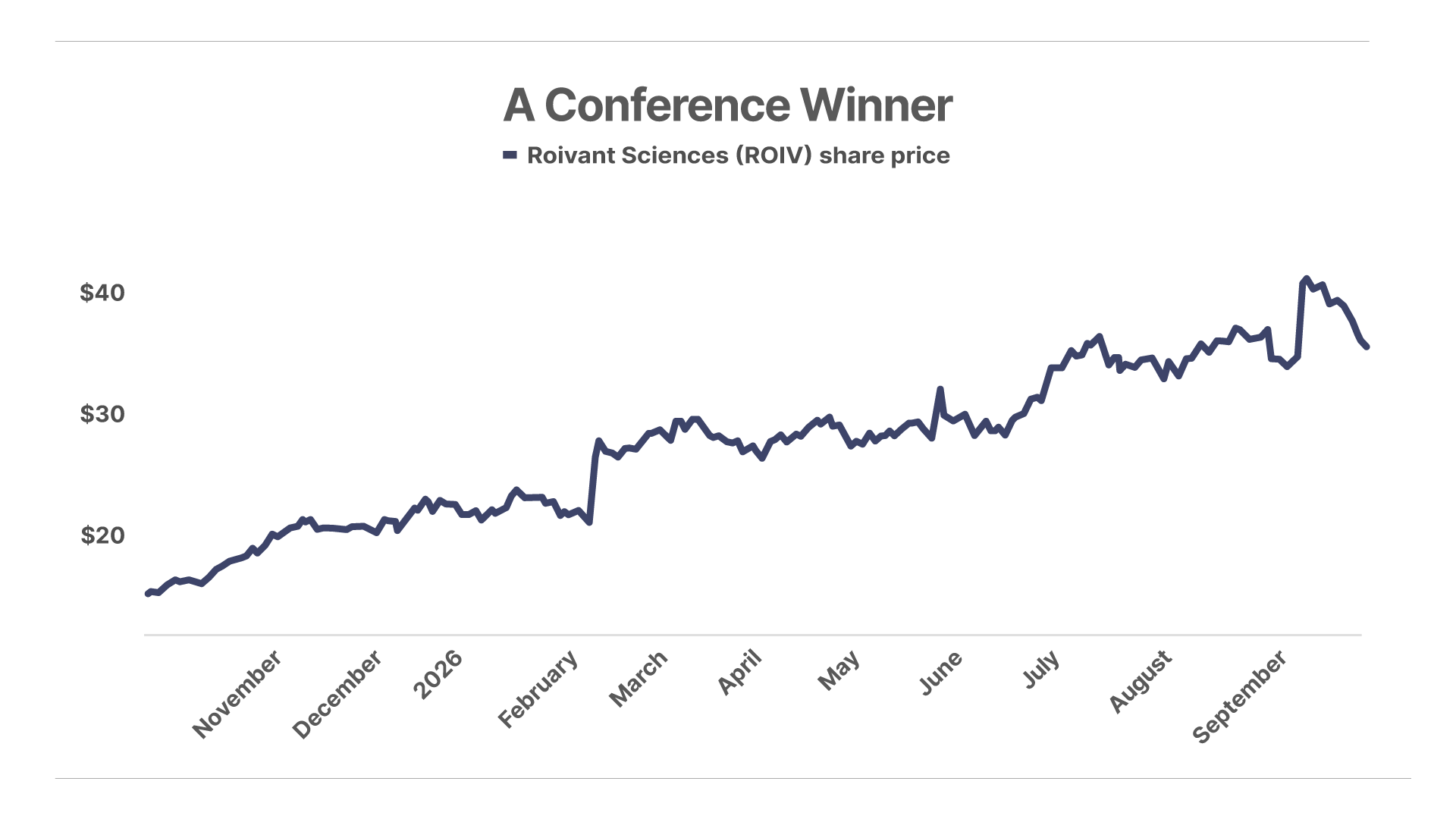
Porter & Co. Biotechnology recommendation Roivant Sciences (ROIV) was one of the top picks from a previous Porter & Co. Annual Conference – this year’s wrapped up yesterday. Shares are up 141% from last year’s Conference.
“The Conference Was Great”
George H. writes:
Although I did not attend in person, I watched the Annual Conference online. And I’m going to tell you, I was glued to my computer. And if I had to go to the bathroom the laptop came with me. I wasn't going to miss a minute. It was great. I may even come in person next year. I took two days off of work to watch this. Every speaker was great. And Porter ya gotta love him – he must have been up late with the boys the night before.
Daniel J. writes:
I enjoyed the real-time access you gave Partners who could not travel to the farm. I appreciate the specificity of your criteria for biotech valuation.
Joan D. writes:
Thanks for the recap – looks like a great conference.