Issue#124, Volume#3

The Most Important Question In Business: What Are We Really Selling?
Inside Today’s Issue
There’s about $500 billion worth of value that’s about to be created in a company that, a decade ago, was left for dead.
This may be the most valuable investment advice you’ll ever get. And I’m giving it away in our free daily e-zine. Why? Because telling you this story is the most fun I’ve had in years.
I genuinely love business. I love the challenge of trying to figure out how to serve millions of people. These opportunities have thrilled and motivated me my entire life, which is why I’ve built and bought so many businesses.
I remember when I passed the $1 billion mark in revenue, combined, across my different companies (before I turned 40). My now ex-wife asked me,
When will it be enough, Porter?
People often mistake my passion for business for greed. But for me, it was never about the money. It was about creating perfect products that people must have.
And so when I see people winning at business, it’s like a drug. I’m not only excited for them. I’m motivated to keep working harder in my own businesses. (By the way, there’s a brand transformation underway at OneBlade, including a vastly improved, proprietary blade and completely free shipping. You owe this to yourself. And your spouse will thank you. Take a look.)
I’d rather do this kind of research than watch any sporting event or read any novel. Watching a great business being built, brick by brick, by people who are completely dedicated and engaged… well, for me, it’s better than porn.
Cigarettes, Cowboys, Fashion
Before we start: I promise, this story isn’t about cigarettes. It is about cowboys.
In 1954, Philip Morris decided to re-brand Marlboro as a men’s (not a women’s) cigarette. They went to Leo Burnett, who at the time was running a tiny advertising agency that no one had ever heard of in Chicago – not Madison Avenue in New York. Leo asked one of his copywriters what was the single most masculine image he could think of, and the writer immediately said, “A cowboy.”
They launched the Marlboro cowboy campaign at the end of 1954. And the results were simply explosive: Marlboro hit #1 in cigarette sales in greater New York in under 30 days, which was even more remarkable because Philip Morris was then the smallest of the major cigarette companies. Sales of Marlboro jumped from 6.4 billion cigarettes in 1954 to 19.5 billion in 1957 – tripling in three years. And by 1972, Marlboro was the #1 best-selling tobacco brand in the world, a position it has held every year since. At its peak in America, Marlboro was more than 40% of the American cigarette market. It was bigger than the next 10 brands combined.
Leo Burnett didn’t sell cigarettes. He sold a dream – freedom, ruggedness, and the open range. But, like I promised you, this story isn’t about cigarettes. It’s about cowboys.
Patrice Louvet is French, but he had no background in fashion. Like Leo Burnett, he’s never ridden a horse. He’s a brand man.
Louvet spent nearly 29 years at Procter & Gamble, running the global beauty portfolio – a roughly $11.5 billion business spanning Olay, Pantene, SK-II, and the licensed Gucci and Hugo Boss fragrances.
Today Patrice Louvet is CEO of Ralph Lauren.
In 2017, when he landed the job, Louvet did something most operators never do. He asked the founder what business the company was actually in. Ralph’s answer was immediate:
We’re in the dreams business. We make people dream. We tell stories, we invite people into dream worlds.
And what dream does Ralph Lauren sell? The greatest dream in the history of branding: cowboys.
Louvet says:
Whether you want to be a banker on Wall Street, whether you want to be a horseback rider in the Hamptons, whether you want to be a cowboy in Colorado, we create these movie sets. The products are the props. The consumers are the actors.
Knowing what business you’re really in is the key to capital allocation.
Once Louvet realized Ralph Lauren was selling a dream rather than a garment, he had an entirely new lens through which to evaluate the company. Every store, every wholesale account, every new product, and every marketing campaign either reinforces the dream or dilutes it.
Louvet gave his team two questions to ask of every part of the business. Are we proud of the way we show up? And is it financially attractive? If the answer to either was no, he said,
We should either make the intervention to address the issue or get out.
Louvet has exited more than 1,000 U.S. department-store doors – about two-thirds of the company’s North American department-store presence at its peak. He cut off-price revenue by roughly half. By his own account, the company walked away from about $1 billion in revenue in places where, in his words, “frankly, we weren’t proud of being.”
Louvet voluntarily surrendered $1 billion because the sales were the wrong sales. In 2011, Macy’s alone sold $1 billion of Ralph Lauren goods, 22% of the brand’s sales. Today, it’s around 12%. And the pruning is not over – Louvet says the company will close roughly another 100 outlets in 2026 and is in talks with department stores about deeper cuts. He expects to still be trimming the least desirable parts of the portfolio a decade from now.
Getting rid of revenue doesn’t help unless you can create far more valuable revenue streams to replace what you’ve cut. To do that, Louvet is transforming Ralph Lauren into the world’s best luxury house, building on the model created by Hermès and Dior.
Louvet sold Club Monaco to private equity in 2021 and pushed the mass-market Chaps brand out to a license. With that capital, he’s building new stores and restaurants in the world’s most important cities – places where the dream can come to life.
So far, Ralph Lauren has built hospitality-integrated flagships in Milan, Tokyo (Ginza), Paris, and on Madison Avenue, complete with Ralph’s Coffee cafés and the Polo Bar restaurant concept. Management runs a “key city” model – roughly 30 gateway cities today, with plans to add 20 more.
Total company store count has barely moved, from 1,198 in 2017 to 1,238, but revenue has doubled. This is the Hermès model: grow revenue several times over without growing the store count, by making each store and each transaction worth more.
Second, far more capital is now going into marketing. Marketing roughly doubled as a share of revenue, from about 3.3% in fiscal 2017 to nearly 8% today – the Olympics opening ceremony, the Milan fashion show, the Very Ralph documentary events in Asia. Louvet compares the strategy directly to Disney’s:
We will become masters at creating worlds that people want to immerse themselves in.
The transformation is most apparent in the numbers. Over the last 10 years:
- Gross margin from 56.5% to 70%
- Operating margin from 7.9% to 14.5%
- Return on invested capital (“ROIC:) from 10.4% to 23.7%
- Earnings per share (“EPS”) from $4.62 to $15.11 — that’s a 3.3x increase in earnings per share on only ~10% more revenue
And, as the business has become much more profitable, capital has been returned to shareholders. Ralph Lauren generated $1.15 billion of operating cash flow in fiscal 2026. It spent $624 million on buybacks and paid $216 million in dividends that year. Since Louvet arrived, the annual dividend has almost doubled to $3.55 per share and the shares outstanding have fallen 27%, as major buybacks continue.
Today the question isn’t whether or not Ralph Lauren is a great business. The question is: can it become an “untouchable” business like Hermès?
The Hermès Way
In 2024 (the most recent fully audited numbers) Hermès did:
- €15.2 billion in revenue, up 15% at constant currency
- Gross margin: 70%
- Operating margin: 41%
- Net margin: 30%
- Free-cash-flow margin: 34%
Hermès trades in Europe at a market value near €175 billion and a price-to-earnings (P/E) of 38.82. That’s roughly 7.5x (!) Ralph Lauren’s market value with only about twice as much revenue.
Hermès operates just 293 stores in 45 countries – fewer than a decade ago. It keeps most of its production in France across 60 workshops. It does not discount. It has grown revenue many times over while barely adding stores. Scarcity, control, no markdowns, owned distribution, timelessness.
Today, the only part of Ralph Lauren’s business that’s comparable is the gross margin: 70%. And I believe that means that as long as Louvet continues to invest heavily in the marketing and continues to follow the Hermès path of doing more with less, there’s a lot more upside to this business and to the stock.
The majority of Ralph Lauren’s revenue is now direct-to-consumer, and the company has spent years pulling out of the wholesale and off-price channels that Hermès never entered. No-discount discipline: Ralph Lauren has cut promotions hard, and management now talks openly about pulling back further.
Where the gap remains is what separates an aspirational brand from an untouchable one. Hermès converts 41% of revenue into operating profit. Ralph Lauren converts 14.5%. Ralph Lauren’s revenue mix is still roughly 70% “core” products – polos, cable-knits, oxfords – sold in volume, with true runway collections under 1% of sales.
There’s a huge runway to continue converting Ralph Lauren into the world’s foremost luxury house. It is, without question, America’s strongest luxury brand: 74% of consumers globally describe Ralph Lauren as a luxury brand. And the transition to an “untouchable” brand will take decades. Louvet says:
I am planting the seeds for my successor.
A CEO who talks about strategy in terms of decades is a CEO running a luxury house, not a fashion label.
Ralph Lauren’s incredible turnaround isn’t a fashion story. It is a capital-allocation story. It’s a great American business that’s returned to the single dream it was built to sell: cowboys.
Tell me what you think of today’s Journal: porterstansberrydirect@gmail.com
Good investing,
F. Porter Stansberry
Stevenson, Maryland
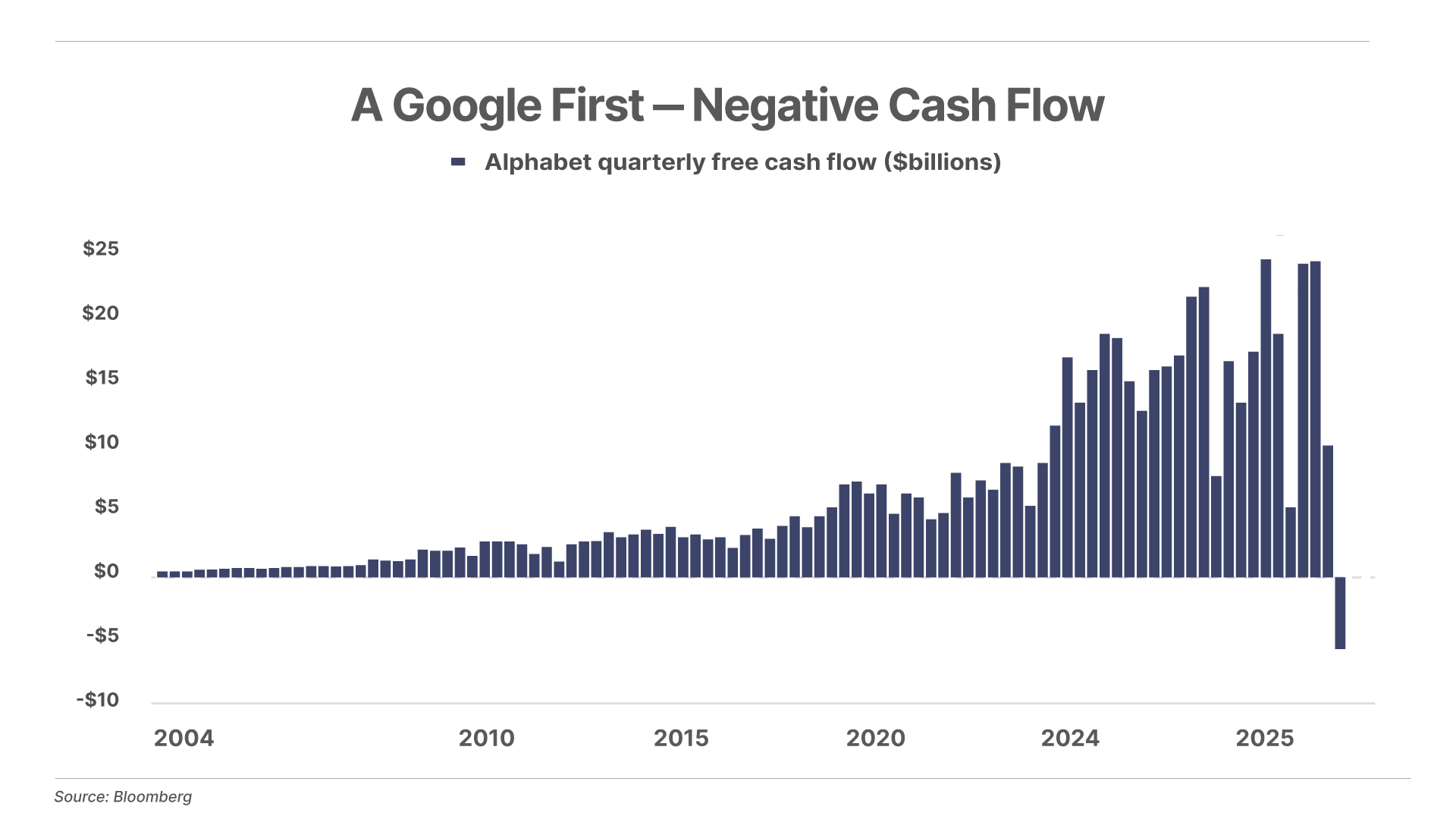
1. Alphabet joins the cash flow inferno. Alphabet (GOOG) just reported its first quarter of negative free cash flow since going public in 2004. Despite an impressive 24% growth in revenue and 30% increase in operating earnings year-on-year (“YOY”), capex increased at an even faster rate – doubling YOY to $45 billion. This resulted in $5.9 billion of negative free cash flow for the quarter, marking a key shift in what was previously one of the world’s biggest cash cows. The data center buildout is straining the cash flows of America’s technology giants.
2. Brent crude oil topped $100 a barrel. The global oil benchmark is now quietly up 38% this month, after Iran-backed Houthi militants attacked two Saudi tankers in the Red Sea – the latest escalation since the U.S.-Iran ceasefire collapsed in early July. Gulf exports in June still ran 8 million barrels a day below pre-war levels. That shortfall has been absorbed largely by draining reserves and by demand falling off as prices rose. Global inventories are now at their lowest of the year, leaving little cushion for the next disruption.
3. Private credit has a software problem. Software companies jumped from 19% to 26% of stressed private-credit borrowers in Q1 2026, by far the largest sector of borrowers under pressure among these funds. Private-credit managers piled into the sector on the assumption that recurring revenue was untouchable – at the exact moment leading private-credit funds, Blue Owl and Apollo, began limiting investor withdrawals. Some software companies are better protected from AI than others, but for now, private-credit investors want to shed any software holdings.
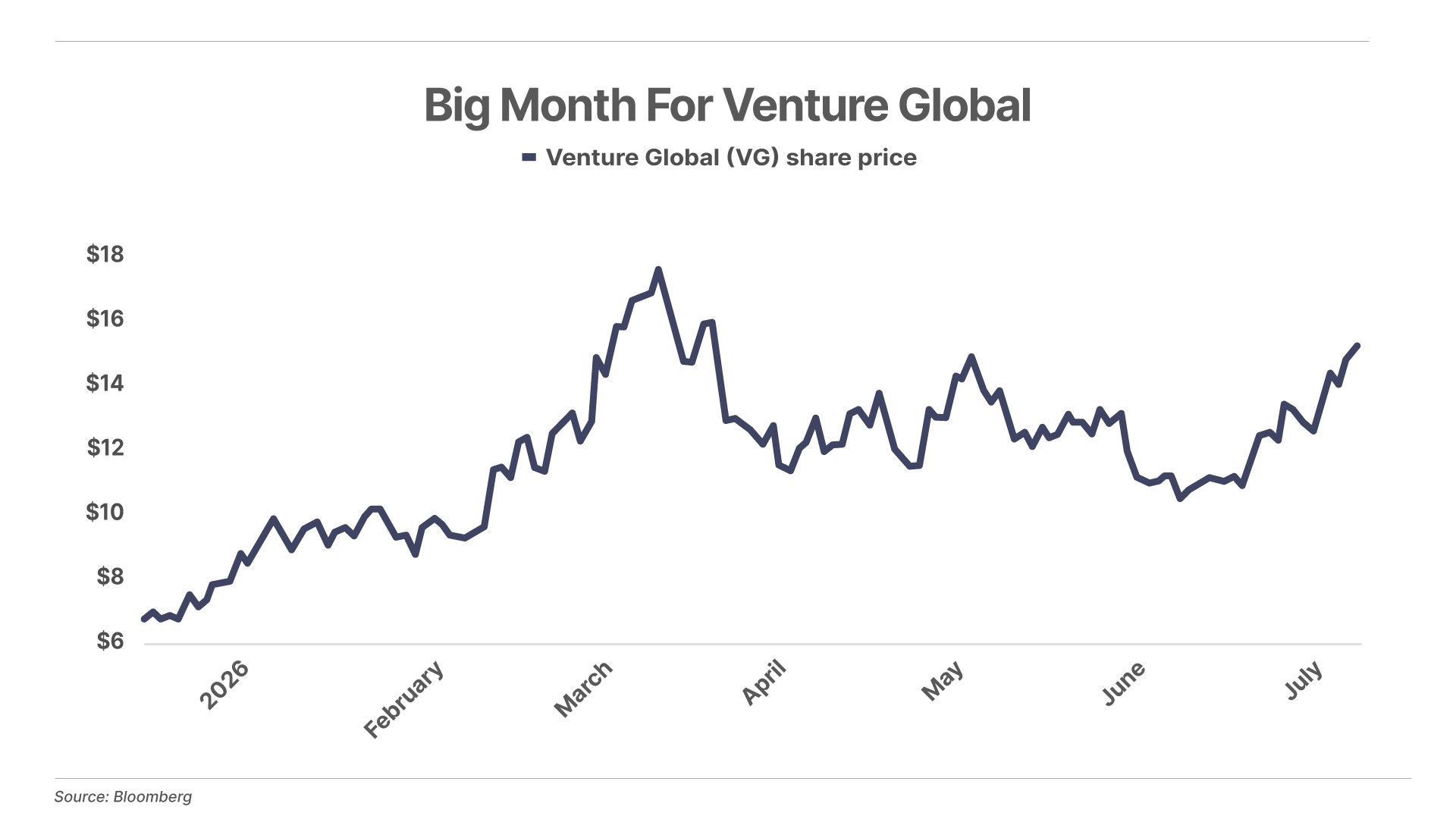
Complete Investor recommendation Venture Global (VG) has surged 37% over the last month as the war in the Middle East intensifies again, and the probability of losing Persian Gulf liquefied natural gas rises, sending buyers scrambling for export capacity – which Venture Global can supply.
“Answering Holocaust Deniers…”
In Wednesday’s Daily Journal, Porter provided both economic and battlefield insights about World War I and World War II – and yesterday he answered reader claims downplaying the number of Jews killed in the Holocaust.
Daniel J. writes:
Your answer to the Holocaust deniers was a service to everyone. Thank you.
James M. writes:
I can’t believe someone would question the Holocaust….
“America Saved England”
Barry H. writes:
How can you say America had little to do with defeating the Nazis? We saved England, liberated France, and defeated the Germans on the Western front. We marched all the way to Berlin and would have arrived before the Russians if General Eisenhower had not prevented General Patton from continuing his rapid march to the capital. I would say the United States had a whole lot to do with winning the war. If Germany had not been forced to divide its army between the western and eastern front, they would likely have defeated the Russians.
Jeannette M. writes:
History is written by the victors, otherwise known as the power structure of the time. No country willingly admits its defeat, so you are spot on, especially regarding Hitler and Stalin as well as about Saigon and Mosul, not to mention Kabul. Sadly, you and Ray Dalio are correct. The cycle is as old as recorded history.
I have read your book as well.
Porter & Co. Market Snapshot
| Price | Yesterday’s Return | Year-to-Date Return | |
| S&P 500 Index | $7,498.96 | -0.14% | 10.2% |
| Gold per ounce | $4,130.25 | 1.30% | -6.4% |
| Bitcoin | $65,890 | -0.74% | -25.8% |
| Oil (West Texas Intermediate) per barrel | $86.83 | 2.53% | 59.0% |
| Berkshire Hathaway (BRK) | $732,750.01 | -0.11% | -2.9% |
| Porter’s Permanent Portfolio | – | -0.22% | 0.8% |
| The Better Than Berkshire Index | – | 0.03% | 7.6% |
| Total Return | Annual Return | ||
| Porter & Co’s Top Ranked* | 35.8% | 16.6% | |
| Yield | Yesterday’s Change | Change Year-to-Date |
|
| U.S Treasury 30-Year Yield | 5.14% | 1 bps | 30 bps |
| Prices as of 4:00 pm ET July 22, 2026 | bps = basis points (or 0.01%) | |||
| *A Complete Investor risk rating of 1 is defined as a “low risk, high allocation” security, while positions rated closer to a 5 are higher risk. Porter & Co.’s top-ranked positions include those rated either 1 or 2 in Complete Investor portfolio. | |||
Porter & Co. Top Positions
| Publication | Ticker | Description | Total Return |
| Tech Frontiers | QURE | uniQure | 237% |
| Complete Investor | BWXT | BWX Technologies | 208% |
| Tech Frontiers | NUVB | Nuvation Bio | 158% |
| Tech Frontiers | ROIV | Roivant Sciences | 154% |
| Tech Frontiers | TGTX | TG Therapeutics | 149% |
| Complete Investor | BTC/USD | Bitcoin | 145% |
| Complete Investor | PM | Philip Morris | 141% |
| Complete Investor | SKWD | Skyward Specialty Insurance | 135% |
| Tech Frontiers | QURE | uniQure | 131% |
| Tech Frontiers | SGMT | Sagimet Biosciences | 131% |
| Prices as of 4:00 pm ET July 22, 2026 | |||
Please note: The investments in our “Porter & Co. Top Positions” should not be considered current recommendations. These positions are the best performers across our publications – and the securities listed may (or may not) be above the current buy-up-to price. To learn more, visit the current recommendations page of the relevant service, here| New Window. To gain access or to learn more about our current recommendations, call our Customer Care team at 888-610-8895 or internationally at +1 443-815-4447.