The AI Leader Needs More Capital Than It Can Possibly Get
Inside Today's Issue
Editor’s note: Porter is attending a family wedding this weekend, and turned today’s Journal over to Porter & Co. Trading Club analyst Ross Hendricks, who looks at the risks to the overall economy of the artificial intelligence (“AI”) buildout.
There is a massive dichotomy in today’s stock market.
On the one hand, we’re in the midst of one of the greatest earnings booms in the history of the U.S. stock market, which is pushing stock prices higher, making it difficult to become too bearish in the short-term. But the problem is that this earnings growth is almost entirely fueled by a capex boom focused on one single area of the economy: data-center construction for the artificial intelligence (“AI”) revolution. Capital spending on every other area of the economy aside from data centers – housing, commercial and industrial, office buildings, etc. – has fallen $120 billion since 2024.
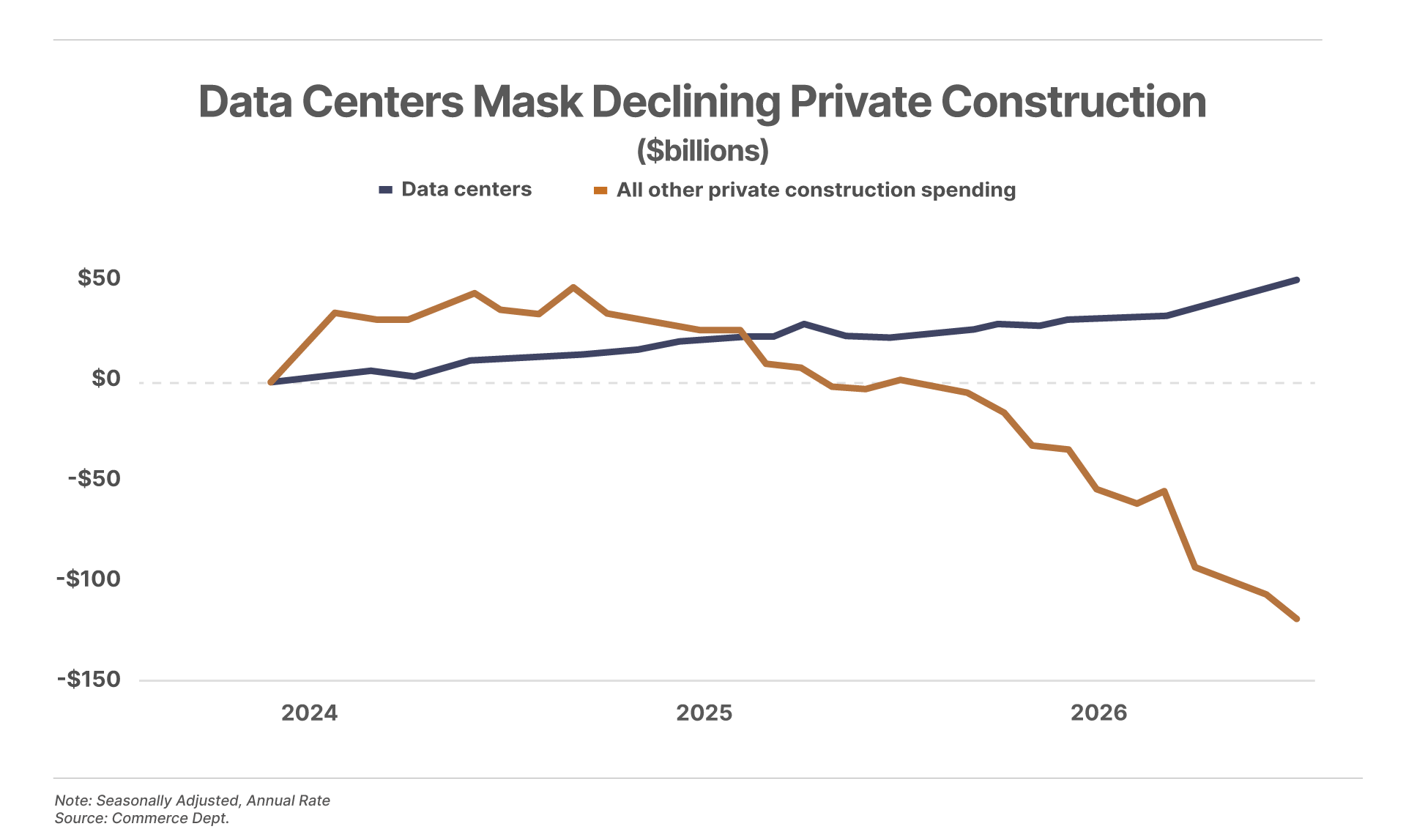
Every prior capex boom throughout history has ended the same way: when the money runs out. And we’re officially reaching that point, as the companies behind this capex mania are exhausting their access to cheap capital.
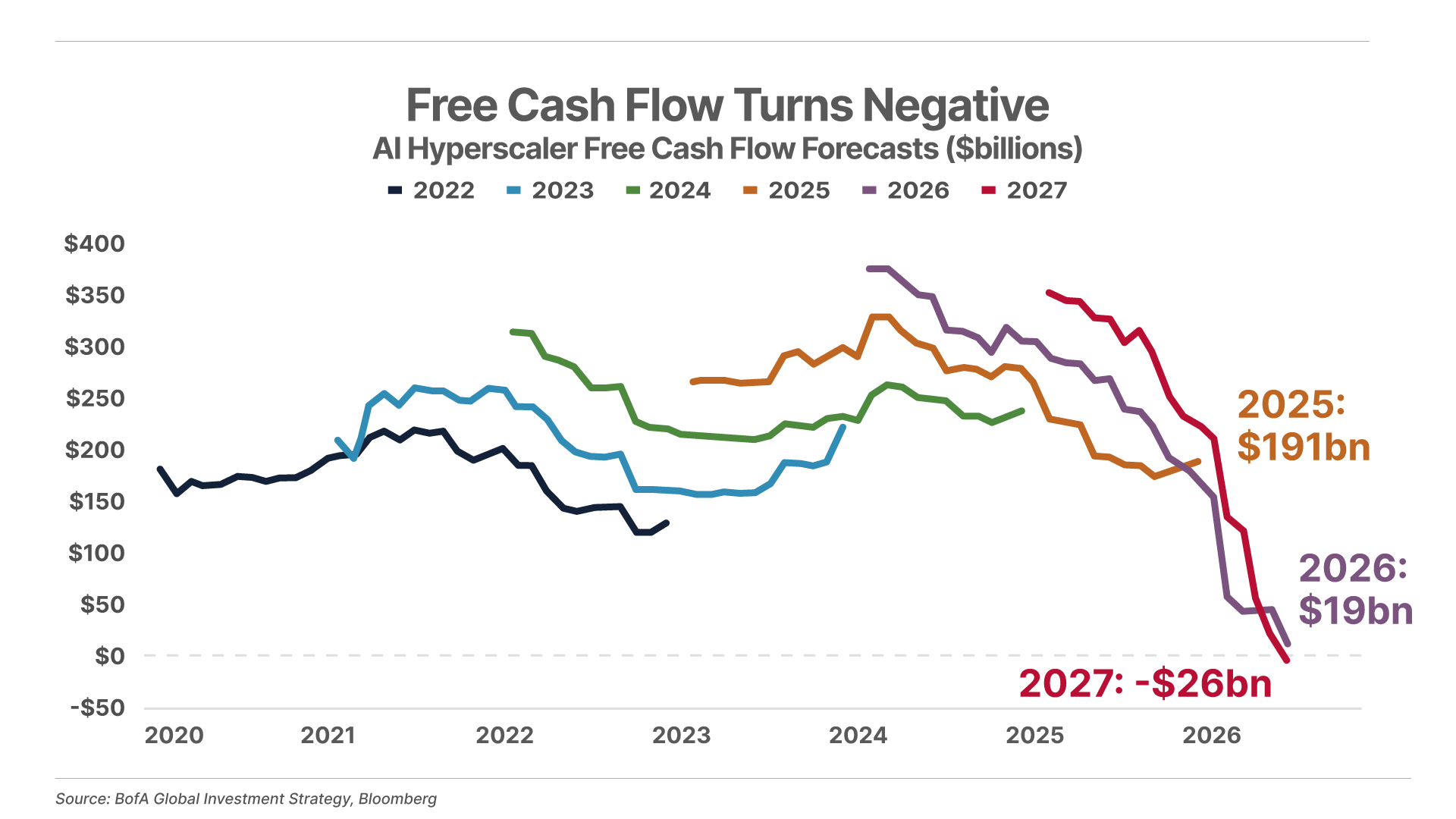
Alphabet (GOOG) recently posted negative free cash flow (“FCF”) for the first time since going public in 2004. Google is one of the most profitable ad businesses ever built – now with YouTube, Android, and a growing cloud arm. All of this combined used to produce mountains of cash. But now with capex doubling to nearly $45 billion in a single quarter, the company burned through $6 billion in cash for the quarter. And this trend shows no sign of reversing, with management guiding to $200 billion in capex this year, more than doubling from $91 billion last year.
Likewise, Amazon (AMZN) burned through $8 billion in Q2 2026, a stunning reversal from the $18 billion in positive FCF for the same quarter last year. This trend will only accelerate as the company plans to spend $220 billion on capex this year, up from $132 billion last year.
It’s the same story across the entire hyperscaler complex, with the group’s free cash flow flipping from hundreds of billions annually into negative territory:
With free cash flow evaporating, America’s tech giants have become some of the world’s largest issuers of debt.
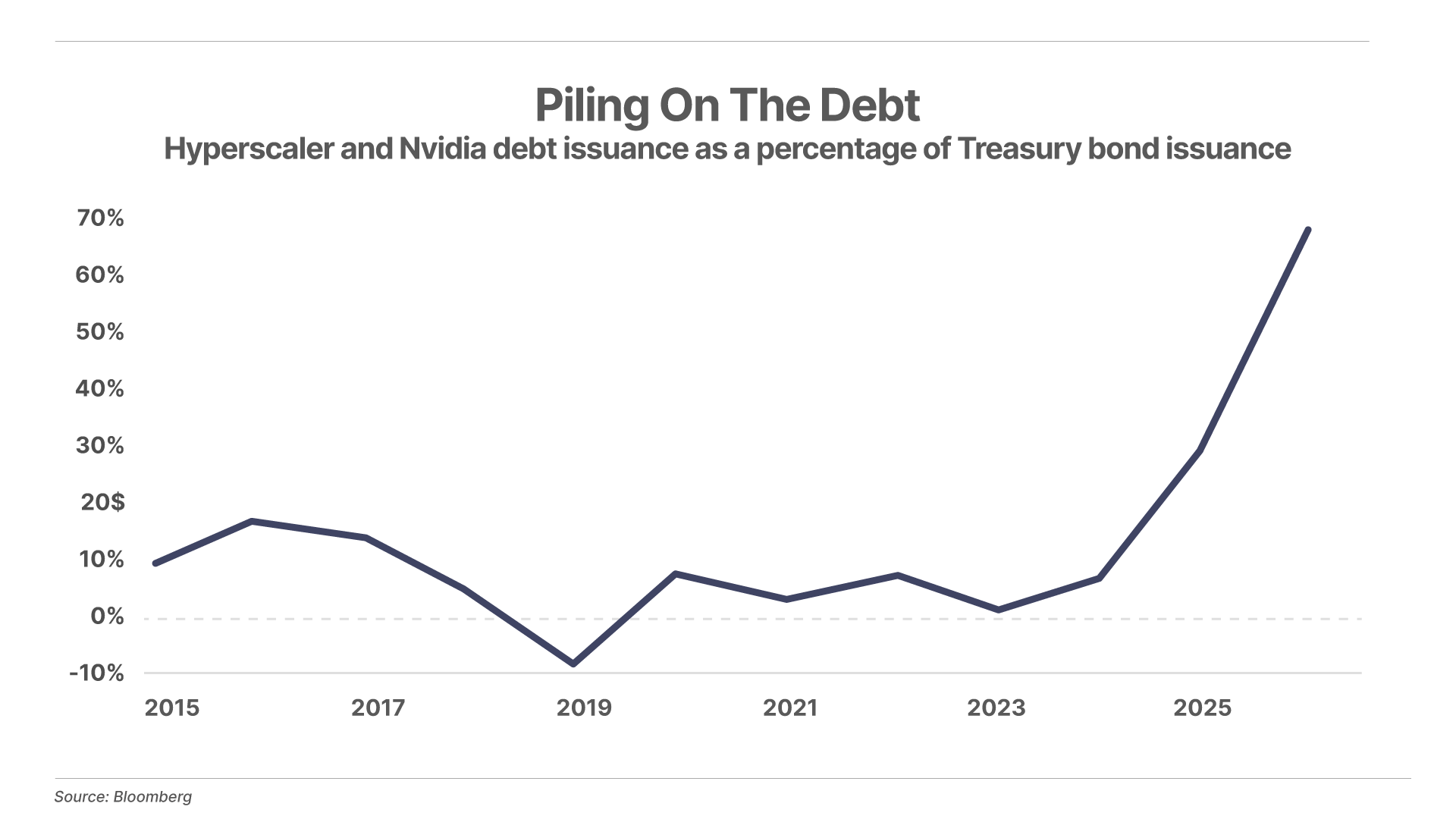
In 2025, the group raised a record $200 billion in debt, including the off-balance-sheet obligations issued through special purpose vehicles (“SPV”). That’s 4x more than any previous year in history. And in the first eight months of 2026, they’ve already blown this number out of the water with more than $300 billion in debt issuance so far.
This flood of bond issuance is so large that it’s beginning to crowd out demand for U.S. Treasuries. The 10-year Treasury yield has jumped above 5.3% to its highest level in 20 years. And with the volume of new tech debt now reaching 70% of 10-year U.S. Treasury bond issuance, there’s every reason to expect continued pressure on borrowing costs across both corporate and government bonds.
The market is showing signs of stress across multiple indicators. Order books covering hyperscaler bond offerings have dropped from nearly 5x oversubscribed in early 2026 to below 2x.
Hyperscalers are now in search of cheaper financing. Alphabet has gone shopping across every major foreign bond market, seeking new offerings denominated in the euro, sterling, Swiss franc, yen, and Canadian dollars. Its recent $8.5 billion Canadian bond issuance was the largest Canadian bond offering in history… that was, until Amazon set a new record weeks later with a $14 billion Canadian bond sale.
This shift is a giant warning sign that capital is becoming increasingly scarce. And that’s a big problem for an economy and stock market reliant on raising endless amounts of capital to keep a capex boom humming.
For now, the bulls have momentum on their side. And they point toward the rising backlogs and earnings outlooks from the major suppliers of today’s capex boom – like Nvidia (NVDA) and the hyperscalers – as evidence that this capex cycle is just getting started. But in reality, it’s a financial time bomb just waiting to go off.
All signs indicate that 2027 is when the detonation event occurs.
The Catalyst: OpenAI’s Liability Wall Hits In 2027
The stress point in the AI capex boom lies specifically with OpenAI – owner of ChatGPT – which makes up the largest source of compute commitments supporting the data center buildout.
At this time last year, OpenAI reigned supreme over the AI revolution, with over 70% market share and growing at triple digit rates. Between June and December of 2025, OpenAI engaged in the most aggressive debt origination spree in the history of capitalism. The climax occurred over a three-week frenzy in October 2025, when OpenAI signed over half a trillion of future purchase agreements with Oracle (ORCL), Nvidia (NVDA), Advanced Micro Devices (AMD), and Broadcom (AVGO).
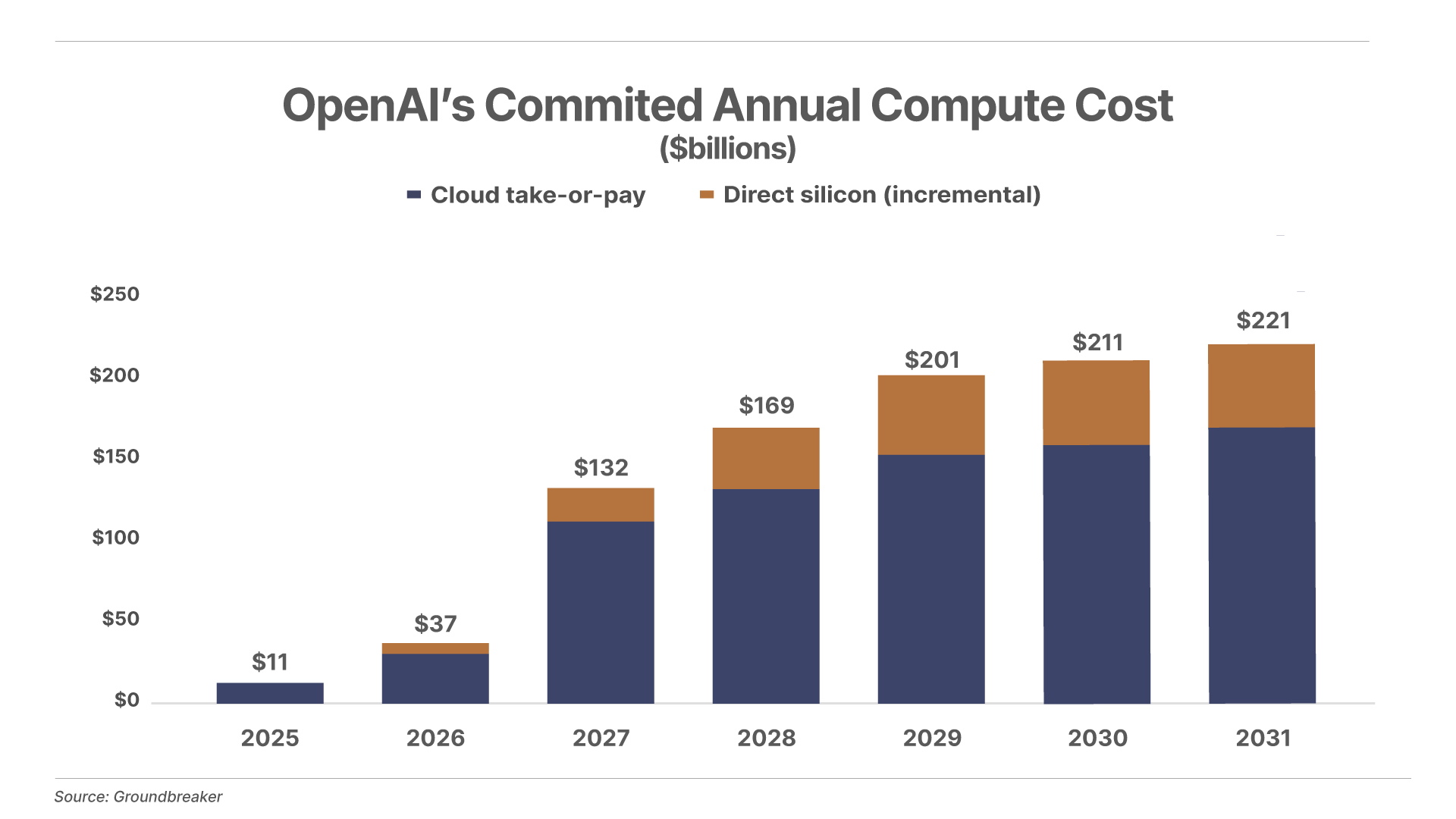
In total, this single company has accumulated $750 billion in purchase agreements for data-center capacity and chip sales through 2030. And next year, it begins climbing the steepest part of this contract obligation wall, with $132 billion in bills coming due.
Now here’s the thing: OpenAI’s financials are already a trainwreck before this mountain of additional liabilities hits. In 2025, the company generated $21 billion in losses on $13 billion in revenue, meaning the business lost $2 for every $1 in revenue. And these losses have only increased this year.
From Q1 to Q2 of 2026, OpenAI’s revenue increased by $1 billion to $6.7 billion. Over the same period, its losses grew by $3 billion to $12.3 billion. The company generated an incremental $3 in losses for every $1 of revenue growth.
In other words, OpenAI loses money on every sale and is trying to make it up in volume. Its own internal financial projections don’t even show the company reaching positive free cash flow until 2030.
This presents an existential risk for OpenAI, and by extension, America’s AI infrastructure boom.
OpenAI needs to raise $750 billion by 2030 just to avoid defaulting on its signed-compute and chip-purchase agreements, not to mention hundreds of billions more to cover overhead.
Our bet is simple: that won’t happen. OpenAI will need a financial miracle just to survive through 2027.
The biggest tell that OpenAI’s funding window is closing came from the company’s latest capital raise in Q1 of this year. On the surface, it looked like a smashing success: the company pulled off the single largest private capital raise of all time – bringing in $122 billion at an $852 billion valuation. But the real story was in who actually wrote the checks.
Traditional venture capital investors provided only $12 billion, or about 10% of the $122 billion raise. The remaining $110 billion came from the following entities:
-
$50 billion from Amazon
-
$30 billion from Nvidia
-
$30 billion from SoftBank
In other words, the anchor money – two-thirds of the total – came from OpenAI’s cloud-compute provider and chip supplier. This is the same style of vendor financing that helped inflate demand during the late stages of the dot-com bubble, and also provided the catalyst that led to the bust.
Back then, when venture capital began drying up, companies like Lucent and Nortel juiced demand by lending to dozens of privately held startups. It only delayed the day of reckoning. When those private companies began going bust, it led to massive asset impairments and an evaporation of demand that ultimately ended with Lucent and Nortel disappearing into the dustbin of financial history.
This time, the vendor financing is concentrated on a single, large entity: OpenAI. But the fundamental mechanics are the same – the lack of demand from venture capital investors for OpenAI shares is currently being propped up by its own suppliers. Companies like Amazon and Nvidia funnel investment capital into OpenAI, which returns that money right back into cloud computing and chip sales to the very same companies.
But now, with hyperscalers like Amazon looking at negative FCF and tapping out the debt market, we see no world where these companies can continue sinking hundreds of billions of dollars into an unprofitable startup company. Even Nvidia – previously having pristine credit – is reaching the limits of using its balance sheet to prop up demand from its own customers. Nvidia now has over $500 billion of off-balance-sheet liabilities across its various backstops, investments, and purchase agreements across the AI ecosystem:
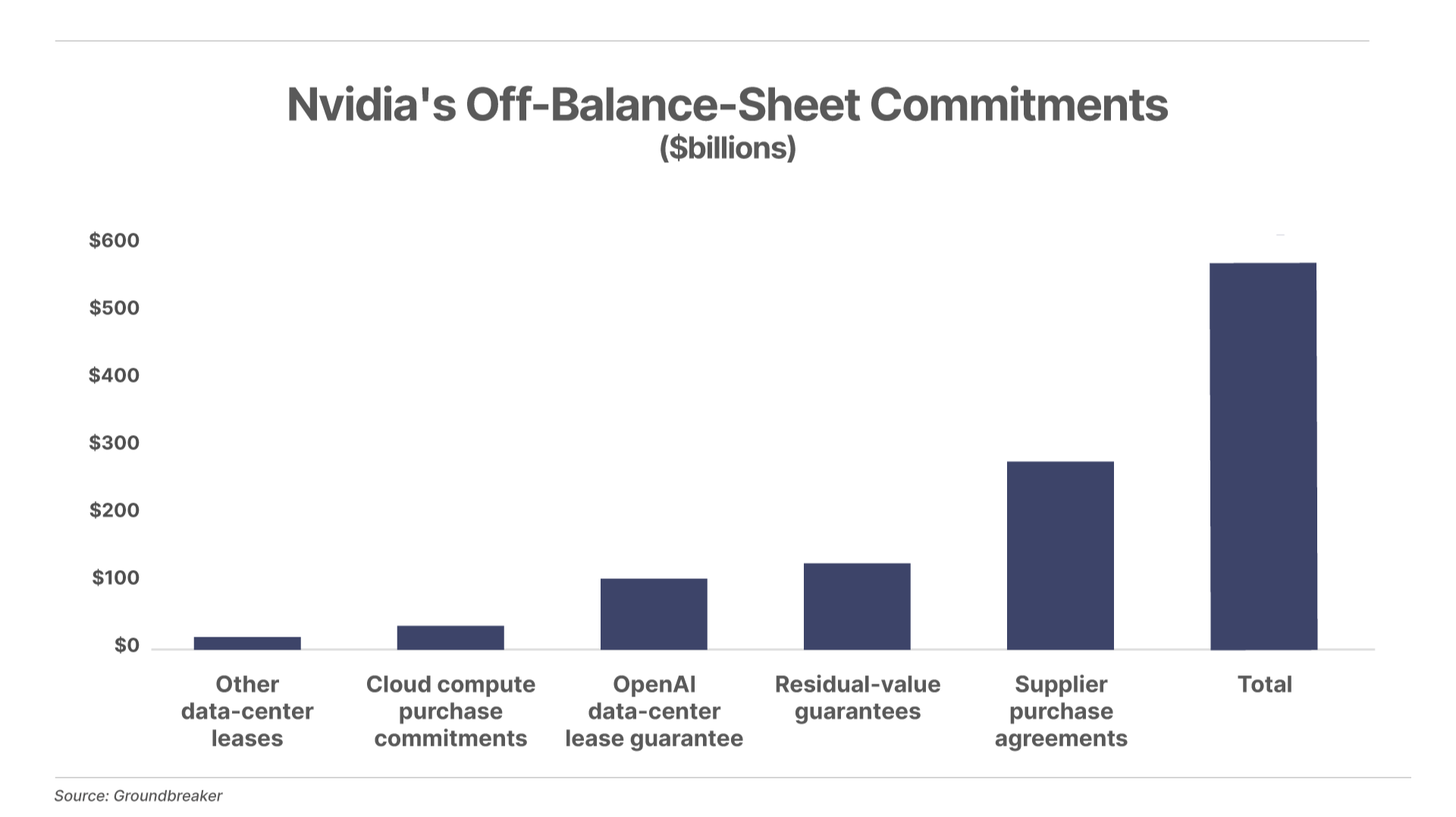
Given this backdrop, we see limited future availability for OpenAI to tap into circular, vendor-financed capital from Nvidia and the hyperscalers. And that’s a big problem for a company whose survival relies on raising endless amounts of capital just to keep the lights on.
The chart below from Bridgewater Associates projects that OpenAI will run out of cash by Q1 2027, a remarkably short timeline considering the company raised $122 billion earlier this year. It will need to come up with over $100 billion in new funding just to make it through next year:
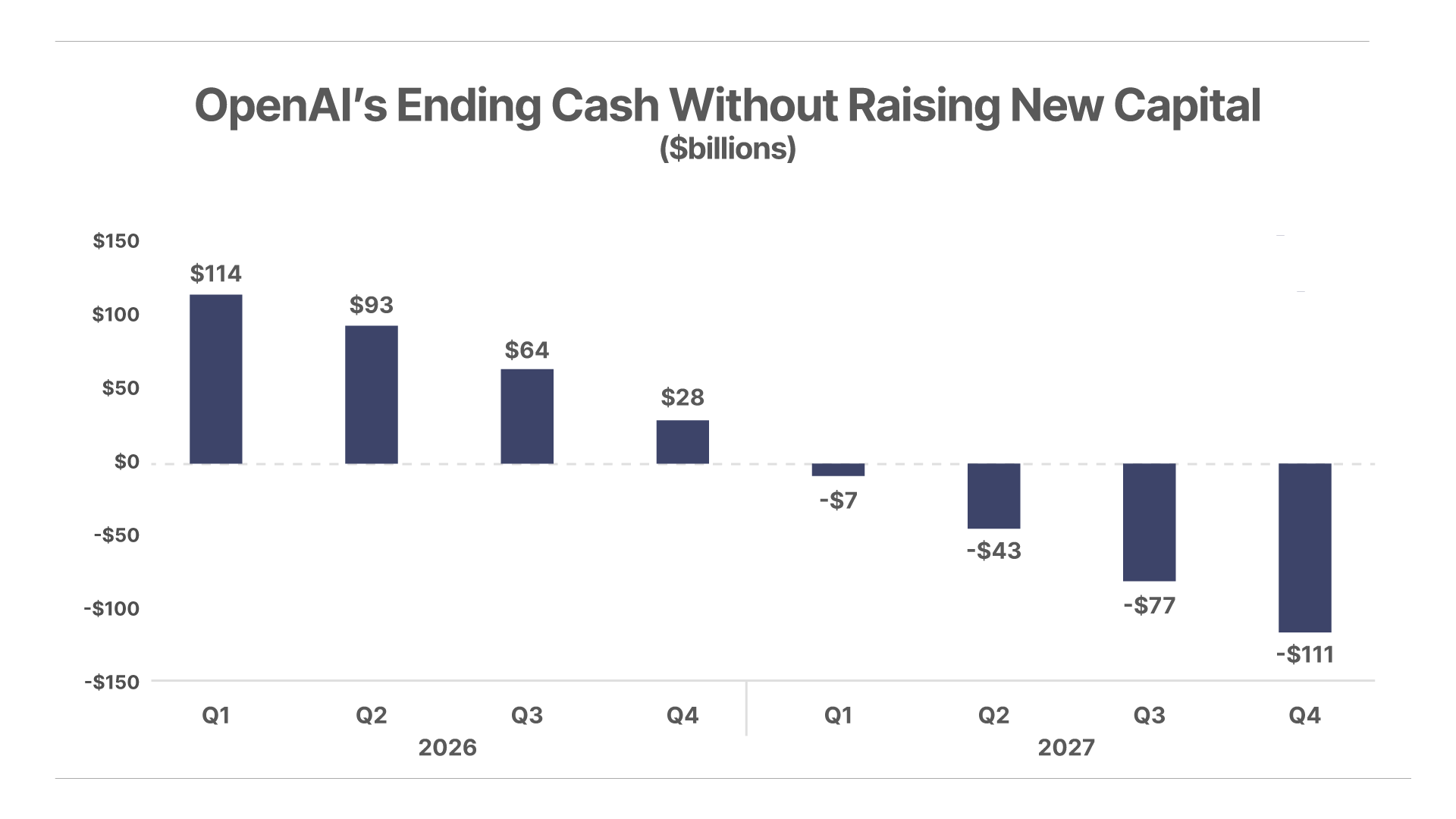
With the financing spigot running dry from venture capital investors and OpenAI’s vendors, that leaves one last remaining source of capital deep enough to fund the company’s massive burn rate: public markets. But the company has already pushed back its IPO plans for 2027.
And if the executive behavior inside the company is any indicator, the odds of an IPO happening in 2027 look increasingly remote. Over the past several months, OpenAI has suffered from a continuous raft of departures from key executives, including:
- Brad Lightcap (Chief Operating Officer)
- Denise Dresser (Chief Revenue Officer)
- Fidji Simo (CEO of Applications)
- Kaylin Voss (VP of Sales, Americas)
- Kate Rouch (Chief Marketing Officer)
- Chris Malone (Head of Data Centers)
- Caitlin Kalinowski (Head of Robotics & Hardware)
- Srinivas Narayanan (VP & CTO for Business Applications)
- Kevin Weil (VP of OpenAI for Science / Former Chief Product Officer)
- Bill Peebles (Head of Sora Video Generation Team)
- Barret Zoph (Senior AI Researcher)
- Johannes Heidecke (Head of Safety Systems)
- Chloé Bakalar (Head of Ethics)
- Joshua Achiam (Chief Futurist)
If OpenAI had any reasonable chance of going public, these executives would be forfeiting the opportunity for generational wealth from their stock grants. The fact that we’re seeing a mass exodus is perhaps the clearest indicator that something has gone horribly wrong inside the business, and that this company will never go public.
The bottom line is this: we see OpenAI as the weak link that could cause today’s AI capex boom to break apart as soon as 2027. Of course, the market hasn’t come close to pricing in this scenario. Maybe the market is seeing something we’re not, or it’s simply caught up in a speculative mania that still has legs left before reality sets in.
Tell us what you think of today’s Daily Journal: porterstansberrydirect@gmail.com
Ross Hendricks
Houston, Texas
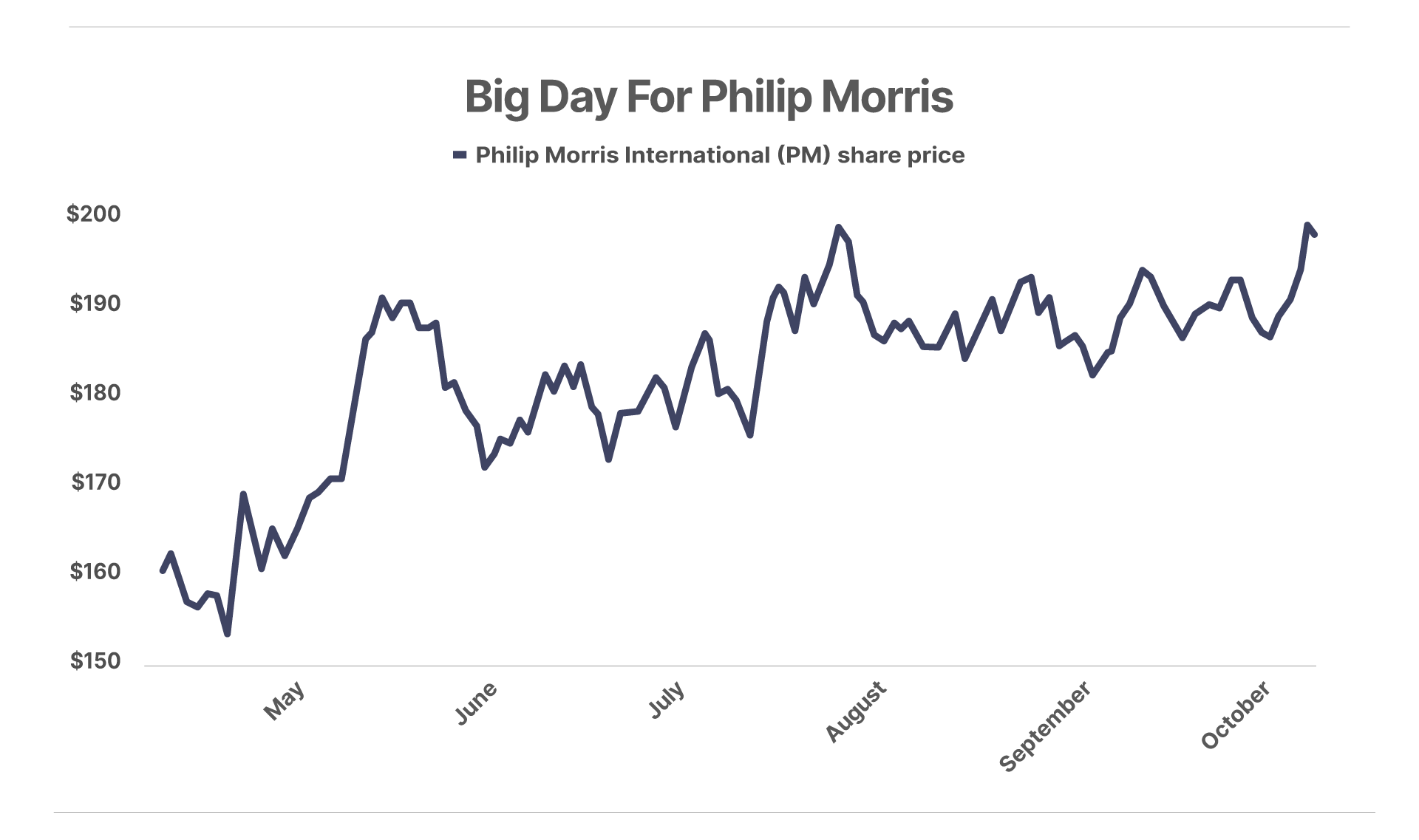
1. Elon Musk’s SpaceX wants to become a major mobile carrier in the U.S. On Thursday, SpaceX (SPCX) agreed to buy a nationwide block of 800 megahertz (“MHz”) spectrum from investment firm Grain Management. SpaceX already owns 65 MHz of higher-frequency airwaves, bought from EchoStar (ECHO) for $19.6 billion last year. Musk called the purchase “the last critical piece of the spectrum puzzle” for SpaceX. Shares of AT&T (T), Verizon (VZ), and T-Mobile (TMUS) opened sharply lower this morning. 2. Buyers showed up at the U.S. Treasury auction. Wednesday's auction of $39 billion in 10-year Treasuries stopped at 5.30%, a discount to pre-auction levels of 5.32%, with indirect bidders taking 80% of the sale. Real money wants the 10-year at 5.3% more than it wants the long bond at 5.6%. The message: supply is not the problem – price is. 3. Europe’s gas storage is at a record low heading into winter. EU storage sites were about 73% full in early October, the lowest for that time of year since Gas Infrastructure Europe began tracking in 2011. The EU normally requires 90%. Most of Qatar’s liquefied natural gas (“LNG”) is still stuck behind the Strait of Hormuz. Europe got only about 7% of its LNG from Qatar last year, but Asian buyers that depended on Qatar are now bidding for the same U.S. cargoes. That pushed Europe’s benchmark gas price above €80 per megawatt-hour in September, nearly double its June average. Last winter, EU storage fell from 83% full to 28%. A drop that size from today’s level would leave it near 18% by spring. The European Commission has asked governments to cut gas use by turning down the heat in public buildings and switching off unneeded streetlights. Following news highlighting growth in smoke-free products and an increase to dividends, shares of nicotine maker Philip Morris International (PM) rose 4% this morning, on top of a 25% gain over the last six months. Yesterday, Distressed Investing analyst Martin Fridson explained to readers the dynamics of what drives bond yields higher (or lower), at one point quoting economist Paul Krugman. Mark S. writes: Generally when Paul Krugman takes a stance on an issue the opposite is true. Bill S. writes: I really enjoyed Marty’s article. Citizens are very nervous about the economy, huge debt problems, and the sudden jump in bond rates. A simple short and concise article like this is so helpful to help people understand why the bond rate increase happened. People fear the economy crashing… Thank you. Alex S. writes: It is somewhat amusing to me with today’s angst about interest rates, especially mortgages. I recall solidly that in the 1960s and 1970s I was earning $12,000 per year and had a very good 6% mortgage with Dime Savings Bank of NY on an 1,150-square-foot modest home in Staten Island, New York, that I bought for $22,500 on a 30-year mortgage. We managed, and were happy with the deal. So pardon me when I skeptically look at all the complaints about interest. Porter & Co. Comment: We would note that you were able to purchase your home for less than 2x your annual income. Meanwhile, at a mortgage rate of 6% – assuming a 20% down payment ($4,500, or 37.5% of your annual income) – your monthly mortgage payment would’ve been roughly $108, representing less than 11% of your gross income. Today, the median home price in the U.S. is $429,100, while the median income is $87,500 – meaning homes now cost nearly 5x the median annual income. Meanwhile, at current mortgage rates, the monthly mortgage payment on the median home would be over $2,300. That’s almost a third of the median gross income – triple the burden you faced… and that’s assuming the buyer can afford a 20% down payment of roughly $86,000, or nearly a full year’s median income.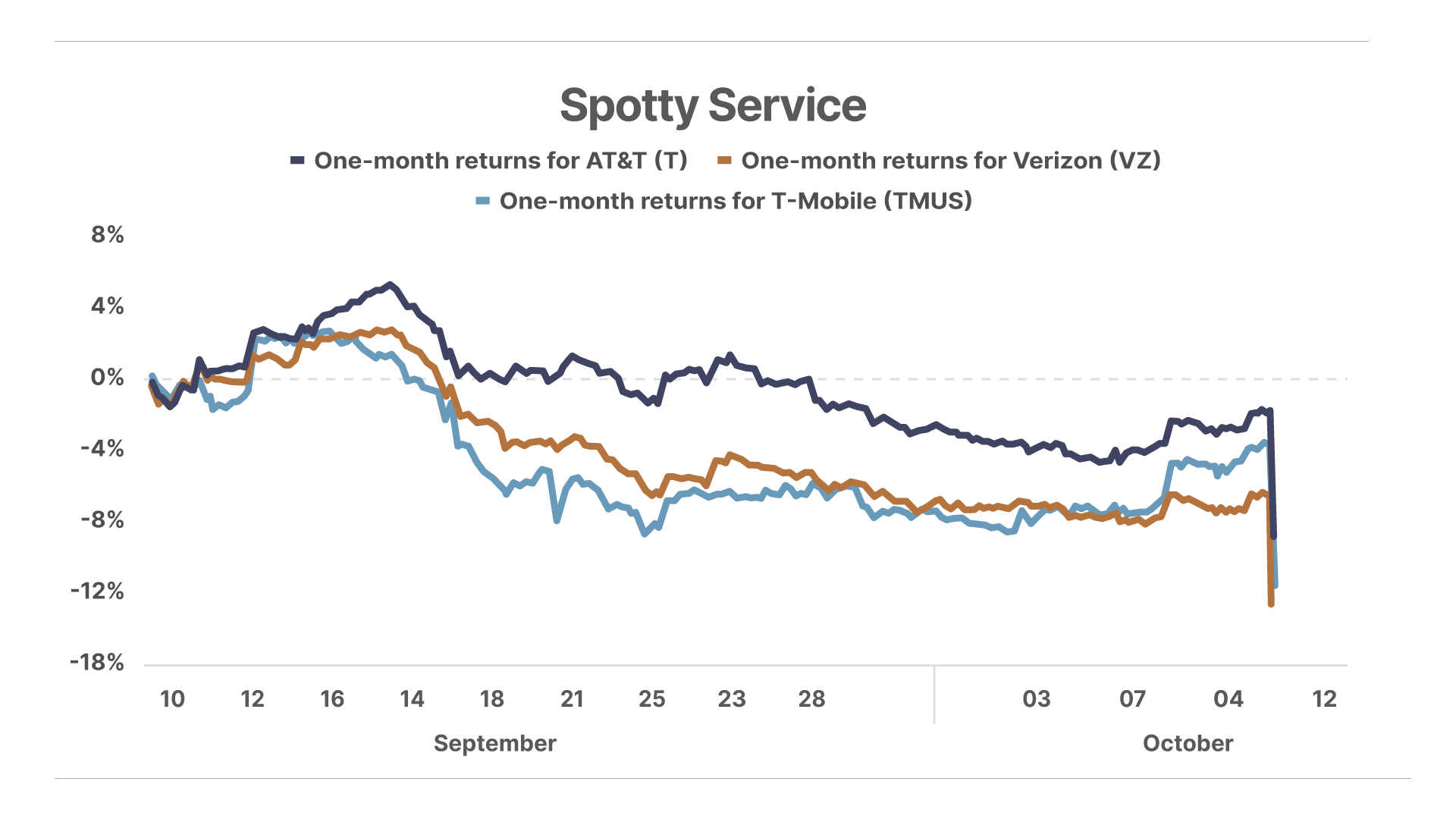
“Bond Yields In The News”
Porter & Co. Market Snapshot
Porter & Co. Top Positions