Issue#125, Volume#3

How Disney Forgot Animation And Saw Its Business Slip
Inside Today’s Issue
Editor’s Note: Before we get into today’s Journal about Walt Disney’s use of animation, we want to share an article Porter wrote that has nothing to do with investing but everything to do with your quality of life and how the world perceives you. Check it out here.
Yesterday I told you about how Ralph Lauren is in the midst of an incredible, multi-decade transition into the world’s leading luxury house.
Today, I want to show you how these same lessons – to focus on the “dream” that lies behind your brand – could save The Walt Disney Company (DIS).
What is Disney actually selling? Not superheroes. Not sports. Not a general-entertainment streaming bundle.
Disney sells the fantasy world of animation: Mickey Mouse. Cinderella. The Lion King. Toy Story. Frozen. Moana. Every enduring, generation-spanning, park-anchoring, toy-selling franchise in the vault started as a drawing, not an action hero or a sci-fi opera.
In 1937 Walt Disney bet everything he had on Snow White And The Seven Dwarfs – the first feature-length animated film. Derided in the press as “Disney’s Folly,” it became the highest-grossing sound film to that point and built the studio, the theme parks, and the empire that followed.
The dream was animation from the very first day.
Everything Disney has ever sold – the parks, the merchandise, the cruises, the streaming catalog – descends from a hand-drawn fairy tale. And the desire for these kinds of deeply felt, human stories in this genre will never disappear. This is Disney’s permanent advantage. It’s Mickey’s “cowboy,” if you’ll recall what drove Philip Morris (Marlboro) and Ralph Lauren.
Bob Iger’s first major act as Disney CEO was to buy Pixar Animation Studios in 2006 for $7.4 billion – not for its film library, which Disney already distributed, but to import its creative culture and put John Lasseter in charge of a Disney Animation studio that had gone creatively dead. Steve Jobs, Pixar’s largest shareholder, reportedly wanted to shut down Walt Disney Animation entirely. Iger refused, and instead used Pixar’s leadership to revive it.
An incredible renaissance followed. Tangled in 2010. Frozen in 2013 at $1.28 billion in box-office revenue, the highest-grossing animated film of its time. Frozen II in 2019 at $1.45 billion.
During Iger’s first tenure as CEO from 2005 to 2020, Disney stock rose 400%, far outpacing the market. A March 2015 headline said it plainly: “Frozen, Star Wars, And Cinderella: Disney At All-Time Highs.”
But… did Star Wars really fit?
Disney invested heavily in the Star Wars franchise, making four films in 29 months. And the unthinkable happened: Solo lost money in 2018, the first Star Wars film ever to do so. And what role will Star Wars play in driving the rest of Disney’s value creation?
In fiscal 2025, Disney’s Experiences segment – parks, resorts, cruises, and consumer products – earned $10 billion in operating income. The Entertainment segment earned only $4.7 billion. Sports earned $2.9 billion.
Experiences alone was 57% of segment operating income.
And what are the parks? Monetized animation. Park attractions and themed areas include Frozen Ever After, Toy Story Land, Cars Land, the Moana attraction, and princess meet-and-greets. The merchandise racks stocked with characters that began as drawings. Walt Disney World and Disneyland are the animation dreams rendered in steel and concrete – the single most profitable way ever devised to sell a cartoon.
And what’s still pulling the company forward? Inside Out 2 – a Pixar sequel, and the highest-grossing animated film ever at roughly $1.7 billion, followed by Moana 2. Not a superhero reboot. Not a live-action remake. Not Star Wars. Animation.
The market doesn’t believe that Disney will ever fix its capital allocation to focus exclusively on animation. And so Disney trades at around $95, a market value of about $167 billion, and at only 16x earnings – a cheap multiple for a company that owns the most valuable dream-world in entertainment and the most profitable theme-park business on earth.
Warner Bros. Discovery is the purest public window into a film-and-TV studio: it owns Harry Potter, DC, and the Warner library. Its Studios segment turned $12.6 billion of revenue into just $2.5 billion of EBITDA in 2025 – a 20% margin in a good year – and only $1.7 billion on $11.6 billion in 2024, a 14% margin. And that is EBITDA, before the enormous content write-offs, amortization, and interest that have left the whole company with a market value of about $65 billion. Harry Potter is one of the most valuable franchises around, and the studio that owns it can barely earn a return. Hit-driven live-action film is lumpy, capital-hungry, and margin-poor. You are only as good as your latest opening weekend.
And what about theme parks? We can look at Universal’s results. It’s a huge business and growing, with almost $10 billion in revenue in 2025. But Universal runs on rented dreams. Harry Potter is licensed from Warner Bros. The Nintendo worlds are licensed from Nintendo. Universal’s own marquee animated franchise is the Minions, and not much else. Comcast, Universal’s parent company, trades at only 6x earnings.
Disney’s parks run almost entirely on wholly owned animated intellectual property (“IP”) created in-house – Frozen, Toy Story, Cars, Moana, the princesses – content Disney drew owns and monetizes forever, across rides, hotels, cruises, and merchandise, with no licensor taking a cut. Disney’s Experiences segment earns about $10 billion in operating income alone – or, as much in profit as Universal makes in revenue.
What makes Disney different is not that it makes movies. What makes Disney different is that it creates timeless animation franchises that are monetized over decades.
Disney half-remembers what it is. That is why the parks carry the company while the studio and the streaming service wander. A re-rating for the stock is going to happen… eventually – when the right management team finally realizes what business it’s in.
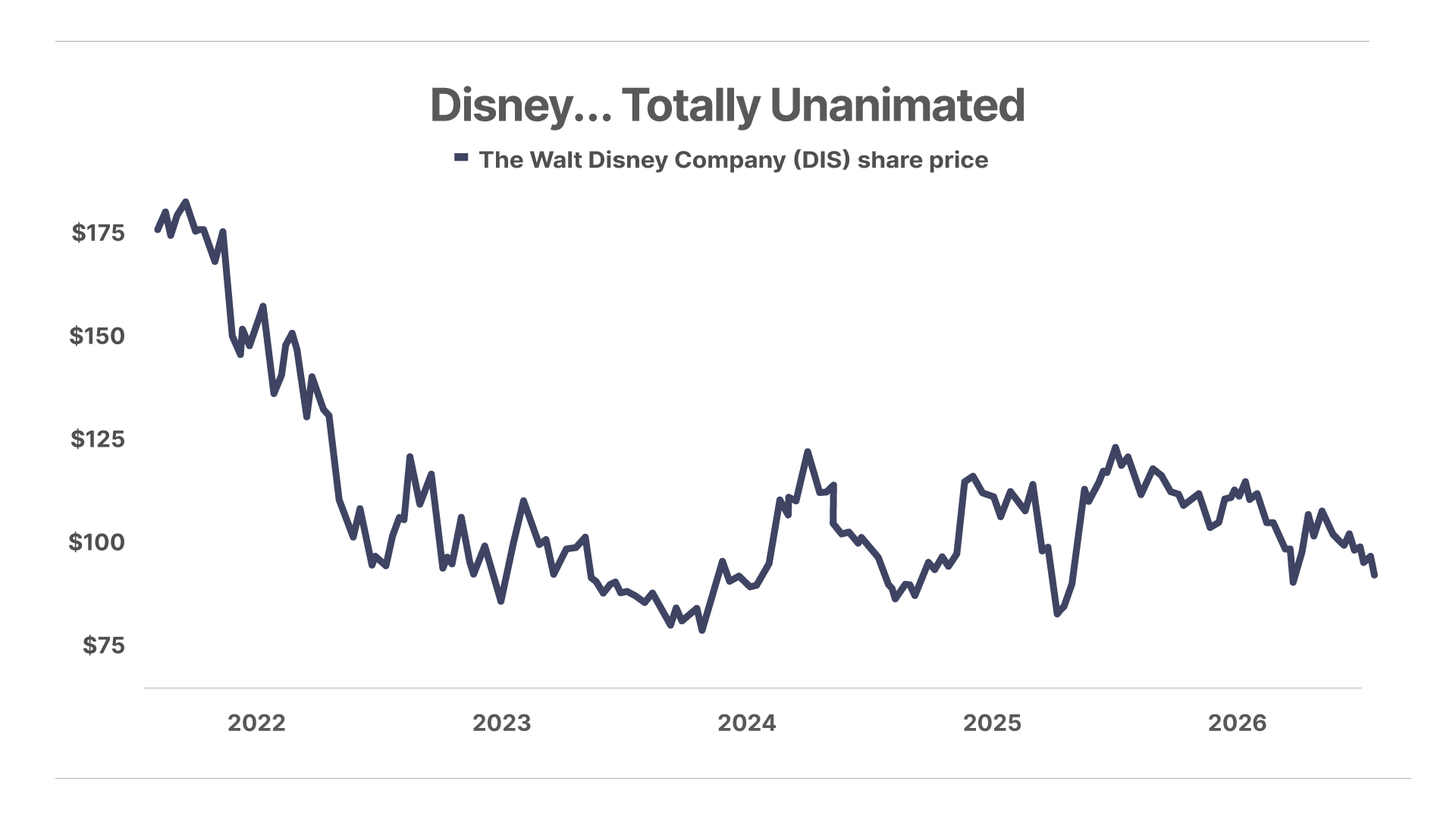
When will it be time to buy The Disney Company (DIS)? Watch the animation hit rate over the next several releases. Zootopia 2 (2025) was a huge hit – it made $1.87 billion worldwide, the fastest film ever to $1 billion (17 days), and the biggest animated opening weekend of all time. It overtook Frozen II and Inside Out 2 to become Walt Disney Animation’s highest-grossing film ever, and it’s a relatively new franchise.
What management needs to do is what Ralph Lauren’s management team has been doing: growing the value of the business by improving the margins. Cut what’s not working. Do more of what is working.
- Sell ESPN Sports earned $2.9 billion of operating income on $17.7 billion of revenue – a 16% margin business, but it’s a melting ice cube tied to the collapsing cable bundle and ever-escalating sports-rights auctions. It has nothing to do with animation. Nobody rides an ESPN attraction at Magic Kingdom. It’s the single largest non-core asset and the cleanest divestiture. Selling it removes the most capital-hungry, lowest-strategic-fit business and lets management stop bidding billions for NFL and NBA rights that will never become a theme park.
- Sell the linear TV networks ABC, the cable channels: FX, Freeform, National Geographic, and the ABC-owned stations all sit inside the Entertainment segment but they are the reason its margin is thin. Broadcast and cable are structurally declining, low-multiple, and utterly disconnected from the animation dream. Sell the whole linear bundle – ABC network, the owned stations, and the general-entertainment cable channels. Keep only what feeds the IP vault or the parks.
- Sell Hulu Hulu’s content is adult general-entertainment and live TV – network reruns, and live sports-adjacent programming. That’s not the animation dream. It’s a Netflix-lite competitor Disney is subsidizing. Keep Disney’s enormous content advantage in animation locked down in Disney+ and sell Hulu. Streaming should be the low-margin way Disney builds the dream, not a money-losing content arms race against every other media company.
These divestitures would generate between $50 billion to $70 billion.
At $300 million to $400 million all-in per new movie, $40 billion to $55 billion could fund 100 to 150 major animated films. Disney makes four to six animated features a year. So this capital could bankroll two decades of Disney’s entire animation output – every Pixar and Walt Disney Animation film through 2045 – without touching operating cash flow. And at around $1 billion each, the leftover $20 billion to $35 billion would fund 20 to 35 major new animated lands across Disney’s existing 12 parks worldwide. That’s enough to put a Frozen, Moana, Encanto, Inside Out, or Zootopia land in every park Disney owns, several times over.
The time to buy shares of Disney is coming. But current management says it will not sell ESPN. So not yet.
P.S. If there are any major shareholders reading this, I’m available at the right price. My strategy would lift the shares 5x to 10x in a decade.
Tell me what you think of today’s Journal: porterstansberrydirect@gmail.com
Good investing,
F. Porter Stansberry
Stevenson, Maryland
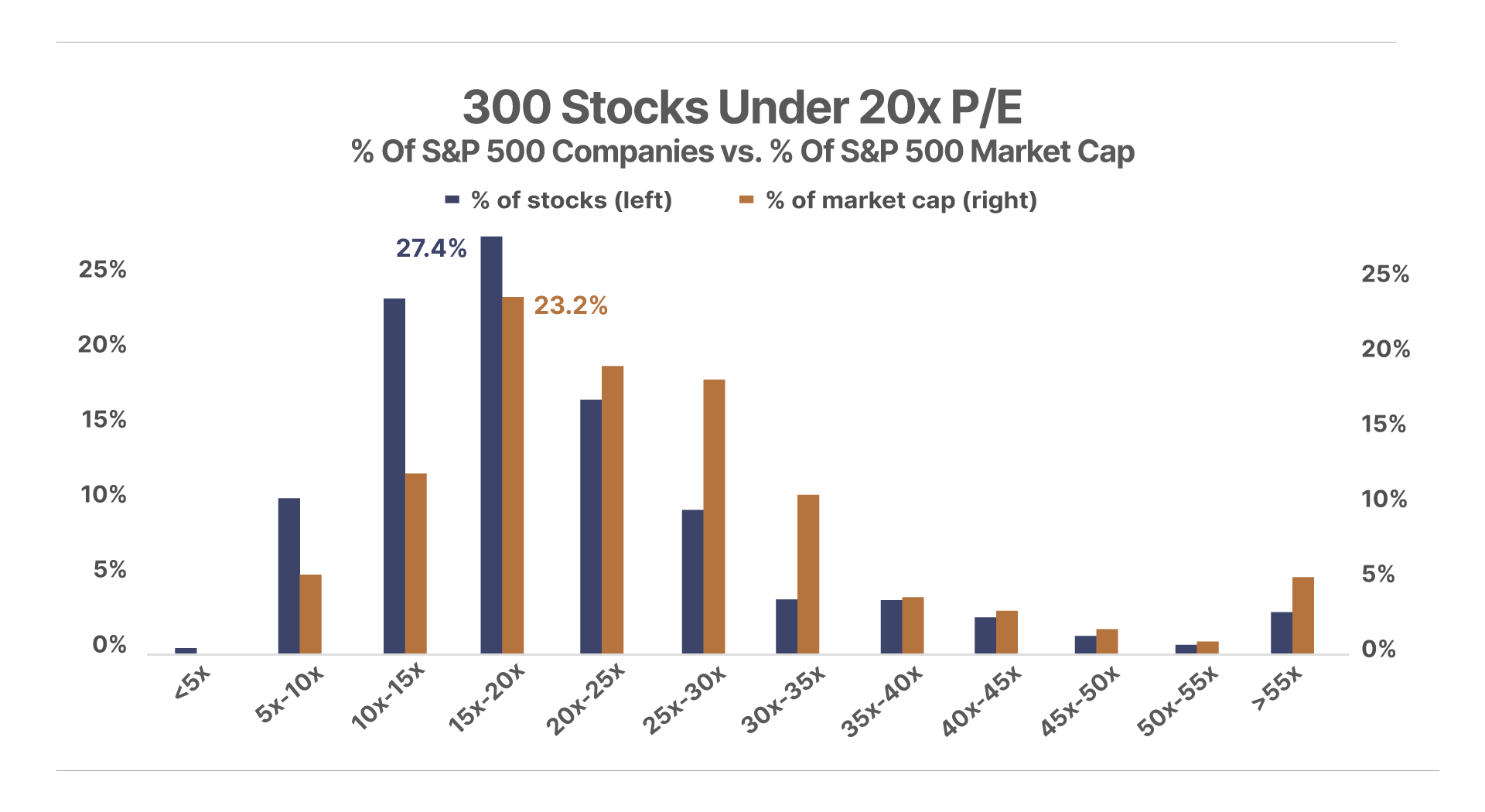
1. Most S&P 500 stocks are cheaper than the index. More than 300 of them – roughly 61% – trade below 20x the earnings analysts expect over the next year, with more than half of those trading below 15x earnings. Meanwhile, the broad index itself trades above 20x forward earnings, because its largest members – like Apple (AAPL) at 34x, Nvidia (NVDA) at 24x, and Microsoft (MSFT) at 22x – carry the most weight.
2. Trump’s global tariffs are back, under a new legal authority. At 12:01 a.m. today, duties of 10% to 12.5% took effect on 60 economies that supply 99% of U.S. imports, replacing the temporary 10% surcharge that simultaneously expired. That move was a stopgap after the Supreme Court struck down President Trump’s emergency-powers tariffs in February. The new basis is Section 301, an unfair-trade-practices statute, and the stated grievance is that these countries fail to block goods made with forced labor. The administration seems determined to impose huge new taxes, and won’t give up even when it’s clearly acting in ways that are unconstitutional – and bad for the economy.
3. The global debt crisis is here. Government bond yields are breaking out to multi-decade highs – the 30-year U.S. Treasury yield trades at a 19-year high of 5.2%, and the 10-year Japanese government bond hit a 30-year high of 2.8%. Across the pond, both the UK and French 10-year bonds are trading at their highest levels in nearly 20 years. Runaway borrowing costs are being fueled by unsustainable government debt burdens and hot inflation, amplified by the recent runup in oil prices to above $90 per barrel.
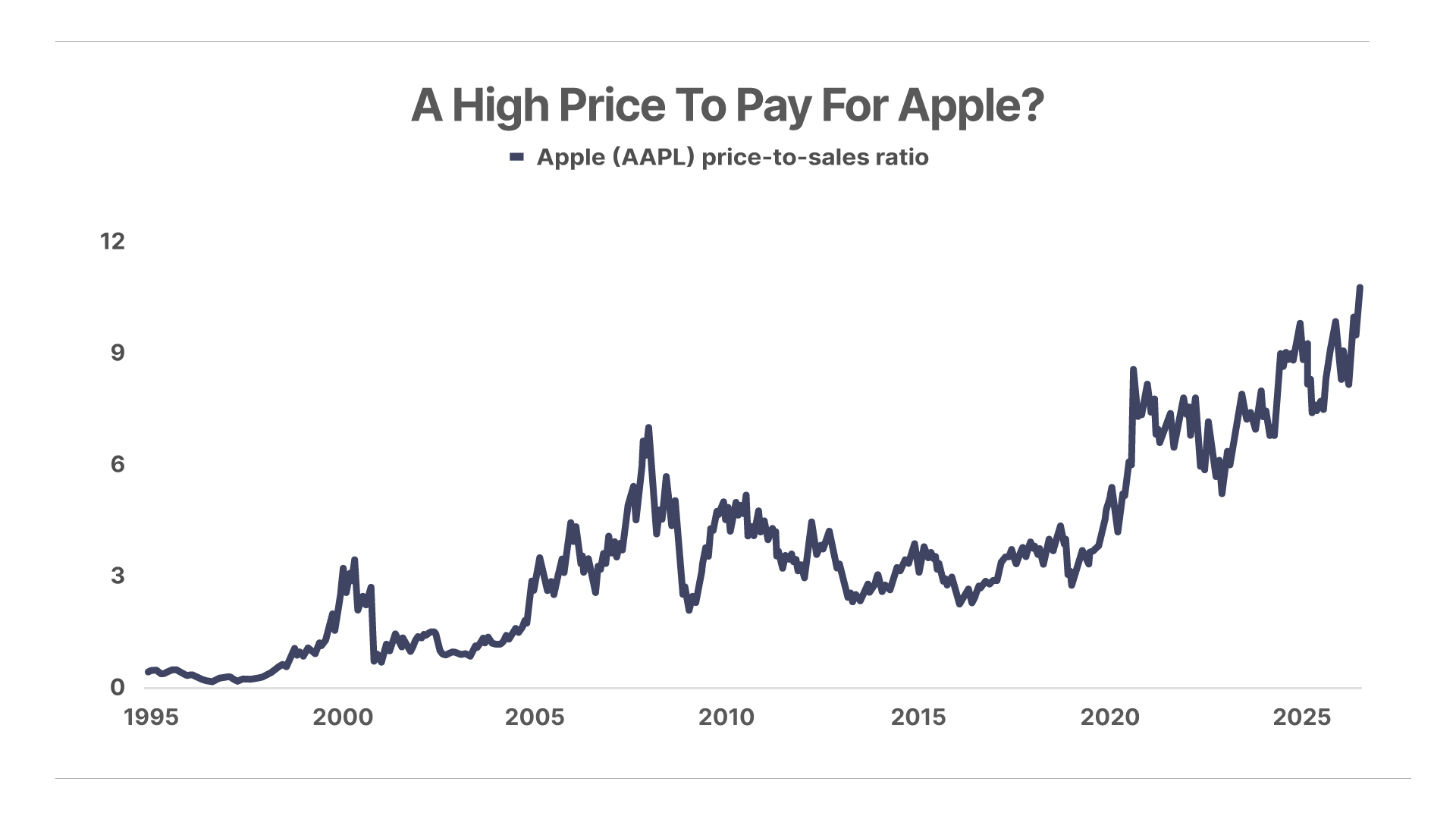
Driven by exuberance over artificial intelligence and new products slated for September, investors have sent Apple’s (AAPL) share price above $330, representing a price-to-sales ratio near 11 – 2.5x its historical average.
“Is This A Recommendation?”
In yesterday’s Daily Journal, Porter reported on the turnaround and possible strong future of the iconic American luxury clothing brand Ralph Lauren.
William D. writes:
“Your issue on Ralph Lauren and Hermès was most informative.”
Skip P. writes:
“So are you recommending the Ralph Lauren stock to buy now?”
Porter & Co. Comment: No, Porter doesn’t officially recommend stocks in the Daily Journal. Recommendations take place in Complete Investor. Porter explained yesterday that his writeup on Ralph Lauren might be “the most valuable” investment insights you’ll ever get, adding:
“And I’m giving it away in our free daily e-zine. Why? Because telling you this story is the most fun I’ve had in years.”
Jon D. writes:
“Less than satisfying, as I have never, ever heard of the company Hermès.”
Porter & Co. Market Snapshot
| Price | Yesterday’s Return | Year-to-Date Return | |
|---|---|---|---|
| S&P 500 Index | $7,408.30 | -1.21% | 8.9% |
| Gold per ounce | $4,049.48 | -1.96% | -6.3% |
| Bitcoin | $65,089 | -1.20% | -26.6% |
| Oil (West Texas Intermediate) per barrel | $92.19 | 5.10% | 56.9% |
| Berkshire Hathaway (BRK) | $736,632 | 0.53% | -2.4% |
| Porter’s Permanent Portfolio | – | 0.27% | 1.0% |
| The Better Than Berkshire Index | – | 0.04% | 7.7% |
| Total Return | Annual Return | ||
|
Porter & Co’s Top Ranked* |
35.1% |
16.4% |
|
| Yield | Yesterday’s Change | Change Year-to-Date |
|
| U.S Treasury 30-Year Yield | 5.16% | 2 bps | 32 bps |
*A Complete Investor risk rating of 1 is defined as a “low risk, high allocation” security, while positions rated closer to a 5 are higher risk. Porter & Co.’s top-ranked positions include those rated either 1 or 2 in Complete Investor portfolio.
Porter & Co. Top Positions
| Publication | Ticker | Description | Total Return |
|---|---|---|---|
| Tech Frontiers | QURE | uniQure | 237% |
| Complete Investor | BWXT | BWX Technologies | 210% |
| Tech Frontiers | TGTX | TG Therapeutics | 156% |
| Tech Frontiers | NUVB | Nuvation Bio | 156% |
| Tech Frontiers | ROIV | Roivant Sciences | 155% |
| Complete Investor | BTC/USD | Bitcoin | 141% |
| Complete Investor | SKWD | Skyward Specialty Insurance | 138% |
| Complete Investor | PM | Philip Morris | 137% |
| Tech Frontiers | QURE | uniQure | 131% |
| Tech Frontiers | SGMT | Sagimet Biosciences | 130% |
Prices as of 4:00 pm ET July 24, 2026
Please note: The investments in our “Porter & Co. Top Positions” should not be considered current recommendations. These positions are the best performers across our publications – and the securities listed may (or may not) be above the current buy-up-to price. To learn more, visit the current recommendations page of the relevant service, here| New Window. To gain access or to learn more about our current recommendations, call our Customer Care team at 888-610-8895 or internationally at +1 443-815-4447.