What’s Replacing The Traditional 60/40 Stocks/Bonds Portfolio
Inside Today’s Issue
Editor’s note: Today, Porter turns the Daily Journal over to Matt Tuttle, CEO of Tuttle Capital Management and portfolio manager of the Porter & Company Porter Portfolio Index ETF (PCPP).
It was April 8, 2025, about 20 minutes after the market open.
I’d already made my peace with the equity screen on my desk. The S&P 500 had given up 10.5% in the two sessions after U.S. President Donald Trump’s “Liberation Day” tariff announcement, bad enough to be the fifth-worst two-day stretch in 75 years.
And then there was the other screen.
The long bond was falling too. Not holding… not lagging… but plummeting. According to the conventions of portfolio management sold by Wall Street, a free-falling long bond while stocks were collapsing was precisely what was not supposed to happen.
By the end of what was a very long week, the 30-year Treasury closed at 4.85%, the sharpest weekly jump in long-dated yields since 1982. (The way a bond works is that when its yield rises, the price falls.)
This was big trouble for anyone with a classic 60/40 stocks/bonds portfolio. The airbag didn’t deploy because bonds – the asset that’s generally supposed to go up, when stocks go down – was going down too.
Three Times Is Not Bad Luck
I’d seen this movie before.
Three times in 17 years, the hedge – the asset that was supposed to be the ballast – didn’t hedge.
In 2008, during the Global Financial Crisis, Treasuries held. Stocks lost 37%, long Treasuries returned more than 20%. What failed, though, was everything else that had sold as diversification: corporate bonds, mortgages, credit funds, alternatives. They fell together at the exact moment managers expected they would provide a cushion for stocks by not marching to the same drummer.
In 2022, the hedge itself failed. Pandemic supply shocks, stimulus spending and the energy spike after Russia invaded Ukraine drove inflation to a 40-year high of 9.1%. The Fed raised rates 425 basis points in nine months. (A basis point is one hundredth of a percentage point, so that’s a 4.25-point increase.) Few things are more challenging for a long bond than rising rates.
The standard 60/40 portfolio – for decades the default recipe in retirement planning – lost roughly 17.5% for the 2022 calendar year, as measured by Morgan Stanley Investment Management using a blend of 60% U.S. equities and 40% U.S. Treasury bonds. It was the worst year since 1937. And stocks weren’t doing the damage alone: long Treasuries fell harder that year than at any point in the recorded data.
Then came, as I mentioned, April 2025, when both equity and bond screens went red at once.
Each time the classic hedges failed, we were told it was an anomaly.
But three anomalies in 17 years starts to look less like bad luck, and more like a design flaw.
Porter Had Been Saying It Already
I reached that conclusion the expensive way, one drawdown at a time. Porter reached it years earlier, and he published his thoughts for the world to read.
He talked about the erosion of the dollar, and the dark and inevitable arithmetic of a government that has not stopped borrowing. He called it the bond trap: the “safe” asset had quietly become one of the riskiest things you could own. He’d been writing that years before the charts made it obvious.
That’s why, when Porter’s team called late last year about turning those ideas into an exchange-traded fund – an ETF – it was a quick and easy answer.
Why The Long Bond Breaks
So how does the asset that the industry treats as its safest… become one of its riskiest?
How the 30-year Treasury works: Hand the government $1,000 for 30 years. You get a fixed coupon (that’s the interest) every six months, and then you get your principal back 30 years later.
Two things decide what that promise is worth: What those dollars will buy in 2056, and what rate other buyers demand for the same promise in the meantime. Because if they demand a higher return, the bond that you own will be worth less.
So let’s look at the borrower. The United States government ran a federal deficit of roughly $1.8 trillion in its 2025 fiscal year – 5.9% of GDP, against a 50-year average of 3.8% – plus trillions more in unfunded Social Security and Medicare promises.
In my view, there is no politically viable tax increase, and no realistic spending cut, that could close a gap that size. Historically, gaps of this kind have often been narrowed by inflation.
In other words, dollars get created, each buys a little less, and the debt gets repaid in money worth a whole lot less in real terms than the money borrowed.
That isn’t a hedge. A hedge is supposed to pay when your stocks don’t. Inflation, though, takes both.
Underwriters, Not Treasuries
So if the long bond isn’t reliably the defensive part of a portfolio, what else might do that job?
Porter’s answer, and the part of his framework I had the hardest time arguing with, is to hand that job to property and casualty (P&C) insurance stocks. Those are the snoozefest (for anyone who’s not an investor, at least) companies that write your home and auto coverage, and pay out when a tree lands on a roof or you get in a fender bender.
A savvy insurer who knows how to price risk could be paid to hold its bonds. Premiums arrive today, claims are paid out years later – and the insurer can retain what it earns on the money in between. For example, Warren Buffett’s Berkshire Hathaway (BRK) ran roughly $176 billion of other people’s money that way in 2025.
Insurance companies also choose what to own and, for example, shorten maturities (to reduce volatility and downward price movement) when the rate environment is dangerous. A bond fund, though, holds whatever its index dictates, all the way down.
Of course, an insurance company that isn’t good at understanding the risks it’s taking on will wind up paying out more than it takes in, which doesn’t do investors any good. That’s why in the “bond” slice of the new fund I’ve created with Porter, we screen for underwriting quality before anything else.
How It Works Inside The Fund
PCPP is a passive fund. It seeks to track the investment results, before fees and expenses, of the Porter & Co. Porter Portfolio Index — a rules-based, multi-asset index. In the Porter & Company Porter Portfolio Index ETF (ticker symbol: PCPP), no holding is chosen by discretion on the day. The rules are written in advance.
A quarter of the portfolio goes to P&C insurance stocks, drawn from Porter & Co.’s analysis that’s screened for size, business mix, and historical return consistency. The top 20 that clear those bars go in, weighted so that historically stronger underwriters receive larger weights. No name accounts for more than 10%, and the index is rebuilt once a year.
Nobody gets to fall in love with a name. Porter & Co. builds the index. As the adviser, we can’t change it.
The other three sleeves of the fund operate the same way. You can read the full framework and the prospectus at porterandcofunds.com.
A Better Definition Of Safe?
In my opinion, “safe” doesn’t suggest an investment that doesn’t move.
The question worth asking is whether the thing you bought as a hedge behaves the way you expected – during a week that the equity side is down double digits, and you’re looking at two red screens.
By that definition, the long bond may have stopped being safe some time ago.
From what I’m seeing, most portfolios haven’t gotten the memo.
Matt Tuttle, CEO/CIO
Tuttle Capital Management
P.S. Every morning before the open, I publish The Daily HEAT, my framework applied to whatever the market is doing that day. It’s free. Sign up here.
Tell us what you think of today’s Daily Journal: porterstansberrydirect@gmail.com

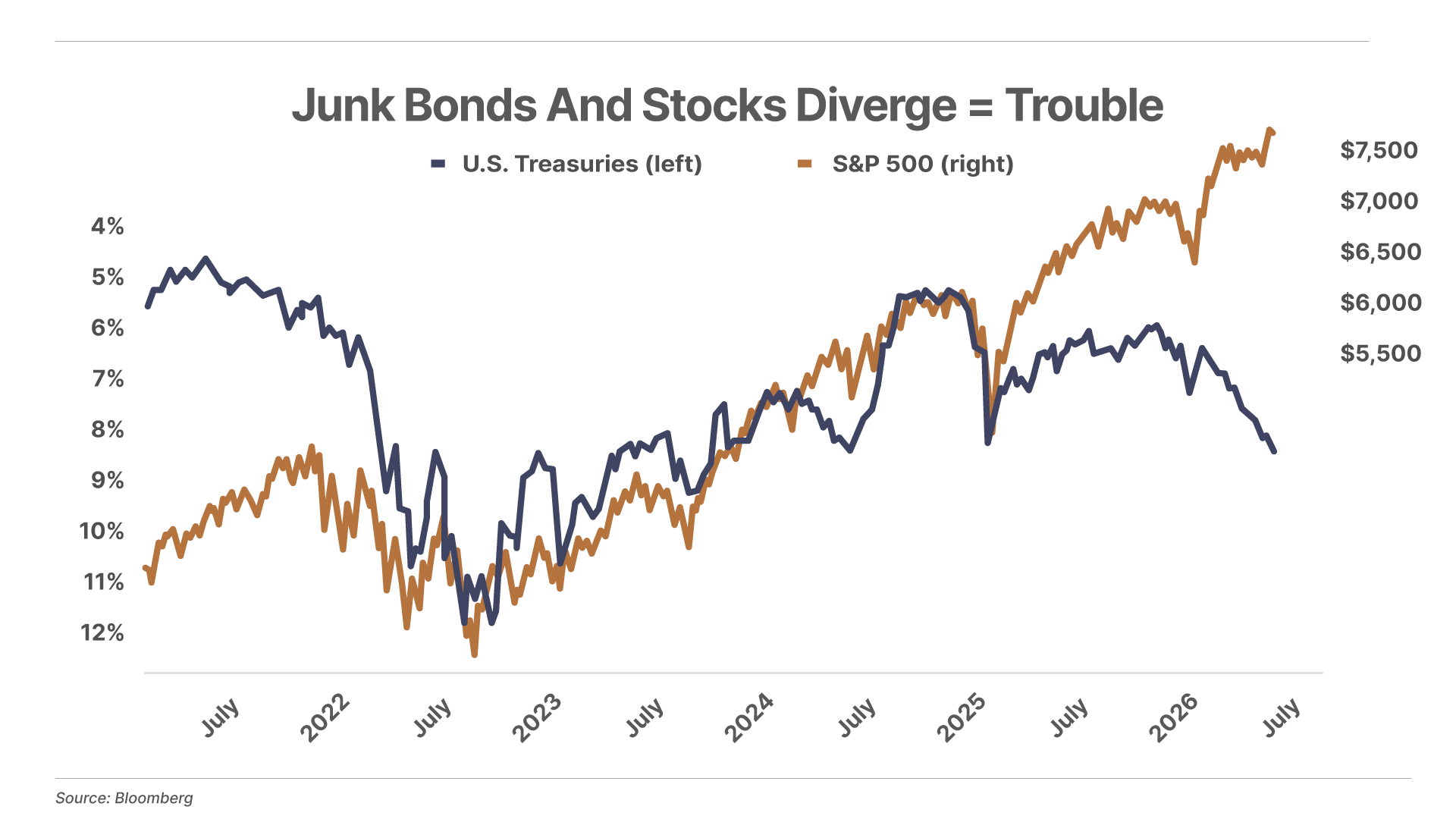
1. The riskiest junk bonds have stopped following the stock market. CCC-rated debt – the lowest tier of junk – is the corner of the bond market that normally tracks stocks most closely, moving about twice as much per point of S&P move as safer BB-rated paper. Since January, the extra yield investors demand to hold CCC debt instead of Treasuries has widened dramatically as the S&P 500 has continued to rise to new highs. The last time the two diverged like this preceded the 2022 bear market in stocks.
2. Axon lands three new deals in three new channels. In one week, Complete Investor recommendation Axon Enterprise (AXON) earned a 10-year, $40 million deal to put body cameras on every correctional officer in Maryland’s state prisons, then the Transportation Security Administration (“TSA”) announced that Axon will supply counter-drone sensors at U.S. airports, and the company also delivered an anti-drone system to Bulgaria – its first to a European military. Correctional facilities, federal civilian aviation, and European defense are all channels Axon didn’t serve two years ago. Shares are up 20% since our July 18 recommendation.
3. Broadcom adds to debt-fueled AI vendor financing woes. Custom chipmaker Broadcom (AVGO) announced yesterday talks with a group of lenders to raise up to $100 billion in debt for the purchase of its chips. The credit will be extended to Anthropic and other companies investing in AI computing power, with Broadcom potentially guaranteeing up to $70 billion of the debt, according to Bloomberg. The credit market reacted by sending Broadcom’s credit default swap – an insurance contract that pays out in the event of a default – to a new high of 80 basis points, up from just 10 basis points in June. The bond market is becoming increasingly concerned about the growing use of debt and circular financing arrangements fueling the AI boom.
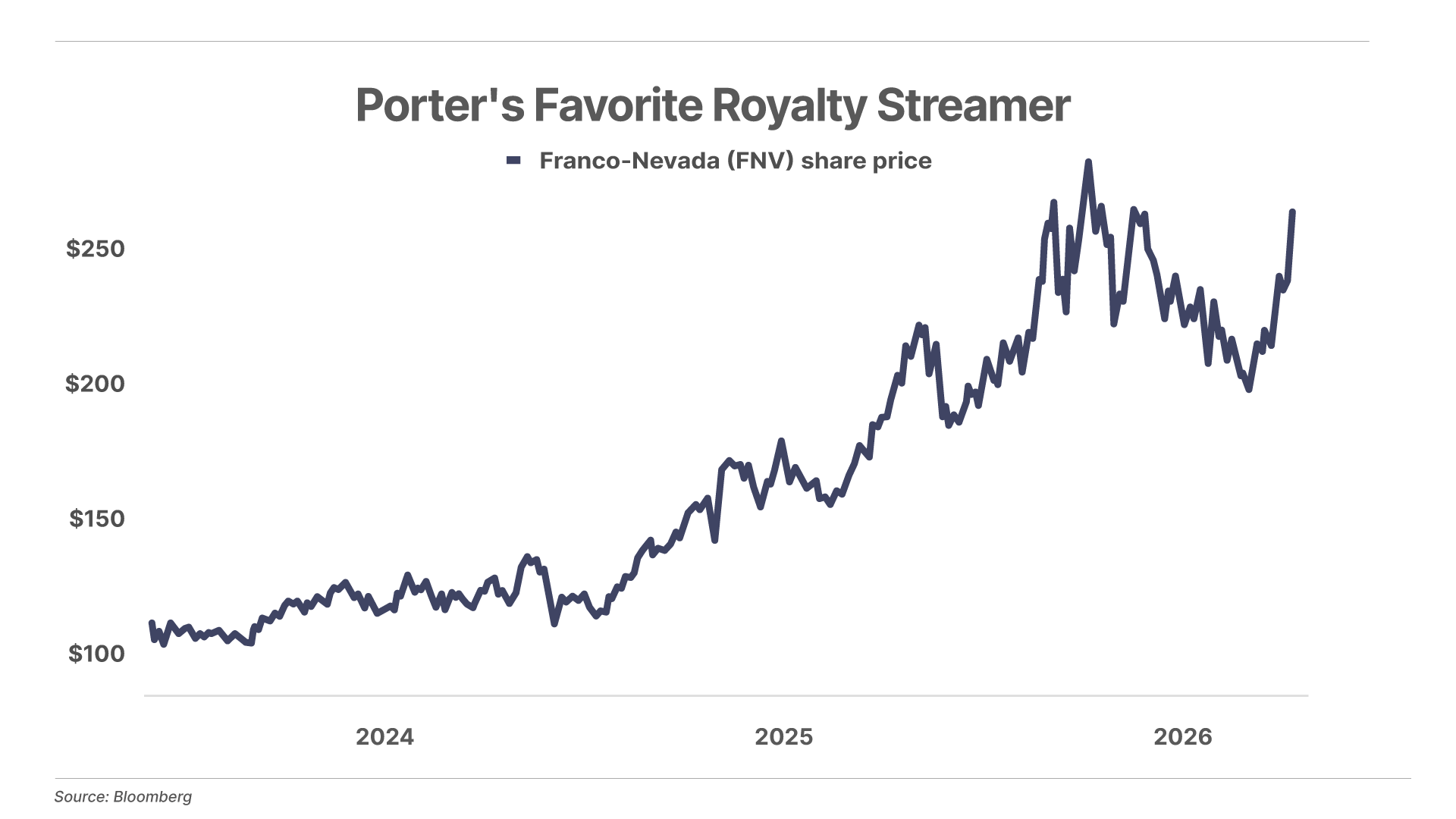
Franco-Nevada (FNV) has long been Porter’s favorite gold royalty company – the most capital efficient business model in the sector, with the best capital allocators – and since we originally added it as a Best Buy in late 2023, shares have gained 142%.
Every month we select three Porter & Co. recommendations that we think are at a particularly attractive buy price. Our next batch of Best Buys goes to paid-up subscribers tomorrow, August 22. To see what the team has selected, click here to learn more.
Yesterday, Porter defended his thesis that retailer Target is a fading business, despite the recent strong performance in TGT shares.
“Spot On”
Anne P. writes:
Porter your assessment regarding more affluent shoppers no longer being Target customers is spot on. The stores are no longer clean, the clerks know nothing, if you can find one. Merchandise quality has degraded while becoming aggressively political. The result of their choices of products, political statements, and employees has ruined their business.
“Woke”
James C. writes:
Porter, your in-depth analysis is impressive except for missing one element. That being the fallout of the store going in the extreme by bowing to the woke, thru endorsing and providing an abundance of gay community merchandise.
That offended and lost a customer base.
“Case Study In What Not To Do”
Marc Z. writes:
I have always considered Target’s business judgment as nonsensical. I used their foray into Canada in my business class as an object lesson in what not to do.
“Virtually Empty”
Michael H. writes:
I am a 27-year subscriber. This recent comment on Target is really interesting. In the last year, I have been inside Target stores in Phoenix, Arizona, Colorado Springs, Colorado, and Casper, Wyoming. To my surprise they have been virtually empty of customers. There are maybe 2-3-4 customers in the whole store. This really surprises me. And so yes, their foot traffic is woefully absent. And yes, as a customer I am wondering how they are staying open.
Thank you for your comments, and a very informative and interesting read.
“Surprised At Ernst & Young”
Tom W. writes:
I am a CPA and I am surprised that Ernst & Young signed-off on this accounting treatment!