Issue#137, Volume#3


How Will The AI Capex Bubble End? Like Every Other Capex Mania Did: They Collapse When They Run Out Of Capital
Inside Today's Issue
Editor’s note: Today, Porter begins a multi-part series on the staggering amount of capital flowing into the build-out of artificial intelligence – and how it ends. Hint: not well.
There’s never been a deal this close to this big – ever.
Yesterday, after the market close, the Financial Times reported that Nvidia (NVDA) is assembling a $500 billion (!) financing package to keep the artificial intelligence (“AI”) build-out going. This is debt, not convertible equity. The lenders: Apollo Global (APO), Blackstone (BX), BlackRock (BLK), Brookfield Asset Management (BAM), Goldman Sachs (GS), and KKR (KKR) – the six largest shadow banks in the world.
Nvidia’s market cap is $5.25 trillion. Its most recent quarterly free cash flow (“FCF”) was roughly $49 billion. Companies that generate $49 billion of quarterly cash do not need a $500 billion financing package – unless something is very wrong.
Something is very wrong: This is Nvidia’s second capital raise in eight weeks.
On June 15, 2026, Nvidia priced $25 billion of senior unsecured notes across seven tranches — coupons from 4.25% on the 2028s to 5.625% on the 2056s. On $8.5 billion of senior notes outstanding, against $49 billion of quarterly free cash flow, the stated use of proceeds was “general corporate purposes.” But, as you’ll see… that’s not where the money is going.
And Nvidia isn’t the only AI business suddenly trying to raise enormous amounts of capital. Look at Intel (INTC), which before the open yesterday announced a $15 billion (!) common stock offering.
This on top of 12 months of capital raises:
-
August 18, 2025: $2 billion from SoftBank Group
-
August 22, 2025: $8.9 billion from the U.S. Treasury
-
September 2025: $5 billion private placement to Nvidia
Intel has also received $5.7 billion from CHIPS Act disbursements – federal funding to support U.S. semiconductor production. And it sold 51% of Altera for $4.3 billion and all its Mobileye shares for $0.9 billion.
Total capital raised in 12 months: $45 billion.
Intel's capital raising is not a growth signal. It is a solvency warning. Intel's cumulative FCF burn over the last five years was: negative $48.7 billion. All this new equity is simply papering over its losses.
Sure, the bulls will point to revenue growth: Q2 2026 revenue was $16.13 billion, up 25.4% — Intel's fastest quarterly growth since 2011. But even so, Intel is still not even close to generating cash earnings.
Revenue growth without cash earnings is the signal hallmark of a capex bubble.
WorldCom had it in 2001. Jay Cooke's Northern Pacific railroad had it in 1872. They both collapsed within a year. And so will the AI bubble.
Raising Equity To Cover Losses Isn’t A Growth Signal
In November 2007, Citigroup (C) sold $7.5 billion of preferred stock to the Abu Dhabi Investment Authority.
A month later, Morgan Stanley (MS) sold $5 billion to China Investment Corp.
Then, in January 2008, Merrill Lynch took $6.6 billion from Kuwait, Korea, and Temasek and UBS AG (UBS) sold $9.75 billion to the Government of Singapore Investment Corp.
Two things struck me at the time:
-
Sovereign wealth funds are the biggest piles of “dumb” money ever created and they’re proving it
-
If they’re the only buyers, the banks are completely fucked
On May 31, 2008, in Stansberry’s Investment Advisory, I wrote:
Firm after firm has been trying to raise capital before the money runs out, just like the railroads did in 1907. And like they did then, financial institutions are using innovative ways, like convertible preferred shares, to entice investors to buy into their stock at a sharp discount from its market price. Even so, firms are beginning to discover no more money is available. That’s what happened to Bear Stearns. As its mortgages lost value, it couldn’t raise enough capital to pay for the losses, thanks to extreme leverage, about 30-to-1.
Within months, Fannie Mae, Freddie Mac, Bear Stearns, Lehman Brothers, Merrill Lynch, Citi, Wachovia, and Washington Mutual were all destroyed.
It’s all happening again.
No, not in mortgage banking this time. Today, the capital tide is going out in tech. The death scramble for capital is starting.
As I mentioned above, Nvidia is generating almost $50 billion of FCF per quarter. It is one of the very few AI businesses that can generate cash earnings. But where is the money coming from? Mostly from two firms – OpenAI and Anthropic – that are losing money and from hyperscalers selling compute to those firms, which derive much of their capital from vendor financing that Nvidia itself is providing.
Vendor financing is also known as “lending for revenue” or more darkly – “how to turn a credit rating into earnings.” Ask Enron or GE to explain how it works out.
Nvidia, seeing these cautionary tales, has doubled down.
Instead of merely providing credit for the purchase of its products, Nvidia is providing equity for its customers. Nvidia’s private-company investments grew from $3.24 billion to $42.34 billion in the 12 months ending April 26, 2026.
That’s a 13-fold increase in a year.
Is Nvidia a hedge fund? Is it a venture capital fund? Nvidia is supposed to be the world’s leading provider of compute. But it’s beginning to look like a very sophisticated and unbelievably large Ponzi scheme.
Nvidia’s latest quarterly filing notes, with unintentional irony:
Some of these investments include AI model makers that may indirectly purchase or use our products in the cloud.
The same filing also discloses agreements to guarantee partners’ facility lease obligations. And what’s the collateral? Warrants on their stock.
In other words: Nvidia is now selling default protection on its customers’ real-estate obligations. These are the same customers it is simultaneously financing to buy its own chips. Do Nvidia’s customers actually pay for anything?
We have seen this before. That is the exact financial structure that destroyed the telecom equipment companies during the internet bubble.
Lucent Technologies booked revenue selling switches to Winstar Communications on vendor financing. Winstar filed Chapter 11 in April 2001. Lucent took $2.2 billion of bad-debt provisions in fiscal 2001 and $1.3 billion more in 2002.
To survive, the telecom equipment makers began a death scramble for capital. Lucent raised $1.75 billion, upsized to $2.0 billion, of convertible preferred stock in August 2001 with an 8% coupon. The investors that bought these securities lost everything.
Lucent lost $16.1 billion in fiscal 2001 and $7 billion in fiscal 2002. And then it disappeared.
Remember that in the coming months, as every kind of AI business is trying desperately to raise capital. Don’t buy it. No matter how good the terms seem.
Tomorrow I’ll explain how this scramble for debt in the AI buildout is much more concentrated than it was during the internet boom of 1999-2000.
Tell me what you think of today’s Daily Journal: porterstansberrydirect@gmail.com
Good investing,
F. Porter Stansberry
Stevenson, Maryland

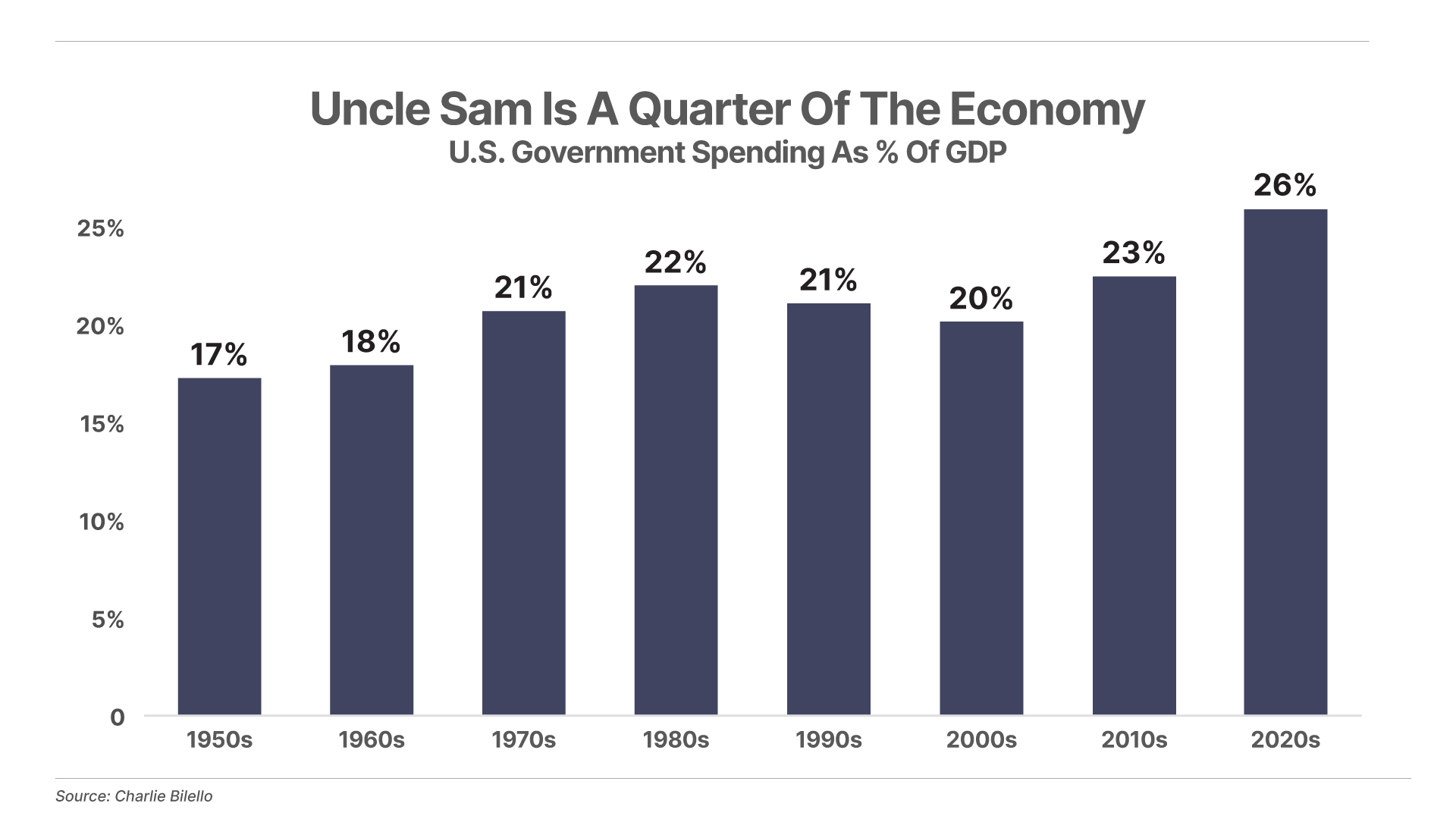
1. The federal government's share of the economy is the largest in 75 years. Federal spending has averaged 26% of gross domestic product – the value of everything the country produces in a year – so far in the 2020s, greater than any other decade since WWII. And the debt tracks spending: Washington owes about $40 trillion today, up from roughly $19.5 trillion 10 years ago, and the same doubling has repeated roughly every 10 years under all presidential administrations for decades. At this pace, federal debt is on track to hit $80 trillion by 2036.
2. AI debt enters its “subprime era.” Following the 2008 Global Financial Crisis, the Securities And Exchange Commission (“SEC”) created new rules on asset backed securities to prevent future crises. These included a 5% risk retention rule designed to force security sponsors to keep skin in the game, as well as loan-level disclosures to prevent conflicts of interest. In late July, the SEC formally waived these rules for securities underwriting data center build-outs based on the idea that these debt instruments are not “asset backed.” In short, regulators just gave the AI credit machine the same free pass that helped inflate the subprime mortgage bubble.
3. The market has never been this expensive. A Bloomberg composite of eight valuation metrics now sits near the 100th percentile of its 125-year history, above both 1929 and the 2000 dot-com peak – at the exact moment the cash flows justifying the valuations are vanishing. Alphabet (GOOG) just posted its first negative FCF quarter since its 2004 IPO, and Amazon's (AMZN) trailing 12-month FCF swung to negative $8.2 billion. Bank of America projects aggregate hyperscaler FCF flips from positive $180 billion in 2025 to negative $64 billion this year. Paying all-time-high multiples for shrinking cash flows rarely ends well.
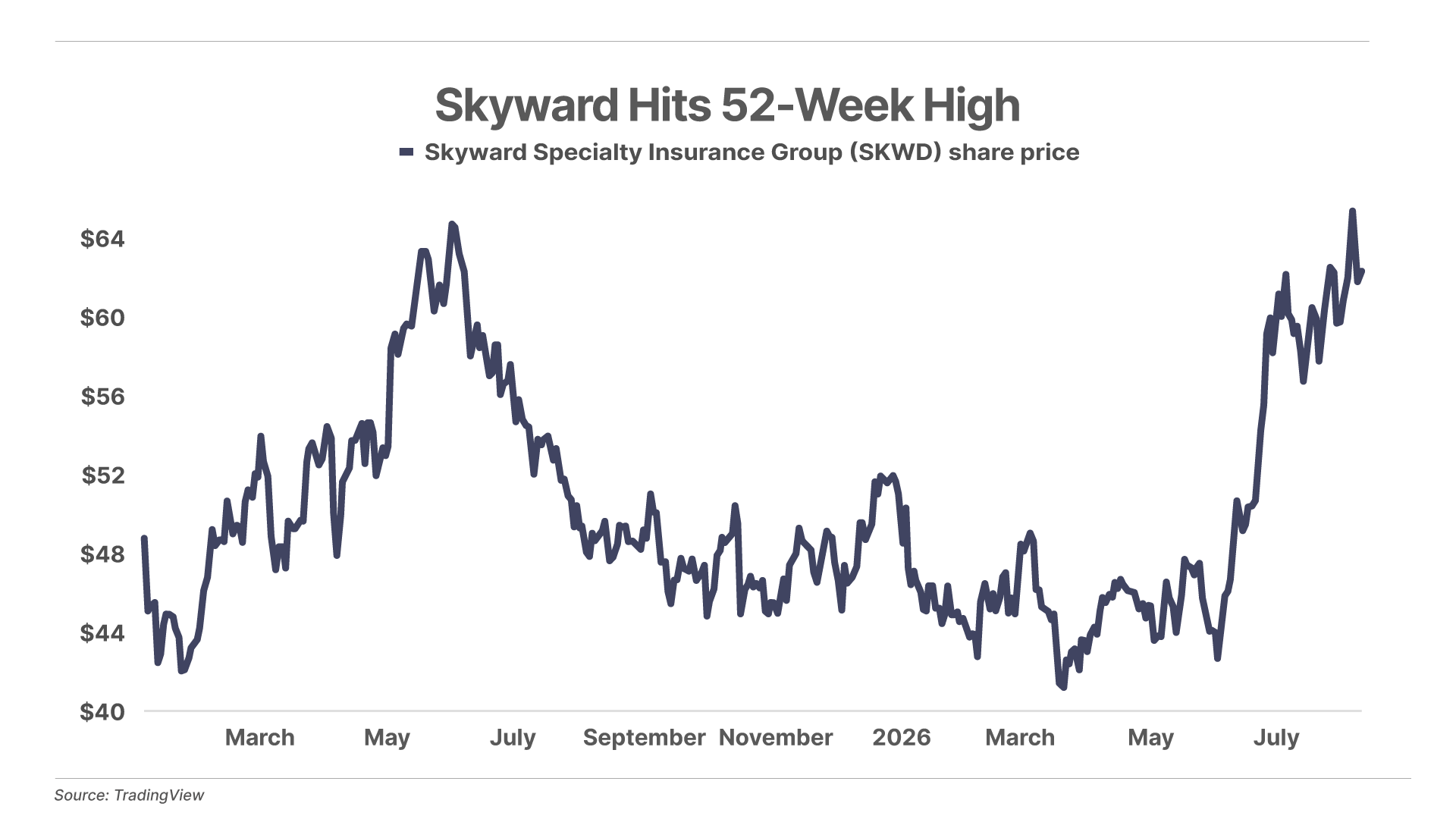
Shares of Complete Investor recommendation Skyward Specialty Insurance (SKWD) defied broad insurance market weakness to trade at a 52-week high last week. The Houston-based insurer, which writes coverage for niche commercial risks that standard carriers won't touch, reported second-quarter net income of $49 million – up 26% from a year ago – on 13% growth in premiums written.
To get access to the full list of Complete Investor recommendations and ongoing research, click here.
Porter regularly writes in the Daily Journal about Warren Buffett – both as the greatest investor in generations and as someone who has made colossal mistakes managing the Berkshire Hathaway portfolio. In fact, Porter wrote a book, Warren’s Mistakes, available on Amazon.
Steven B. writes:
Thank you Porter for an astute comment on Warren Buffett's transition. I would like to suggest that the influences go beyond Bill Gates. Warren's inclusion in the World Economic Forum and his conversion to resource scarcity goes beyond his association with one man. The group think that established the EU should have been enough to dissuade him to stay far away from the un-elected control of sovereign nations. But it didn't.
For the next 25 years he abandoned the stewardship that was his hallmark. For what? The fear that humans could not overcome the challenges of their own existence. So they had to be reduced in number as the only rational solution.
Porter Comment: It is genuinely one of the most confounding sets of facts I have ever encountered in my entire life.
How did Buffett and his colleague Charlie Munger – two of the smartest Americans of all time – come to believe so completely in a bunch of absolute nonsense?
I think it’s because they, like Malthus, mistook the math for reality. Sure if the population of the world is doubling every decade, it won’t take long before there’s way too many people. But people aren’t numbers on a chalkboard. They’re thinking machines. They innovate. And their behavior is homeostatic. They course correct.
Something that Munger and Buffett never seemed to understand.
Porter & Co. Market Snapshot
Porter & Co. Top Positions
Please note: The investments in our “Porter & Co. Top Positions” should not be considered current recommendations. These positions are the best performers across our publications – and the securities listed may (or may not) be above the current buy-up-to price. To learn more, visit the current recommendations page of the relevant service, here| New Window. To gain access or to learn more about our current recommendations, call our Customer Care team at 888-610-8895 or internationally at +1 443-815-4447.