Issue #80, Volume #3


Three Analysts Explain Debasement From Different Vantage Points
Inside today's Daily Journal…
|
Editor’s note: Porter is hosting his first of many Mastermind events at his farm in Maryland today – a day-long group discussion about investing, portfolio management, and wealth creation. Porter will return to the Journal tomorrow.
Porter & Co. analysts are aligned on one common thesis… That in one way or another we are due for a major financial reset. Porter invited each of them to discuss the melt-up and eventual meltdown – and each offered a way you can benefit from it.
But each analyst has also highlighted a longer-term threat to the economy and to the U.S. Over the last three weeks, three Porter & Co. analysts – Tech Frontiers editor Erez Kalir, Distressed Investing’s Marty Fridson, and Porter himself – have warned of a major structural change to the American economy… and therefore to the global economy.
First it was Marty, who told readers in an April Daily Journal…
The U.S. government has spent its way into a collapse of the sovereign U.S. Treasury debt regime…
Tighter banking regulations following the Global Financial Crisis raised the cost for banks to provide dollar funding to the rest of the world. As a result, Marty wrote, the premium paid by foreigners for directly accessing dollars went up.
Even with those added costs, the rest of the world still wants dollars, and the Fed has been creating those dollars with seemingly no limit. Neither the euro nor the Chinese yuan is on the verge of usurping its place in global trade… yet.
For U.S. Treasury bonds, on the other hand, a grim future has already arrived, Marty explained…
Up until 2023, Treasury bills, which are issued with maturities of one year or less, still enjoyed their special privilege, yielding less than comparable foreign obligations. No longer, thanks to the Treasury flooding the market with this near-cash type of paper. Between 2013 and 2019, the amount of Treasury bills outstanding expanded by 52%. In the next six years the amount ballooned 171%.
There’s no mystery about the Treasury’s increasing reliance on these very short-term obligations. At most times, T-bills represent cheaper funding than bonds, which have maturities of up to 30 years. At certain times during the last 20 years, the gap has been as great as two percentage points. That means the government can save taxpayers billions of dollars by issuing shorter-dated debt.
The problem is that the Treasury could have to replace a large portion of its debt at a difficult time in the market, when borrowing costs are higher.
Given these disturbing facts, he concluded, it’s not surprising that America’s debt has already lost its elite investment status. He also warned that we should not be complacent about the foreigners’ longstanding love affair with the dollar. There have already been some rumblings of discontent.
If the dollar falls off its pedestal sooner rather than later, he concluded, don’t say you haven’t been warned.
Erez took us back 70 years when the British government did not heed the warning when the integrity of its own currency was being undermined.
In 1956, Britain had launched a military attack to maintain its control of the Suez Canal, which Egypt had determined to put under its control.
At the time, Erez explained, Britain still clung to the illusion that its currency, pound sterling, remained the global reserve.
But sterling’s position as the world’s dominant currency had been eroding for decades… losing ground to the ascendent U.S. greenback. And in this crucial moment of geopolitical crisis, Britain depended on foreign capital to support sterling’s stability in the foreign exchange markets. When President Dwight Eisenhower signaled that U.S. support for sterling would be withdrawn, the rest of the world’s capital followed.
It was a financial disaster for Britain. The sterling eventually collapsed. Historians often describe the moment as the end of the British Empire. That’s not quite right, of course, as empires rarely end in a single moment.
Ray Dalio, founder of the world’s largest hedge fund, Bridgewater Associates, has spent decades carefully studying the rise and fall of empires – the Dutch, the British, and now the American.
Erez described Dalio’s framework this way…
In the beginning, a powerful nation dominates key trade routes – controlling key maritime trade routes makes a nation’s currency the one everyone wants to use. Subsequently, reserve currency status enables that nation to borrow from the rest of the world more cheaply. Cheap borrowing helps reinforce the nation’s military strength – and so the cycle continues.
But as that dominant power borrows more, it becomes complacent, believing it can continue to borrow in perpetuity. As is happening in the U.S. now, its debt grows out of control. Soon, foreign creditors begin to question the currency. The currency’s reserve status erodes, causing borrowing costs to rise, and the military weakens. The empire falls into a terminal decline.
Erez explained…
In this downward spiral, the crucial moment isn’t when the hegemon weakens – it’s when the world realizes it has weakened.
Which brings us to the current situation in the Middle East. The U.S.’s role in the closure of the Strait of Hormuz is causing devastating injury to the dollar. For one, the world is seeing that the U.S. can’t keep the most important maritime trade route in the world open. In addition to that, the Hormuz closure is wreaking havoc on the economies of U.S. allies. And it’s providing a boost for China’s currency, as a shadow fleet of cargo carriers was able to transit the Strait carrying shipments paid for using the yuan.
What’s happening in the Middle East is not going to lead to the replacement of the dollar now – just as the Suez crisis didn’t immediately lead to the end of the British pound. It is however a sign of the slow erosion of the dominance of the greenback as the global reserve currency.
And while Erez details the erosion of trust in the dollar from a global perspective, Porter details that erosion of trust from within the dollar’s ecosystem… from Americans who rely on the dollar for their daily lives. In Porter’s new book 2029: The End of America, he writes this…
No CEO in the country can get his people to come back to work. They will not come back. And they cannot be made to come back. Why not? Because everyone, at some level they cannot articulate, understands that the pay isn’t real. They understand that the raise they got last year was eaten by the grocery store. They understand that the 401(k) that grew 8% grew less than gold did, which means it actually shrank. They understand that the house they bought in 2015 for $400,000 and that is “worth” $700,000 now is actually worth fewer ounces of gold than it was when they bought it. They understand that their labor – the one irreplaceable, nonrenewable thing they have to sell – is being paid for in a unit of measure that is shrinking under their feet. So they stop giving it. Not all of it. Just some of it. They show up three days because they have to. They keep the other four for themselves. They tell themselves they’re “setting boundaries.” What they are actually doing is the most rational thing a worker can do when the currency has failed: they are withholding effort from an economy that is no longer offering them a fair exchange.
That is the crisis of meaning in action. It is not laziness. It is not a generational character flaw. It is a perfectly logical response to two generations of monetary debasement. When money stops being a reliable store of value, time itself stops feeling valuable. Why pour your real effort into anything if the reward is just going to be inflated away, or taxed away, or both? Why sacrifice for your corporation? Why sacrifice for your community? Why sacrifice for your own family, when everything around you suggests that sacrifice is for suckers and the game is rigged for people with access to the money printer? Without a reliable currency, there is no way for human beings to cooperate at scale. I mean that as a technical statement, not a moral one. Cooperation runs on trust. Trust runs on a unit of measure that stays the same from one day to the next. Break the unit of measure and you break cooperation, and once you break cooperation, the entire architecture of a free society — the voluntary exchanges, the long-term commitments, the marriages and mortgages and business partnerships — starts to come apart.
Porter’s book is quickly moving up on the best-seller list on Amazon – it is now #11 in its category. To get a copy of 2029: The End of America, click here.
Meanwhile, to see the discussion that Porter had with fellow Porter & Co. analysts – including Erez and Marty – about the melt-up happening in today’s economy right now, click here to watch it… before it’s too late.
Tell me what you think of today’s Journal: porterstansberrydirect@gmail.com
Good investing,
Porter & Co.
Stevenson, Maryland
3 Things To Know Before We Go…
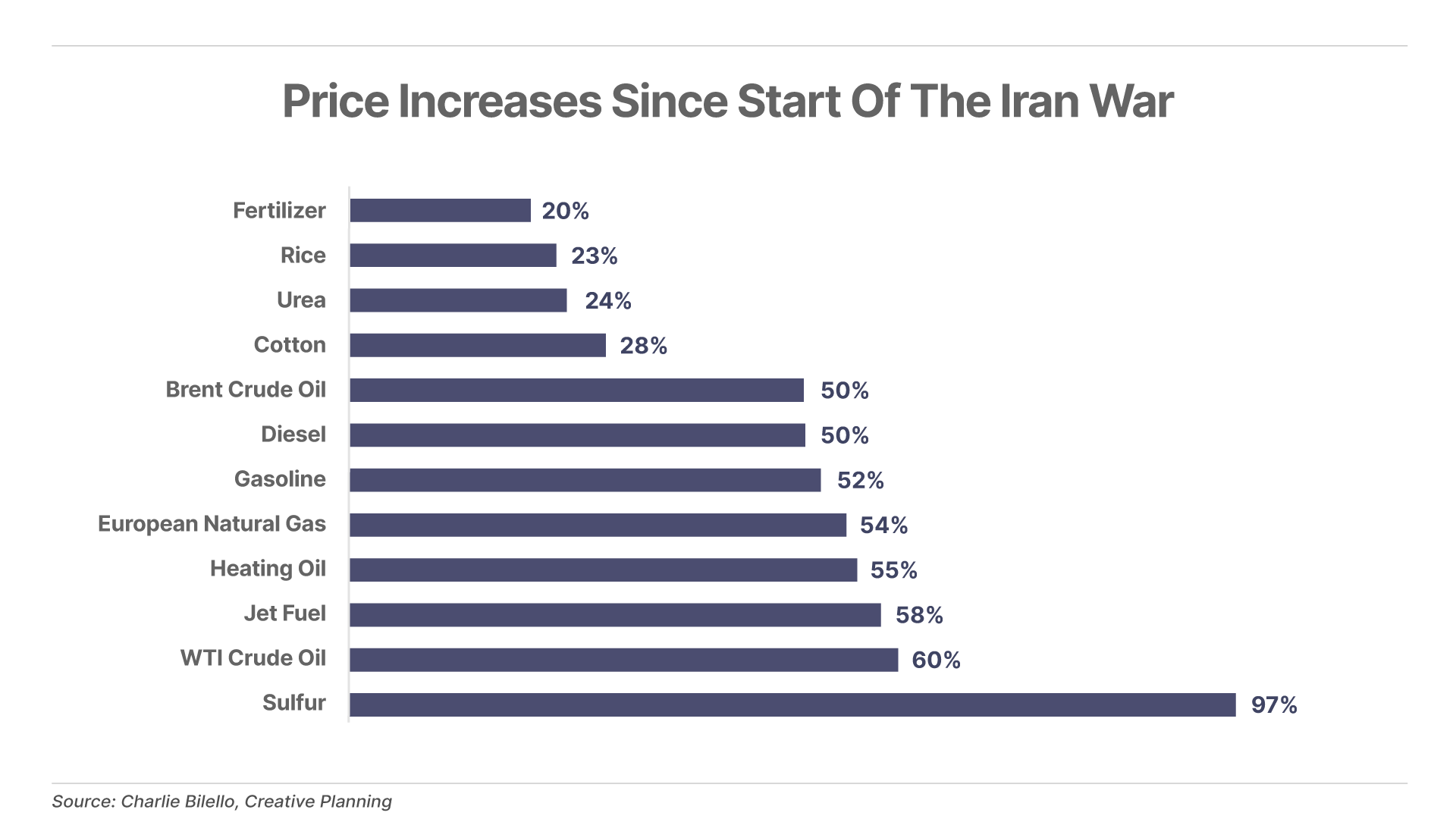
1. The Iran war inflation tax is spreading. As Porter wrote last Friday, the Persian Gulf isn't just the world's gas station – it's the world's food supply. The same petrochemical complex shipping crude and liquefied natural gas (“LNG”) also ships the nitrogen, sulfur, and phosphate inputs that feed roughly half the planet. Fertilizer shipments in the first month of the war fell 56%, and unlike crude, there is no strategic reserve to draw down. Energy prices might fall if the Strait of Hormuz opens, but food prices will not anytime soon.
2. Hedge funds go all-in on chip stocks. Global hedge funds now hold a record 19% of their assets in semiconductor stocks – double the amount since the start of 2026. By comparison, hedge funds had only 2% of their assets in this group during the 2022 bear market. Meanwhile, software stocks make up just 2% of hedge fund assets. The professional investment community has gone all-in on the same trade: selling software and buying chip stocks.
3. Paying the price for public debt. A massive government debt binge has bond markets flashing critical warning signs – pushing yields to multi-decade highs. Driven by geopolitical conflicts, rapidly aging demographics, and lingering pandemic-era stimulus, the global pile of sovereign debt is surging relative to GDP. As a result, borrowing costs are escalating sharply for governments, corporations, and consumers, threatening to choke off economic growth.
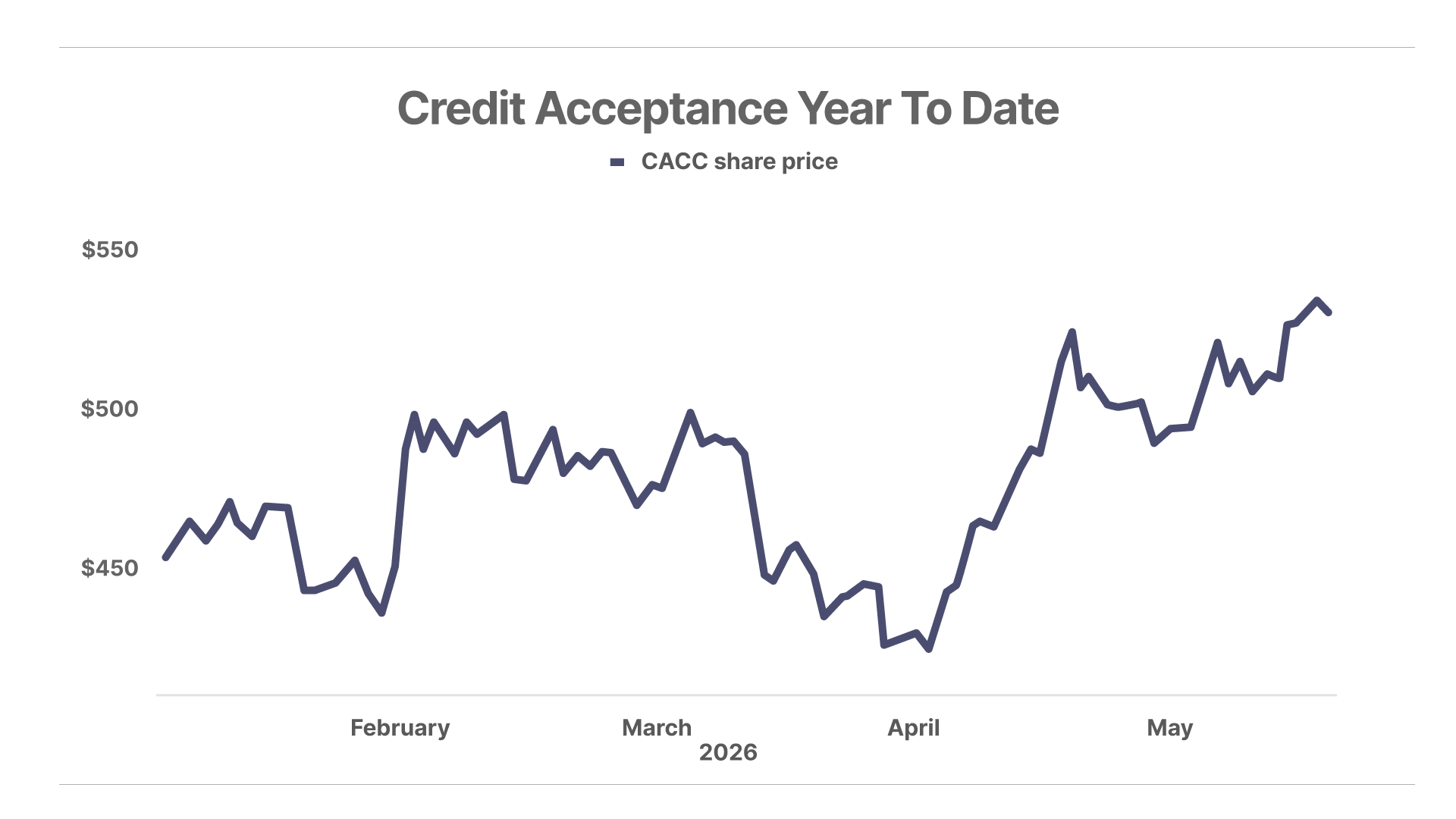
Chart Of The Day… Credit Acceptance (CACC)
Shares of subprime lender Credit Acceptance (CACC) have struggled since we first recommended them in Complete Investor more than three years ago, but with a steady loan portfolio and significant reduction in credit loss provisions, investors have liked what they have seen. Shares are up 25% year to date.
Poll Results… The Mid-Term Elections And The Market
Yesterday we reported that mid-term election years are usually a coin flip for the performance of the S&P May through October. Then we asked readers: “Where will the S&P 500 land on October 30, 2026?” Clearly there is no consensus… 30% anticipate “a large dip” of 10% or more between now and then while 27% expect “a melt-up” of 10% or more. Others are in the middle: with 21% seeing the market being up less than 10% and 23% seeing it down less than 10%.
Mailbag
“Bitcoin And Ethereum”
Linda N. writes:
Hi Porter!
Thank you for writing 2029… I am deeply sad about how our currency is being destroyed. Obviously, the damage has been intentional and done over several decades, so most are unable to recognize the pattern.
I feel I have very little time to make some wise decisions and purchases. Since you do not give personal investment advice and you suggest a company or individual who shares your mindset? I have met with a few local men and women in the Phoenix area and I've not found a good fit.
(I purchased three copies of your book, and I need three more! Is it available anywhere else besides Amazon?)
In a recent Daily Journal, you say "Bitcoin, specifically, is increasingly behaving like a digitally native form of monetary scarcity – gold for the internet age. In a world of accelerating fiat debasement, scarce digital assets may become profoundly important stores of value.”
Is the "buy up to" price for Bitcoin still <$50,000 – do you think Bitcoin will ever go that low or is now a good time to buy?)
Thank you for this wonderfully informative book, along with everything else you publish. I look forward to reading your work every day.
Porter Comment: Hi Linda –
I’m glad you enjoyed the book.
I have a RAI (registered investment advisory) firm that I founded a decade ago and that is familiar with my research and the ideas in this book. The firm is called Stansberry Asset Management.
I didn’t write the book to advertise the firm (obviously – I don’t mention it). But if you need help with your investing, I would call them.
“Comments On Erez’s Monday Journal”
Bob H. writes:
Bonjour Daily Journal,
Whilst I agree fully with Erez's take on the concern, I suspect that a U.S.-centric view is not the only one. Western Europe is worse off since any significant growth depends on resources and energy which WE lack. Or maybe I could mention that several significant Asian countries are even worse prepared for the Endgame.
Compared to other parts of the world, the U.S. may be the best-looking horse at the glue factory.
“2029: The End Of America”
Adrianah S. writes:
I want to thank you for writing this book. It was the greatest history on this subject I have ever read. I cried through most of it, because I am 81 years of age and remember a lot of it and how much pain and sorry it brought. It also helped me release so much of the pain because I have always blamed myself for so much of what happened to me. I was always mad at Nixon, because I lost my job and could never get another one I loved as much. I was aware of his meeting and we all thought that what you said in the book was true. There were a couple of people who jumped off of the buildings.
The knowledge of how history has repeated itself in so many ways was explained so well.
And there doesn't seem to be anything to stop such a disaster.
Porter & Co. Market Snapshot
| Price | Yesterday's Return | Year-to-Date Return | |
|---|---|---|---|
| S&P 500 Index | $7,403.05 | -0.07% | 8.14% |
| Gold per ounce | $4,552.50 | -0.93% | 4.27% |
| Bitcoin | $76,954.17 | -0.13% | -12.17% |
| Oil (West Texas Intermediate) per barrel | $108.66 | 2.51% | 87.3% |
| Berkshire Hathaway (BRK) | $730,000.05 | 0.85% | -3.29% |
| Porter's Permanent Portfolio | - | 0.53% | 0.24% |
| The Better Than Berkshire Index | - | 1.34% | 2.4% |
| Total Return | Annual Return | ||
| Porter & Co's Top Ranked* | 33.3% | 14.1% | |
| Yield | Yesterday's Change | Change Year-to-Date |
|
| U.S Treasury 30-Year Yield | 5.15% | 2 bps | 31 bps |
*A Complete Investor risk rating of 1 is defined as a "low risk, high allocation" security, while positions rated closer to a 5 are higher risk. Porter & Co.'s top-ranked positions include those rated either 1 or 2 in Complete Investor portfolio.
Porter & Co. Top Positions
| Publication | Ticker | Description | Total Return |
|---|---|---|---|
| Complete Investor | BWXT | BWX Technologies | 253% |
| Tech Frontiers | QURE | uniQure | 237% |
| Complete Investor | BTC/USD | Bitcoin | 185% |
| Complete Investor | PM | Philip Morris | 136% |
| Tech Frontiers | QURE | uniQure | 131% |
| Tech Frontiers | ROIV | Roivant Sciences | 127% |
| Tech Frontiers | SGMT | Sagimet Biosciences | 123% |
| Tech Frontiers | TGTX | TG Therapeutics | 114% |
| Distressed Investing | HLF | Herbalife | 102% |
| Distressed Investing | PTON | Peloton Interactive | 98% |
Prices as of 4:00 pm ET May 18, 2026
Please note: The investments in our “Porter & Co. Top Positions” should not be considered current recommendations. These positions are the best performers across our publications – and the securities listed may (or may not) be above the current buy-up-to price. To learn more, visit the current recommendations page of the relevant service, here. To gain access or to learn more about our current recommendations, call our Customer Care team at 888-610-8895 or internationally at +1 443-815-4447.