Disrupting The Market For How Consumers Borrow To Buy
This is the free version of Porter Stansberry’s Complete Investor, which provides market analysis and investor insights. Paid subscribers get access to the full issue, including investment recommendations with buy-up-to prices, a real-time list of holdings, and more. Click here for details.
Two scalps taken, 30 stolen horses recovered, and a good yarn to tell when he went back East. All in all, it had been a pretty successful expedition for wilderness scout Kit Carson.
He’d escaped death multiple times, helped map 2,000 miles of the Oregon Trail, and along the way, unwittingly launched the J.C. Penney department store.
Penney’s came about by accident when Carson put his foot down a rabbit hole in Kemmerer, Wyoming. In June 1843, Kit and his exploring buddy, John Fremont, quickly realized they’d stepped in the first known coal deposit in Wyoming Territory – definitely something to write home about.
A few maps and a newspaper notice later, Kemmerer was a booming mine town with railroads, shanties – and a shiny new general store called the Golden Rule, run by straight-laced Baptist shopkeeper James Cash Penney… (pictured below)
Penney took “do unto others” so seriously that he refused to allow his customers to go into debt. Where most stores in frontier towns issued piles of store credit or scrip, Penney ran a strictly cash-only establishment – pay upfront or get out.
Surprisingly, the coal miners loved it. Penney’s first year in business scored him $29,000 in a town of a thousand, well over $1 million in today’s money. Dropping the Golden Rule name, but keeping the gold-only ethic, he opened up nine more newly named J.C. Penneys across the Rocky Mountains over the next decade… and then kept expanding.
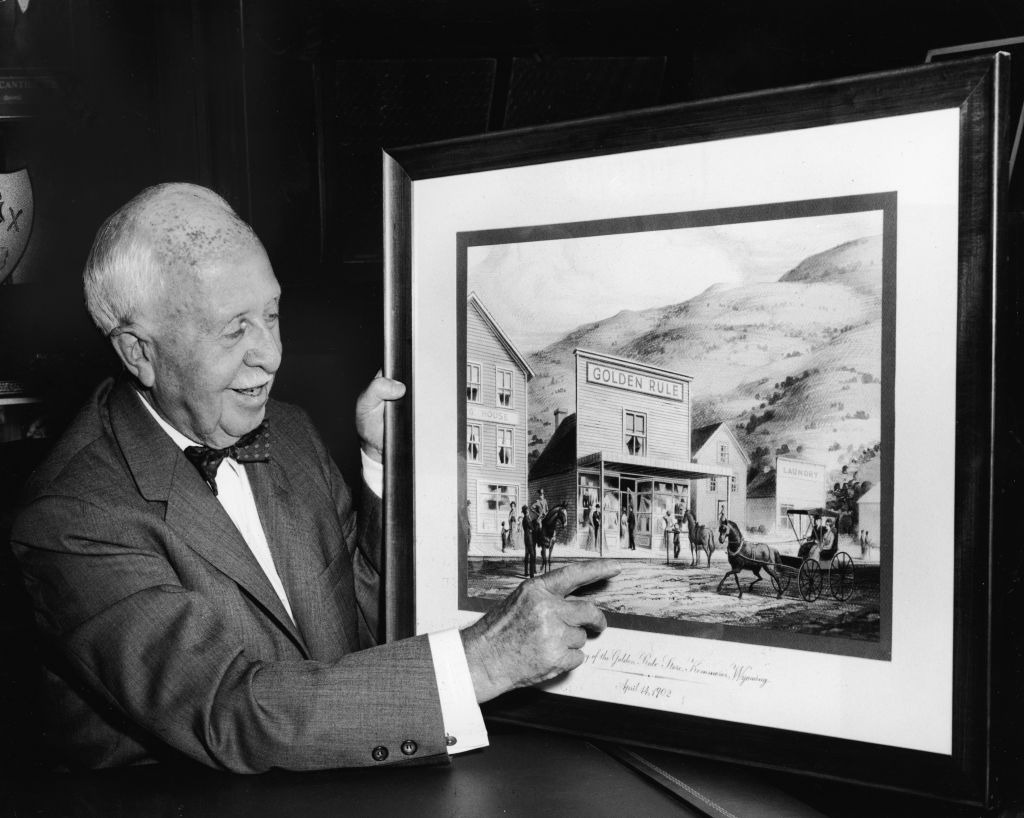
By the mid-1950s, with over 1,600 locations across 48 states, Penney’s had established itself as one of the Big Three American dry-goods stores, neck-and-neck with catalogue kings Montgomery Ward and Sears. The difference was that Sears and Montgomery Ward offered store credit... and JCPenney still refused.
By 1957, that stance had started to pinch Penney just a bit.
Post-World War II, young baby-boom families eagerly purchased cars and Frigidaires on credit (via a growing assortment of bank-licensed charge cards, in addition to store credit). Ward and Sears were only too happy to feed the beast. If JCPenney didn’t start offering credit too – proclaimed then-vice president William Batten – they’d be out of business by 1970.
Reluctantly, James Cash Penney – a year or two away from retirement – agreed. Batten took over as president in 1958, stamped out the J.C. Penney Charge Card, and the long-delayed credit party got started. Even James Cash himself had to admit “It seems to be working,” as he prepared for the chain’s first year of $3 billion sales in 1970, one year before his own death.
Apparently, JCPenney customers just loved to be in debt. And that insatiable appetite for credit caught the eye of Dee Hock, the mysterious man who invented the Visa card.
Finding The Chaordic Way
Dee Hock had cut up all his credit cards by 1968.
“I have absolutely no use for credit cards,” he explained. Like James Cash Penney, he believed in exchanging money, not debt.
The only difference was that Hock envisioned a giant, cashless, cooperative network of virtual money, where merchants, consumers, and banks freely traded value back and forth. He called this system – a decentralized, self-governing organization – “chaordic,” because it was a blend of chaos and order.
He dreamed all this up while twiddling his thumbs as a mid-level manager at the National Bank of Commerce in Seattle.
And when his boss knocked on the door and asked him to fix the bank’s broken credit card system, 39-year-old Hock jumped at the chance...
Bank of America had tried to “license” its proprietary credit cards out to other banks (like Hock’s employer, Bank of Commerce) for $25,000 a franchise, but the clunky arrangement rapidly imploded on itself.
Hock’s vision was radically different: He proposed that Bank of America should give up its rights to the card, and that the new credit card, called VISA, would be owned and operated jointly by a cooperative of banks. Privately, he didn’t believe VISA should be a credit card at all, but something more akin to a debit card: a global “exchange of value.” (The member banks nixed this idea, because credit made them a lot more money than debit ever would.)
Still, Hock’s powers of persuasion were almost magical. Within two years, he’d convinced Bank of America to relinquish its rights to the “Americard”... gotten 3,000 banks on board as cooperative owners... and risen to CEO of the newly-formed company. He’d also turned the stumbling business around and grown it at 50% annually.
And then he took things a step too far.
Building The Visa Empire
In a move far ahead of his time, Dee Hock decided to loop merchants in as part of the credit card transaction. Specifically, JCPenney, which he knew was ga-ga for credit cards.
Credit cards worked then – and still work – as direct communication between banks. The merchants and consumers don’t have access to payment information. They are just dragged along for the ride (and dinged for fees). But in Hock’s democratic vision, this wasn’t fair: Every participant should be in the loop.
As he put it:
Many bankers refuse to realize that many large retailers can do everything a bank can do, and often better. [J.C.] Penney is more sophisticated in data capture and data communications than any bank I know of.
Credit-crazed Penney was also an easy sell. In 1979, Hock offered them a deal they couldn’t refuse: He’d cut them into the VISA network as direct partners, without routing them through a third-party bank.
Of course, the problem there is... if merchants can do anything a bank can do, what do we need banks for?
That’s what spooked Hock’s bank colleagues at VISA – and why they forced him out of his boardroom chair and sleek penthouse office in 1985. He spent the next decade sulking on a ranch in Pescadero, California, before reemerging to give lectures on chaordic management.
Without Hock, VISA continued to grow into a $700 billion credit card juggernaut – but along strictly conventional lines. It boxed out merchants and consumers and operated as a bank-to-bank-only network. And in 2008, it ditched its cooperative structure and became a standard shareholder-owned corporation.
As for JCPenney... like many tee-totaling Baptists who take their first drink later in life, JCP couldn’t hold its liquor.
Drunk on credit, the chain eventually found itself $3.6 billion in debt and filed for bankruptcy in 2020, following which, its stores have been slowly going dark in malls across America. James Cash Penney would disapprove.
Dee Hock, too, expressed disappointment in how his brainchild had turned out:
By the standards of what VISA ought to be, it would be a lie to deny a sense of failure. I do not believe that VISA is a model to emulate. It is no more than an archetype to study, learn from, and improve upon.
Strangely, in the 40 years since Dee Hock left VISA, no one’s managed to do that. Nobody seems to be able to build a Hock-style payments network that satisfies banks, merchants, and consumers. Walmart, Target, and Lowe’s have all tried and failed.
And then – not long ago – one tiny payments company succeeded...
Directly inspired by Hock’s cooperative network, virtual monetary exchange, and bank-merchant-customer equality, this is an under-the-radar fintech that’s solved almost everything wrong with Big Credit Card. It’s a company with insane scale and a pristine balance sheet, one we recommended live on stage at last year’s Porter & Co. Annual Conference... and one that we’re officially adding to our portfolio in this issue.
Sixty Years Of Nothing
Nobody has built a payments network to supersede what Dee Hock created with VISA. Visa (V) and American Express (AXP) went live in 1958, and Mastercard (MA) followed in 1966. Then there were 60 years of no innovation, while these incumbents compounded. And still do…
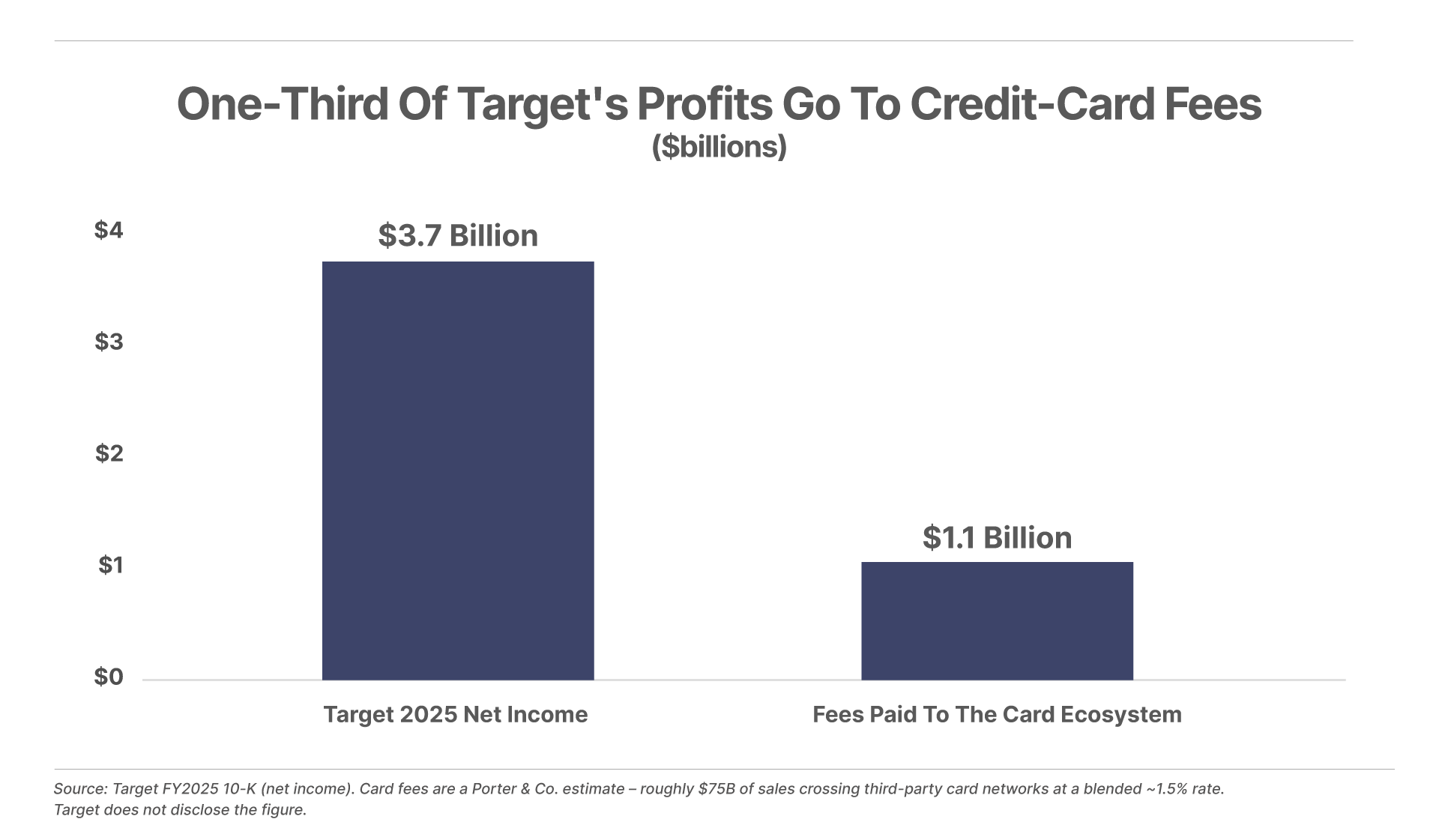
But consider how much a retailer pays to use the card networks every year. Large retailer Target (TGT), for example, recorded $105 billion of sales in fiscal 2025 – and about $75 billion of that filters through the card networks. Credit transactions cost a merchant 2% to 3% and regulated debit closer to 0.5%, so blended across the mix Target pays on the order of 1.5%. Target does not break out the figure, but the arithmetic is not hard – call it $1.1 billion a year to card processing against $3.7 billion of net income, roughly a third of what Target earned last year.
Across the top 15 retailers, with a trillion dollars of sales, the prize was some $15 billion a year. In 2012, those 15 retailers – Walmart, Target, Best Buy, and others – formed a consortium called the Merchant Customer Exchange ("MCX") to build a payments network of their own, and four years later it was dead, having asked consumers to scan a QR code at the register in exchange for nothing at all.
But one company understands the lesson that Dee Hock understood in 1968 and the one MCX did not. A network is not assembled from the side holding the money. It is assembled from the side holding the choice. Every attempt to build a competing network had failed because none addressed a consumer need.
That is the company we are recommending today. It started from the other side – the consumer side.
Subscribe to Porter Stansberry’s Complete Investor to unlock the rest of this issue and more.
Become a Complete Investor subscriber today to get instant access to the rest of this issue and other valuable subscriber-only content.
A Complete Investor subscription gets you:
-
Monthly Issues – a detailed analysis on a new recommendation plus ongoing updates on the existing list of recommendations
-
Special Reports – deep-dive analyses covering every major market-moving trend such as artificial intelligence and other breakthrough technologies. Plus, why property & casualty insurance stocks are a must-own, the best ways to invest in energy and commodities.
-
Buy / Sell Alerts – instant notifications when any stock in our recommended list makes a major move worthy of your attention.
-
Monthly Roundtable – listen in to this exclusive podcast as Porter and his editorial team discuss the markets, the open recommendations, and the strategies subscribers can use to maximize their returns
-
Custom Investment Indexes - such as the Better Than Berkshire Index, a systematic approach to building your own Berkshire Hathaway holdings using superior companies, and The Lindy Index, the top-40 companies that have been compounding returns for at least 50 years, to name just two
-
Porter’s Permanent Portfolio – a fully balanced portfolio with 25% allocated to bond-like investments, 25% in the world’s best businesses, 25% in hard assets, and 25% in cash-like investments. Despite having half the risk of the market, this portfolio has consistently outperformed the S&P since inception
-
And more…
Use the link below today and lock in our lowest available rate --> a savings of $575 off the usual annual rate.
This content is only available for paid members.
If you are interested in joining Porter & Co. either click the button below now or call our Customer Care team at 888-610-8895.