Issue#155, Volume#3


The Iran War Has Created A Diesel Shortage That Threatens The World Economy
Inside Today's Issue
Before Fort Sumter fell in 1861, Stephen Duncan was the richest man in America.
He owned 15 plantations, enslaved hundreds of people, and was America’s largest cotton producer. His liquid investments alone were worth more than $1 million ($200 million today). Fully valued and capitalized like a corporation, Duncan was probably America’s first billionaire.
That’s because back then, the world’s economy didn’t run on crude oil. It ran on cotton.
The American South grew roughly 80% of global cotton. Britain bought virtually all of it. England held two-thirds of the world’s mechanical spindles, making the textiles that clothed the world. Textiles were more than half of British exports. And 25% of Britain’s population depended on the textile trade.
Nearly all of this commerce passed through one market: Liverpool. About 140 cotton brokerages worked around the Liverpool Cotton Exchange. A bale might change hands 10 times before reaching a mill in Lancashire.
And then, the U.S. Civil War.
Much like Iran’s mullahs today view oil, the Confederacy’s politicians believed Britain could not live without cotton. They embargoed their crop to force London to recognize the Confederacy. American cotton arrivals at Liverpool fell from 166,000 bales in July 1861 to 35 bales in September. Cotton exports from America to Europe fell from 3.8 million bales in 1860 to almost nothing in 1862.
New Orleans cotton sold for 7¾ pence per pound in June 1861. By 1863, it cost 29 pence. British mills cut consumption by more than half. In November 1862, 412,830 Lancashire workers were unemployed or working reduced hours, and more than 250,000 people required relief. Britain searched everywhere for substitutes, and imports from India tripled while their price quadrupled. Indian cotton was shorter, dirtier, and harder to spin: more than one-sixth of the cotton reaching British mills in 1862 could not be used and shipping it to Liverpool took four to six months.
Notice the pattern: unemployment soared, prices increased by 4x, refining costs rose, and shipping became vastly more expensive too.
As we first explained in March, a war with Iran is a threat to the global economy.
Virtually all the world’s transportation networks depend on crude-oil fuel stocks, from which diesel fuel and Jet A are refined. The Persian Gulf normally sends roughly 20 million barrels of crude oil and refined products through the Strait of Hormuz each day, about 20% of the world’s total production. About 80% of this crude oil goes to Asia. Before the war, the Gulf also shipped about 900,000 barrels of diesel and 350,000 barrels of jet fuel each day. Those volumes represented roughly 10% of seaborne diesel and 20% of seaborne jet fuel.
The first phase of the war cut Hormuz oil flows to 2.7 million barrels a day from March through May. The Gulf producers then found partial escape routes: Saudi exports through the port city of Yanbu rose from 2 million barrels a day before the war to more than 5 million by early June, while the United Arab Emirates filled its 1.8-million-barrel-a-day line to Fujairah on the Gulf of Oman.
Some crude is moving again, but how much? The available official and commercial counts do not agree.
U.S. officials claim 15 million to 18 million barrels are passing through Hormuz on heavily escorted days. Commercial trackers tell a different story. Kpler estimated 4.8 million barrels a day in July and about 2 million in August. Lloyd’s List counted roughly 12 large commercial vessels a day during the final week of August. The 10-day average fell to 10 vessels on September 6, the lowest since May.
U.S. forces resumed strikes inside Iran on September 1 after reported Iranian attacks on commercial shipping. Four days later, U.S. forces struck three Iranian oil tankers near Kharg Island, Jask, and the Gulf of Oman. Iran says it has mined shipping lanes and attacked unauthorized vessels. Commercial tracking confirmed the operational result on September 6: only one very large crude carrier and three bulk ships entered the Strait of Hormuz, while a Saudi-loaded product tanker tried to leave and turned back.
Whatever the exact Hormuz flow, buyers are paying for a severe shortage. Brent crude closed at $97.92 on September 8, while U.S. retail diesel reached a record $5.85 per gallon.
Today diesel’s premium reflects two additional constraints, beyond a simple shortage of crude: refinery configuration and tanker time.
Gulf crude is generally medium or heavy and sour, which means it contains more sulfur than other sources. Virtually all Asian refineries were built around those grades. It cannot quickly or easily be replaced. American shale oil is generally light and sweet: it contains less sulfur and produces a different mix of fuels when it enters a distillation tower.
Then there’s the problem of distance. From the Strait of Hormuz, a cargo ship can reach China in about 25 days. A replacement cargo from West Africa or the Americas can take double that time – six to eight weeks. The route time consumes tanker capacity.
And then there’s Russia.
Ukraine has attacked refineries across Russia. At the end of June, more than 2.5 million barrels a day of Russian refining capacity was offline. The export figures show the damage more clearly: Russia loaded about 817,000 barrels a day of diesel and gasoil in 2025, but that fell to 400,000 barrels a day in June and 234,000 during the first 10 days of July. Russia then banned diesel exports and jet-fuel exports.
Gasoline shocks punish household travel. Diesel shocks enter the cost of farming, mining, trucking, rail, and shipping: nearly every physical good becomes more expensive before it reaches you.
We can already see the second-order effects. The World Bank expects 2026 energy prices to rise 24%, fertilizer prices to rise 31%, and urea prices to rise 60%. It estimates that a prolonged conflict could push as many as 45 million additional people into acute food insecurity.
Oil-importing countries must also find more dollars for every cargo just as their currencies weaken. The Indian rupee, Indonesian rupiah, and Philippine peso reached historic lows during the first phase of the war.
The United States has more protection than Europe or Asia from the energy disruption because the U.S. produces 13.6 million barrels of crude a day and exports crude and refined products, and the U.S. Gulf Coast holds some of the world’s most capable refineries. But those advantages do not seal the borders.
Diesel trades in a global market, and American refiners sell wherever the net price is highest. We entered September with a record-low 19.3 million barrels of distillate inventory on the East Coast, while total U.S. stocks stood at 104.2 million barrels, the lowest August level since 1982.
This is a difficult reality: the U.S. does not have enough diesel inventory to absorb another large supply loss. And Iran is now threatening to attack key regional production facilities in the Gulf: Yanbu, Fujairah, and Ras Tanura.
Longer voyages transfer money from fuel consumers to shipowners first. I wrote earlier this month about how crude shipping firms are paying massive dividends to shareholders this year because of the tightness to crude shipping capacity.
Frontline (FRO), DHT Holdings (DHT), and International Seaways (INSW) own the large crude tankers required to move replacement barrels from the Atlantic Basin to Asia. The U.S. Gulf Coast-to-China very large crude carriers (“VLCC”) freight rate reached a record $14.29 per barrel on September 4. Frontline earned an average $152,700 per day on its VLCCs during Q2 against a 12-month cash breakeven of $23,800.
The war also reaches natural gas. Venture Global (VG) benefits if the Gulf loses liquefied natural gas (“LNG”) as well as oil because about one-fifth of global LNG normally passes through Hormuz each year, almost all of it from Qatar. Qatar declared force majeure in March after Iran destroyed 20% of its capacity.
Venture Global exported 127 cargoes in Q2 (a new record) and raised its 2026 adjusted EBITDA guidance to $8.7 billion to $9.1 billion. Yet Venture Global is not a clean spot-price bet because it had already sold 91% of its available 2026 cargoes forward at an average liquefaction fee of $5.05 per million British thermal units. Only the unsold cargoes capture today’s extraordinary prices. I expect the larger gains to come later, as more capacity comes online in ’28 and ’29.
Britain found more cotton but not cotton its existing mills could use at the same cost and speed. We can find more crude oil, but we cannot quickly add the tankers to deliver it or the refinery capacity to turn it into diesel.
Complex refiners will earn even more, as demand for diesel soars and sour crude becomes scarce.
We explained the physics of refineries in our April 2 Daily Journal: a refinery with a Nelson Index near 1 is a microwave, while an index near 15 describes what is like a cruise-ship kitchen for crude oil. Reliance Industries’ Jamnagar refinery can process more than 200 crude grades. It has a Nelson Index of 21. These refiners own refineries with a Nelson Index over 11: Reliance Industries (Bombay: 500325), Marathon Petroleum (MPC), Phillips 66 (PSX), Shell (SHEL), ExxonMobil (XOM), BP (BP), Chevron (CVX), Valero Energy (VLO), and Cenovus Energy (CVE).
What’s This Mean For Investors?
I’ve written several Journals this year about the growing risks of inflation, about the risks to a serious bear market in bonds, about the similarities between our current market and the bear market of 1973-1974, and about how the risks to the war with Iran are far larger than President Donald Trump admits.
For example, from the March 6 Journal:
It’s virtually certain that instability in Iran will lead to more violence as multiple factions begin to compete for power. How that will impact energy prices in the short term and the long term is far from certain… but higher prices for longer is the most likely scenario... If you’re looking at retirement in the next five years or if you simply don’t want to stomach the volatility that an ongoing war in the Persian Gulf is almost certainly going to cause, then I recommend selling out of bonds (aka, property and casualty insurance) and moving those assets into the ‘cash’ bucket’ of our Permanent Portfolio.
Contrarily, if you were comfortable with some volatility or didn’t want to sell P&C stocks (tax reasons, etc.) then I advised:
Another way to hedge the risks of a wider war is to add exposure to the companies best positioned to profit from the ongoing disruptions to global oil supplies.
I recommended buying a handful of stocks that, while certainly volatile, have all proven to be good hedges against the Iran War (returns since March 6): Venture Global (+18%), Frontline (+42%), APA (+35%), and Glencore (+29%). Equal-weighted basket: 31% (S&P 500: 13%).
Note: that these returns do not include Frontline’s recently declared $2.61 regular dividend or its $0.80 special dividend, as they’ve been declared but the stock is not trading ex-dividend yet. That income will lift the total return on FRO to over 50%.
If I were going to make these same hedges today, I’d add a high-quality refiner to the list of stocks: Marathon Petroleum (MPC).
Since I offered that advice, bonds have gotten killed. Ten-year U.S. Treasury-bond yields have moved from 4.20% to over 4.80%, leading to capital losses. I continue to believe that the 5% level on the 10-year bond yield is the point at which higher inflation and higher bond yields will trigger a bear market in stocks. If we reach that level on the 10-year U.S. Treasury, I will officially change the recommended allocations to Porter’s Permanent Portfolio.
I’m not trying to predict the future. But I am willing to hedge against material risks as they develop.
Finally... a special message for the hundreds of Trump supporters who accused me of having something called “Trump Derangement Syndrome” for explaining that a war with Iran wouldn’t prove to be cheap or easy. These same folks would light up my inbox every time President Trump declared “victory” in this war, which by my count has occurred 31 times so far. I suspect these are the same people who believed Trump when he claimed our foreign trading partners would pay for his tariffs. You’ll note that the billions in tariff refunds have gone to major U.S. corporations, not our foreign trading partners.
You can’t fix stupid.
P.S. Speaking of politics, you’ll never guess what happened to Stephen Duncan, the cotton-plantation owner. He opposed secession because he believed it would destroy the Union, weaken property rights, and expose the South’s economy to war. He offered to emancipate all his slaves, without compensation, in return for a promise from President Abraham Lincoln to recognize his other property rights, a compromise he believed could avoid the war. When the Civil War broke out, he blamed the South’s politicians and pledged his loyalty to the Union. He accepted the Emancipation Proclamation in 1863, honoring his pledge. And guess what happened...? Federal troops looted his plantations and, instead of freeing his slaves, impressed them to build fortifications. Fortunately, Duncan was diversified. He owned railroads, timber, and shipping both in the North and the South. He left the South in 1863, after his plantations were looted, and lived the rest of his life in New York City. His sons remained planters in Mississippi, and when his last son died in 1910, he donated the family’s Natchez mansion to the city. It’s now called Duncan Park.
Tell me what you think of today’s Daily Journal – good, bad, or somewhere in between: porterstansberrydirect@gmail.com
Good investing,
F. Porter Stansberry
Stevenson, Maryland

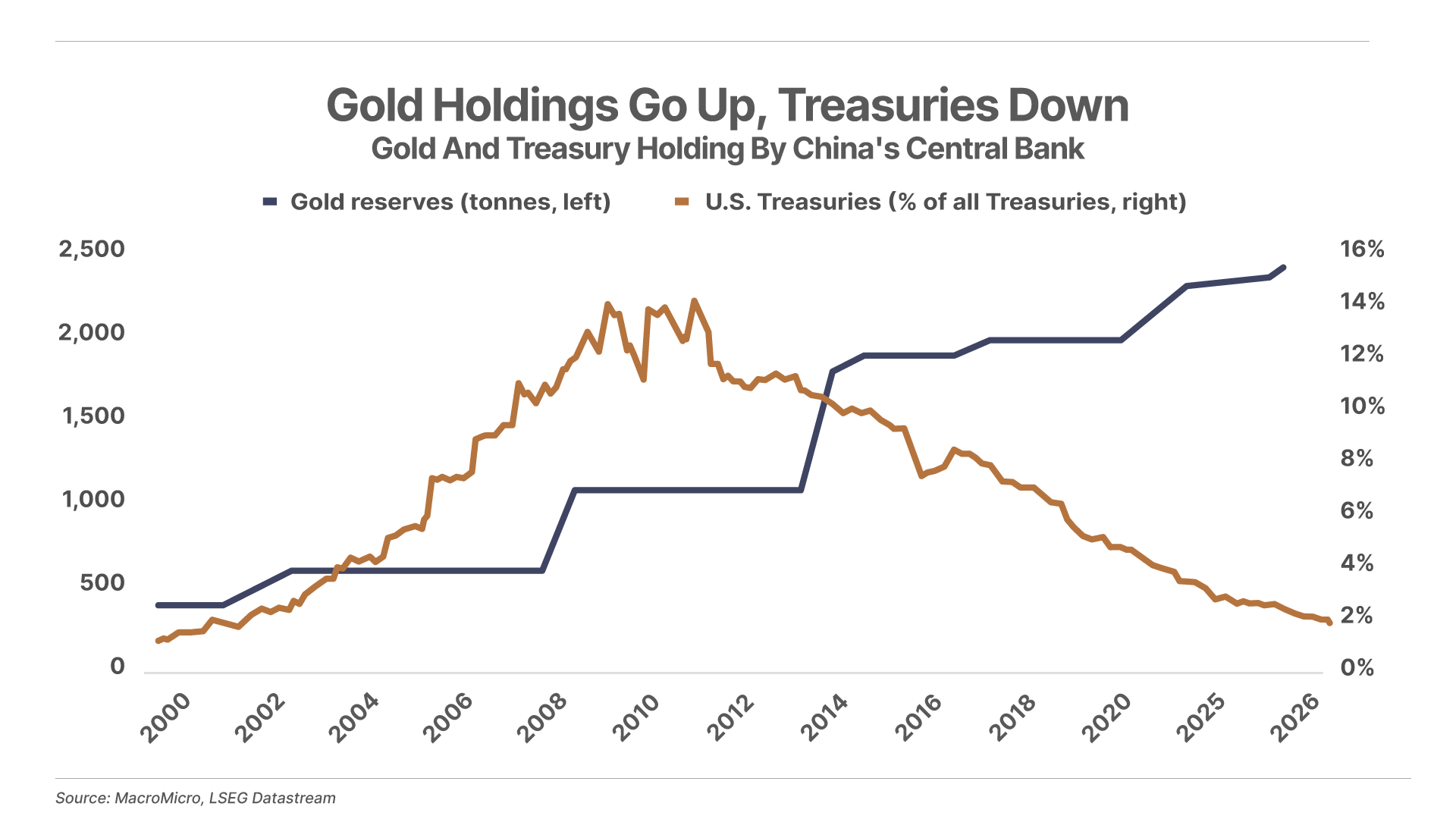
1. China continues to buy gold and sell Treasurys. The People's Bank of China added 20 tonnes in August, its largest monthly purchase since October 2023 and its 22nd consecutive month of buying. Official holdings hit a record 2,387 tonnes, with roughly 80 tonnes added this year. Meanwhile, its U.S. Treasury holdings went the other way, falling to $633 billion in June from a peak of $1.32 trillion in 2013. China's share of the U.S. Treasury market is now back to 2001 levels.
2. Ongoing war in Iran disrupts energy supply. Crude-oil inventories in the U.S. strategic petroleum reserve have dropped to 285 million barrels, the lowest levels since 1983, sending oil prices up toward $100 per barrel. Meanwhile, global refining capacity has dropped by an unprecedented 5 million barrels per day since this time last year, pushing prices of key refined products like diesel to new highs. The energy shock is far from over, and will likely boost inflation and interest rates in the months ahead.
3. Scott Bessent says, "I am the house now." The Treasury Secretary claimed yesterday he had asymmetric information on Japanese yen intervention and dared traders to bet against him. Bessent is telling the market he's playing inside baseball and that the Bank Of Japan may bail him out with a hike on September 18. “You can bet against me if you want.”
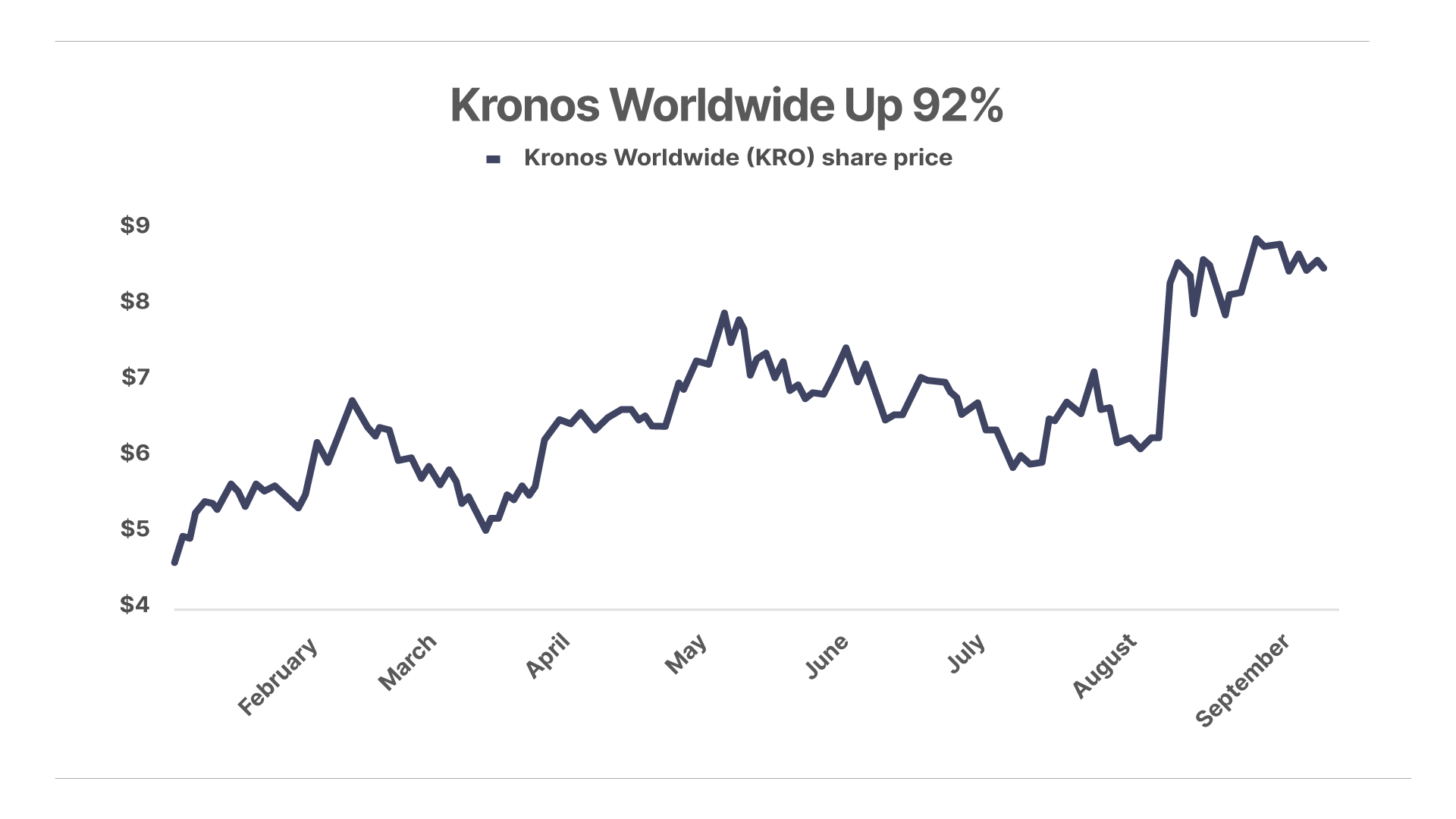
Shares of pigment maker Kronos Worldwide (KRO), recommended to Distressed Investing subscribers in December, have risen 92% year to date. Marty Fridson will be releasing a new recommendation this weekend – another stock-bond combination. The last two combo positions rose more than 50%.
“Novartis Update”
Kenneth R. writes:
Thank you for the update on Novartis (NVS) in yesterday’s Daily Journal. Looking forward to more analysis here. Bummer the decline happened so quickly after the High Conviction recommendation. It happens…..Thanks for all you do.
“Skipped Over Medical Details”
Ghassan K. writes:
I do appreciate the detailed update, but frankly I skipped over a lot of the details that are of great significance to the medical profession but do not mean as much for an investor. But thanks for the report.
“Clear Analysis”
John H., MD writes:
Your analysis is sound, and the explanations are clear. From my perspective as an academic investigator, clinical trial principal investigator, medical journal reviewer and editor, I compliment you on this forthright presentation. High-quality research in both medicine and financial domains can be hard to find. This report qualifies.
Porter & Co. Market Snapshot
Porter & Co. Top Positions
Please note: The investments in our “Porter & Co. Top Positions” should not be considered current recommendations. These positions are the best performers across our publications – and the securities listed may (or may not) be above the current buy-up-to price. To learn more, visit the current recommendations page of the relevant service, here| New Window. To gain access or to learn more about our current recommendations, call our Customer Care team at 888-610-8895 or internationally at +1 443-815-4447.