Issue #74, Volume #3


The Perfect Recipe: Inflation + Booming Tech Spending Meets Global Commodity Collapse
Inside today’s Daily Journal…
|
Imagine if the peak of the internet bubble occurred just before the COVID market panic. That’s what’s shaping up in the markets this summer.
Let me start with the big initial public offering (“IPO”) this week.
Cerebras Systems (CBRS) is a next-gen artificial-intelligence (“AI”) chipmaker scheduled to go public on Thursday, May 14. Most AI already runs on specialized computer chips, but Cerebras Systems has built the most integrated chip sets that are designed specifically for inference – inference is the “thinking and responding” part of AI, when it generates answers, images, or predictions for users.
AI computer systems, like the kinds built by Nvidia (NVDA), are massively parallel. They use thousands of cores working together. The problem? They constantly have to pass information back and forth across bridges. That shuffling eats up time, burns extra energy, and creates bottlenecks – especially when the AI is in its inference phase, which is its busiest phase.
To facilitate this kind of compute power, Cerebras builds large silicon wafers – big, round silicon wafers – and turns the whole thing into one enormous processor called the Wafer-Scale Engine (“WSE-3”). All the processing power that’s needed for inference, the fast memory storage, and the connections stay right there on a single piece of silicon. This design gives it enormous speed and energy efficiency. The result is their CS-3 system: a compact, rack-sized AI supercomputer you can plug into a data center.
Companies don’t just buy the chip – they get the full package: hardware, easy-to-use software, and support. And it works: Cerebras claims its systems can handle AI inference up to 20 times faster than top competing setups, while using less power per answer generated.
I suspect this IPO could unleash a massive speculative bubble.
The AI boom is still in its early innings, and everyone is hunting for alternatives to Nvidia’s dominance. Cerebras offers a truly differentiated technology that big players (like OpenAI, which launched ChatGPT) are already buying in bulk. With explosive growth, a clear moat (it’s extremely hard for anyone to copy wafer-scale chips), and a massive backlog of orders ($25 billion), the story is compelling. Cerebras’ technology could become the go to for inference.
Nvidia’s software ecosystem is still the industry standard. But with proven technology, paying customers, and perfect timing in the AI gold rush, Cerebras looks like one of those rare hardware plays that could deliver outsized returns.
Remember, when the AI capex spending boom finally ends (and it will), many of these AI hardware firms will see their share prices fall 80% or more.
Apple (AAPL) is a more conservative way to invest in the AI boom.
Like Cerebras’ wafers, Apple’s chips use a “unified memory” architecture. In a regular computer, the main processor and the graphics processor each have their own separate memory banks, so data has to be copied back and forth constantly. Apple puts everything – processor, graphics, and a dedicated AI engine – on the same chip and lets them share one fast, shared memory pool. No wasteful copying. This makes Apple’s devices incredibly efficient and responsive for on-device AI tasks: things like real-time photo editing, voice assistants, or even running surprisingly large AI models right on your laptop without draining the battery or sending data to the cloud.
The big difference is scale and purpose. Apple’s chips are optimized for personal, edge computing – small, power-sipping tasks on consumer gadgets where privacy matters (your data never leaves the device) and you want instant responses. They’re fantastic for everyday inference on iPhones or Macs, and Apple has even started using similar silicon in its own data centers for some cloud-based AI.
I believe, like every other digital technology I’ve seen develop over the last 50 years, more of the AI compute functions will become distributed. Think about your iPhone. About 25 years ago, the world’s most powerful supercomputer was ASCI Red – a massive, warehouse-sized machine that cost tens of millions of dollars, sucked up enormous amounts of electricity, and could perform roughly 3.1 trillion calculations per second (what engineers call teraflops). It was used for nuclear-blast simulations and national security work. A current iPhone 17 Pro, with its A19 Pro chip, has a dedicated Neural Engine (Apple’s built-in AI accelerator) that can handle 35 trillion operations per second – 10x the ACSI Red supercomputer.
My point is, over time, I’m confident that Apple’s moat – its enormous global distribution platform (the iStore), its installed user base, and its consistent ability to stay ahead of key technological changes – will end up being much more valuable over time than Cerebras. That probably won’t matter next week. Or next month. But it will matter over the next decade.
And then there’s the Iran War.
The Strait of Hormuz crisis is not simply an oil supply shock. It is a simultaneous disruption of oil, liquefied natural gas (“LNG”), helium, fertilizers, sulfur, aluminum, jet fuel, diesel, and the shipping infrastructure that carries manufactured goods around the globe.
The International Energy Agency says,
it is the largest supply disruption in the history of the global oil market.
There’s been a 95% decline in shipping traffic, removing around 20 million barrels of oil and refined products per day from global markets. There’s already permanent damage to 17% of Qatari LNG production. And we’ve seen commodity prices soar – spanning oil (+57% year-over-year), LNG (+51%), urea fertilizer (+75%), helium (+100%), and jet fuel (+100% in Europe).
For now, the market is full speed ahead, not letting this commodity disruption slow things down, but that won’t last much longer.
Asia – which received 80% of the Strait’s oil flows – faces the sharpest, most acute energy shortages in history. Small open economies like the Philippines, Vietnam, and Pakistan will collapse within weeks. The economic superpowers of East Asia – Japan, South Korea, and China – will, under a longer disruption, likewise face an existential energy crisis. Europe faces a structural LNG deficit lasting into the 2030s due to Qatari infrastructure damage. This summer will see enormous jet fuel and diesel price premiums, and, eventually, food inflation arriving in late 2026. Germany, Europe’s industrial engine, has already halved its growth forecast.
The biggest challenge will, eventually, be food. The fertilizer shortfall, already embedded in 2026 spring planting, will produce food inflation regardless of what happens to oil prices in the second half of this year.
The helium picture is even worse than most coverage acknowledges. Iran’s retaliatory strikes on Qatar’s Ras Laffan facility shut 33% of global helium production. Helium stored in Qatar will evaporate after roughly six weeks. It can’t be replaced quickly or easily.
The macro effects of these problems are not hypothetical. They are already appearing in factory closures and airline route cuts. The lagged effects on food prices and manufacturing costs are still months away from their full realization, but they will happen.
U.S. inflation data comes out this week – the consumer price index (“CPI”) tomorrow and the producer price index (“PPI”) on Wednesday. Look for big increases that should drive 10-year bond yields back above 4.5%. Don’t forget my “get out of the pool” threshold of 5% on the 10-year U.S. Treasury note. If inflation takes off, it won’t come back soon. And the bond market will get killed. That isn’t bullish for the stock market.
Tell me what you think of today’s Journal: porterstansberrydirect@gmail.com
Good investing,
Porter Stansberry
Stevenson, Maryland
Presented by Jared Dillian Money
Ex-Lehman trader Jared Dillian breaks down exactly which beloved Wall Street trade he’s taking the other side of, and why it’s the kind of contrarian call that has made Porter Stansberry name him one of his favorite newsletter writers.

Editor’s Note: This post is sponsored by our friends at Jared Dillian Money. We only accept advertising from publishers we know to offer well-researched ideas vetted by a legal team, excellent customer service, and reasonable refund policies.
We do not, however, make any representations about their investment ideas, nor will we warrant them as equal to our own.
Porter & Co. also may disagree with the ideas presented by our sponsors but we understand there’s more than one way to skin a cat. With that said, you can check out what Jared is predicting by clicking here.
3 Things To Know Before We Go…
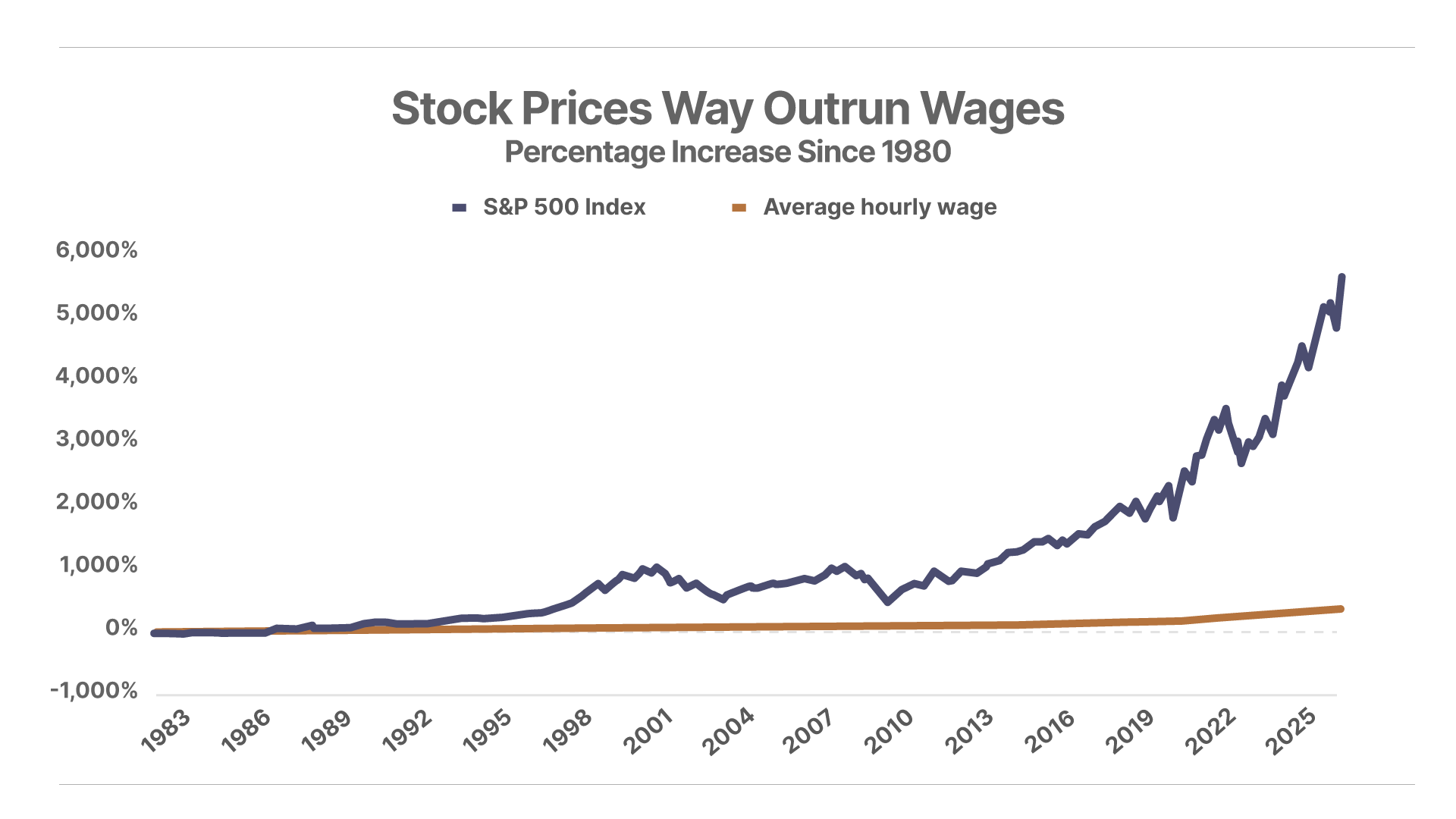
1. Wages in the dust. Since 1980, the value of the stock market has increased 16x faster than the average hourly wage. If wages had kept pace with the S&P 500, workers would be earning $523 per hour… instead of the actual $37. This surge in asset valuations has occurred alongside a stagnation in real wages, as workers grapple with the compounding pressure of a silent depression where the cost of living and the price of entry into the market far outpace the growth of the average paycheck.
2. India braces for fallout from the Iran War. In a national address on Sunday, India’s Prime Minister Narenda Modi called on citizens to help address the country’s energy shortage – encouraging increased use of public transport, carpooling, and working from home. India imports nearly 85% of its oil and gas, and is part of a growing list of countries facing acute energy shortages from the disruption in shipping traffic through the Strait of Hormuz.
3. Data centers could actually lower U.S. electricity bills. Conventional wisdom says the AI buildout will push power bills higher. But new large loads could actually spread the grid’s fixed costs across more paying customers, thus lowering rates rather than raising them. Grid-optimization firm GridCARE – in San Antonio, Texas – estimates that adding one gigawatt of flexible data-center load to the local utility’s existing system there would generate $123 million in annual revenue at zero incremental cost – enough to cut system-wide annual rates 4.4%, or $64 per customer. It seems the AI boom could become a rate-cutter nationwide.
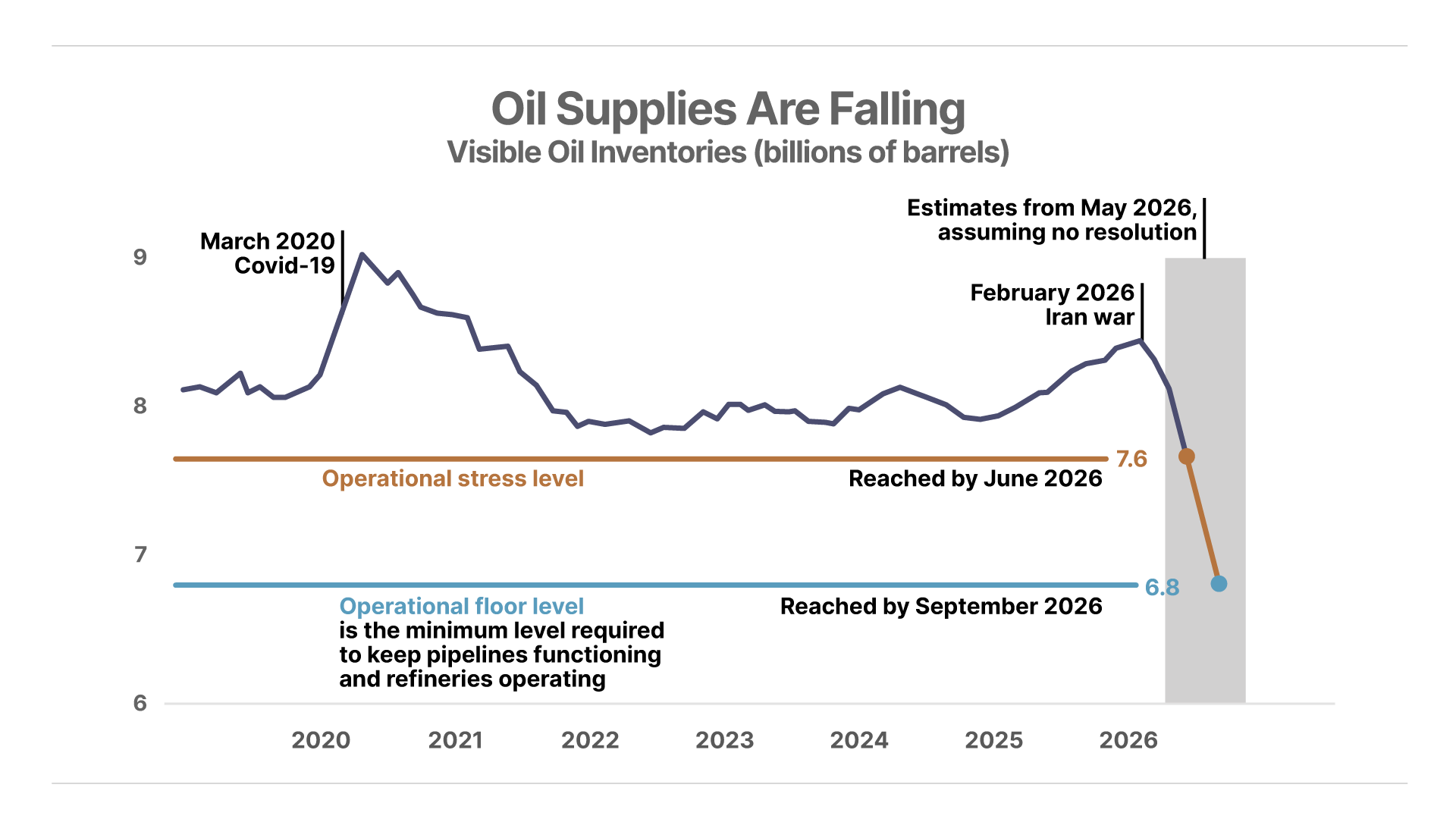
Chart Of The Day… Oil Inventories Are Plunging
In January, Complete Investor named energy as its investment theme for the year. This chart below from JPMorgan Chase (JPM) crystalizes the critical shortage of global oil inventories due to the closure of the Strait of Hormuz. Within a month, the world could fall below the minimum level required to keep pipelines and refineries operating. In this crisis, there will be investment opportunities… Keep an eye on the nine recommendations in Complete Investor’s “Energy & Commodities” section.
Mailbag
“I’m Pleased To Be Associated With Prophet”
Charles G. writes:
I am so pleased to be associated with Prophet. Thank you for helping me gain access to this dynamic investment opportunity. I am up 12% in two weeks, and have covered my lifetime subscription fee by time and a half. Thank you for all you have done for my family and me through Stansberry Research and Porter & Co.
“Better Than Berkshire Portfolio”
Sheryl S. writes:
I just read your write-up on The Better than Berkshire Index. As a retired person, is one better owning Better Than Berkshire, the Capital Efficient Index, or the Lindy Index for the equity portion of our portfolio?.
I appreciate your opinion.
Porter Comment: That all depends!
It’s a great question, by the way.
They all have a different focus, but all of them are very high-quality, low-beta approaches to investing in stocks.
I’ll run down some 10-year dynamics on these portfolios and show you how they’ve done. Past results aren’t perfect, but they show, somewhat, how these portfolios may respond to various market conditions.
“Your Thoughts On Amrize’s Earnings”
Mario M. writes:
Any updates on Amrize after their earnings report? Thank you.
Porter Comment: Amrize (AMRZ) reaffirmed its full-year guidance on April 29, reporting a 4.7% revenue increase to $2.18 billion. While Q1 earnings of -$0.16 EPS narrowly missed estimates, the company’s Building Materials segment saw a massive 41.7% jump in adjusted EBITDA, fueled by the integration of the West Texas-based PB Materials acquisition. To sweeten the pot for shareholders, the board authorized a $1 billion share-repurchase program and declared its first quarterly dividend of $0.11 per share. With price increases and fuel surcharges implemented in April to counter cost inflation, management expects margins to strengthen.
Porter & Co. Market Snapshot
| Price | Friday’s Return | Year-to-Date Return | |
|---|---|---|---|
| S&P 500 Index | $7,398.91 | 0.86% | 8.5% |
| Gold per ounce | $4,715.25 | 0.63% | 8.2% |
| Bitcoin | $80,717 | -0.09% | -7.6% |
| Oil (West Texas Intermediate) per barrel | $95.42 | -2.88% | 70.4% |
| Berkshire Hathaway (BRK) | $717,387 | 0.16% | -5.0% |
| Porter’s Permanent Portfolio | – | 0.08% | -0.6% |
| The Better Than Berkshire Index | – | -0.75% | -0.9% |
| Total Return | Annual Return | ||
| Porter & Co’s Top Ranked* | – | – | |
| Yield | Friday’s Change | Change Year-to-Date |
|
| U.S Treasury 30 – Year Yield | 4.93% | -3 bps | 9 bps |
*A Complete Investor risk rating of 1 is defined as a “low risk, high allocation” security, while positions rated closer to a 5 are higher risk. Porter & Co.’s top-ranked positions include those rated either 1 or 2 in Complete Investor portfolio.
Porter & Co. Top Positions
| Publication | Ticker | Description | Total Return |
|---|---|---|---|
| Complete Investor | BWXT | BWX Technologies | 259% |
| Tech Frontiers | QURE | uniQure | 237% |
| Complete Investor | BTC/USD | Bitcoin | 204% |
| Tech Frontiers | SGMT | Sagimet Biosciences | 143% |
| Tech Frontiers | QURE | uniQure | 131% |
| Tech Frontiers | ROIV | Roivant Sciences | 127% |
| Tech Frontiers | TGTX | TG Therapeutics | 123% |
| Complete Investor | PM | Philip Morris | 113% |
| Distressed Investing | PTON | Peloton Interactive | 104% |
| Distressed Investing | HLF | Herbalife | 102% |
Prices as of 4:00 pm ET May 8, 2026
Please note: The investments in our “Porter & Co. Top Positions” should not be considered current recommendations. These positions are the best performers across our publications – and the securities listed may (or may not) be above the current buy-up-to price. To learn more, visit the current recommendations page of the relevant service, here. To gain access or to learn more about our current recommendations, call our Customer Care team at 888-610-8895 or internationally at +1 443-815-4447.