Everything You Need To Know About Modern Investing Can Be Summed Up In The Story Of One Man: Hugo Stinnes
Inside Today’s Issue
- Essay: The Inflation King
- Private Equity Thirsty For Capital
- Short Time For Hedge Funds
- The Soaring Cost Of Power
- Chart Of The Day… Wingstop (WING)
- Today’s Mailbag
Porter Comment: I’m turning today’s Journal over to Handre van Heerden. Handre is a young Austrian School economist from South Africa. He’s become my favorite writer on X.com (@Handre). This week he wrote about why using debt is so powerful during times of high inflation. In my personal investment account, I’m using between 50% and 300% leverage. I believe that learning how to use leverage wisely in a low-beta, balanced portfolio (like Porter’s Permanent Portfolio) is one of the few true secrets of the world’s current financial system. In “hard” money systems, it pays to save. In paper money systems, it pays to borrow.
Here’s Handre…
Hugo Stinnes built the largest private empire in Weimar-era Germany.
He did it by doing something most people thought was reckless. He borrowed. Constantly. Aggressively. In German marks.
Stinnes came from a coal family in the Ruhr Valley. He ran a solid industrial operation before World War I. When the war ended and Germany began printing marks to pay its reparations debts under the Treaty of Versailles, most citizens watched their savings dissolve. But not Stinnes.
While German citizens hoarded paper marks in mattresses and savings accounts, Stinnes borrowed enormous quantities of those same marks from German banks, then immediately converted them into real assets: coal mines, steel plants, newspapers, shipping lines, hotels, forests, paper mills.
By 1923 his conglomerate, the Stinnes-Konzern, controlled over 1,500 enterprises across Germany, Austria, Luxembourg, Belgium, England, and the Netherlands. He employed roughly 600,000 people. The inflation that ruined an entire generation of German savers made Hugo Stinnes incomprehensibly wealthy.
How did he do it?
When a government or central bank expands the money supply, the purchasing power of each existing unit of currency falls. Prices across the economy do not adjust simultaneously. The new money flows into specific assets first, before it filters through to wages and consumer goods. Thus, whoever holds those assets during the transition captures a windfall. (Economists call this the Cantillon Effect.)
Stinnes borrowed in a currency he correctly identified as dying, bought hard assets whose value was tied to physical reality rather than government decree, and then, later, repaid his loans in marks worth a fraction of what he had borrowed.
After the Weimar hyperinflation, the value of what he owed was virtually nothing. He got the hard assets he bought with loaned marks for free.
The same thing happens today too, most commonly in housing. You take out a mortgage denominated in dollars, a currency the Federal Reserve has expanded by over 50% since early 2020. You hold a fixed-rate liability in a debasing currency while the asset itself reprices upward. The bank receives dollars of diminished purchasing power over 30 years. You own the land and the structure.
The reason property specifically has captured so much of the post-2020 inflation is that new money always travels along the path of least resistance toward collateral-eligible, financeable assets. Residential real estate sits at the center of the credit system. Banks lend against it readily. Institutional buyers treat it as a store of value.
When the Fed slashed rates to near zero and Congress distributed trillions in fiscal transfers, that purchasing power flowed directly into housing markets with predictable results: U.S. median home prices rose from $329,000 in early 2020 to over $420,000 by 2022.
When Stinnes died in 1924 he was the wealthiest man in Germany.
Tell me what you think of Handre’s contribution to today’s Daily Journal: porterstansberrydirect@gmail.com
Good investing,
F. Porter Stansberry
Stevenson, Maryland
P.S. Next week, Porter will be on stage at the 2026 New Orleans Investment Conference, October 28-31.
With 52 consecutive annual events, it is the longest-running investment conference on Earth. Those lucky enough to attend will hear from today’s top macro and market analysts. And of course, you’ll hear what Porter is watching right now, and why.
Seating is limited. If you want to be there, click here to register now.

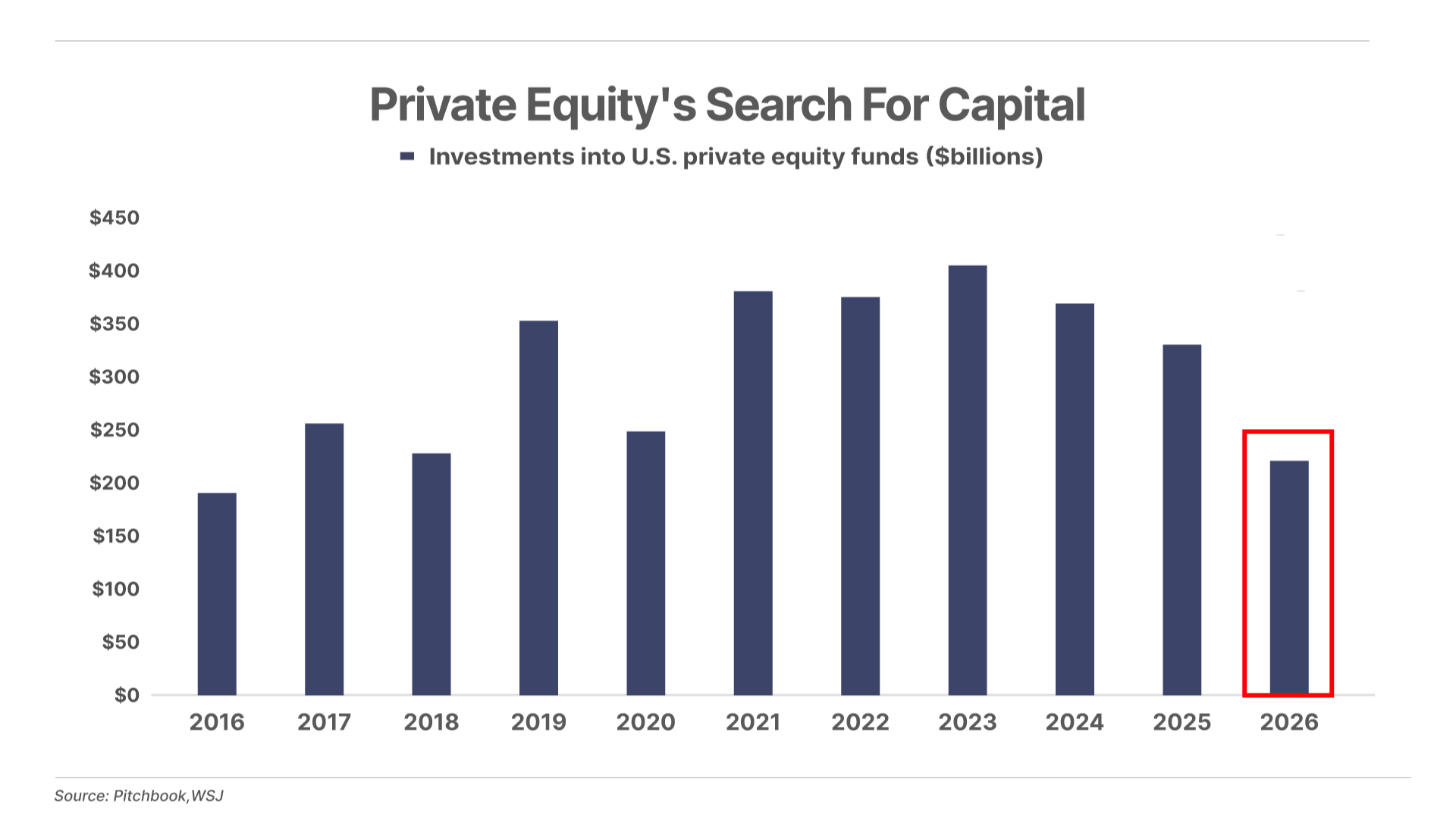
1. Private equity is having its worst year since 2020. U.S. private equity firms raised $222 billion in the first nine months of 2026 – on track for the industry’s weakest fundraising year since 2020 and the third straight annual decline. Higher rates have made it harder for firms to sell portfolio companies at the prices they paid. Investors who haven’t gotten cash back from old funds are reluctant to commit to new opportunities. Meanwhile, credit markets are paying investors to wait – everything from Treasuries to private credit now offers a more attractive yield than a locked-up equity fund.
2. Hedge funds turn bearish. According to Goldman Sachs, hedge funds are aggressively building up short positions – that is, betting that stock prices will fall. The ratio of short sales to purchases is 5x, and the amount of leverage used in these short positions is at the 99th percentile over the previous five years. While the hedge funds could be right in the long run, such an elevated short position runs the risk of creating a short squeeze that drives prices higher in the near term.
3. Electricity costs outpace inflation. U.S. consumers are facing a 38% rise in their electricity bills versus 2020, which is outpacing the reported inflation rate of 29% over the same period. Electricity demand from America’s data center build-out is creating the squeeze, with large projects consuming as much power as a small town. This is leading to pushback on data-center construction among communities across the country, and will play a pivotal role in the upcoming midterm elections.
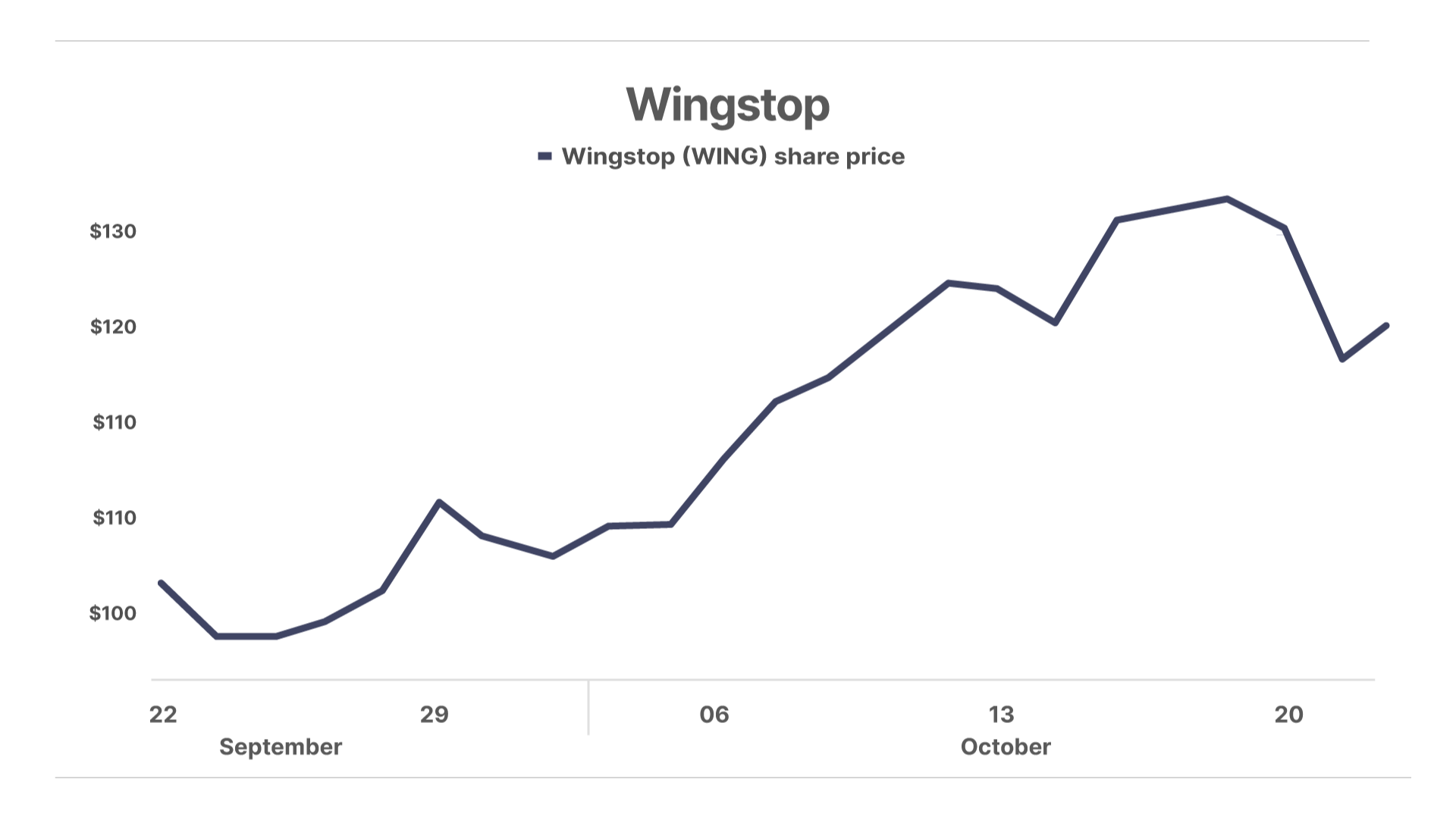
Shares of quick-service restaurant (and Complete Investor recommendation) Wingstop (WING) have shot up 20% over the past month – due partly to a rebound after being (over) sold off for much of the year and partly related to promotions related to the start of the NFL football season.
In yesterday’s Journal, Porter reported on the most recent SpaceX earnings call and analyzed how the rocket/satellite company’s growth and possible merger with Tesla might play out.
“Musk, SpaceX, Tesla, And Tech Domination”
Roy C. writes:
In your worst case scenario, SpaceX ends up with $320 billion in debt.
If SpaceX can merge with or purchase Tesla with stock, then the combined company would only need to sell 32 million robots for $50,000 each at a projected gross profit margin of $20,000, less estimated overhead of $10,000 each to pay off the debt.
If the net profit on each robot after overhead is $5,000 each, then the sale of 64 million robots would pay off the debt. Tesla has given guidance in the past that sales of robots may hit 1 billion units per year in year two or three of operations.
So the solution might be to raise money the old-fashion way by selling unique manufactured products in high demand.
However, I agree with your thought of waiting to buy SpaceX stock after more internally held shares hit the market or perhaps after a major correction in the overall market. And I don’t believe Elon is going to sell any stock at least until the majority of his dreams are fulfilled.
Ken L. writes:
Fascinating analysis – thanks.
I’ve been avoiding stocks for both companies because they seem like a wild rollercoaster ride. I now think that they are both going to be successful but like you I think I will wait until the insanity is a bit more predictable.
George F. writes:
Talk is cheap. Musk is a genius no doubt, but he tends to promise and not deliver. It took eight years for his truck to come on line, I think your approach of waiting helps.
Michael S. writes:
I think it is unacceptably dangerous to have that much power concentrated in the hands of one man-child. The anti-trust laws need to be dusted off and applied.
Porter & Co. Top Positions |
Through October 21, 2026 close |
| # | Position | Total return |
|---|---|---|
| 1 |
uniQure QURE
Biotechnology
|
+237% |
| 2 |
Bitcoin BTC/USD
The Complete Investor
|
+211% |
| 3 |
Sagimet SGMT
Biotechnology
|
+185% |
| 4 |
Roivant Sciences ROIV
The Complete Investor
|
+163% |
| 5 |
TG Therapeutics TGTX
Biotechnology
|
+150% |
| 6 |
Skyward Specialty Insurance SKWD
The Complete Investor
|
+149% |
| 7 |
Philip Morris PM
The Complete Investor
|
+146% |
| 8 |
BWX Technologies BWXT
The Complete Investor
|
+139% |
| 9 |
uniQure QURE
Biotechnology
|
+131% |
| 10 |
Sagimet SGMT
Biotechnology
|
+124% |