Issue #109, Volume #3


There Is Still Huge Value Being In The Room
Inside today’s Daily Journal…
|
Editor’s note: This August, Emmet Savage and the MyWallSt team will host Investicon in Dublin – their biggest investor event yet.
Headlining the day is David Gardner, co-founder of The Motley Fool and one of the most successful retail investors of the modern era.
Following the publication of his new book, Rule Breaker Investing, David is travelling to Dublin to share the principles, habits, and mindset that have helped him identify some of the greatest growth companies of the past three decades.
He will be joined by Bill Mann, Pieter Slegers, Eric Bleeker, Emmet Savage, and other investors who have spent their careers studying exceptional businesses.
For readers who have followed Emmet’s work through Prophet and Nova, this is not a typical investing conference. It is a chance to spend a day inside the thinking of serious investors.
Here’s Emmet to explain more about it…
Almost everything about the market has changed in the 30 years I have spent investing in public companies.
When I started, information was scarce. You waited for annual reports. You read newspapers. You searched message boards. You had to work to find what now appears instantly on your phone.
Today, information is everywhere. We can read earnings transcripts within minutes, listen to founders speak, study reviews, track products, follow hiring trends, and monitor competitive threats in ways that would have been unimaginable when I first began investing.
That is a remarkable advantage for private investors.
But more information has not removed the hardest part of investing.
It has not removed fear, impatience, or the temptation to sell a great company because the share price is falling. It has not removed the temptation to chase something simply because everyone else seems to be getting rich from it. And it has certainly not removed the difficulty of sitting still while the market tests your conviction.
That is why I believe the real edge in investing is not simply access to more facts. It is judgment, temperament, and the ability to think clearly when the market is trying to pull you in a dozen different directions.
That kind of edge is hard to download.
The Value Of A Serious Conversation
Some of the most important investing lessons I have learned did not come from a screen. They came from conversations.
Sitting across from someone who has lived through multiple market cycles. Hearing how they handled the dot-com crash. How they held great companies through years of doubt. How they separated temporary price movements from permanent business damage.
You can read a transcript of that kind of conversation, but it is not the same.
When you are in the room, you hear the experience behind the words. You hear what excites someone, what makes them cautious, and how they think before they answer.
Investing is as much emotional and behavioral as it is intellectual.
Anyone can say they are a long-term investor when markets are calm. It is much harder when your portfolio is red and every headline is telling you to do something.
That is where experience counts. And experience is often transferred best in person.
Why Investicon Matters
That is the reason we created Investicon… our biggest investor event yet, taking place in Dublin on August 27.
We wanted to build a room for serious investors – not simply to hear presentations, but to spend a day thinking about the problems that matter most to long-term wealth creation.
This year, The Motley Fool co-founder David Gardner will headline the event.
David’s philosophy has had an enormous influence on me. His willingness to back exceptional companies early, hold through volatility, and think in decades rather than quarters is one of the most powerful investing mindsets a private investor can adopt.
His recent book, Rule Breaker Investing, is not just about finding great stocks. It is about building the habits and behaviors required to own them long enough for extraordinary returns to happen.
There is no doubt that stock investing will test even the best of us. But it is also for that reason why it has been my life’s work.
Many investors can identify a good business. Far fewer can hold one through volatility, overvaluation fears, market crashes, leadership transitions, and long periods when nothing seems to be happening. That is the psychological side of investing, and it is where the largest fortunes are usually won or lost.
Bill Mann will bring a global perspective and decades of experience studying businesses around the world. Pieter Slegers, creator of Tiny Titans – who was a big hit at the Porter & Co. Annual Conference last year – will bring his focus on smaller, less obvious companies. Eric Bleeker will bring his perspective on technology, innovation, and the companies shaping the next decade.
I will be there to share how we think about long-term investing at MyWallSt, including the principles behind Prophet, Nova, and our search for the next generation of exceptional companies.
Together, the day is built around one essential question:
Where are the great businesses of the future being built – and how do we become the kind of investors capable of owning them?
Answering that well requires more than a stock screen. It requires an understanding of business quality, market psychology, founder behaviour, competitive advantage, valuation, patience, and the uncomfortable reality that many great investments look imperfect at the beginning.
What We’ll Be Talking About In Dublin
At Investicon, we will spend a lot of time on the psychology of owning winners:
-
Why investors sell great companies too early, how to distinguish a broken stock from a broken business, and how to keep conviction without becoming stubborn
-
We will also talk about the next generation of opportunity. Artificial intelligence (“AI”) will clearly be part of that discussion, but not in the usual breathless way. The useful question is not simply, “What is the next AI stock?” It is which companies are using new technology to build real advantages, expand margins, deepen customer relationships, or attack markets that were previously too inefficient to change.
-
There will be discussion around smaller companies, global opportunities, long-term compounding, stock selection, portfolio construction, and the kinds of businesses that can become far more valuable over 10 or 20 years than they appear today.
Just as importantly, there will be conversation between the people in the room.
A good investor in the audience will often ask the question everyone else was thinking but could not quite phrase. A conversation over lunch can open up a new way of looking at a company, a sector, or a risk. Meeting other serious investors can remind you that you are not alone in trying to do this properly.
Investing can be strangely solitary. Most of us make decisions by ourselves, in front of a screen, surrounded by noise. Spending a day with people who care about the craft of investing can sharpen your thinking in a way that is hard to replicate.
The Part You Cannot Download
I do not believe one conference will make anyone a great investor overnight.
But I do believe one idea can change how you invest. One framework can help you avoid a costly mistake. One conversation can give you the conviction to hold a great company when the market is trying to shake you out.
David Gardner travelling to Dublin would be enough to make this a special day. Add Bill Mann, Pieter Slegers, Eric Bleeker, the MyWallSt team, and a room full of serious private investors, and it becomes something more valuable than a series of presentations.
It becomes a day of shared thinking about great companies, investor behavior, the future, and what it really takes to own exceptional businesses for long enough to let them matter.
In an age where every fact is searchable, the greatest edge may be the one that cannot be downloaded: the judgment to know which facts matter, the temperament to stay with a company through discomfort, and the humility to keep learning from people who have seen more than you have.
And sometimes, it is the simple act of being in the room when the right conversation changes how you see the future.
I know what these types of situations have been worth to me as an investor.
I know the remarkable value that comes from the types of conversations that only happen in-person.
And I know you, as a Porter & Co. subscriber, understand you’ve often got to be in the room to reap the rewards.
That’s why I asked Porter if I could write personally to his readers and invite them to Investicon in August.
He kindly agreed, under one condition.
We offer a discount exclusive to the Porter & Co. family.
So, if you’re interested, check out the Investicon website here, and use code PORTER200 for a €200 discount – that’s about US$225 at the moment.
I hope to see you in Dublin.
Emmet Savage
MyWallSt
Keep in mind, we at Porter & Co. only publish guest essays from publishers we know to offer well-researched ideas vetted by a legal team, excellent customer service, and reasonable refund policies. MyWallSt is one such partner. We do not, however, under any circumstances, make any representations about their investment ideas or strategies, nor will we warrant them as equal to our own. We do recognize that the markets are tempestuous and, at times, ideas that we may not endorse prove valuable.
Tell us what you think of today’s Daily Journal: porterstansberrydirect@gmail.com
3 Things To Know Before We Go…
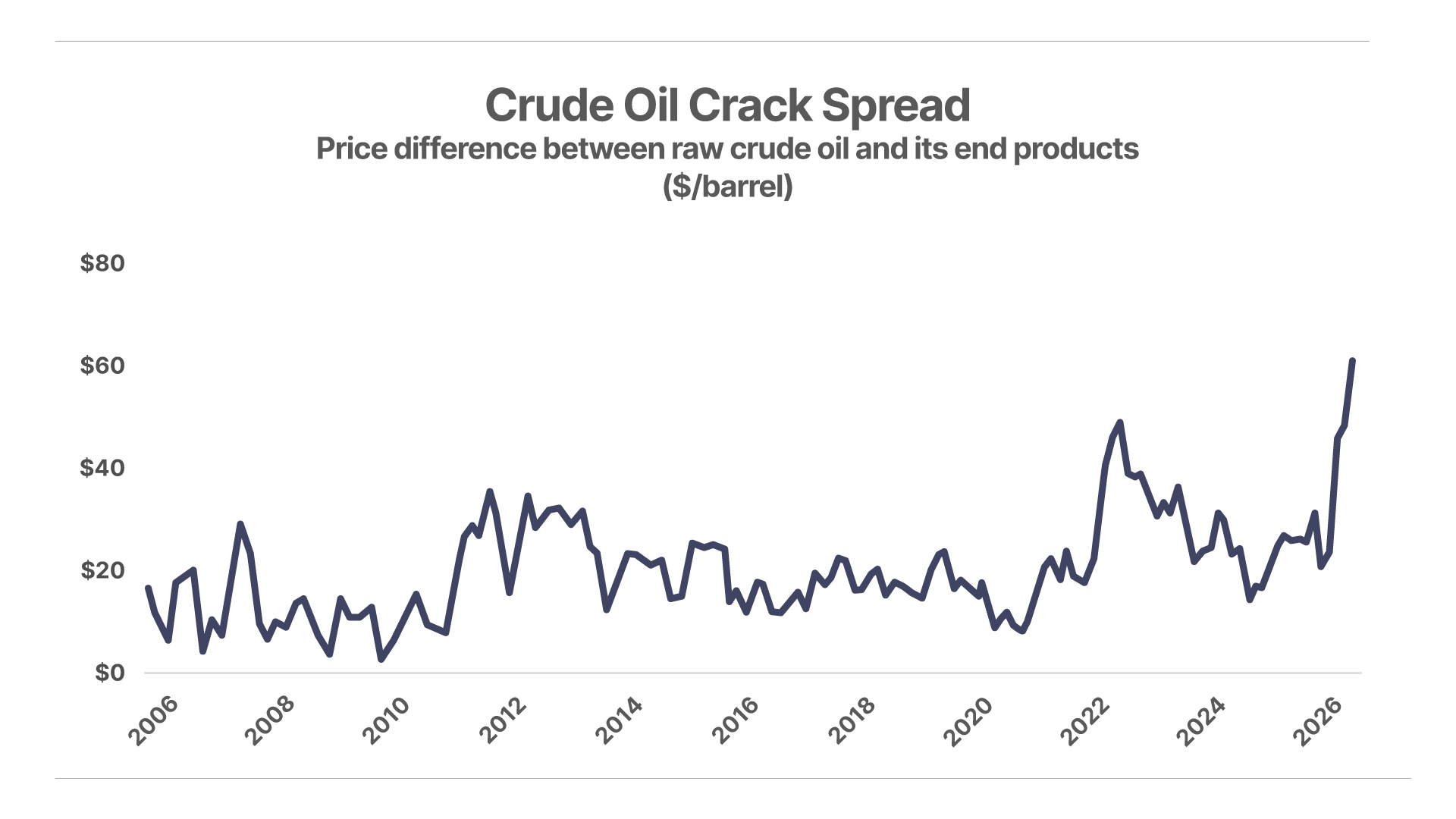
1. The 3:2:1 crack spread has broken out to its highest level in two decades. The price gap between crude oil and the gasoline and diesel it’s turned into pushed to a fresh high near $60 a barrel, its highest level in over 20 years. Wide cracks translate directly into larger downstream profits, a clear benefit for refiners like Valero (VLO) and Marathon (MPC) and for the refining and chemicals arms of majors like Complete Investor recommendation ExxonMobil (XOM). Historically, a sharp expansion in the crack spread has also been a bullish leading signal for the broader energy trade: as refiner margins improve, capital has tended to move into exploration and production (“E&P”), oilfield services, and midstream. The current surge is largely due to disruptions in the Strait of Hormuz, which are tightening refined-product supply, so how long these margins hold will track the pace of normalization there.
2. Meta Platforms (META) plans to resell spare AI computing power. According to Bloomberg, the effort – an internal initiative called Meta Compute – would offer both access to AI models running on Meta’s own infrastructure and raw capacity in the mold of neocloud firms such as CoreWeave (CRWV). The aim is to earn a return on the hundreds of billions Meta has committed to data centers and chips – spending that has left investors uneasy about the payoff. It would put Meta in direct competition with Amazon Web Services (“AWS”), Microsoft’s Azure, and Google Cloud. Meta CEO Mark Zuckerberg raised the option himself in May, noting that outside firms ask “almost every week” to buy compute, but Meta hasn’t sold any yet: the plans are still in development and could change. Shares traded 10% higher this morning on the news.
3. Peak pessimism in gold. According to data compiled by SentimenTrader, sentiment among gold traders has dropped to levels only seen nine times in the last 18 years. And in each case, gold was higher one month later, with returns averaging 4.1%. The returns over the following year were also positive in 100% of prior cases, with an average gain of 16.6%. After a 30% decline, gold prices may have bottomed if the past is prologue.
Chart Of The Day… Distressed Investing Income Streams
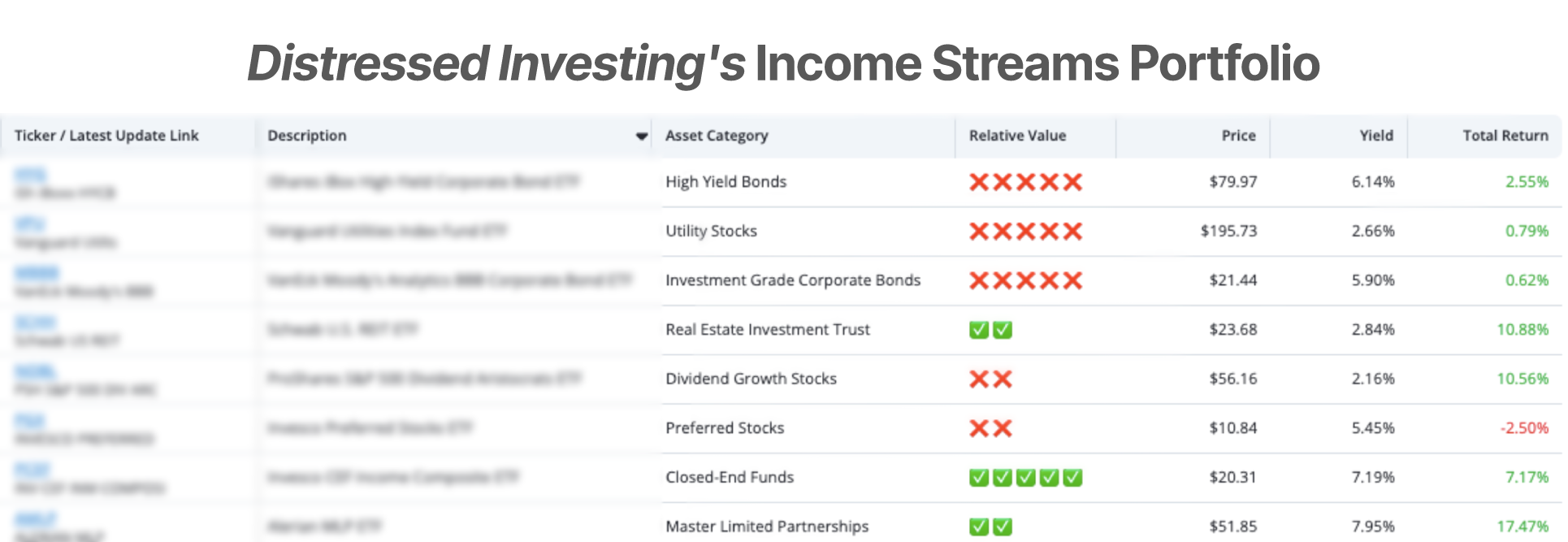
Distressed Investing editor Marty Fridson has chosen eight income-producing ETFs for his Income Streams portfolio, which generated a 3.97% total return in Q2 2026. If that rate were maintained for 12 months – extremely unlikely! – the return would be 16.85%. That’s well above the long-run annual return on common stocks.
Today’s Poll
At around $4,100 per ounce, gold is up 23% over the last 12 months, but down 31% from its January 28 high of $5,589.
Poll Results… What We Thought Would Happen By June 30
On January 14, we asked readers where consumer price index (“CPI”) inflation would stand by the end of June 2026 – yesterday – with the baseline at 2.7%. A strong majority of readers (60%) correctly predicted it would rise at least one percentage point higher – and they were vindicated decisively. Inflation climbed to 4.2% by May and has continued rising, driven largely by the energy shock from the war in Iran.
On February 28, we asked whether silver had peaked, with the metal then trading at $115 an ounce. A 68% majority (incorrectly) predicted it would climb at least 20% higher by June 30 – silver sits near $59 today, roughly half the price readers expected, after a stunning reversal from its January all-time high above $121 an ounce. The 20% minority who said silver had peaked were proven right, and then some.
Mailbag
In Tuesday’s Daily Journal, Porter reported on the souring relationship between fellow billionaire philanthropists Bill Gates and Warren Buffett and some of the poor decisions Buffett made with his investments in Berkshire Hathaway.
“Eye Opener”
Danny J. writes:
Wow, that story on Buffet and Berkshire was a real eye opener, thanks!
“Man!”
Mark K. writes:
Man, just re-read your 2029: The End of America book and got a copy for my son (head of corporate strategy and global M&A for an S&P 500 company). I have also finished Warren’s Mistakes book about Buffett’s investing. I used to read a lot of fiction and history books. Now I mostly just read your stuff. I wish I were younger so I’d have more time to imbibe and mind-meld with your writings.
Keep on “writin” and “makin” it available to me and the rest of your very lucky Partners as we gain from your valuable perspective.
With kind regards and cheers
Porter & Co. Comment: Porter’s book 2029: The End of America is quickly moving up the best-seller list. To get a copy now, click here.
Plus, his book about Warren Buffett and Berkshire Hathaway, referenced above, can be found here.
Porter & Co. Market Snapshot
| Price | Yesterday’s Return | Year-to-Date Return | |
|---|---|---|---|
| S&P 500 Index | $7,499.36 | 0.79% | 10.22% |
| Gold per ounce | $4,008.02 | -0.19% | -6.9% |
| Bitcoin | $58,558.86 | -2.61% | -33.1% |
| Oil (West Texas Intermediate) per barrel | $69.50 | -1.32% | 20.3% |
| Berkshire Hathaway (BRK) | $748,850.00 | 0.72% | -0.8% |
| Porter’s Permanent Portfolio | – | -0.55% | -0.5% |
| The Better Than Berkshire Index | – | 0.49% | 7.1% |
| Total Return | Annual Return | ||
| Porter & Co’s Top Ranked* | 34.7% | 16.4% | |
| Yield | Yesterday’s Change | Change Year-to-Date |
|
| U.S Treasury 30-Year Yield | 4.95% | 9 bps | 11 bps |
*A Complete Investor risk rating of 1 is defined as a “low risk, high allocation” security, while positions rated closer to a 5 are higher risk. Porter & Co.’s top-ranked positions include those rated either 1 or 2 in Complete Investor portfolio.
Porter & Co. Top Positions
| Publication | Ticker | Description | Total Return |
|---|---|---|---|
| Complete Investor | BWXT | BWX Technologies | 241% |
| Tech Frontiers | QURE | uniQure | 237% |
| Tech Frontiers | ROIV | Roivant Sciences | 157% |
| Complete Investor | ARM | ARM Holdings | 156% |
| Tech Frontiers | TGTX | TG Therapeutics | 155% |
| Tech Frontiers | SGMT | Sagimet Biosciences | 143% |
| Complete Investor | SKWD | Skyward Specialty Insurance | 137% |
| Tech Frontiers | QURE | uniQure | 131% |
| Complete Investor | PM | Philip Morris | 126% |
| Complete Investor | BTC/USD | Bitcoin | 117% |
Prices as of 4:00 pm ET June 30, 2026
Please note: The investments in our “Porter & Co. Top Positions” should not be considered current recommendations. These positions are the best performers across our publications – and the securities listed may (or may not) be above the current buy-up-to price. To learn more, visit the current recommendations page of the relevant service, here. To gain access or to learn more about our current recommendations, call our Customer Care team at 888-610-8895 or internationally at +1 443-815-4447.