
This is Porter & Co. Biotechnology – where Porter Stansberry presents a revamped portfolio to capitalize on the next biotech bull market. The details of the recommendations – and the specific names of the companies and buy prices – are for paid-up subscribers only. To learn more about subscribing to Porter & Co. Biotechnology, click here.
Why RNAi Is The Next Monoclonal Antibody – And How To Own It
Silence one gene and you can silence almost any gene.
That is the whole investment case for gene silencing – part of what we call biotech's 11 Kingdoms Of Medicine.
Instead of blocking a disease-causing protein after the body has already built it, these drugs intercept the genetic message and stop the protein before it exists. The hurdle to more therapeutics in this class of drugs is the delivery mechanism. Safe delivery mechanisms must be developed for each kind of tissue. But, once you solve the delivery issue, you can silence essentially any gene in that tissue. The liver is now solved. The rest of the body is the next frontier.
The biggest prize is the untreated cardiovascular target: lipoprotein(a) – or Lp(a) – an inherited driver of heart attacks and strokes that affects about one in five people and has no approved therapy.
What Gene Silencing Is, In Plain English
Every disease-causing protein in the body starts as a message. A gene copies its instructions onto a short strand of RNA called messenger RNA, and that message travels to the cell's factories, which read it and build the protein. Almost every drug ever made works downstream of this message – it blocks the finished protein, or the receptor the protein acts on. Gene silencing works upstream. It destroys the message before the factory ever reads it.
There are two dominant approaches to gene silencing.
The first is RNA interference, or RNAi, which uses double-stranded snippets called small interfering RNA – siRNA. The siRNA loads into a protein complex called RISC and turns that cellular machinery into a shredder for those cellular messages.
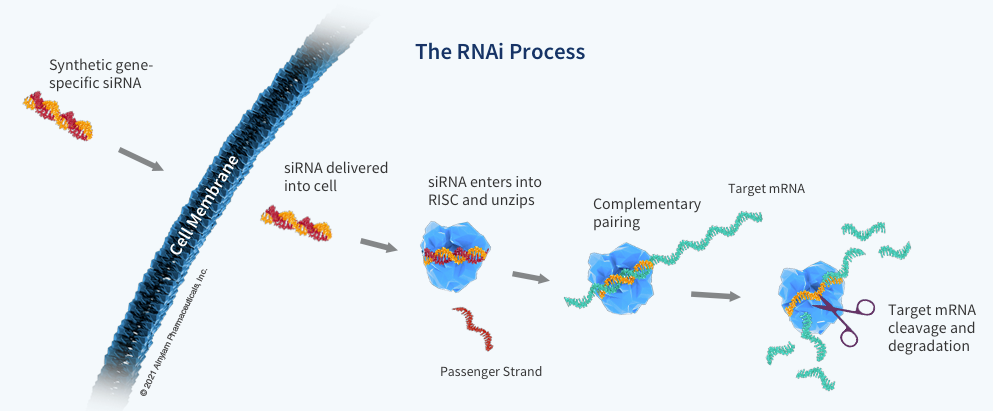
This is the mechanism that's been developed for decades by Alnylam Pharmaceuticals (Nasdaq: ALNY), Arrowhead Pharmaceuticals (ARWR), Silence Therapeutics (SLN), and Dicerna Pharmaceuticals (formerly DRNA), now owned by Novo Nordisk (NVO).
The second approach is the antisense oligonucleotide (“ASO”) – a single-strand molecule, and it is the older and simpler approach. It binds the target message directly and either blocks it or flags it for a cutting enzyme.
Ionis Pharmaceuticals (IONS), founded in 1989 as Isis Pharmaceuticals and renamed Ionis in December 2015 (to avoid association with the militant group), has developed this approach since the 1990s and has four approved drugs.
The commercial difference between the two approaches is dosing frequency.
siRNA is catalytic. Once one siRNA molecule loads into the RISC complex, that complex chews through thousands of copies of the target message before it is recycled. Thus one dose keeps working for months.
ASO is stoichiometric. Each molecule takes down roughly one message and is then used up, so you have to keep replacing the drug. In practice, that is the difference between an injection four times a year and an injection 12 times a year.
The catalytic advantage is significant. When Novo Nordisk bought Dicerna in 2021, it paid $3.3 billion – an 80% premium – for the delivery platform, not for any single drug in the pipeline.
How Gene Silencing – The Fourth Kingdom – Was Built
Andrew Fire, a pathology and genetics professor at the Stanford School of Medicine, and Craig Mello, a research investigator at the University of Massachusetts Chan Medical School, discovered RNA interference in C. elegans (a roundworm) and published their breakthrough in the journal Nature in 1998. They injected double-stranded RNA into C. elegans and watched it silence a specific gene. This was the founding experiment of the entire gene-silencing field. Their discovery won them the 2006 Nobel Prize in Medicine. This is the science every siRNA drug (produced by Alnylam, Arrowhead, Silence, Dicerna) descends from.
The next breakthrough came from Thomas Tuschl's lab at the Max Planck Institute in 2001. Tuschl discovered that short 21-nucleotide double-stranded RNA snippets could silence genes in mammalian cells without setting off the immune alarm. Every commercial siRNA drug on the market today descends from this discovery.
Alnylam Pharmaceuticals was founded in Cambridge, Massachusetts, the next year, in 2002, by four scientists, Tuschl among them. In 2003, Alnylam merged with Germany's Ribopharma, folding a second, independently derived patent family under one roof. That merger is the most important corporate event in the sector's patent history, because it gave Alnylam a claim to the broadest foundational intellectual property in the field – the Tuschl II patents, which were issued in 2006 and covered the design of the silencing molecules themselves.
As with all new approaches to medicine, the path to widespread commercialization hasn’t been easy.
Big Pharma tried to develop RNAi three times and failed. Merck (MRK) paid $1.1 billion for Sirna Therapeutics in 2006 and sold it back to Alnylam in 2014 at a $925 million loss. Roche (RHHBY) paid Alnylam $331 million for a platform license in 2007, then exited the field in 2011, selling its Wisconsin research site, its delivery chemistry, and 40 scientists to a small company called Arrowhead in exchange for a 10% equity stake. That fire sale is the origin of Arrowhead's entire modern platform. Novartis (NVS) repeated the pattern in 2015, dumping its RNAi assets on Arrowhead for $35 million after spending roughly $700 million on Alnylam over the prior decade.
The lesson the survivors learned is the one that governs the Kingdom today:
RNAi did not fail in those years – the delivery of RNAi failed.
The science is real and effective. But getting a fragile strand of RNA to the right cells intact has not been solved for all tissue. The company that stayed – Alnylam Pharmaceuticals — has now spent 20 years solving delivery.
Solving Delivery, One Tissue At A Time
An siRNA molecule injected into the bloodstream degrades within minutes, gets filtered out by the kidney, or fails to cross into cells.
The central fact of the entire Fourth Kingdom is that there is no such thing as an all-purpose gene-silencing drug. There will be dozens of gene-silencing drugs and the delivery system for each will depend on the tissue it’s targeting.
The first tissue that’s been solved is the liver. The key to unlocking it is a sugar tag called GalNAc. GalNAc is a molecule that the liver's main cells naturally grab and pull inside through a specific receptor. Attach GalNAc to an siRNA and the whole package delivers itself to the liver after a simple injection under the skin. Every approved liver-targeted siRNA drug uses some version of this technology. It is what turned RNAi from a laboratory promise into a commercial category.
Here’s the good news: there are a lot of valuable drug targets in the liver. Lipoprotein(a) is made in the liver. So is apoC-III, the target of the triglyceride drugs. So is the protein behind transthyretin amyloidosis, the disease that built Alnylam's current revenue stream.
And because the liver is the tissue the industry knows how to reach, the first wave of gene-silencing blockbusters is a wave of liver-targeted drugs. But the next decade of value creation is about every other tissue: brain, muscle, fat, kidney, lung, heart, eye.
Two public companies are furthest along.
Arrowhead Pharmaceuticals' platform now spans seven cell types, with five in human testing – liver, lung, skeletal muscle, brain, and fat. Alnylam has gone deep on one tissue that matters enormously, the brain, and has published 18 to 24 months of human data showing more than 70% knockdown of a target implicated in Alzheimer's with dosing just twice a year. Prior attempts at brain diseases managed 25% to 30% knockdown and were poorly tolerated.
Arrowhead is broader; Alnylam is deeper where it has chosen to fight.
Both bets can pay off, and neither stock is reflecting the enormous potential value of an effective Lp(a) drug.
The Big Prize: Lipoprotein(a)
Lipoprotein(a) – Lp(a) for short – is a cholesterol-carrying particle, similar to the LDL (low-density lipoprotein) that every doctor already treats, but with an extra protein wrapped around it.
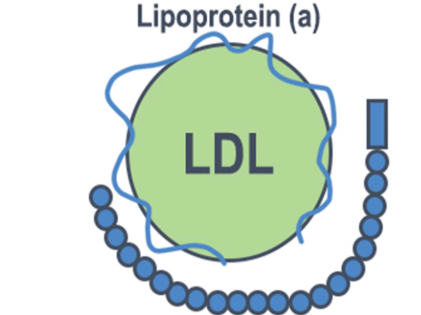
Unlike almost every other risk marker in cardiology, your Lp(a) level is roughly 80% to 90% set by the gene you were born with. Diet does not change it. Exercise does not change it. Statins, the drugs that made cardiovascular prevention a mass market, barely touch it and can even nudge it the wrong way. It is a direct, independent cause of heart attack, stroke, and a narrowing of the heart's aortic valve, and it is elevated in about one in five people.
There is no approved drug that lowers it. None.
This is a major driver of the world's leading cause of death, written into the DNA of 1.4 billion people, with zero approved therapy.
This is the largest untreated cardiovascular market left in medicine. If the ongoing trials prove that lowering Lp(a) prevents heart attacks, then these drugs represent a $50 billion-a-year, statin-scale market.
Every drug in the race has already proven it can lower Lp(a). But none has proven that lowering Lp(a) alone will prevent heart attacks. Lowering Lp(a) is a surrogate – a stand-in the field believes tracks the real outcome, but has not yet confirmed.
The Four Contenders
Four late-stage drugs are competing to be first to prove it can lower Lp(a), split across the two approaches to gene silencing.
The leader is an ASO from Novartis in partnership with Ionis. Pelacarsen lowers Lp(a) by about 80% and requires a monthly injection. Its cardiovascular outcomes trial, Lp(a)HORIZON, enrolled 8,323 patients with established heart disease and is the first outcomes trial for any Lp(a)-lowering drug in history. In its July 21 investor update, Novartis reports that the results are expected in the second half of 2026. The precise timing isn’t known because it is an event-driven trial, meaning it reports when a preset number of cardiovascular events have accumulated rather than on a fixed calendar date.
The other three new drugs use the siRNA approach, which is more potent and more convenient.
-
Olpasiran, from Amgen, originated at Arrowhead. It is dosed once a quarter and cuts Lp(a) by more than 95%. Its outcomes trial, OCEAN(a), enrolled roughly 7,000 patients and is expected to report in December 2026.
-
Lepodisiran, from Eli Lilly, descends from the Dicerna platform Novo Nordisk (NVO) now owns. It is dosed roughly twice a year, cuts Lp(a) by about 94%, and has shown a single dose lasting up to a year and a half. Its outcomes trial is the largest of the group and reports toward the end of the decade.
-
Zerlasiran, from Silence Therapeutics, can be dosed as infrequently as every six months and has driven Lp(a) down 90%, with peak knockdown near 99%. It has not yet started a Phase III outcomes trial, and it needs a partner to fund a trial.
The shape of the race is clean: the ASO leads because it could be first to market, while the siRNAs lead on potency and dosing.
We believe this market is big enough for there to be several winners.
Who Owns The Fourth Kingdom: The Patent Question
The natural assumption is that because Alnylam pioneered RNAi, it collects a royalty on every siRNA drug ever made.
That was mostly true for 15 years, but the intellectual property (“IP”) landscape is changing significantly.
There are two core IP layers in the Fourth Kingdom.
The first layer is foundational – the enabling technology itself, the RNAi mechanism and the GalNAc delivery chemistry that makes liver drugs possible. This is the layer Alnylam dominated, anchored by the Tuschl II patents. But this IP is now expiring. A drug launching around 2030 can avoid these IP costs entirely. The tollbooth Alnylam built over the whole category is closing at almost exactly the moment this generation of Lp(a) drugs arrives.
The second layer is composition-of-matter – the patents on each specific drug, the exact RNA sequence and chemical pattern. This layer does not belong to Alnylam. It belongs to each developer: Amgen and Arrowhead for olpasiran, Eli Lilly for lepodisiran, Silence for zerlasiran. These patents run into the late 2030s and give each drug roughly a decade of exclusivity after launch. This is where the real, durable value of each individual drug lives.
So the Fourth Kingdom has fractured into four parallel patent estates. Alnylam holds its GalNAc and its proprietary next-generation chemistry. Arrowhead built its own platform out of the assets Roche abandoned. Ionis owns a separate universe of antisense (ASO) chemistry. And Silence holds its own foundational chemistry too – a set of patents strong enough that in their 2018 settlement it was Alnylam that took a license from Silence and paid royalties, not the reverse.
The key IP battle today is Ionis versus Arrowhead, over the target their triglyceride drugs share. Arrowhead's most valuable near-term drug depends on how a California court reads the scope of an Ionis patent.
The Four Companies We Cover
Subscribe to Porter & Co. Biotechnology to unlock the rest of this issue and more.
Become a Porter & Co. Biotechnology subscriber today to get instant access to the rest of this issue and other valuable subscriber-only content.
A Porter & Co. Biotechnology subscription gets you:
-
Monthly Issues – a detailed analysis on a new recommendation plus ongoing updates on the existing list of recommendations.
-
Special Reports – Covering the biggest biotech trends impacting investing and society as a whole.
-
Buy / Sell Alerts – instant notifications when any recommended stock makes a major move worthy of your attention.
-
And more…
Use the link below today and lock in our lowest rate --> 60% off the usual annual rate.
This content is only available for paid members. If you are interested in joining Porter & Co. either click the button below now or call our Customer Care team at 888-610-8895.