Issue #116, Volume #3


How We Saw The Opportunity Coming, What We Learned Along The Way, And The Approach That Will Carry Us Through The Decade Ahead
Inside today’s Daily Journal…
|
In late 2023, I saw the most incredible market formation I’d ever seen in my career.
And, fortunately, at 50 years of age, I had the experience needed to recognize it and capitalize on it. You may recall that I tried desperately to get you to do the same…
It was a pattern I’d seen twice before. It isn’t hard to spot, either.
Biotech booms always follow tech booms.
You don’t have to guess when biotech stocks are going to soar. All you have to do is wait for tech stocks to take off, and you can know about 24 months later, biotech is going to the moon.
And for good reason… As each new wave of new computing capability washes over the economy and creates enormous new capabilities (and fortunes), those same capabilities and that same capital flood into life sciences. The tools that just transformed information inevitably get tuned to use on biology. I saw it happen after the PC boom in the 1980s with Genentech and Amgen. I saw it happen after the internet boom of the 1990s with Regeneron and Illumina. And in late 2023, the largest technology wave of all had just launched.
At the time (late 2023 / early 2024), the biotech sector had just endured the most brutal bear market in its history. Interest rates had spiked after the COVID bubble, and for long-duration assets like drug developers, interest rates are financial gravity. When money is expensive, the far-off cash flows of a future blockbuster get discounted into oblivion. By the end of 2023, more than 180 biotech companies on the Nasdaq and NYSE traded at a negative enterprise value. Which means you could have bought these entire companies, pocketed the cash on their balance sheets, and owned their drug pipelines for free. I had never seen anything like it before, in any U.S. market sector.
This was a certain boom… beginning at a generational bargain.
Like my old friend and partner Steve Sjuggerud taught me: you only need one biotech bull market. It just takes one. And there it was, just waiting for us.
In November 2023, Erez Kalir was in D.C. on other business and asked if he could stop by Meadowdale Farm (Porter & Co. headquarters outside of Baltimore, an hour away) to talk about something important. He didn’t say what it was, but I already knew: the opportunity in biotech.
Erez’s résumé reads like something out of a novel: Stanford, where he double-majored in biology and English; a master’s in cell biology and genetics from Oxford; a JD from Yale Law School; and then a key position at a hedge fund seeded by the legendary Julian Robertson of Tiger Management.
And there’s the incredible story of how we met.
It was 2008. The financial world was imploding. And Erez was among only a handful of other senior people on Wall Street who knew why. He came across my research on Freddie Mac and Fannie Mae – he literally found my June 2008 newsletter sitting on a copy machine. He read it, immediately subscribed, and reached out to have lunch with Steve and me. We’ve been friends ever since.
That afternoon in late 2023, we laid out exactly what we knew about what would happen next in biotech, and we talked about how to best capture the coming returns. With Erez at the helm, we launched Biotech Frontiers in January 2024 (later renaming it Tech Frontiers).
We started by buying a large portfolio of the cheapest names (the “net-nets”). And then, one by one, Erez built a concentrated book of clinical-stage names that earned some of the biggest returns we’ve published at Porter & Co: Roivant Sciences (ROIV) more than doubled, TG Therapeutics (TGTX) more than doubled, and Sagimet Biosciences (SGMT) – the fatty-liver-disease play he recommended in the very first issue at around $5 – jumped 170% in a single trading day when its Phase 2b data from the Food And Drug Administration (“FDA”) hit. In fact, Erez recommended Sagimet three separate times and rang the register each time. The realized gains across those round-trips ran well beyond what any single entry-to-today figure captures.
Those are the kinds of gains that happen in biotech, caught at the right moment.
Sadly, last week, Erez told us he’s decided to leave the firm to pursue other opportunities. We wish him nothing but the best. He remains a friend, and the record he built for our Partner Pass members speaks for itself.
Replacing an analyst like Erez will not be easy. I won’t pretend otherwise. (If you believe you’re qualified and you’re interested in a job with us, please send a note.)
But until another genius walks in our door, here’s what we’re going to do. I hope you’ll pay attention, because this bull market in biotech hasn’t even really gotten started yet. There are life-changing gains ahead.
When I studied Biotech Frontiers’ full record – not just the highlight reel, but every recommendation, equal-weighted, measured from its own entry date – I found something very interesting, something that gives me confidence that we can continue to produce great results going forward.
Erez’s biotech picks returned about +61% on average. That’s extraordinary! But over those same windows, if you had simply bought the SPDR S&P Biotech ETF (XBI) on the very same days, you’d have made roughly the same – around +64%. And the more aggressive ALPS Medical Breakthroughs ETF (SBIO) would have returned close to +85%.
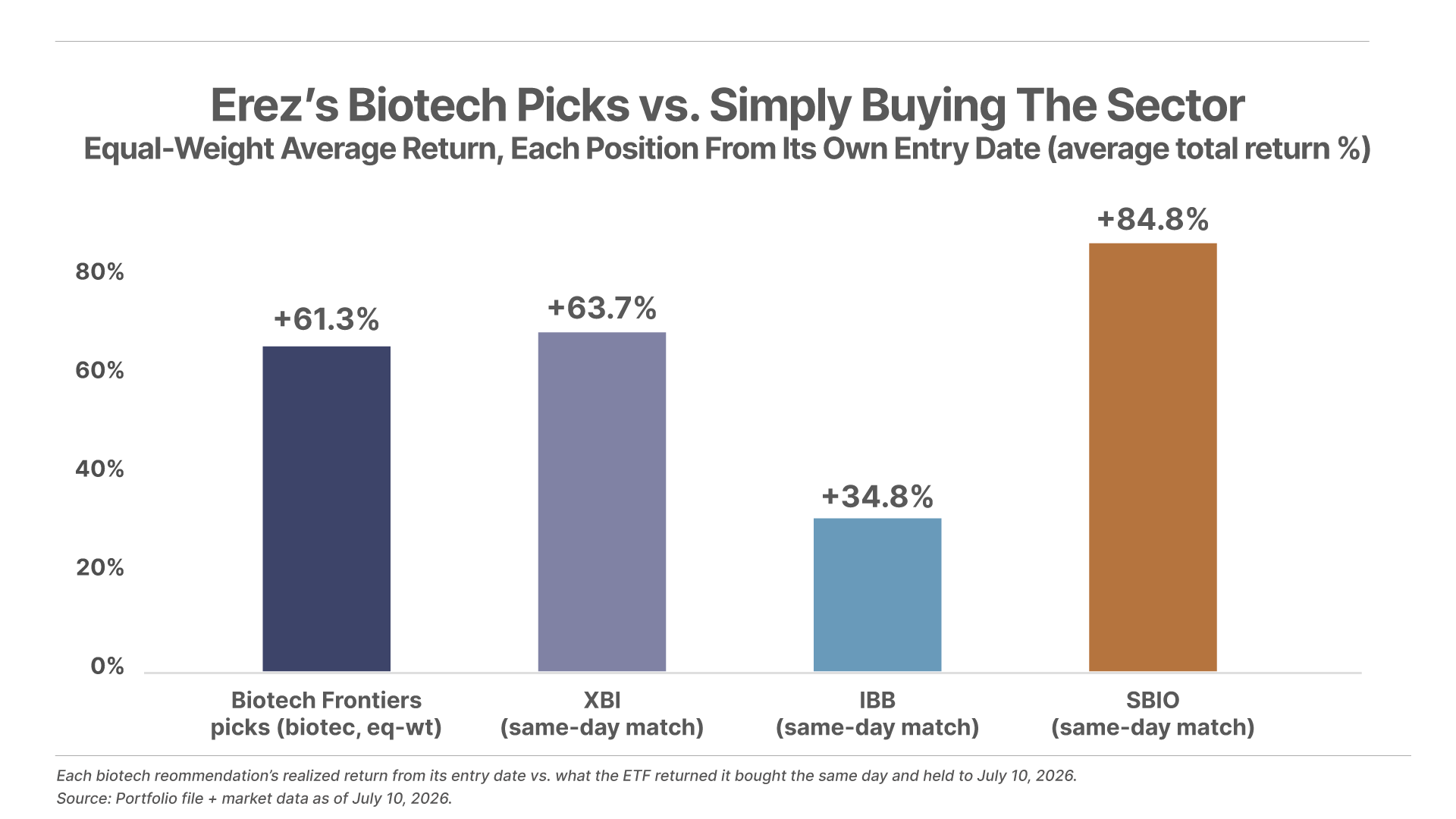
Each biotech recommendation’s realized return from its entry date vs. the ETF bought the same day and held to Jul 10, 2026.
A brilliant, credentialed, three-decade professional, picking individual stocks with real skill, produced returns that in aggregate roughly matched the sector he was operating in. This is not, in any way, a criticism of Erez. After all, what this analysis doesn’t capture is how much value Erez created by telling you which of the names (like Sagimet) he was most certain about.
And this comparison understates Erez’s actual results because it measures each position statically, from entry to today – so it can’t capture the profit-taking and re-investing he did along the way, like the repeated Sagimet round-trips where he sold half into every spike and bought back on the dips. His true realized edge was better than the static figure implies.
But… the bigger lesson is… in a biotech bull market, there’s a lot of value being created all across the sector. Most of the alpha is generated by simply buying the sector when it’s running. It was the decision we made in November 2023 – to be in biotech – that mattered the most.
That realization is liberating, not deflating. Because it tells us exactly what to protect as we go forward: the exposure. And it tells us we don’t have to find another once-in-a-generation stock-picker (although that would be nice!) to keep winning.
All we need for now is the smartest, most durable way to hold the exposure through the long boom ahead.
To capture the broadest exposure and earn the highest returns, what we need is a biotech tollbooth.
A tollbooth business owns a long-lived, hard-to-replicate asset that everyone else must pay to use – and, crucially, lets other people supply the capital and take the operating risk.
You see the model everywhere you find outstanding long-term compounding.
Visa (V) and Mastercard (MA) don’t lend a dime or bear a cent of credit risk – the banks do that – yet they take a toll on every swipe. Mastercard runs at a 100% gross margin! Texas Pacific Land (TPL) doesn’t drill a single well – it owns the West Texas ground and collects a royalty on everything others pump out of it, compounding at roughly 28% a year for decades. Moody’s (MCO), S&P Global (SPGI), InterDigital (IDCC), Domino’s Pizza (DPZ), McDonald’s (MCD) – patents, ratings, franchises – all have the same economics and the same financial structure. They use other people’s capital and assets, but everyone pays a toll to them.
The economics are unmistakable: 80% to 100% gross margins, almost no capital spending, torrents of free cash flow, and returns on capital that stay extraordinary for years. These businesses don’t win by executing better than everyone else. They win at capital allocation – one brilliant decision to own the scarce thing and let others carry the cost.
In effect, they are exclusive investment clubs that, instead of charging you dues, pay you to belong, through dividends and buybacks. There’s no new member committee either: if you’re smart enough to recognize the model, all you have to do is buy the stock to join the club.
There’s a small circle of elite biotech companies that have quietly rebuilt this model inside pharma. They use research and development (R&D) and acquisitions to develop or buy long-lived intellectual property – drug royalties, enabling platforms, formulation technologies – and then let partners fund the expensive trials, manufacturing, and salesforces. They collect the toll while someone else takes the clinical risk.
Royalty Pharma (RPRX) buys drug royalties and never commercializes a thing – its free cash flow actually exceeded its revenue at 104.7% last year.
Ligand Pharmaceuticals (LGND) licenses formulation platforms at a 94.6% gross margin.
Halozyme Therapeutics (HALO) owns the technology that turns IV drugs into simple injections, and gets paid every time a partner uses it.
XOMA Royalty (XOMA) aggregates royalties at a 100% gross margin.
This is Texas Pacific Land, but the land is a patent estate, and the oil is a royalty on someone else’s approved drug.
We’re going to pursue a “barbell” strategy in our biotech portfolio. At one end of the portfolio, we’re going to hold these extraordinary tollbooths, the royalty compounders with superior, durable economics that survive no matter which trial fails. This is the ballast. It keeps us fully invested in the sector without depending on any single data readout.
The other end of the portfolio will keep hunting breakthrough therapeutics, the first-in-class molecules that can multiply capital thousands of times. This is where the homeruns will emerge. No, we won’t have Erez. But we will still have my extensive network of experts, including my oldest colleague, David Lashmet. Using technology and human intelligence, we’ll continue to build an industry-leading track record.
Safe, durable advantage on one side; clinical breakthrough on the other. The two ends do different jobs, and together they let us ride the boom without betting the portfolio on a coin flip.
How Will This Strategy Work?
Well, I’ve tracked an equal-weighted index of the biotech tollbooth companies since the day we opened Biotech Frontiers to Partners, January 10, 2024. Here’s how the tollbooth model held up against the three largest biotech ETFs and the market:
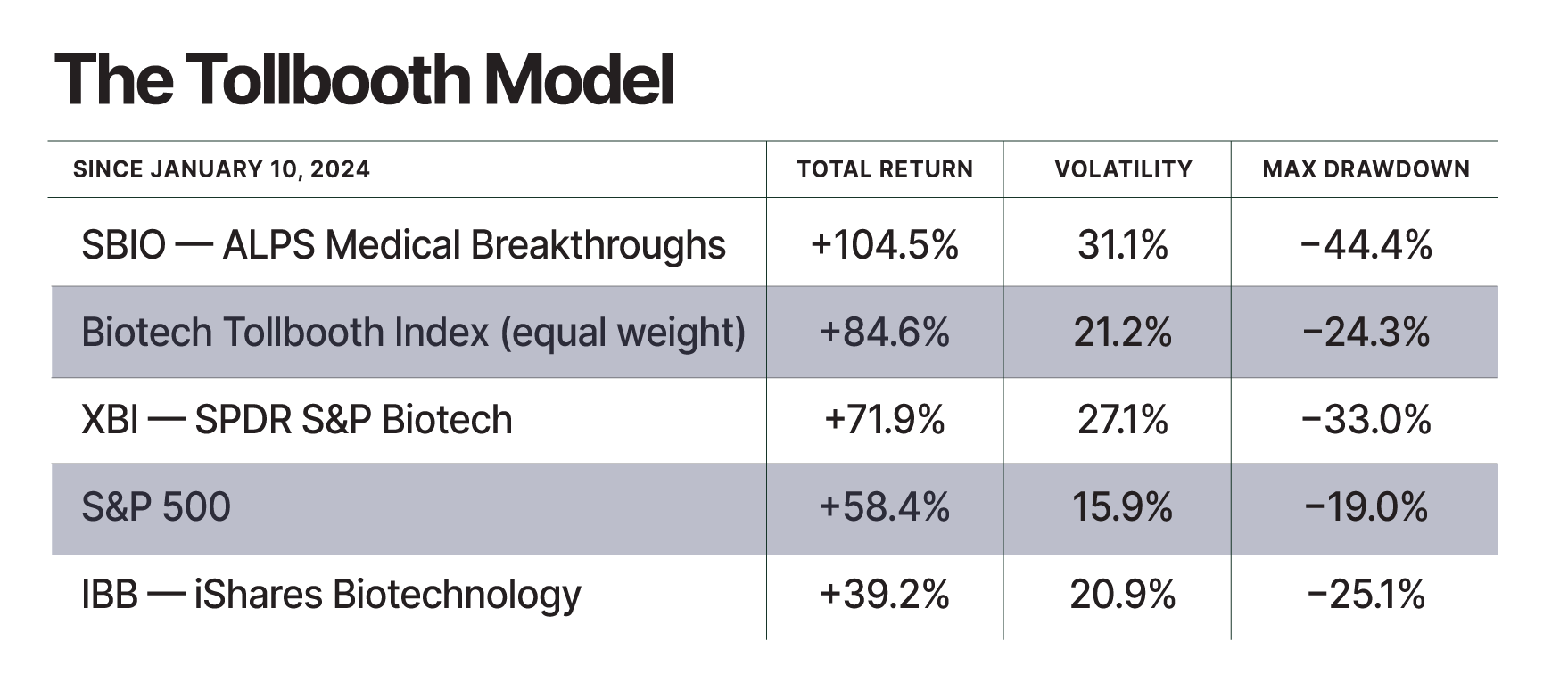
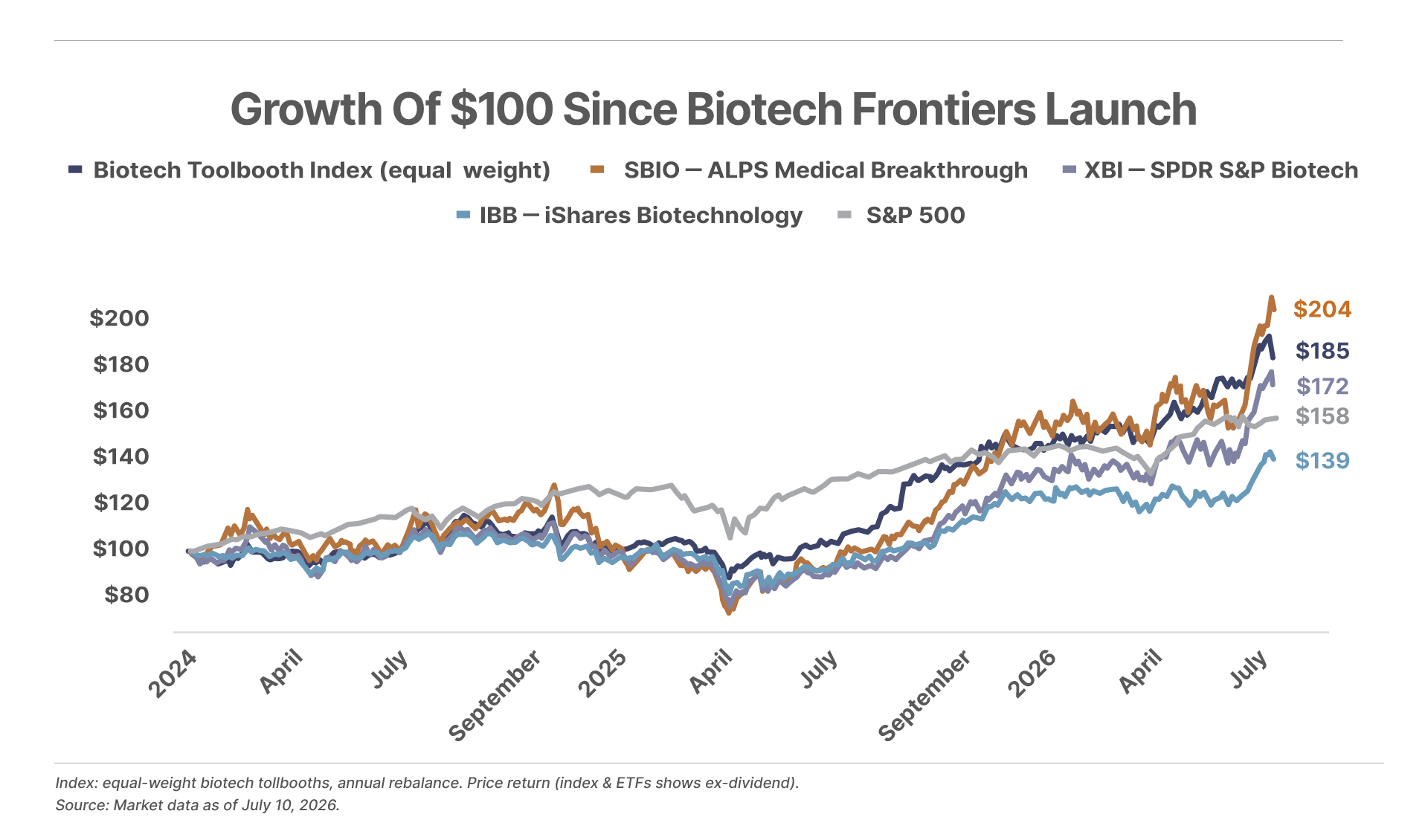
Growth of $100 since launch (Jan 10, 2024 – Jul 10, 2026). Index: equal-weight biotech tollbooths, annual rebalance.
The tollbooth basket returned +84.6% – beating XBI, crushing IBB, and roughly doubling the S&P 500. Only the most aggressive breakthrough ETF out-returned it, and look at the price of that extra return: 31% volatility and a −44% drawdown, versus the tollbooth index’s 21% and −24%. The tollbooth half captured nearly all of the breakthrough sector’s upside with roughly half the pain. That is the ballast end of the barbell, proven in real time.
The two halves of the barbell together give us the sector’s upside on a foundation that holds when individual bets fail – something neither a single ETF nor a pure stock-picking service can offer.
Step back from all of it – the tollbooths, the barbell, the track records – and one truth towers over the rest:
The single most important thing in biotech is simply to have exposure. And most investors still have none.
That was the masterstroke in early 2024, and it remains the masterstroke today. We were right that biotech booms follow tech booms – and the artificial-intelligence (“AI”) wave now reshaping the economy is only beginning to turn its tools on biology. Over the next decade, AI is going to compress drug discovery timelines, resurrect shelved compounds, and create staggering value in pharma. The companies that own the long-lived intellectual property that this revolution produces – the tollbooths – will collect a toll on all of it. And the breakthrough innovators will hand out the moonshots.
We caught this boom at the bottom, but there is a long way to go. I expect to see at least a decade of outstanding performance. The innovation engine is running faster than ever. With one hand on the tollbooth and the other on the frontier, we intend to ride it the whole way.
This is the last bull market you’ll ever need.
Tell me what you think of today’s Journal: porterstansberrydirect@gmail.com
Good investing,
F. Porter Stansberry
Mantoloking, New Jersey

3 Things To Know Before We Go…
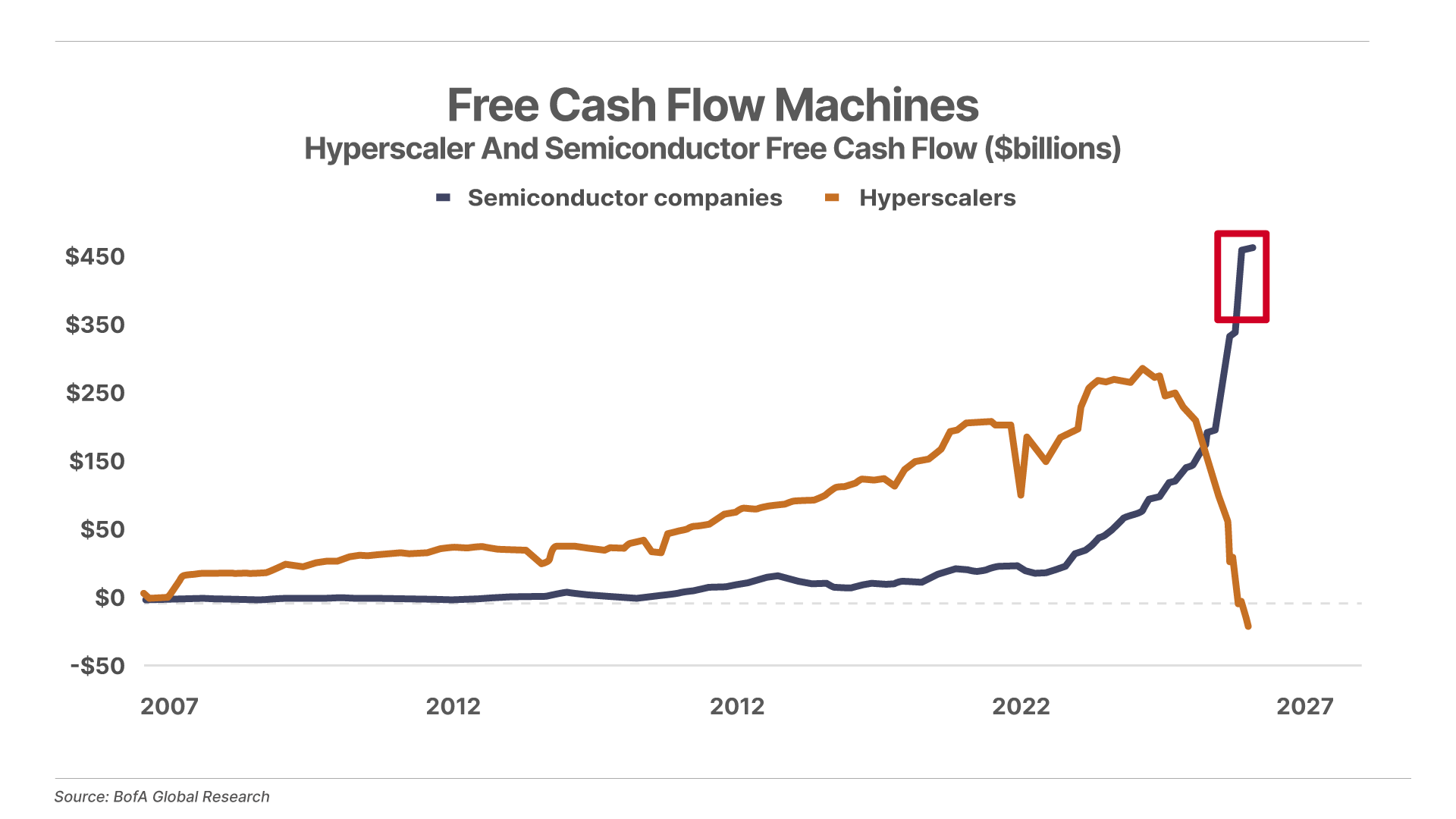
1. The AI boom’s real cash machines are the chipmakers. Bank of America projects that Nvidia (NVDA), Micron Technology (MU), Broadcom (AVGO), and Applied Materials (AMAT) will generate a record $430 billion in combined free cash flow over the next 12 months – more than triple their output two years ago. Over the same window, the combined free cash flow of Amazon (AMZN), Alphabet (GOOGL), Meta (META), Microsoft (MSFT), and Oracle (ORCL) is projected to turn negative for the first time since 2007 – down from a peak of roughly $260 billion in 2024. The hyperscalers are funding the buildout. The chipmakers are banking the cash.
2. AI bonds are the worst performers. Eight of the 12 worst-performing investment-grade (“IG”) bonds this year were issued by some of these AI-buildout funders, with Meta (META) the single biggest drag on the IG index. Alphabet (GOOGL), Amazon (AMZN), Meta, Microsoft (MSFT), and Oracle (ORCL) have piled on roughly $350 billion in debt over five years. With an additional $725 billion in pledged spending this year, credit investors are demanding more compensation for AI-capex risk.
3. Traffic through the Strait of Hormuz has collapsed again. Kpler, which tracks seaborne tanker movements, logged 13 crossings last Wednesday versus a 33-a-day average the prior week. The June 17 U.S.–Iran deal to reopen the strait broke down last week after Iran attacked three ships, drawing fresh U.S. airstrikes and sanctions. Tehran now says the strait is closed “until further notice,” but the Trump administration rejects the claim and says the Navy-escorted lane along Oman’s coast remains open. For now, markets are siding with Washington: Brent crude is trading near $79, well below the $120-plus it hit when the strait first shut earlier this year. But we’ll see: A genuine reclosure would strand roughly a fifth of the world’s seaborne oil and liquified natural gas and push prices higher again.
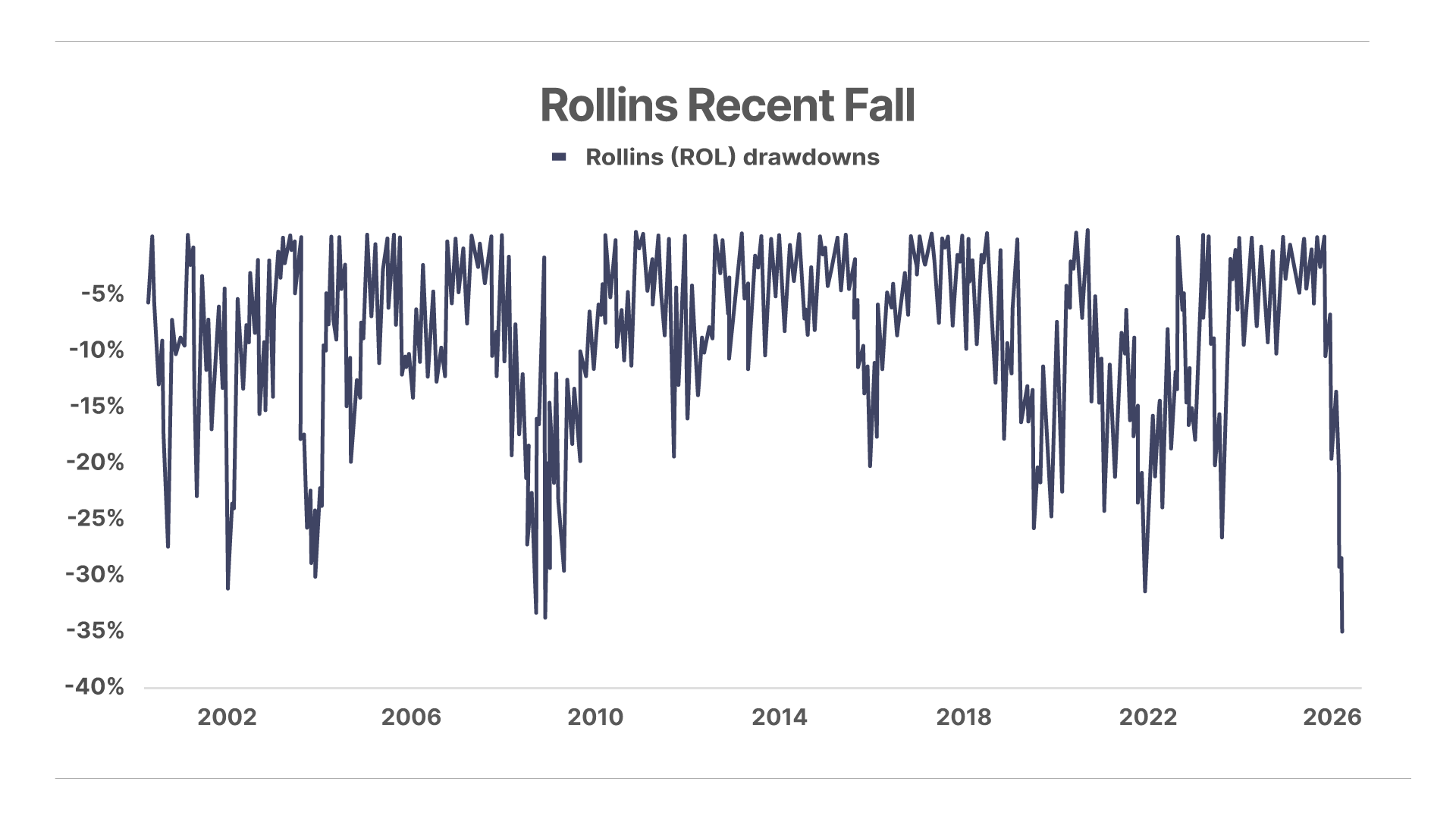
Chart Of The Day… Rollins (ROL)
Pest-control company Rollins (ROL) has suffered its largest share-price decline in 25 years, down 35% in six months. Rollins was among the stocks Terry Smith’s Fundsmith sold in Q1 after the fund manager threw in the towel on his prior strategy of buying and never selling high-quality businesses, focusing instead on “momentum” stocks. These kinds of capitulations often mark the bottom, and we suspect the same could be true for Rollins.
Mailbag
On Friday, Tech Frontiers editor Erez Kalir announced that the July issue was his last, and Porter announced that he would be taking over the monthly stock selection and issues for the Porter & Co. newsletter focusing on biotech, tech, and the blockchain.
“It Is A Shame”
Tammy A. writes:
Porter,
I really hope you are on the hunt for another biotech expert post-Erez – if there is anyone else even in his league. What a huge loss for the Porter & Co. family. I’ll be selling all his recs as there is no way to keep up with the updates.
Jaro V. writes:
I am writing to express my genuine sadness after learning that Erez Kalir is leaving Porter & Co. It is incredibly disappointing to see him go so soon, especially since I don’t believe we have even experienced a true bull market in biotech.
While I never had the pleasure of meeting Erez personally, the way he presented himself always stood out. He came across as deeply humble, despite having a phenomenal educational background. He was a careful but incredibly confident speaker and an exceptional investing mind. His approach made it incredibly easy to trust him and confidently take on his biotech recommendations. His market insights are going to be very missed.
I also noted in the latest newsletter that Porter will be taking charge of the Tech Frontiers moving forward. I would greatly appreciate it if you could elaborate more on how this transition will work and how the portfolio will be managed. Frankly, I have never felt that this specific type of investing – focusing on low-cap, higher-risk equities – is traditionally your “cup of tea.” Hearing more about your strategy and vision for this specific letter would be very reassuring.
Finally, I would like to pass along a sincere thank you to Erez. Thank you for your immense dedication to your subscribers. I wish you the very best of luck in your next chapter, and I hope that you might eventually find your way back to Porter & Co. in the future.
Sincerely
Gary K. writes:
Porter and team.
I wanted to check in with regards to Erez’s announced departure from Tech Frontiers. It seemed abrupt, particularly on the heels of transitioning the advisory from biotech specific to broader tech/biotech which made a ton of sense just based on flexibility to pursue numerous innovative sub sectors. That said, I know the original mandate was a biotech advisory in the same vein as Dave Lashmet’s Venture Technology service, which Erez was uniquely qualified to author. I’m curious what the go-forward plan is for the service relative to the original mandate. I greatly appreciate the content that you and your team assemble. I’ve been a Partner Pass member from its first availability. You and your team’s ability to see around corners, inform us of angles that consensus hasn’t yet contemplated (both market and stock specific), and willingness to stick your neck out on ideas is unsurpassed in my view.
Thanks and best regards.
Porter Comment: Hi Gary —
Thanks for your note.
Erez’s departure is a disappointment.
It is difficult to keep talented people to stay engaged when they have many professional opportunities. Writing is a difficult job and it is actually a very different job than investing.
I’ve been pretty good at recruiting and developing talent and I’m sure we will find someone soon.
In the meantime, I’m going to do my best. And after 25 years in these markets and after working with both Dave Lashmet and Erez, I think I can do a good job.
Hope you’ll stick with us.
Porter & Co. Top Positions
| Publication | Ticker | Description | Total Return |
|---|---|---|---|
| Tech Frontiers | QURE | uniQure | 237% |
| Complete Investor | BWXT | BWX Technologies | 226% |
| Tech Frontiers | TGTX | TG Therapeutics | 161% |
| Tech Frontiers | ROIV | Roivant Sciences | 159% |
| Complete Investor | SKWD | Skyward Specialty Insurance | 141% |
| Tech Frontiers | SGMT | Sagimet Biosciences | 137% |
| Complete Investor | BTC/USD | Bitcoin | 136% |
| Complete Investor | ARM | ARM Holdings | 134% |
| Tech Frontiers | QURE | uniQure | 131% |
| Tech Frontiers | NUVB | Nuvation Bio | 129% |
Prices as of 4:00 pm ET July 10, 2026
Please note: The investments in our “Porter & Co. Top Positions” should not be considered current recommendations. These positions are the best performers across our publications – and the securities listed may (or may not) be above the current buy-up-to price. To learn more, visit the current recommendations page of the relevant service, here. To gain access or to learn more about our current recommendations, call our Customer Care team at 888-610-8895 or internationally at +1 443-815-4447.