Issue #120, Volume #3


Buffett’s Biggest Mistake Might Have Been His Last
Inside Today’s Issue
In 1720, Sir Isaac Newton was the Master of the Mint – the most trusted and careful quantitative mind in Europe.
He was also an avid investor. He owned the SpaceX of his day – The Governor and Company of the Merchants of Great Britain, Trading to the South Seas and Other Parts of America, and for the Encouragement of the Fishery. (You can understand why most people just refer to it as the South Sea Company.)
It owned a royal monopoly on British trade with Spanish South America, which, most importantly, included the “Asiento de Negros.” That was the contract to supply enslaved Africans to the Spanish plantations in America. The money wasn’t in transporting the slaves. It was in smuggling sugar after gaining access to Spain’s ports. Back then, sugar was the most valuable commodity in the world, much like oil is today. In the early 1700s, sugar made up about 25% of all imports to Europe. It was Britain’s most valuable import for almost a century, before cotton finally surpassed it in 1825. There was a fortune to be made in sugar, and the South Sea Company was the best way to invest in the opportunity.
The stock became so popular that the company proposed to take over the bulk of Britain’s national debt – roughly £31 million of government annuities, by converting the securities into South Sea shares.
The company issued new stock at a face value equal to the debt it absorbed. Seems reasonable. But there was a very important wrinkle: if the share price rose above face value, the company could sell the excess shares and pocket the difference. Thus, every uptick in the price directly enriched company insiders. And that gave them every reason to drive the price up, by any means necessary, including bribes of stock to politicians, loans to buyers secured by the very shares they were buying, and using the company money to buy its own stock. A mania was born.
By the spring of 1720, Isaac Newton realized it was time to sell. On April 19, he sold 3,000 shares. Through May he sold more. And on June 14, he “puked” the stock, selling every share he owned. Newton walked away with a profit of roughly £20,000, which was an enormous fortune at the time.
But then… he watched the stock going higher and higher… without him!
After about six weeks, he couldn’t take it anymore. By late July, he was converting his safe government annuities back into South Sea stock, at twice the price he had sold! And, fatefully, on August 24, he subscribed to a new offering of shares. Four weeks later, the stock collapsed. He rode it into the ground, losing everything he’d made, and then some.
A mania doesn’t convert fools. The fools were always in. A mania converts the skeptics. And the top is in when the “last bull” finally buys.
In the 1860s, Jay Cooke was the most trusted banker in America. He financed the Union in the Civil War, selling government bonds to farmers and shopkeepers by the millions. When the Northern Pacific Railroad first asked him to underwrite its transcontinental line in 1865, he turned it down. He called it speculation, and he said he did not do speculation. He stayed out of railroad stocks for four years.
But in 1869, he changed his mind. By 1870, his firm was the Northern Pacific’s exclusive banker. He sold its bonds to the public the same way he had sold war bonds. And then… when the public stopped buying, he bought the bonds himself, onto his own balance sheet. By 1873, Jay Cooke & Company owned roughly three-quarters of the railroad, using his bank’s depositors’ money. On September 18, 1873, his firm suspended payments and failed. Two days later, the New York Stock Exchange closed for the first time in its history and stayed shut for 10 days. A hundred banks went down behind it. The country fell into a depression that ran the rest of the decade.
Jay Cooke was the last bull.
Stanley Druckenmiller ran money for George Soros for 20 years. He’d helped break the Bank of England in 1992. In early 2000 he looked at the internet stocks and knew it was a bubble. They were up 10-fold over the previous 18 months and he knew they would collapse. He shorted them. He put $200 million short in February. By mid-March the market had run him over and the short had lost $600 million. He was down 15% on the year.
But inside the firm, two young traders he had hired kept buying the stocks he had just sold. Their small account was up 50% on the year! Druckenmiller watched it every day. The market was going up, without him!
‘So like around March I could feel it coming. I just, I had to play. I couldn’t help myself,’ he explained.
Three times that week he reached for the phone and stopped. Then he picked it up. He bought $6 billion of technology stocks on the very day that the Nasdaq topped (March 10, 2000). “I think I missed the top by an hour.”
In six weeks Druck lost $3 billion and his job. Asked later what he learned, he said:
I didn’t learn anything. I already knew that I wasn’t supposed to do that. I was just an emotional basket case and couldn’t help myself.
Kevin O’Leary, famous from his role on the hit ABC show Shark Tank, called Bitcoin garbage in 2019. In January 2021, with the coin climbing, he called it a giant nothingburger and said he would never own it. But… it kept going up! Without him! By March 2021 he owned it with 3% of his portfolio. He kept buying. By November it was 10% of his portfolio. On November 12, 2021, Bitcoin hit its then all-time high near $69,000. Bitcoin fell roughly 75% over the next 13 months.
By early this spring, the AI mania had turned chip and memory stocks into the hottest investments in the world. The Philadelphia Semiconductor ETF (SOX) had risen more than 80%. Micron Technology (MU) was up more than 200%. Sandisk (SNDK) was the single best-performing stock in the S&P 500. Money poured into AI picks-and-shovels names on the theory that an industry (semiconductors) that has been defined by booms and busts since its inception would no longer ever bust.
Terry Smith built Fundsmith on three rules: buy good companies, don’t overpay, do nothing.
This year, badly trailing the index with a portfolio of the highest-quality businesses in the world, Smith decided to do something. He dumped all of his best stocks – Intuit (INTU), Rollins (ROL), LVMH Moët Hennessy Louis Vuitton (LVMUY), Otis Worldwide (OTIS), Wolters Kluwer (WTKWY), Novo Nordisk (NVO), and Nike (NKE). He bought what looked like it had momentum: GE Vernova (GEV), AppLovin (APP), Netflix (NFLX), and Taiwan Semiconductor (TSMC) at enormous high multiples, with no margin of safety.
Will Terry Smith be remembered as the last bull of this mania? No, I think history will remember Warren Buffett as the last bull of the AI mania.
On June 1, Buffett’s Berkshire Hathaway bought $10 billion of Alphabet (GOOG). It was part of an enormous $80 billion equity raise that went directly into Google’s AI build-out. On July 15, sitting across from CNBC’s Becky Quick, Buffett took full credit for the investment. “I initiated it.”
The same investor who bought Coca-Cola (KO) in 1988 at 14x earnings and who bought Apple (AAPL) in 2016 at 10x earnings, net of its cash, was buying Google at the top of the cycle, at 27x earnings… just as its launching its largest capital investments ever on a completely unproven theory that demand for compute can only grow.
If Buffett’s Google deal is the “last bull,” it won’t be the first time.
In 2008, Buffett bought a large position in ConocoPhillips (COP) with oil near $145 a barrel – because he honestly believed the world was running out. Oil then fell 70%.
Without urging from Charlie or anyone else, I bought a large amount of ConocoPhillips stock when oil and gas prices were near their peak. I in no way anticipated the dramatic fall in energy prices that occurred in the last half of the year… the terrible timing of my purchase has cost Berkshire several billion dollars.
The mania does not convert fools. The fools were always in. A mania saves its cruelest trick for the last disciplined investor. When he finally caves, the buying is done, because he was the last buyer left.
The last bull.
Tell me what you think of today’s Journal: porterstansberrydirect@gmail.com
Good investing,
F. Porter Stansberry
Stevenson, Maryland
P.S. I urge all of our subscribers to read Warren’s Mistakes. It’s a book I spent more than a decade writing. It tracks all of Warren Buffett’s biggest investment mistakes and shows you exactly how to avoid making them yourself. Buffett built the greatest investment machine in history. The book shows you exactly how it worked and exactly how he broke it. There’s no better way to learn how to become a great investor than by studying the mistakes of the greatest investor who ever lived. Available at Amazon and now on Audible too.
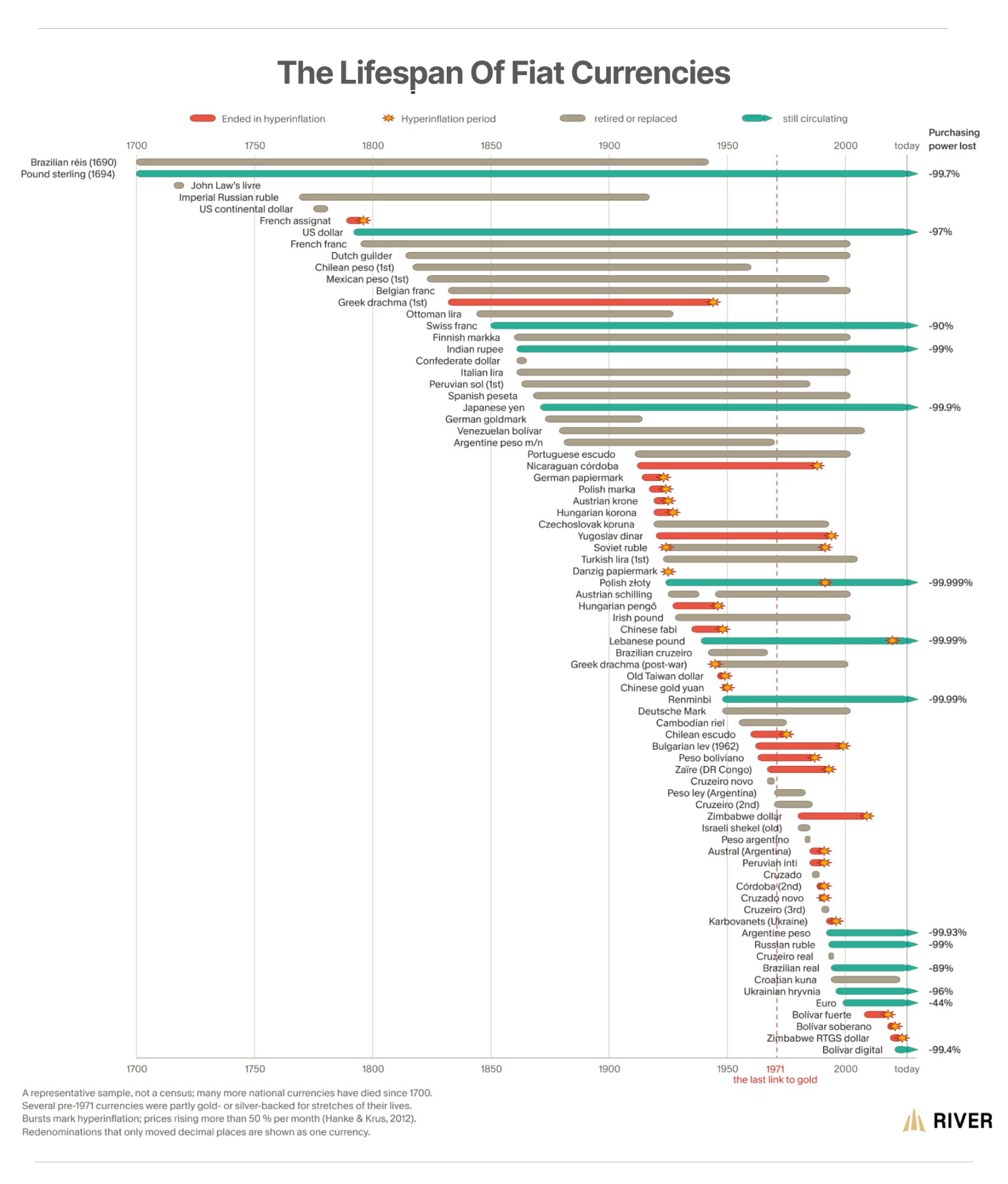
1. Fiat currency is a melting ice cube. Every paper currency in history has lost most of its purchasing power. Even the relatively rare, long-lived survivors prove the point: the British pound, in use since 1694, and the U.S. dollar have each lost well over 90% of their buying power over their lifetimes. Fiat money – currency that derives its value by government decree rather than because it’s backed by gold or silver – doesn’t need a dramatic hyperinflation to punish savers. Ordinary, compounding inflation does it quietly.
2. Margin mania unwinds in Korea. South Korea’s stock market is currently experiencing a historic deleveraging. According to the country’s Financial Supervisory Service, more than 1.2 million retail accounts hit margin call thresholds in mid-July, or one in every 30 adults in the country. After becoming the best-performing stock market globally over the past year, the South Korean KOSPI index has dropped 30% in the last month as forced liquidations caused a cascade of selling. Chalk this one up as “a sign of the times.”
3. Chip stocks sell off on a surprise AI breakthrough. Moonshot, an open-source Chinese AI startup, sent shockwaves through markets with the release of its Kimi K3 – and drove a third straight day of semiconductor selling, with the iShares Semiconductor ETF (SOXX) down nearly 9% on the week. But even if Chinese labs are training AI models more cheaply, inference (actually using the models) is where compute demand is headed – and K3 shows no inference advantage at all.
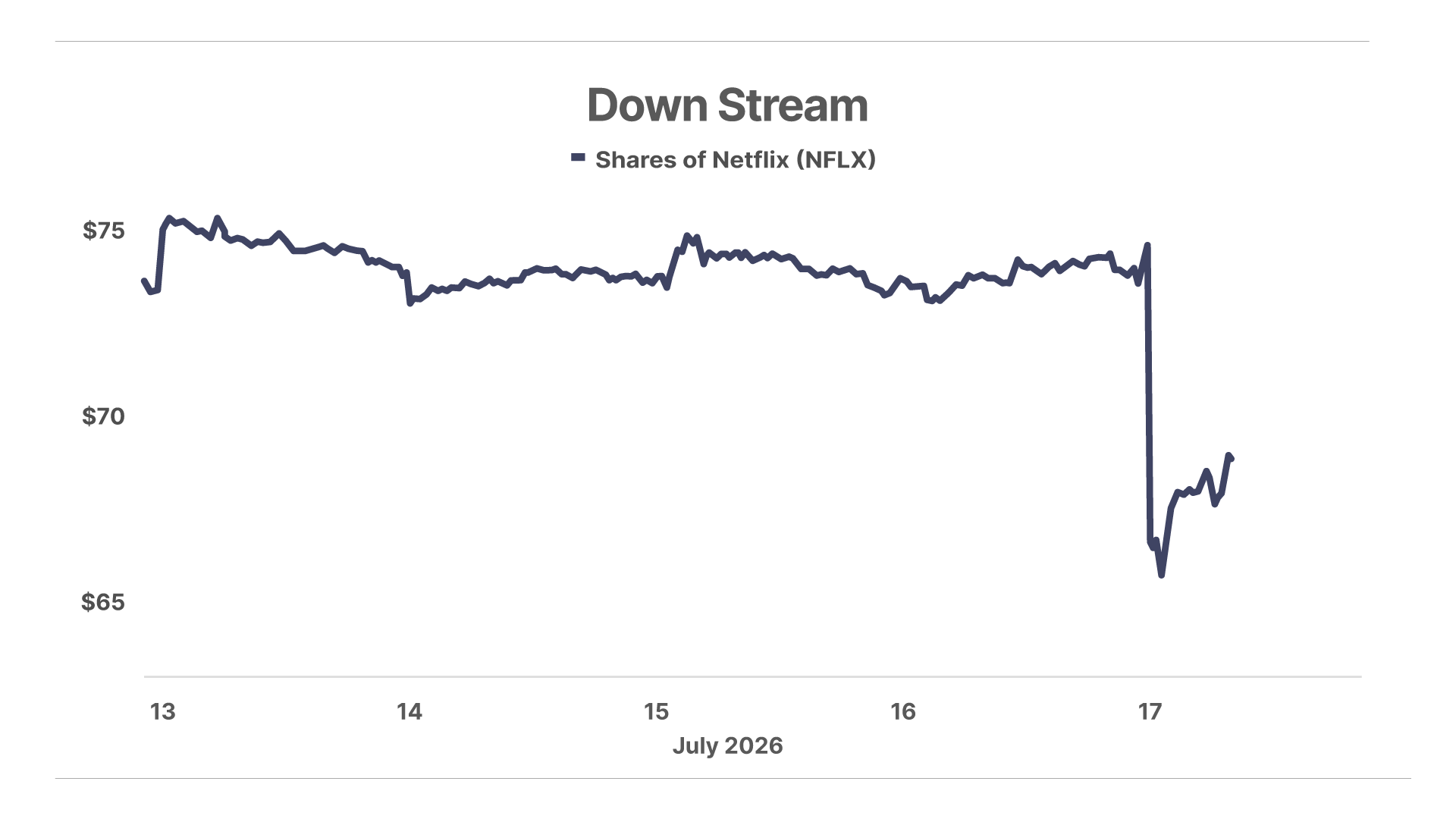
Shares of media streaming company Netflix (NFLX) plunged as much as 12% this morning after reporting weaker-than-expected earnings. The stock has now fallen nearly 50% over the last 12 months and is trading at its lowest level since August 2024.
In Wednesday’s Daily Journal, Porter explained how using simple math, you can take virtually any portfolio – whether it’s Erez Kalir’s biotech or Warren Buffett’s compounders – and vastly increase that portfolio’s returns. You don’t take more risk, either, he said. You take less.
“The Kelly Way”
Opher L. writes:
Seems like this Kelly algorithm could work well for the tollgate part of the biotech barbell you outlined, but I think the “rocket” side is ill-suited to it. There may not be any signal there. It is more like bonds that you buy for a penny on the dollar. Very binary with any “signal” in the price or earnings representing hopes and dreams rather than any real predictor of future success. Even for pseudo-toll gates like Fortress Biotech (FBIO), which has actual earnings, the signal is weak, but perhaps it is meaningful enough. I think Erez Kalir’s contribution here was in identifying those among the “rocket” side that could potentially either produce an actual quantifiable signal, or could at least produce an intuitive subjective signal that was processed by a human brain, since there were no earnings and the expectations for future earnings did not seem to me easily quantifiable to plug into Kelly’s formula.
As regards the rocket side, is the plan to start with members of the broader biotech index, where there is probably a more reliable signal, and look for the companies with the strongest Kelly formula value? Or perhaps start with any biotech company not replicating the tollgate side and having reliable positive EPS for more than some number of years?
Porter Comment: Actually, it’s the opposite.
Kelly engines are designed to price binary events — like a bet, or an FDA decision. They don’t allocate perfectly for things like ongoing businesses with regular cash flows. For those kinds of assets, the risk-parity approach works best.
Porter & Co. Market Snapshot
| Price | Yesterday’s Return | Year-to-Date Return | |
|---|---|---|---|
| S&P 500 Index | $7,533.77 | -0.51% | 10.7% |
| Gold per ounce | $3,976.50 | -2.20% | -7.6% |
| Bitcoin | $64,081 | -1.32% | -28.5% |
| Oil (West Texas Intermediate) per barrel | $78.95 | -1.31% | 41.6% |
| Berkshire Hathaway (BRK) | $738,500.00 | 0.73% | -2.2% |
| Porter’s Permanent Portfolio | – | 0.69% | 0.3% |
| The Better Than Berkshire Index | – | 1.06% | 9.0% |
| Total Return | Annual Return | ||
| Porter & Co’s Top Ranked* | 35.9% | 16.5% | |
| Yield | Yesterday’s Change | Change Year-to-Date |
|
| U.S Treasury 30-Year Yield | 5.08% | -2 bps | 24 bps |
*A Complete Investor risk rating of 1 is defined as a “low risk, high allocation” security, while positions rated closer to a 5 are higher risk. Porter & Co.’s top-ranked positions include those rated either 1 or 2 in Complete Investor portfolio.
Porter & Co. Top Positions
| Publication | Ticker | Description | Total Return |
|---|---|---|---|
| Tech Frontiers | QURE | uniQure | 237% |
| Complete Investor | BWXT | BWX Technologies | 205% |
| Tech Frontiers | TGTX | TG Therapeutics | 155% |
| Tech Frontiers | ROIV | Roivant Sciences | 150% |
| Tech Frontiers | SGMT | Sagimet Biosciences | 142% |
| Complete Investor | SKWD | Skyward Specialty Insurance | 137% |
| Complete Investor | BTC/USD | Bitcoin | 136% |
| Complete Investor | PM | Philip Morris | 136% |
| Tech Frontiers | QURE | uniQure | 131% |
| Tech Frontiers | NUVB | Nuvation Bio | 122% |
Prices as of 4:00 pm ET July 16, 2026
Please note: The investments in our “Porter & Co. Top Positions” should not be considered current recommendations. These positions are the best performers across our publications – and the securities listed may (or may not) be above the current buy-up-to price. To learn more, visit the current recommendations page of the relevant service, here. To gain access or to learn more about our current recommendations, call our Customer Care team at 888-610-8895 or internationally at +1 443-815-4447.