Issue #110, Volume #3


The Big Winner Of The AI Revolution
Inside today’s Daily Journal…
|
Editor’s note: Porter & Co. will be closed tomorrow, Friday, July 3, in honor of Independence Day. The Daily Journal and the Customer Care team will return on Monday, July 6.
Also note that Porter’s 2029: The End of America – which continues to move up the best-seller list – is now available as an Audible book here, or to read on Amazon here.
The consensus trade of this decade is artificial intelligence (“AI”).
The hyperscalers. The data-center landlords. The chip designers. The power companies feeding them. The logic is intuitive: if intelligence is the new electricity, own the machines that make it.
But the question of whether a business is a good investment is not decided by the value of its product. Air travel, for example, is a service of enormous utility. But airlines are a terrible investment.
For a business to yield outstanding results to investors, it must possess outstanding economics. And, most importantly, it must possess a moat – a means of preventing additional capital from flooding the market and driving marginal returns to zero.
The danger for AI investors is two-fold.
First, a chip that defines the AI technological frontier becomes a discounted item in 18 months. The technology is evolving so rapidly that it has, so far, been impossible for any particular model to maintain its technological leadership. But that won’t stop the AI companies from trying. The resulting depreciation schedules and corresponding capital budgets are staggering.
But even that’s not the real problem – which brings us to the second danger. Massive investments in rapidly depreciating computer architecture could be afforded if it were possible to lock-in customers and increase prices over time. Alas, that is completely impossible. There are zero switching costs between AI models. I run two of them constantly so that I can evaluate in real time which is performing better. I spend my tokens accordingly. Not only is there no brand loyalty, there’s also a constant, real-time Pepsi Challenge going on every day.
AI is an industry that looks to have even worse economics than airlines. High capital intensity, brutal depreciation, rapid obsolescence, and zero customer lock-in. If I’m right, the worst thing for any of these businesses is revenue growth. When you’re losing money on every user, you’re not going to make it up with volume.
But this doesn’t mean that AI is going away – planes still fly every day.
Where Will The Real Value Of AI Show Up?
The abundance of cheap digital intelligence is real, and it is going to be the defining economic force of our lifetimes. The question for investors is this: where will the value it creates accrue?
Ironically, abundance does not always create value for the producer of the abundance. When electricity became cheap and ubiquitous, the fortunes were not made by the utilities. They were made by the businesses that used cheap power to make something the market could not easily copy, where prices and margins could remain at a certain level even as the cost of production fell.
The question every investor should be asking is not who sells the best intelligence? It is: what is the most valuable product that can be made with this intelligence?
The answer is obvious. And it is already making some of our subscribers very, very wealthy.
Erez Kalir recommended Roivant Sciences (ROIV) to Tech Frontiers subscribers in March 2024 at $11.37 per share. Anyone who acted on that recommendation is sitting on a gain of roughly 208%. And, I suspect, there’s another 10x upside in the business and others like it. But Roivant is the clearest example I’ve found of the one place the artificial-intelligence boom is going to mint durable fortunes.
Pharmaceuticals is the rare business where the moat is written into federal law.
A patented drug approved by the Food And Drug Administration (“FDA”) is protected from competition by statute for the life of its patents. During that window, the manufacturer can set a price near the value the medicine delivers to the patient, not near its marginal cost of production, which for many drugs is negligible. Gross margins on approved branded drugs routinely run north of 80%. The switching cost is total: a patient stabilized on a working therapy does not shop around. And the product itself – a molecule that safely and measurably improves a human life – is the definition of scarce. Most attempts to make one fail.
That’s why novel therapeutics command monopoly economics: they are extraordinarily hard to discover. Big Pharma spends roughly $350 billion a year on research and development (“R&D”), feeding something like 15,000 novel therapies into the pipeline at any given moment. But the FDA only approves around 50 new drugs a year. The bottleneck is not manufacturing. It is intelligence – the ability to predict, among thousands of candidates, which few will work in a human body.
Intelligence is exactly what AI produces in bulk. The AI revolution is a machine for driving down the cost and driving up the capability of prediction, pattern recognition, and analysis. AI’s product – cheap and accurate predictions – will drive the marginal price of intelligence to zero, as there is zero switching cost.
But, in pharmaceuticals, the plummeting cost of accurate predictions is merely an input into a product whose price is protected by patent and whose scarcity is protected by biology.
What’s the most profitable way to use AI? Using the falling cost of intelligence in the highest-margin, most defensible, most scarcity-protected product in the economy.
You get a miracle factory.
And, if you owned a miracle factory, where would you look for leads…?
Big Pharma has a discard pile. Because each company can only afford to push a handful of candidates through the gauntlet of clinical trials – costing hundreds of millions of dollars – the vast majority of promising compounds sit on the shelf. These are abandoned not because they failed, but because they lost an internal competition for resources, or corporate priorities shifted.
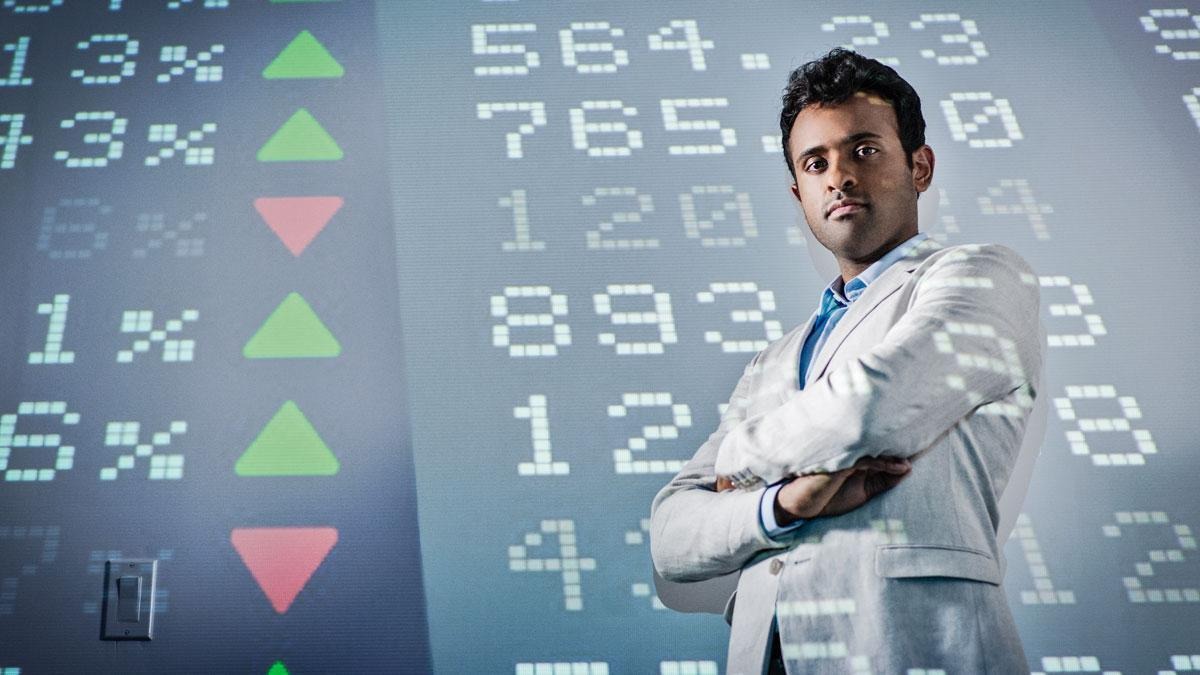
Roivant’s founding insight, hatched by Vivek Ramaswamy after years running the biotech book at the hedge fund QVT Financial, was to build a systematic, data-driven engine for finding the unrecognized gems in that Big Pharma discard pile and buying them at fire-sale prices.
Roivant can develop transformative medicines faster by building and applying computational tools to drug discovery. It built a dedicated artificial-intelligence subsidiary, VantAI, alongside its own data company Datavant, and paired them with its clinical-technology arm Lokavant. This is an entirely new way of developing therapeutics.
The single best illustration of the machine at work is a deal that Erez described in his original recommendation.
In 2021, Roivant identified a compound sitting in Pfizer’s (PFE) discard pile – an inflammatory-bowel-disease candidate then called PF-06480605. Roivant licensed it into a subsidiary called Telavant, paying Pfizer $45 million for a 75% stake and investing a further $5 million to complete a Phase IIb trial. The trial results were startling: a 36% remission rate in ulcerative colitis, roughly twice the standard of care.
In October 2023 – 10 months after striking the deal – Roche bought Telavant for $7.1 billion. Roivant’s three-quarters share was $5.3 billion. A greater than 100x return in under a year.
Skeptics called it luck. We knew better.
Roivant’s approach produced six FDA-approved drugs and 10 consecutive positive Phase III trials for in-licensed compounds, at an R&D efficiency of roughly $85 million per clinical readout – five to 10 times better than its Big Pharma peers.
That is a miracle factory.
Roivant is a computational engine for the single hardest judgment in today’s economy – deciding which of thousands of existing, de-risked compounds is most likely to succeed, and buying the winners before anyone else recognizes them.
The cost of the analytical input – the scanning, the modeling, the probability-weighting across a vast database of pipeline compounds – is collapsing toward zero as digital intelligence gets cheaper and more capable.
But the value of the output – a patented, approved, life-improving medicine – is protected by law and biology and does not fall at all.
Roivant sits precisely on that spread. Every improvement in the cost and capability of computation widens the margin between what it pays to find a winner and what a winner is worth.
That’s the miracle factory.
But to execute the business model, Roivant needs more than great data science. It must master patent protection and, even more importantly, capital allocation. Like any other business, Roivant’s capital is limited. It must constantly reevaluate its portfolio and focus on its most valuable targets.
In the March 2024 issue of Tech Frontiers, Erez devoted several pages to something almost no one on Wall Street was pricing – Roivant’s patent-infringement claims against Moderna (MRNA) and Pfizer over the lipid-nanoparticle technology that made their COVID vaccines possible, held through its subsidiary Genevant Sciences. Erez called it a “litigation asset,” walked through an expected-value analysis with the help of an intellectual-property expert, and assigned it a probability-weighted value of roughly $2.1 billion.
That call has now paid off in cash. In its results for the fiscal year that ended March 31, 2026, Roivant disclosed a $2.25 billion global settlement with Moderna ending all pending patent litigation between Genevant, Arbutus Biopharma, and Moderna. Moderna is to pay $950 million in July 2026, with a further $1.3 billion contingent on the resolution of an appeal. The company booked a $770.2 million gain on the settlement and carried a litigation-settlement receivable of the same amount on its balance sheet.
On capital allocation, we’ve seen recent moves that show excellent execution. Roivant sold Dermavant, the subsidiary holding its Vtama skin cream, to Organon (OGN) in a transaction with an aggregate value of up to approximately $1.2 billion, including a $175 million upfront payment and a $75 million milestone for FDA approval in atopic dermatitis. Meanwhile, the company repurchased $1.3 billion of its own shares in the fiscal year that ended March 2025, reducing its share count 14% in 12 months. This is selling proven drugs to invest in owning the future pipeline and will be massively accretive for shareholders.
Why do they want to own more of their pipeline? Because it has advanced on nearly every front.
Brepocitinib – an oral TYK2/JAK1 inhibitor – hit statistically significant benefit on all 10 ranked endpoints in its pivotal dermatomyositis trial. It has been accepted for FDA review with Priority Review and a target action date in Q3 2026.
Roivant’s next-generation FcRn inhibitor, IMVT-1402, delivered striking early data in difficult-to-treat rheumatoid arthritis – a 72.7% ACR20 response at week 16 in a population where the overwhelming majority had already failed multiple advanced therapies. This drug has a slate of potential applications across Graves’ disease, myasthenia gravis, and other autoimmune indications.
But, look, I don’t want you to get bogged down in all of the jargon and in every potential new drug.
Instead, imagine if someone told you back in 1999 that the big winner in the new internet economy wasn’t going to be the company building it – Cisco Systems (CSCO). It was going to be the company best able to use the internet to build new services, like offering same-day delivery on every single retail product in the world: Amazon (AMZN).
Amazon was the miracle factory of the internet.
Roivant Sciences is the miracle factory of AI.
Tell me what you think of today’s Daily Journal: porterstansberrydirect@gmail.com
Good investing,
F. Porter Stansberry
Stevenson, Maryland

3 Things To Know Before We Go…
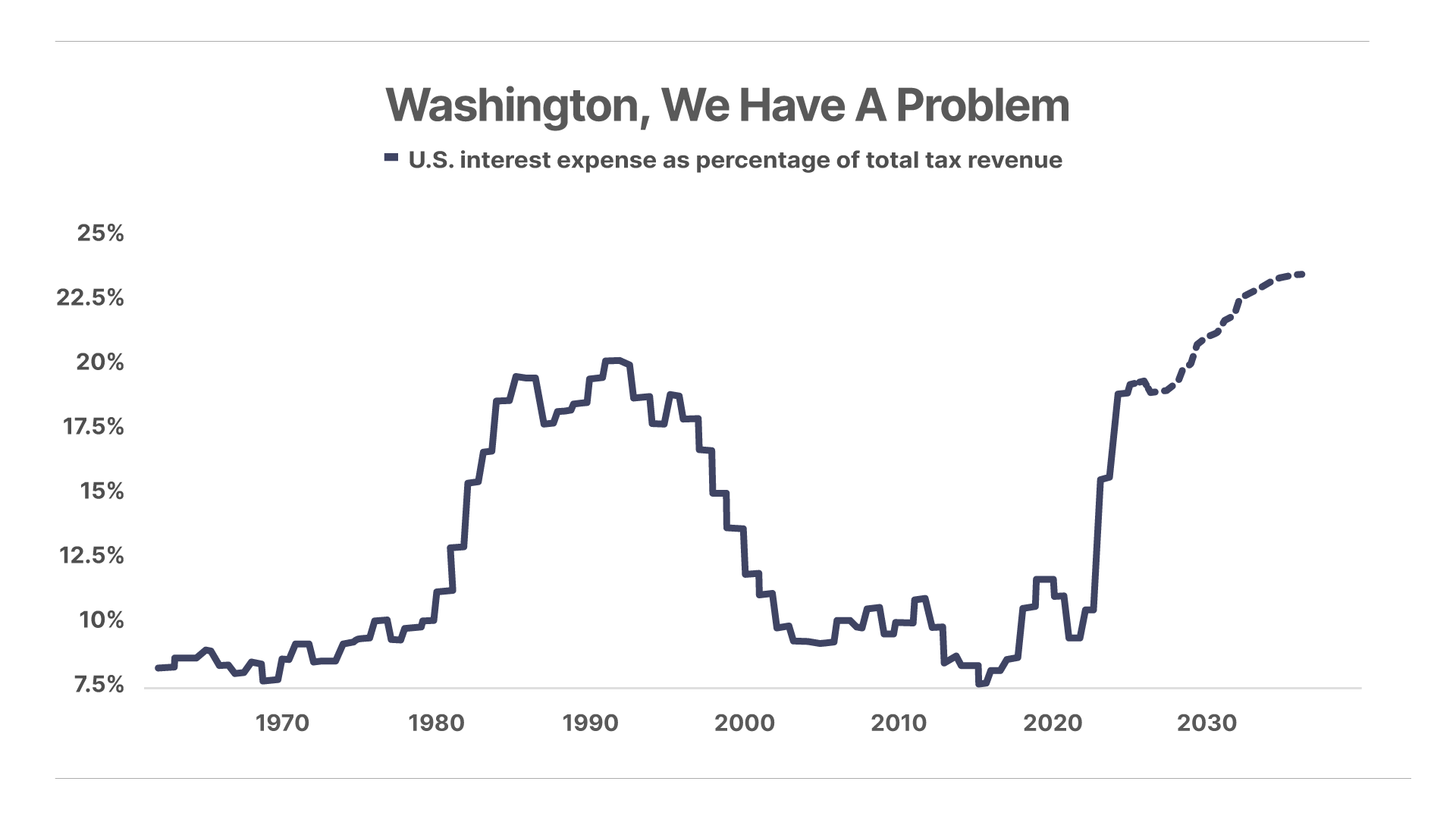
1. Washington spends one of every five tax dollars servicing its own debt. Net interest payments hit $970 billion in fiscal 2025 – 19% of all federal revenue – and the Congressional Budget Office (“CBO”) projects the ratio to climb to 26% by 2036. Interest already exceeds defense and Medicare spending. This is fiscal dominance in plain sight: with $38 trillion of debt, the Treasury cannot afford sustained high rates, which means the pressure valve is inflation and a debased dollar – the only way to protect against it is by owning high-quality assets.
2. OpenAI floats handing Washington a 5% stake as political scrutiny mounts. The proposal, reported by the Financial Times this morning, would be worth roughly $42.6 billion based on the AI company’s $852 billion valuation from its March funding round. CEO Sam Altman has argued that giving the public a direct stake in AI’s upside is the best way to defuse political pressure, and he’s held “active talks” on the structure with President Donald Trump, Commerce Secretary Howard Lutnick, and Treasury Secretary Scott Bessent. The proposal envisions other leading U.S. AI developers – including Anthropic, Google, and Meta – also handing over 5% stakes, though none has said they would agree. Uncle Sam already holds a 10% stake in Intel (INTC) after an $8.9 billion investment last August. Talks remain “conceptual”…
3. The June jobs report missed badly – but the unemployment rate fell anyway. Payrolls grew just 57,000 versus 113,000 expected, and April and May were revised down by a combined 74,000. Yet unemployment dropped to 4.2% because fewer people were looking for work: labor force participation fell to 61.5%, a five-year low. Leisure and hospitality shed 61,000 jobs, a warning sign for discretionary consumer spending. The news quieted the rate-hike chatter, for now.
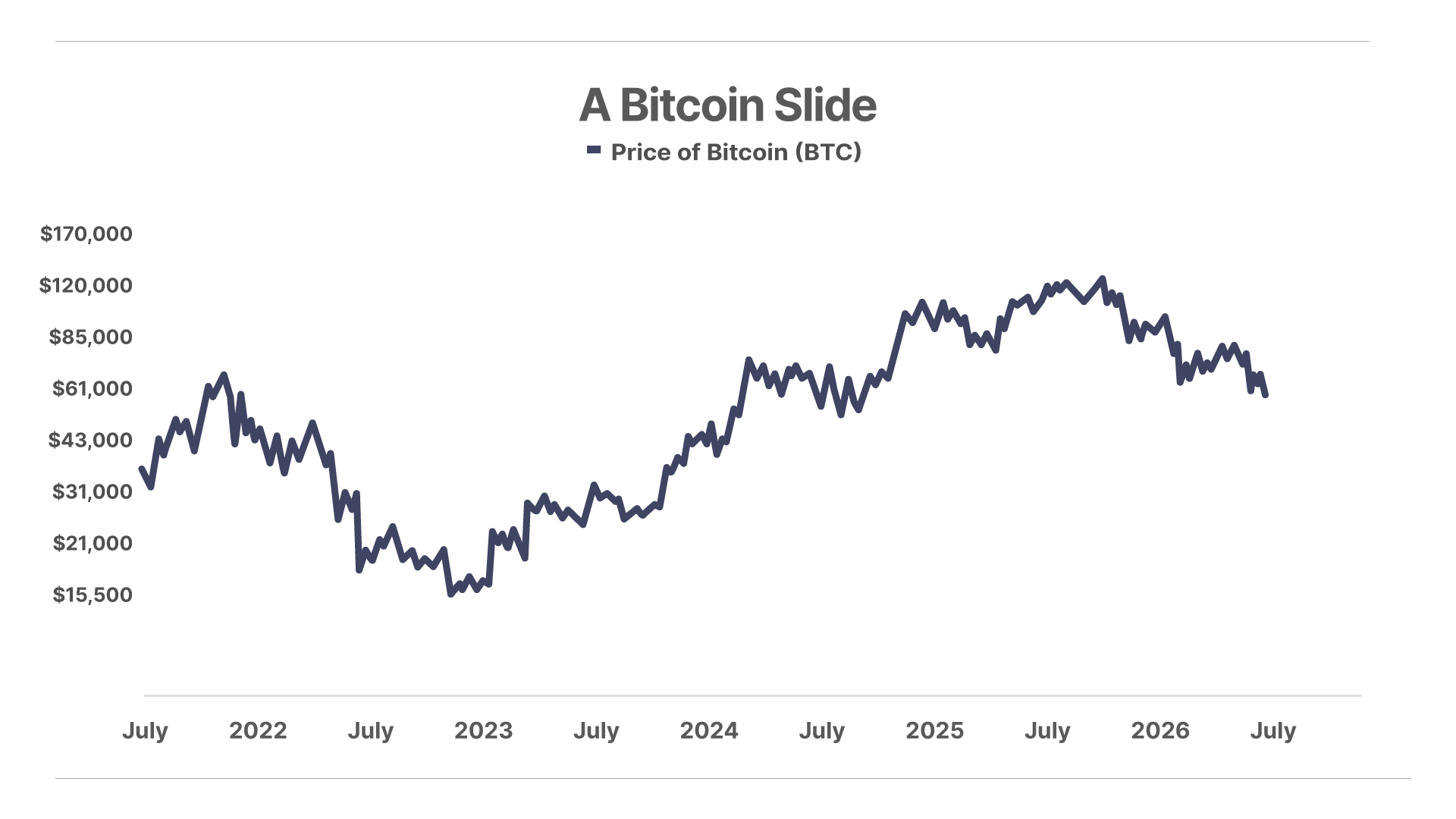
Chart Of The Day… Bitcoin (BTC)
Bitcoin (BTC) has fallen 54% from its October 2025 peak, its longest and deepest drawdown since 2022.
Poll Results
Yesterday, we wrote that at $4,100 per ounce, gold is up 23% over the last 12 months, but down 31% from its January 28 high of $5,589. We then asked readers… “Has the price of gold bottomed?” Most survey takers – 61% – said yes, while the remaining 39% feel the price will fall further.
Mailbag
“Invest In What You Understand”
David A. writes:
One of Warren Buffett’s favorite quotes is “Invest in what you understand.” It just does not get simpler than that.
For the life of me, I do not understand the significance of going to Mars. And honestly, even back to the moon. And investing in companies that support such nonsense. How will that impact me or my everyday life? And in 40 years, I will be dead and gone.
What I do understand is that today I went to my local grocery store and bought some Hershey candy, I bought some toothpaste and shaving blades from Johnson & Johnson. I filled up with gas at $3.03 a gallon. And felt good about all three.
“Congratulations!”
Sushi P. writes:
I just finished reading the book, 2029: The End of America. It’s the most interesting book. It is informative and entertaining. Furthermore, it is insightful and enlightening. It is a must read book for all Americans.
On the joyous occasion of your baby girl Briar’s birth – congratulations!
Porter & Co. Comment: Porter’s 2029: The End of America – referenced above – is now available as an Audible book here, or to read on Amazon here.
Porter & Co. Market Snapshot
| Price | Yesterday’s Return | Year-to-Date Return | |
|---|---|---|---|
| S&P 500 Index | $7,483.23 | -0.22% | 10.0% |
| Gold per ounce | $4,068.30 | 0.56% | -4.4% |
| Bitcoin | $60,003.76 | 2.43% | -30.0% |
| Oil (West Texas Intermediate) per barrel | $68.58 | -2.00% | 17.2% |
| Berkshire Hathaway (BRK) | $750,999.99 | 0.29% | -0.5% |
| Porter’s Permanent Portfolio | – | 0.41% | -0.1% |
| The Better Than Berkshire Index | – | 0.68% | 7.8% |
| Total Return | Annual Return | ||
| Porter & Co’s Top Ranked* | 37.2% | 17.1% | |
| Yield | Yesterday’s Change | Change Year-to-Date |
|
| U.S Treasury 30-Year Yield | 4.97% | 2 bps | 13 bps |
*A Complete Investor risk rating of 1 is defined as a “low risk, high allocation” security, while positions rated closer to a 5 are higher risk. Porter & Co.’s top-ranked positions include those rated either 1 or 2 in Complete Investor portfolio.
Porter & Co. Top Positions
| Publication | Ticker | Description | Total Return |
|---|---|---|---|
| Tech Frontiers | QURE | uniQure | 237% |
| Complete Investor | BWXT | BWX Technologies | 235% |
| Tech Frontiers | ROIV | Roivant Sciences | 155% |
| Tech Frontiers | TGTX | TG Therapeutics | 151% |
| Complete Investor | ARM | ARM Holdings | 144% |
| Complete Investor | SKWD | Skyward Specialty Insurance | 141% |
| Tech Frontiers | SGMT | Sagimet Biosciences | 138% |
| Tech Frontiers | QURE | uniQure | 131% |
| Complete Investor | PM | Philip Morris | 122% |
| Complete Investor | BTC/USD | Bitcoin | 122% |
Prices as of 4:00 pm ET July 1, 2026
Please note: The investments in our “Porter & Co. Top Positions” should not be considered current recommendations. These positions are the best performers across our publications – and the securities listed may (or may not) be above the current buy-up-to price. To learn more, visit the current recommendations page of the relevant service, here. To gain access or to learn more about our current recommendations, call our Customer Care team at 888-610-8895 or internationally at +1 443-815-4447.