Follow The Cash – It’s Called Checkbook QE
Inside Today’s Issue
Editor’s note: Today, Porter turns the Journal over to his friend Marin Katusa, of Katusa’s Resource Opportunities – who shares the latest opportunities related to gold.
The Fed didn’t print a dollar, and gold had its best month in 27 years.
The Federal Reserve’s balance sheet didn’t move an inch this month, and gold still had its best month since 1999.
If that sounds backwards, you’ve been watching the wrong building.
On August 19, the U.S. Treasury announced it would double its buybacks of long-dated government debt, from $2 billion an operation to at least $4 billion. Treasury Secretary Scott Bessent calls it a “Treasury Twist.”
Then on Monday, August 24, two senior Treasury officials told CNBC where the money could come from: the government’s own checking account at the Fed. Bessent has built it to roughly $950 billion. The last Treasury ran it at $550 billion to $600 billion.
Follow the cash…
The Treasury buys long bonds from the banks, its balance at the Fed goes down, and the banks’ reserves go up by the same amount. Money that sat frozen in a government account starts moving, and the Fed’s balance sheet never does.
Nobody has to call it quantitative easing (“QE”), so I’ll call it what it is: Checkbook QE.
It’s the same liquidity, in a different building, with no press conference.
Why The Treasury Is Doing The Fed’s Job
Because the Fed won’t do it. Federal Reserve Chair Kevin Warsh took the helm wanting a smaller central bank, and futures give better than one-in-three odds his Fed hikes this month.
Meanwhile, the 30-year yield hit its highest since 2007 this month and federal debt crossed $40 trillion. Somebody has to be the buyer of last resort for the long bond. The Fed declined. The Treasury volunteered, and told you where it keeps the money.
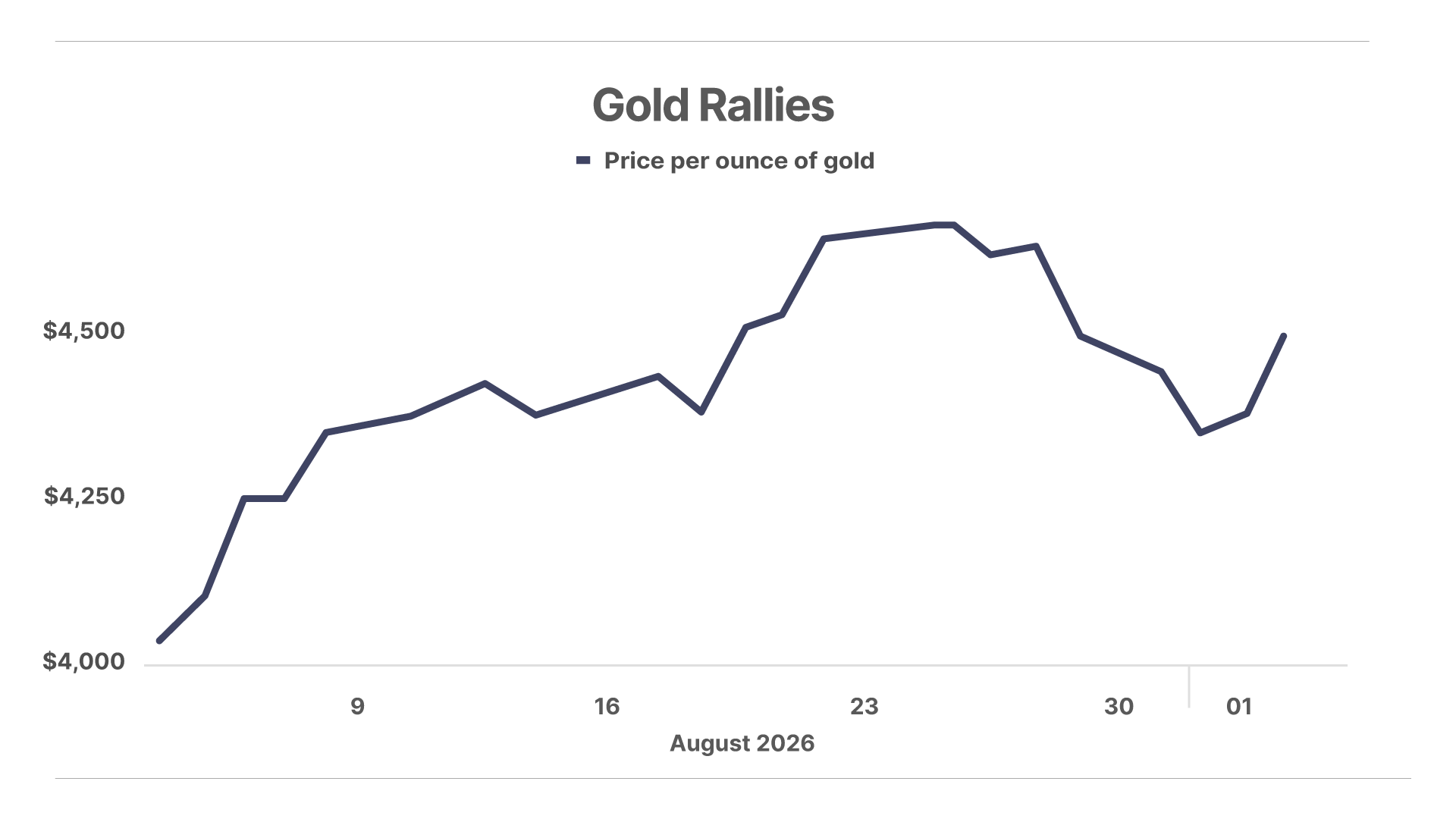
Gold answered inside a week.
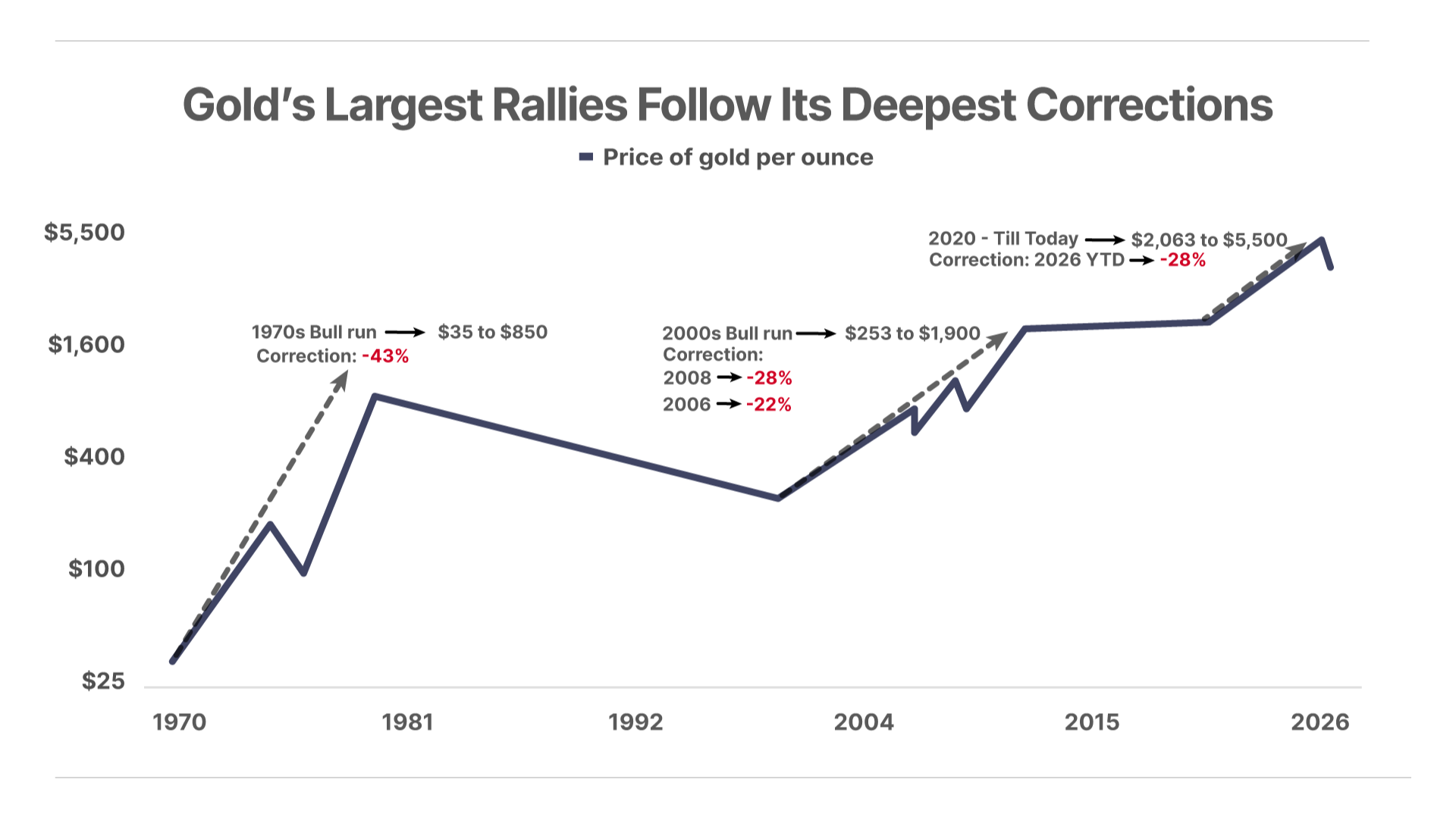
Bullion started August near $4,000 an ounce and traded above $4,700 to end the month, up about 14% on the month. The last time it moved that fast was September 1999, when 15 European central banks agreed to sell less gold. This time a government showed you its checkbook.
The Most Famous Chart In The Gold Market
Gold is a great way to be right about Checkbook QE. It’s a slow way to get paid for it.
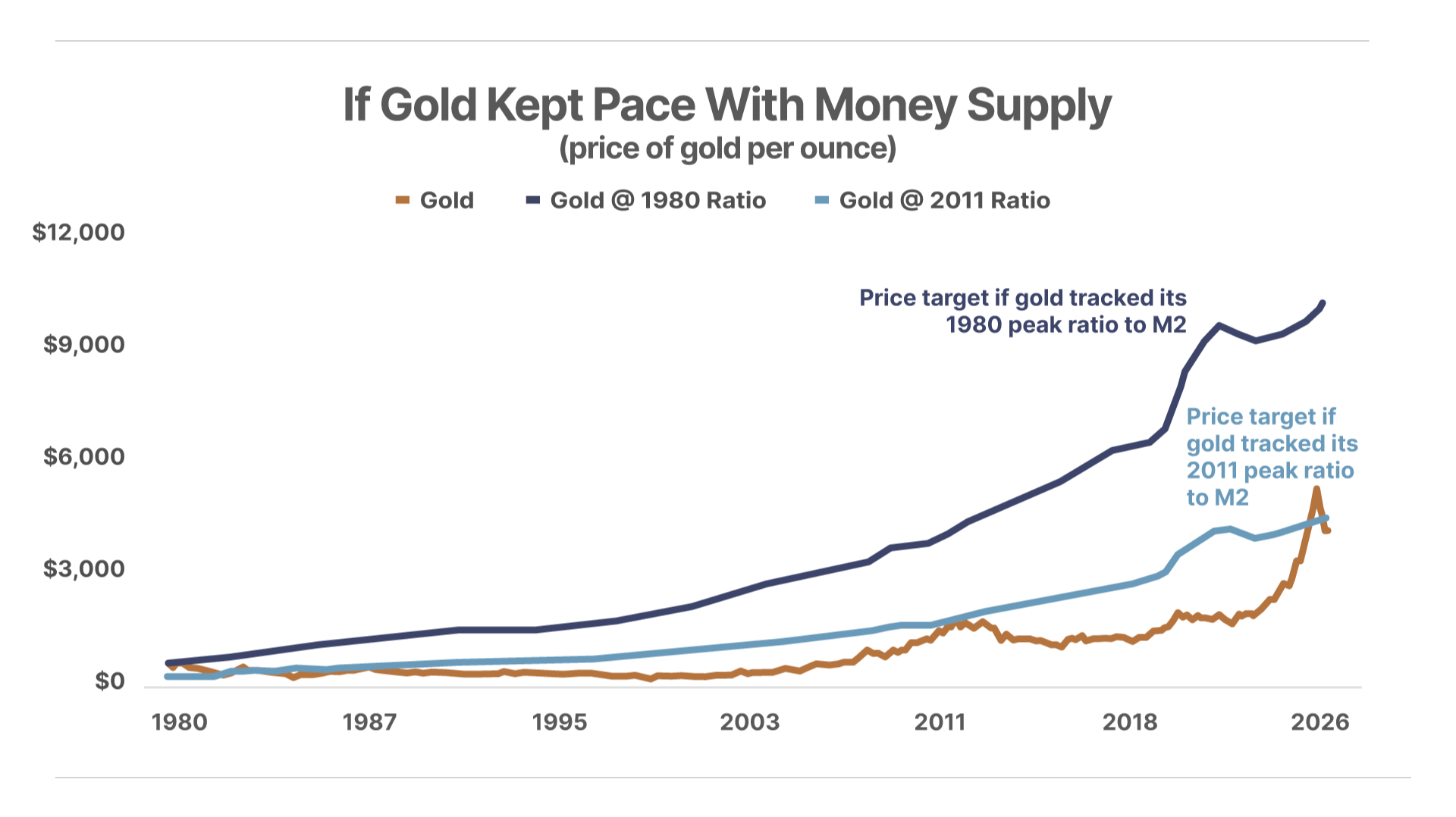
M2 hit a record $23.2 trillion this summer. Hold gold at the ratio to the money supply it reached in 1980, and the price lands near $10,000 an ounce.
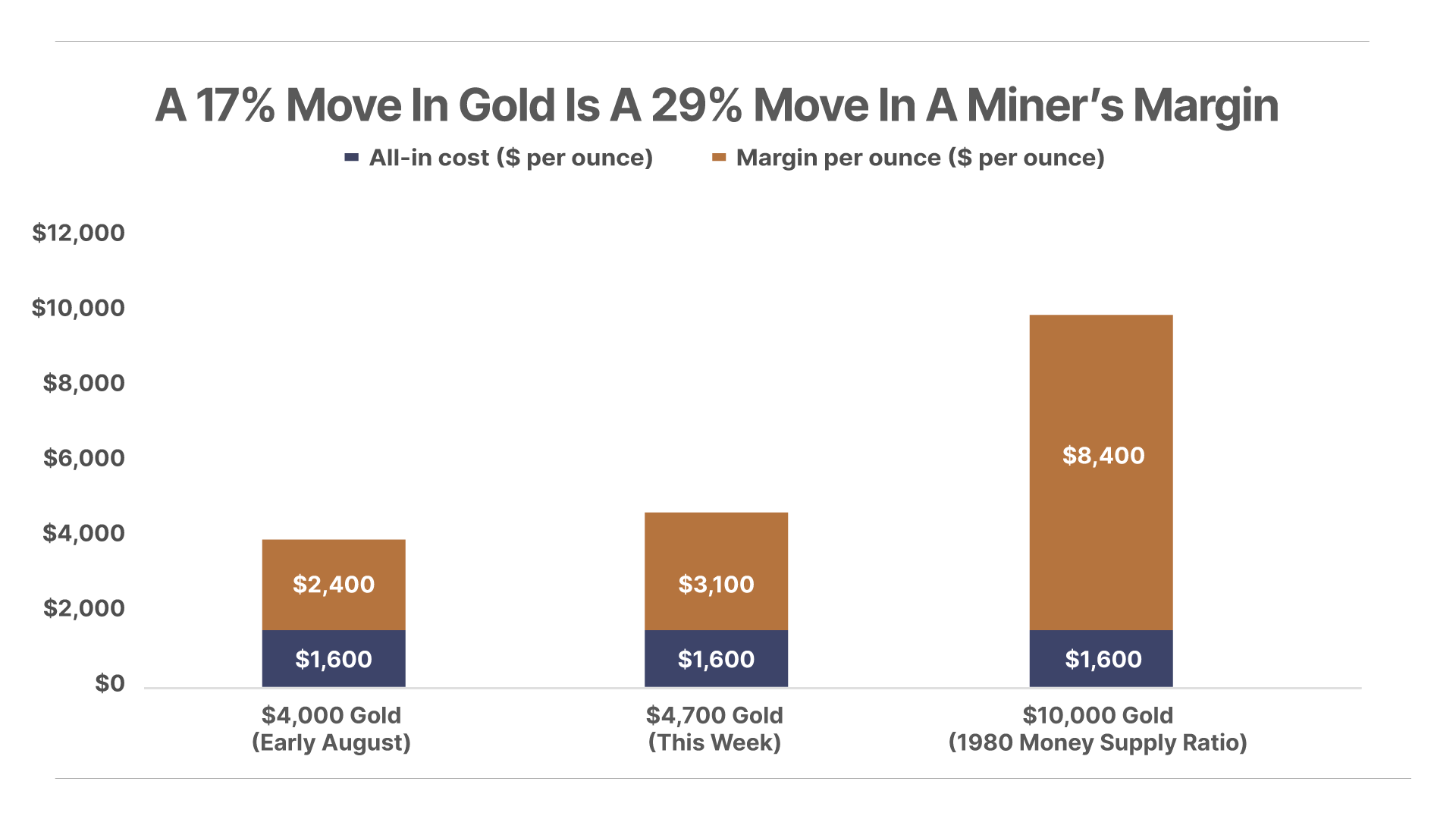
Now run the same arithmetic on a miner. The big producers pull an ounce out of the ground for roughly $1,600 all-in, so at $4,000-an-ounce gold, they clear $2,400 an ounce, and at $4,700 they clear $3,100. The metal moved 17%. The margin moved 29%.
At $10,000, the number is on the chart below, because if I say it out loud you’ll think I’m selling something.
I am. Just not that.
Ten Years Of Doing This
My flagship service, Katusa’s Resource Opportunities, turns 10 this year.
I started it to show readers the names I own, the price I paid, and why, and to bring them into the private financings I write my own check into first, at the same price and terms.
-
That’s how a $0.90 unit in Artemis Gold’s 2019 financing became a $45 stock.
The losers are in the letter next to the winners, with what I got wrong.
The correction left a list of gold producers priced at margins I haven’t seen in my career.
Some have repriced. Most haven’t.
The three I’d own first are in a report every new member gets on day one.
For the anniversary, for 10 days, I’ve reopened the price our charter members paid the day we launched: $1,499 instead of $3,500, with a full refund inside 30 days if it isn’t for you.
I’ve never reopened that price in 10 years and I won’t again.
Claim the charter price: $1,499 instead of $3,500.
The Treasury has $950 billion and just told the market it’s willing to use it. Gold had its best month since 1999 on the announcement alone. The spending hasn’t started.
Join Katusa’s Resource Opportunities at the 10-year charter price
Marin Katusa
Keep in mind, we at Porter & Co. only publish guest essays from publishers we know to offer well-researched ideas vetted by a legal team, excellent customer service, and reasonable refund policies. Katusa’s Resource Opportunities is one such partner. We do not, however, under any circumstances, make any representations about their investment ideas or strategies, nor will we warrant them as equal to our own. We do recognize that the markets are tempestuous and, at times, ideas that we may not endorse prove valuable.
Tell us what you think of today’s Daily Journal: porterstansberrydirect@gmail.com

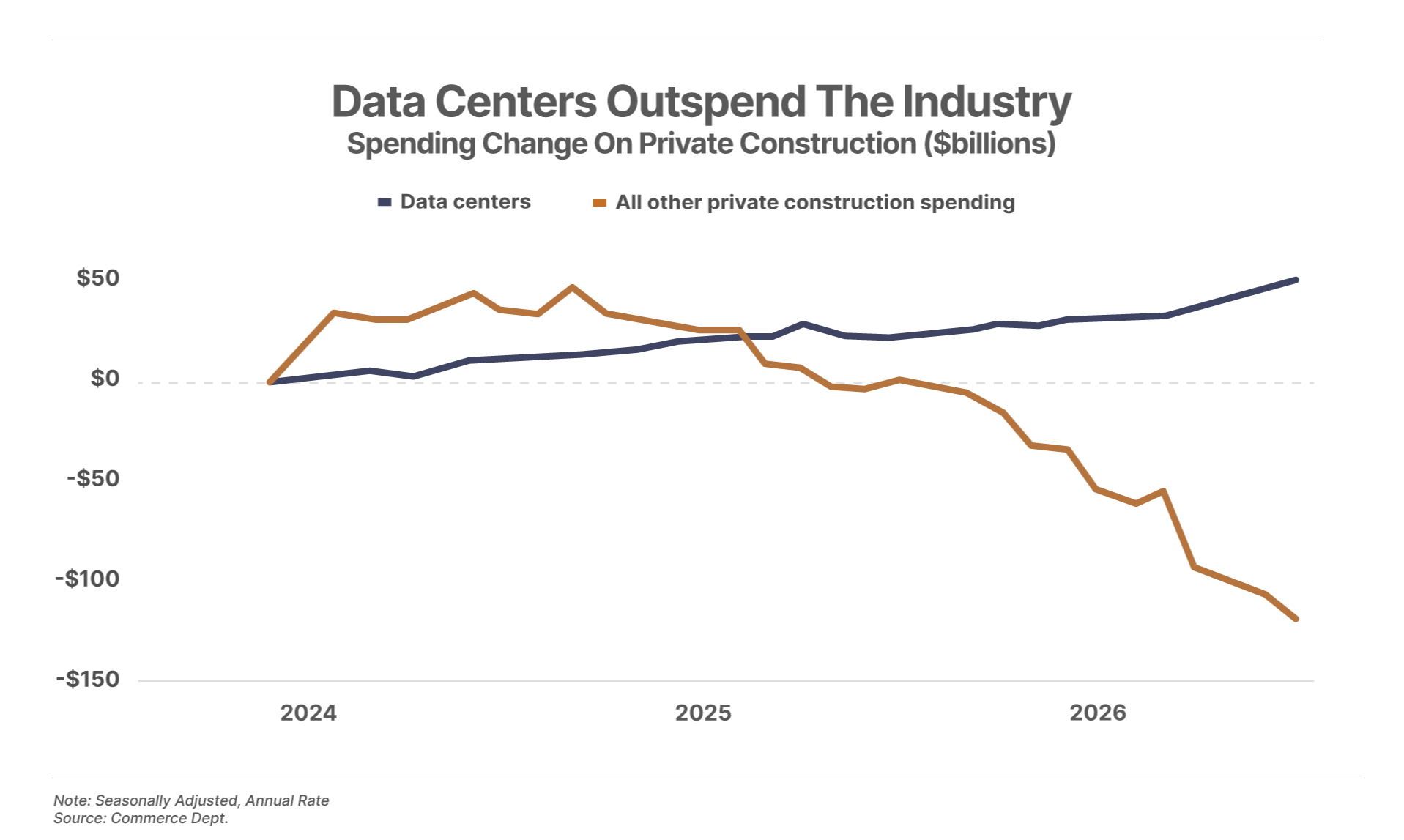
1. The AI economy is eating the real economy’s lunch. New Commerce Department data shows that spending on data-center construction dwarfs that on all other private construction. Since December 2023, data-center construction spending is up roughly $45 billion, while everything else – housing, retail, warehouses, manufacturing plants – is down $120 billion and declining. The private economy is being crowded out of capital, labor, and power by one single sector.
2. The latest circular financing deal. Nvidia (NVDA) and Anthropic have signed a $35 billion cloud-compute deal with Nvidia-backed cloud provider Lambda. In this deal, Lambda will buy the much-in-demand GPU processing chips from Nvidia and then rent them to AI platform Anthropic through a data center site that Nvidia holds the lease on. Yes, that’s right, Nvidia performs three roles in this deal: underwriting the data center, providing equity-backing for the cloud tenant, and supplying the silicon that generates the rental revenue flowing back through the chain. It’s the latest example of the vendor-financing boost Nvidia is providing to stoke demand throughout the AI ecosystem.
3. Erasing six years of falling software prices. The PCE Price Index for computer software and accessories – a measure inside the Fed’s preferred inflation gauge – has risen at a 39% annualized rate year to date, wiping out roughly six years of decline in just eight months. The broader information processing category – which covers computers, tablets, accessories, and software – rose 15.5% over the past year, and 1.4% in July alone. We’ve been told that AI will push prices down, but we aren’t seeing it yet.
In yesterday’s Journal, Porter explained the history of oil-tanker pricing to provide insight into the recent surge in shipping costs.
“Better Reader Than Investor”
Mike J. writes:
Really enjoyed your story today, thank you. I owned 2,000 shares of Frontline (FRO) from 2000 to 2009 (approx.). When Jon Frederickson publicly stated the tanker market was going to collapse, soon, around 2009, I didn’t act. My 2,000 shares quickly became 200 with a 10-1 split. I had accumulated just enough dividends over that nine-year period so I was even. I never sold.
I also remember you pounding your fist during that same period that Microsoft (MSFT) had over $1 billion in cash, and the stock was a steal at $21 per share. I didn’t act on that, either.
I’m a better reader than I am an investor, so I’ve got that going for me. You’re an excellent writer.
Thanks again.
“I’m Older Than You”
Dom B. writes:
Porter, A good wake-up call and some perspective. I’m older than you and recall these events well. A word to the wise. Thanks.
“And One More”
Jim H. writes:
You left out NAT, Nordic American Tankers, with the largest fleet of suezmax tankers. They too will post huge profits this quarter.