Issue#161, Volume#3


Why The Insiders Never Talk About The Dividends That Matter
Inside Today's Issue
Editor’s note: Today, we are taking the unusual step of republishing Porter’s Journal essay from yesterday… while, yes, it is so good that it's worth republishing, we had technical gremlins that prevented the issue from getting to readers on time and in the regular format. We apologize for the glitch and offer it here today – still as timely and relevant as it was yesterday… The content in the other sections of today’s Journal – “3 Things…,” “Chart Of The Day,” “Mailbag,” “Market Snapshot,” and “Top Positions” – did not appear yesterday.
You will not get rich on regular dividends.
And you’ve probably never heard of the three kinds of secret dividends that public companies use to make the insiders incredibly rich.
The average payout ratio of the S&P 500 is around 35%.
That means, if you’re counting on regular dividends, you’re missing out on roughly two-thirds of the earnings of the companies you own. Where does all the money really go...?
It probably won’t surprise you that company insiders try very hard to make sure that you never understand where the wealth really accrues. It ain’t the dividend you read about in the paper that matters, that’s for sure. It’s the dividends you never hear about that will make you rich.
Ask me how I know...
In October 2023, while I was CEO of MarketWise (MKTW), our board declared a “special” $50 million cash dividend. This was the largest cash distribution we’d ever made as a public company. It was about 4x more than our regular annual dividends. But it never showed up on the securities databases as an “indicated” dividend. It went virtually unmentioned and unnoticed. It doesn’t even show up as part of the total return in most equity databases. It’s like it never happened.
And unless you were a shareholder on November 10, 2023, you didn’t get any of the money. None. Even if you’d held the stock for years previously. But... if you owned the stock on that one day, you got your pro-rata portion of a huge pile of money. Otherwise, you got zilch.
A trailing 12-month dividend yield divides the regular dividends of the past year by the current share price. But the databases exclude these kinds of “special” or one-time distributions. It’s like they don’t exist. Nasdaq's methodology only reinvests regular dividends. And market makers deduct special dividends from the price of the stock on the open after the ex-date, when the stock trades “ex-dividend.” So the largest cash payment a company makes in a decade can be absent from the yield figure on public-pricing screens and buried in the return series we use to judge the stock. It’s like they never happened.
But it’s these kinds of huge dividends that will make you rich.
It’s funny how the most powerful thing public companies can do with their cash payments is virtually a secret from the public.
Why? Well because that’s how the insiders want it. High-quality companies that are closely managed and closely held by insiders use these kinds of dividends to massively enrich themselves.
For example, RLI (RLI) is one of America’s leading specialty property-and-casualty (“P&C”) insurance companies. I’ve followed it and written about it in my newsletters since 2006. They sure wish I wouldn’t...
On May 14, 2026, RLI declared a $2.00 special dividend, expected to total approximately $184 million, payable June 12 to holders of record on May 29. They've been paying out most of their profits in this way for decades. Since the Global Financial Crisis, RLI has paid out a total of $611 million in regular dividends. But where did the real money go...? RLI has paid out a total of $1.8 billion in special dividends – 3x more.
Or there’s TransDigm Group (TDG). You’ve probably never heard of the company, but it is the best managed aerospace company in the world. On September 20, 2024, TransDigm declared an enormous special cash dividend of $75.00 per share ($4.4 billion in cash!), paid October 18, 2024, to holders of record on October 4. Where did the money come from? TransDigm borrowed it. Its stated goal is to deliver returns comparable to a well-performing private equity fund – but only to the insiders who know when these huge payments will be made.
Four dates govern every dividend. The declaration date is when the board announces it. The record date is the day you must appear on the company's books as an owner. The ex-dividend date is the trading cutoff, set by exchange rule rather than by the company. The payment date is when cash arrives.
Since May 28, 2024, American stocks settle one business day after the trade. Buy a stock and you become the owner of record the next business day.
The TransDigm board declared the $75 dividend on September 20, 2024, with a record date of Friday, October 4, and a payment date of Friday, October 18. To collect $75 per share, you had to buy no later than the close on Thursday, October 3, so that the trade settled on October 4.
These big special dividends are fun to track and are great for padding your account with cash. But ... there’s a problem with big cash distributions. First, they trigger taxes. And second – and more important – they take capital away from the company, where it will no longer compound.
If you want to become vastly wealthy, you need to look for the second kind of secret dividend.
These are truly invisible. They’re not typically announced. And no payment will reach your account directly, so there’s no taxes you’ll owe. Instead, this is a hidden way of buying more shares. Only... you don’t have to pay for them.
AutoZone (AZO) began paying this kind of secret dividend in 1998. Through November 22, 2025, the company has spent $38.9 billion on these dividends – none of which was announced publicly.
What kind of dividend is this...? The kind that buys more of a company for you, silently and automatically.
Berkshire Hathaway (BRK) bought about 10% of American Express (AXP) in 1995. It hasn’t spent a dime on the stock since then, 31 years ago. And yet... today Berkshire owns 22% of one of America’s greatest companies. Berkshire paid $1.29 billion for 10% of American Express. But today it owns 22% ... worth almost $50 billion. Without the secret dividends it received, Berkshire’s stake would only be worth $20 billion.
There are many of these kinds of leading secret dividend-paying stocks. And, I believe, most of the passive wealth in America today was created through these secret dividends.
My favorite example of America’s leading secret dividend payer is homebuilder NVR (NVR), a company that I’ve been recommending since 2007. It’s just a homebuilder. It’s not rocket science. But it has created massive wealth through its secret dividend program and almost no one knows it even exists.
If you bought 5% of NVR in 1996, it would have cost about $7 million (732,955 shares). You became a major shareholder in a national homebuilder. And you never bought another share. But over the last 30 years, NVR has paid out $17 billion in secret dividends. None of this money hit your account, directly. You paid no tax. But your wealth exploded as a result.
Today, your 732,955 shares would be 26% of the company. Your stake would be worth $4.59 billion. You didn’t just become rich, you became massively wealthy. All from dividends that no one else can see. All you had to do was understand how they work.
These kinds of secret dividends create so much wealth, all the libtards want to make them against the law. And they were against the law until the mid-1980s. I’m convinced there’s simply no better way to become truly wealthy in America. And it’s easy: you literally do nothing and get incredibly rich.
But even they aren’t the best kind of secret dividend.
The best kind of secret dividend is so rare and such a closely guarded financial secret that I honestly shouldn’t ever write about it. If I was smarter, I would never explain this to anyone else – ever. This is, without question, the single greatest wealth secret I have ever discovered.
You see, companies like AutoZone, American Express, and NVR become pretty famous for their secret dividends. A lot of analysts and investors know about these stocks and track the size and scope of their big secret dividends.
But no one has ever told you about HEICO (HEI). And no one ever will.
In 1990 the Mendelson family took control of a tiny $25 million South Florida company with about 200 employees. Laurans Mendelson and his sons Eric and Victor did not attempt a transforming acquisition. They didn’t fire a bunch of people to cut costs and raise profits. They didn’t borrow a ton of money, either. And like a regular business, they paid cash dividends twice a year. HEICO occasionally pays special dividends, too.
But that’s not where the money went. The Mendelsons were among the savviest capitalists in the United States. They weren’t going to waste their cash on dividends. HEICO’s payout ratio is 4%. The Mendelsons took 96% of their earnings and they invested in the most valuable secret dividend stream of all...
Look at last year. In fiscal 2025, HEICO reported record net sales of $4.49 billion, up 16%, and record net income of $690.4 million, up 34%, on a consolidated operating margin of 22.7%. Nothing extraordinary. Just a good business with solid growth.
But where did the money go? HEICO completed five acquisitions during the year, three at the Electronic Technologies Group and two at Flight Support Group, whose net sales have now grown sequentially for 21 consecutive quarters.
Thirty-five years of that arithmetic turned a $25 million company into a company earning $690 million a year.
Instead of paying you cash, HEICO invests your pro rata share of their earnings into better businesses than you can invest in yourself. It manages them. It grows them. And you reap the returns with higher earnings, higher cash dividends, and a vastly higher stock price.
These kinds of special dividends mean you don’t need the stock market to go up to get very rich. These companies are, independent of other factors, their own compounding machines.
Danaher (DHR), AMETEK (AME), Roper Technologies (ROP), and Constellation Software (CNSWF) run this same strategy in life sciences, instruments, vertical software, and industrial niches. These stocks aren’t called private equity firms, but that’s what they do. And they’re among the best in the world at it. They buy small businesses at sensible prices with modest leverage and the returns compound quietly for decades.
Shhhhhh...!
Don’t tell anyone.
But do tell me what you think of today’s Daily Journal: porterstansberrydirect@gmail.com
Good investing,
F. Porter Stansberry
Stevenson, Maryland
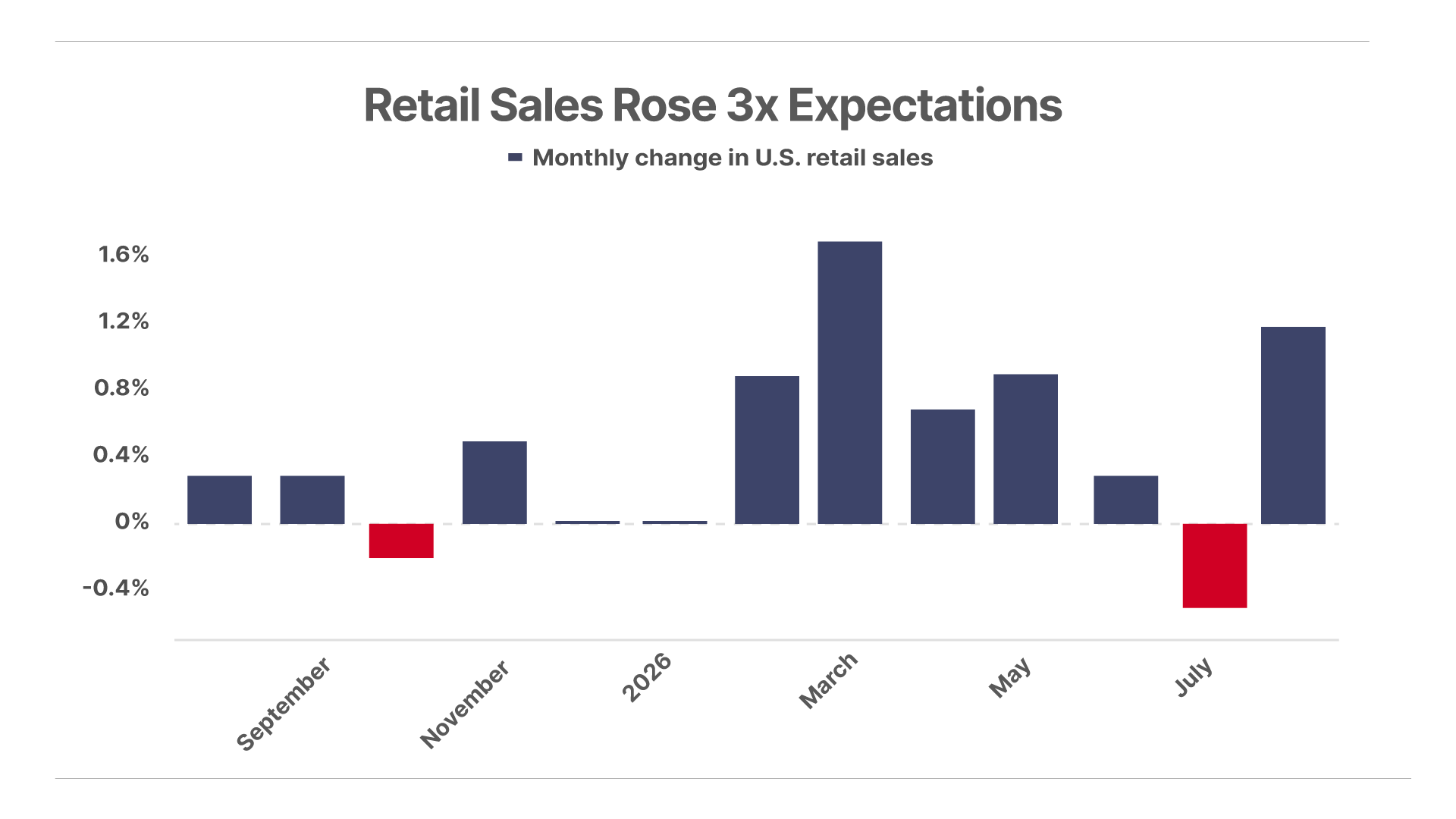
1. The U.S. economy is running hot, and wealthy consumers are part of the reason. Retail sales rose 1.2% in August, the Census Bureau said Wednesday, and are up 6.0% from a year earlier. The "control group" – sales excluding gasoline, autos, building materials, and restaurants, which feeds directly into gross domestic product (“GDP”) – rose 1.4%, more than triple the 0.4% forecast. But not all consumers are participating equally… the top 10% of earners account for roughly half of all U.S. consumer spending, according to Moody's Analytics, and the bottom 90% are increasingly struggling.
2. While the S&P 500 is 3% below its peak, most individual investors are bearish. In this week's American Association of Individual Investors survey, 53.3% of respondents expect stock prices to fall over the next six months, the highest share since May 2025, while 28.8% expect them to rise, the lowest since September 2025. Bearish readings above 50% have occurred in fewer than 5% of weeks since the survey began in 1987. A market near its highs that most investors expect to fall is what Wall Street calls a "wall of worry,” and it tends to be a bullish signal. The last comparable reading – 49.5% bearish in September 2025 with the S&P 500 at a record high – saw the index gain 18% over the following 11 months.
3. Nike (NKE) gets a new board member. The shoe and apparel giant announced today that Alexandre Arnault has joined the company’s board of directors. Alexandre is the son of Bernard Arnault, who built one of the largest and most enduring premium brands of all time: LVMH Moët Hennessy (LVMHF). Alexandre is credited with turning around LVMH’s struggling Tiffany’s brand, before moving on to the CEO role in Moët Hennessy (LVMH's wines and spirits division). We see this as a promising new addition to the Nike board as the company continues its turnaround effort.
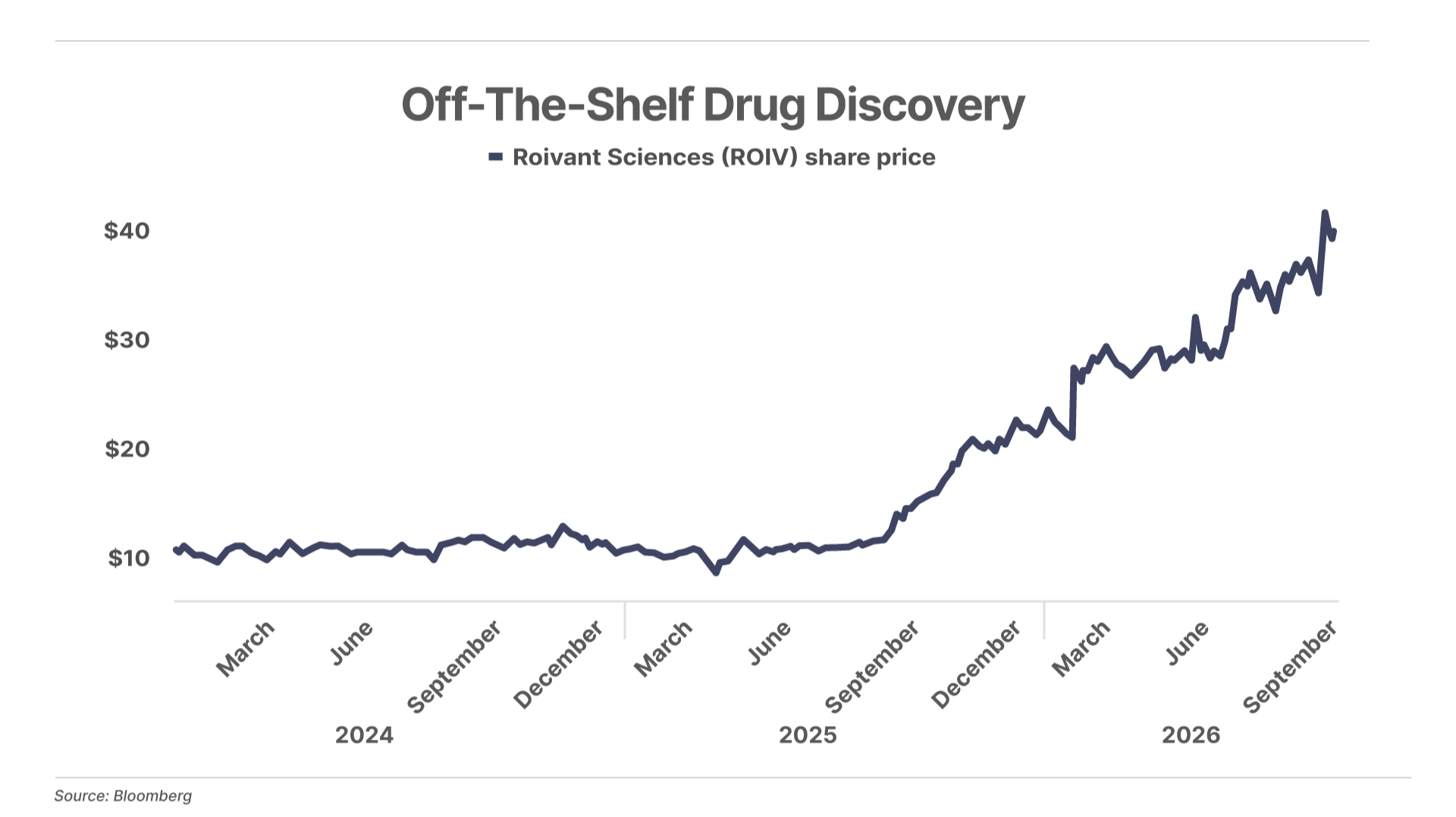
Roivant Sciences (ROIV) is up 252% since we recommended it to Porter & Co. Biotechnology readers in March 2024. The drug maker, which licenses discarded drugs, earned FDA approval of dermatological drug Lisraya in August, and won a $2.25 billion patent-litigation settlement from Moderna (MRNA).
Yesterday, Porter released explosive new details as to why we are likely to see this sector take over in dramatic fashion in the near term. To watch Porter’s video – released just 24 hours ago – click here now.
“Permanent Portfolio Input”
Chip F. writes:
My portfolio is cash, physical gold and silver, miners and royalty companies, most of them picked by Garrett Goggin of Golden Portfolio. He is really good.
Just for fun you should look at Mason Sexton's performance. Absolutely amazing. I am not a short-term trader, but he has had an 80%+ hit rate this year.
And when you are bored, come out to sunny St. Michaels for some crabs. Now is the best time of year!
“P&C Allocations”
Wayne writes:
Thanks for having "the balls" to tell us the truth about your thinking on selling insurance-company stocks and going to cash as a precautionary measure.
I'm a 55-year veteran in the life-insurance business, which are primarily bond investors, and I've wondered about your opinions on the stock companies like Lincoln National, MET Life, etc.
Much appreciated.
Porter & Co. Market Snapshot
Porter & Co. Top Positions
Please note: The investments in our “Porter & Co. Top Positions” should not be considered current recommendations. These positions are the best performers across our publications – and the securities listed may (or may not) be above the current buy-up-to price. To learn more, visit the current recommendations page of the relevant service, here| New Window. To gain access or to learn more about our current recommendations, call our Customer Care team at 888-610-8895 or internationally at +1 443-815-4447.