Poland Is Already Richer Than Japan – Soon It Will Be Richer Than The U.S.
Inside Today's Issue
Most investors believe emerging markets are risky.
And, really, who wants to buy a business you’ve never heard of, in a country you’ve never even been to? But, as I showed you earlier this week (with Chris Weber’s Max Yield strategy), if you’re careful, emerging markets investments can create very significant amounts of what I call “real wealth.”
Real wealth isn’t just a lucky stock tip. Real wealth derives from understanding the permanent structural advantages that some businesses (and some markets) have, which enable them to produce market-beating rates of return on capital. Understanding these structural advantages is what allows the rich to get a lot richer.
In short: using these strategies isn’t guessing. It’s playing a rigged game.
Not surprisingly, these ideas aren’t often taught. Not in business school. Not on CNBC. But if you’ve read my work for any length of time, you’ve probably got five or six of these ideas taped to your trading desk. Access to this information is really what I’m selling – as every long-time subscriber knows.
By the way, I sincerely appreciate it when you share what you’ve learned from our work and how it’s changed how you invest. Please, take a minute to tell me about your investing journey and what you’ve learned from us about real wealth building: porterstansberrydirect@gmail.com.
I’m going back to emerging markets again today because we’re launching our next investment practice (Porter & Co. Emerging) early next year. I hope all of you will become a Porter & Co. Partner Pass member this year to lock in access to this work, which will be exclusively for our Partners.
Why do we care about emerging markets? They offer two significant “real wealth” advantages for investors.
- The first advantage is the currency. When a poor country gets richer, its money tends to get stronger against the dollar. As you saw earlier this week, when emerging markets currencies appreciate, the gains can be substantial.
- The second advantage is a re-rating. As a country grows richer and safer, investors will pay more for each dollar of its companies' earnings. The same profits that were worth 10x earnings become worth 15x earnings. Nothing about the business has to change – your investments can appreciate simply because the entire economy is growing wealthier.
You’ll notice something about our emerging markets investments: they’re even more conservative than our U.S. investments. That means buying companies that…
- have been around for decades
- have huge moats
- have very high returns on their capital
- are likely to remain the market’s leaders for at least the next decade
And – no matter what – we will always make sure that we’re getting paid to take these risks. That means a dividend that’s far above what we’d receive in a similar U.S. business.
Now, what’s the one country in the world that’s most likely to see its per-capita GDP increase by 50% or more in the next seven years? My bet is Poland.
In 2001, Poland's government paid 17.5% to borrow money for one year – I know because it was part of our Max Yield trade. Today, Poland's central bank sets its benchmark rate at 3.75%.
Poland no longer has to pay up to borrow, because Poland is no longer poor.
Poland’s path to prosperity started on January 1, 1990. Finance Minister Leszek Balcerowicz launched "shock therapy" on its communist-built economy. Poland freed about 90% of its prices overnight, stopped printing money to pay its bills, and began selling its state-owned companies. After a brutal transition recession, the economy grew for 28 straight years. Poland was the only member of the European Union to avoid a recession during the 2008 financial crisis.
Measured in constant dollars and adjusted for local prices, Polish output per person grew from $12,800 in 1990 to $46,900 in 2025: a gain of 266%. The economy passed $1 trillion for the first time last year, making it roughly the 20th-largest in the world.
As recently as 1994, the average Pole produced less than a third as much as the average Japanese worker. This year, Poland will surpass Japan: Poland's output per person (adjusted for prices) will reach $60,051 this year, while Japan's will be $59,712.
I’m sure you know that Warren Buffett began investing in Japan about a decade ago, as he realized its economy was finally recovering from a 20-year depression. But… maybe he should have been buying into Poland instead. After all, Japan keeps its central bank reserves in U.S. dollars. Poland has been buying gold.
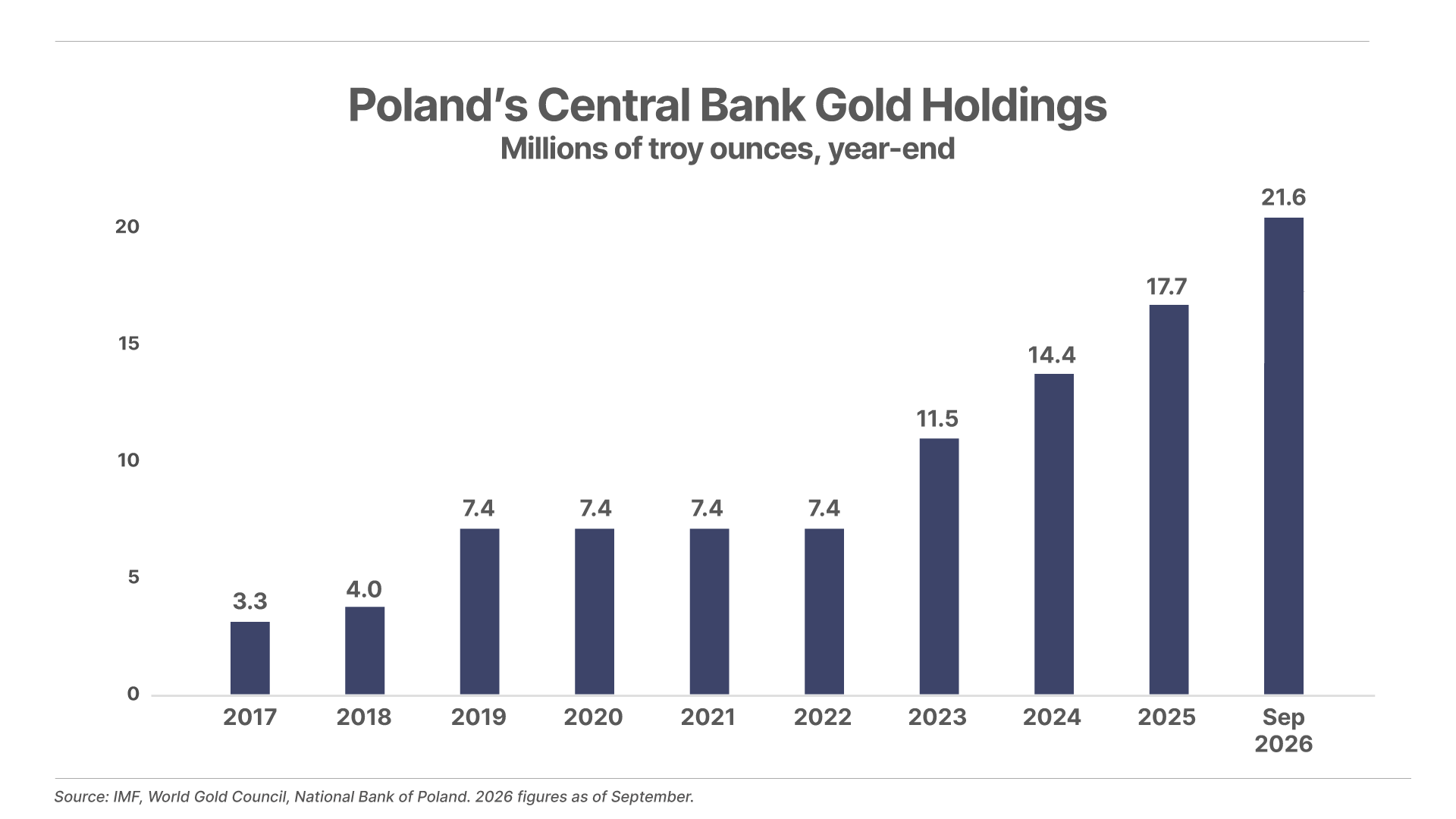
But it’s not the biggest reason.
The biggest reason is Poland’s economy and its highly educated and productive work force. Economists have a name for what happens to the money of a country like Poland: the Balassa-Samuelson Effect. The idea is simple: as a catching-up country's factories become more productive, their workers earn more. Higher wages spread to the rest of the economy (barbers and waiters get raises too), and prices rise. Over time, the country's currency strengthens in real terms, because each zloty is backed by more productive work.
Between 2004 – when Poland joined the European Union – and July 2008, the U.S. dollar fell from about four zlotys to about two zlotys. Anyone who owned Polish assets in dollars nearly doubled his money on the currency alone in only four years.
Today, the dollar buys almost four zlotys again. The dollar has gained about 9% to 10% against the zloty this year. But we don’t think the zloty will weaken further. In fact, I believe it will double in value against the dollar in the next four years. Why?
Poland's current account deficit was only about 0.7% of GDP last year, so the country isn't depending on hot money to pay its bills. Foreign companies keep building factories in Poland, and the central bank is stuffed with gold. Meanwhile, it’s becoming obvious that the only way the U.S. government can pay its bills is by printing an enormous amount of money over the next several decades.
And what about the “re-rating” of the entire economy?
In August, S&P Dow Jones Indices announced it will move Poland from "emerging" to "developed" market status in September 2027. The Warsaw Stock Exchange expects market-index maker MSCI to follow within three to five years. I bet it will happen much sooner than that.
So how do we capture these gains without taking too much risk? We buy the best business in the country, in an industry we know better than just about anyone in the world. I've made a lot of money for investors in insurance over the years. If you’re rolling your eyes and saying “insurance is boring,” I’d beg you to reconsider. Since I built the property-and-casualty (P&C) insurance research practice at Stansberry Research between 2012 and 2014, my industry model has produced annual returns of around 24%. That’s about twice the stock market’s return in the period.
Why are P&C stocks such good investments? Because if they do their underwriting well, they get all of their capital (and more) for free. An insurer collects premiums today and pays claims later. If the premiums it collects are larger than the claims and expenses it pays, it earns an underwriting profit. Meanwhile, it invests the money it's holding for future claims ("float") and keeps the returns.
The single most important number in an insurance company is the combined ratio – claims paid out plus the operating costs, divided by premiums collected. A combined ratio of 100 means the insurer broke even on its operations. But a combined ratio below 100 means it collected more in premiums than it cost to pay claims and run the business. Most P&C companies can’t consistently deliver combined ratios below 100. But some do. And those are the ones to own.
Poland's best insurer is PZU (PZU on the Warsaw Stock Exchange).
PZU's roots go back to April 21, 1803, when Prussia's King Frederick William III created a fire-insurance society for the towns of the Polish lands his kingdom then ruled. Property owners were required to insure their buildings against fire. In 1921, the parliament of newly independent Poland passed a law requiring fire insurance for nearly every building and created a national mutual insurer to provide it. In 1927, it became Powszechny Zakład Ubezpieczeń Wzajemnych, and the initials PZU have survived ever since.
It has survived everything Poland has gone through over the last 100 years. The Germans allowed it to keep operating during the Nazi occupation. The communists turned it into the State Insurance Company in 1952, and after 1989, the new Poland turned it into a joint-stock company.
In 2010, PZU sold shares to the public in an 8.1 billion zloty offering, which was the largest initial public offering (“IPO”) in the history of the Warsaw Stock Exchange. It was very bad timing: in 2010, Poland suffered two waves of flooding and heavy snow damage, while a price war raged in auto insurance. Poland's other property insurers lost a combined 273 million zlotys in the first nine months of the year. But PZU earned 2.4 billion zlotys.
Now look at the record since. PZU's combined ratio in P&C insurance was between 85.3% and 89.8% from 2017 to 2025 – except for 2024, when a major flood hit southwestern Poland. Even then, PZU earned an underwriting profit, and its combined ratio was 92.5%. In the first half of 2026, it was 87.9%.
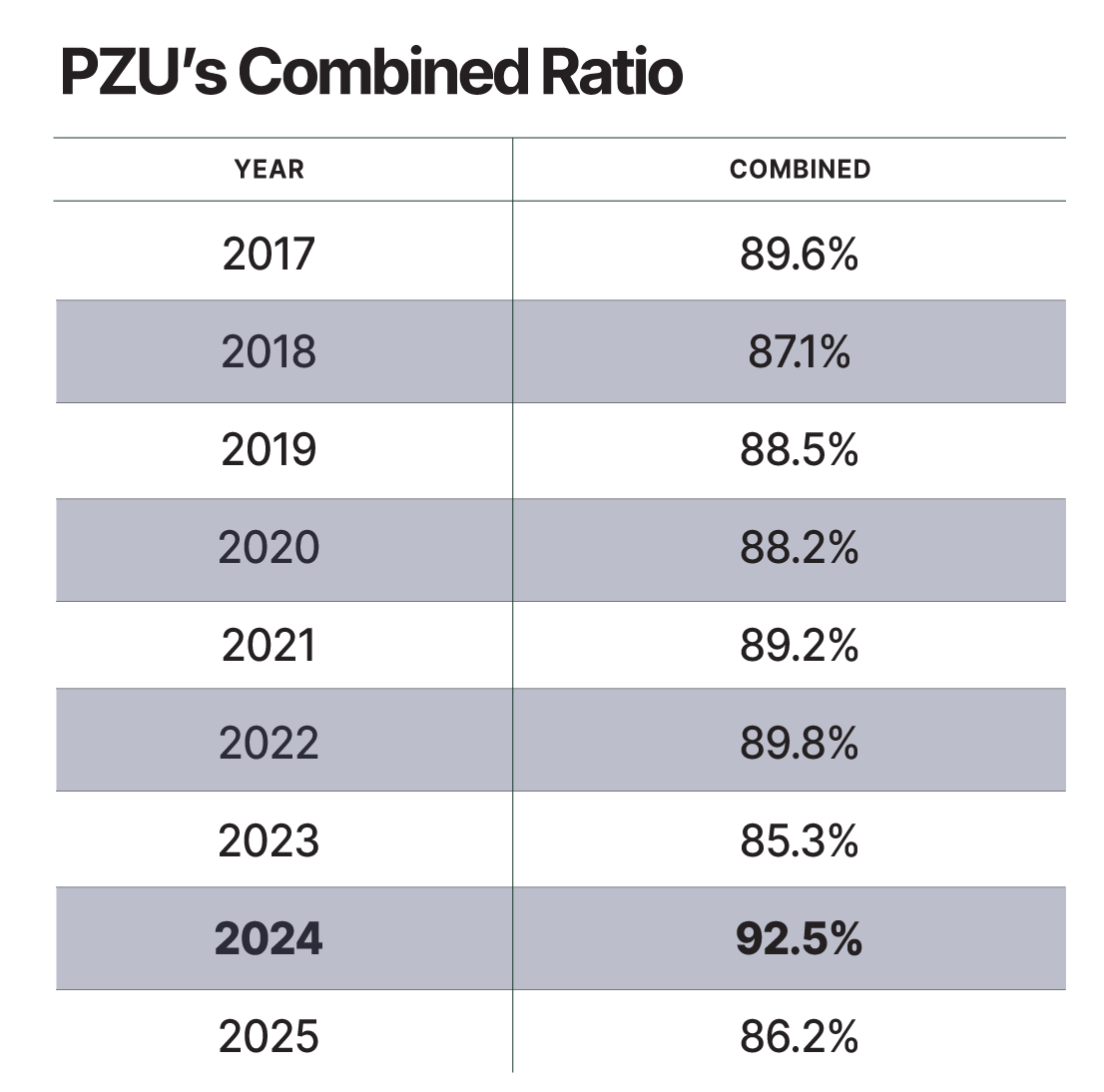
PZU's scale shows up in its share of the industry's profits: it writes about 29% of Poland's non-life premiums, but it earns about 48% of the industry's underwriting profit. It has about 22 million customers.
Where does all of the money go? Dividends. PZU paid 1.09 zlotys per share in its first year as a public company. This October it paid 4.80 zlotys per share, up from 4.47 zlotys a year earlier.
At the end of 2010, PZU's shareholders' equity was 12.8 billion zlotys. Since its IPO, PZU has paid out nearly 37 billion zlotys in dividends, almost 3x the starting equity, and its equity attributable to shareholders still grew to 24.3 billion zlotys by the end of 2025.
From its IPO in May 2010 through May 2026, PZU returned 410% to shareholders, including dividends. But notice what happened to a dollar investor over the same period. At the IPO, a dollar bought about three zlotys. Today, it buys 3.90 zlotys. At today's exchange rate, the weaker zloty cuts a dollar investor's return to roughly 290%. Over those 16 years, the currency worked against PZU's American owners. But, at four zlotys to the dollar, we expect that trend will cut the other way going forward.
Today, PZU trades at about 74 zlotys per share: about 10x earnings, with a dividend yield of about 6.5%.
We have real issues to work through before we make a recommendation. Poland's government owns 34% of PZU. A planned merger with Bank Pekao, the big bank PZU partly owns, needs changes to four laws, and it has stalled while the government studies alternatives. Those decisions will shape what PZU's shareholders own and what they're paid.
That's the work we'll be doing in Porter & Co. Emerging, which we'll launch next year.
Poland has become a rich country. Its currency is out of favor, and its stock market is still classified as “emerging.”
PZU has insured Polish property through partition, war, communism, and floods. It earns nearly half of its industry's underwriting profit, and it trades at 10x earnings. We think it could be the foundation of our new emerging markets strategy.
Watch for Porter & Co. Emerging next year.
Tell us what you think of emerging-market investing: porterstansberrydirect@gmail.com
Good investing,
F. Porter Stansberry
Stevenson, Maryland

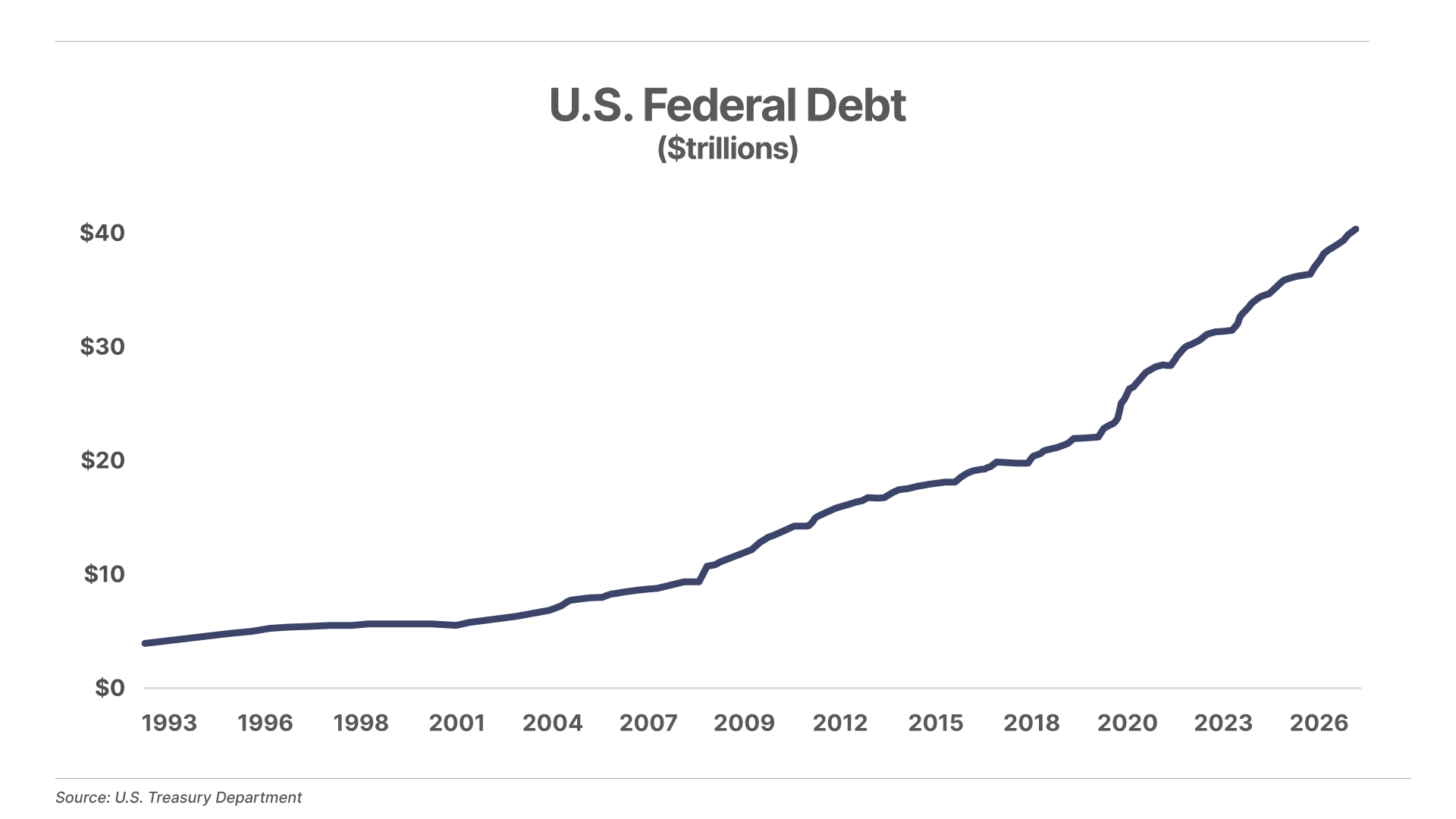
1. Washington added $422 billion to the federal debt in October. Total debt reached $40.6 trillion on October 30. Fiscal 2026 ended with a $1.99 trillion deficit, and a record-high net interest cost of $1.05 trillion. Each new dollar of debt is being financed at today’s higher rates, so the interest bill keeps rising even if spending holds flat.
2. Gold and silver surge after Democrats take Congress. Gold rose 2.9% to about $4,040 an ounce and silver 4.5% to near $52, adding nearly $1 trillion in combined value. The popular explanation is that a divided government will borrow less. That would slow the rise in Treasury yields, in turn reducing the income an investor gives up by owning gold, which pays none. However, divided government has not reliably meant less spending: after Democrats won the House in 2018, Congress still ultimately raised spending limits by about $320 billion.
3. Investors are nervous about the high-yield bond market. At the end of October, bonds rated B yielded 363 basis points (1 basis point = 1/100 of a percent) more than U.S. Treasury bonds. In the last 30 years, there have been nine other months in which the risk premium (or spread) on B bonds was at a similar level – and in those months, the spread on bonds rated CCC ranged from 648 to 809 basis points. In October, the CCC spread was an astounding 1,319 basis points. While investors feel confident enough about the economic outlook to hold BB or B bonds, they have an uneasy sense of danger lurking beneath the surface. The good news, reports Distressed Investing’s Marty Fridson, is that with CCC bonds getting beaten down so severely, more opportunities for distressed debt buyers may be opening up. Always the optimist.
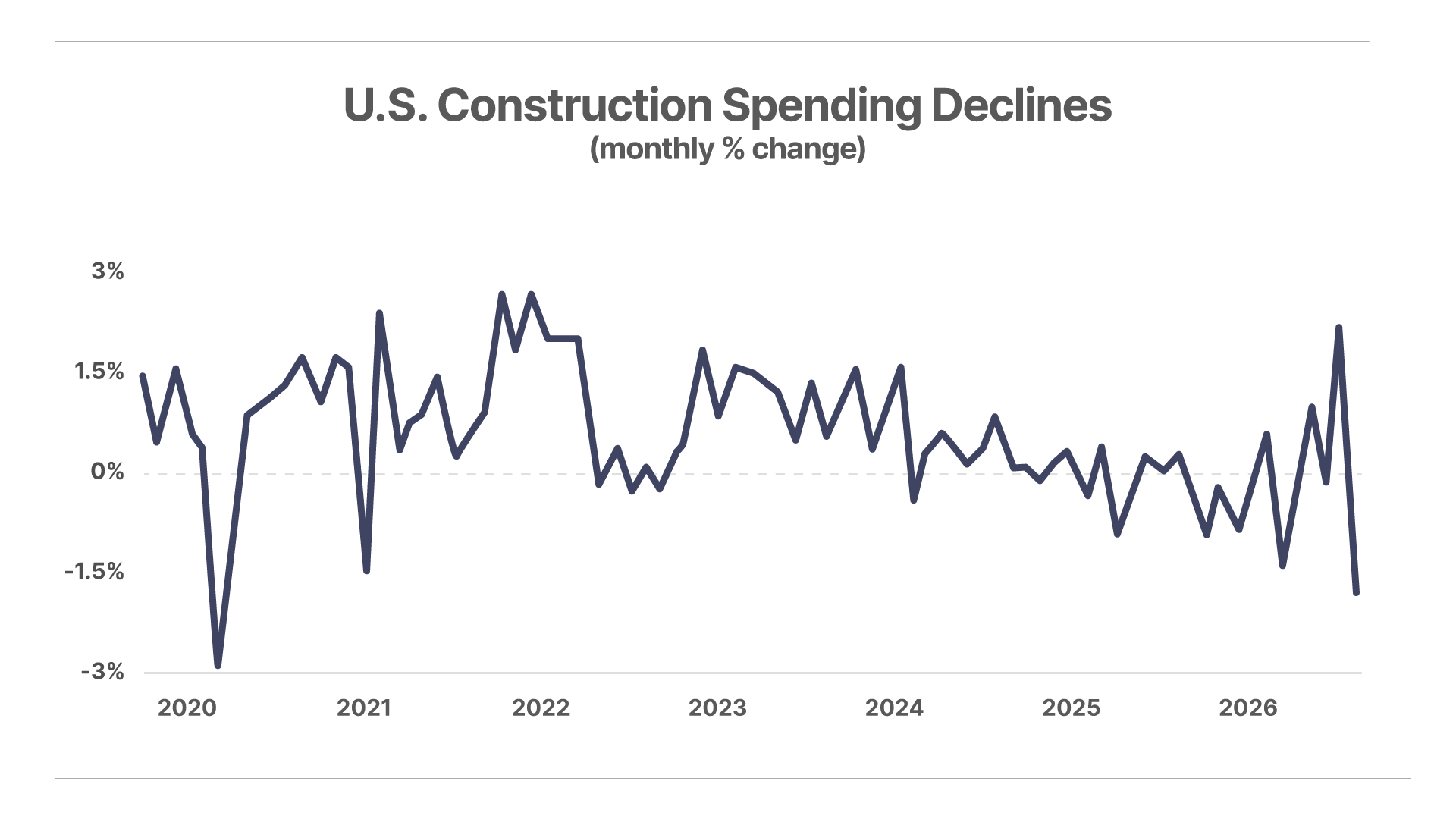
Retail building led overall U.S. construction’s 1.9% September decline, according to the U.S. Census Bureau. Private residential construction spending dropped 5.5%. Material costs and high mortgage rates weighed heavily on home renovation projects.
Michael G. writes:
“I’m looking forward to this Saturday’s Biotechnology recommendation. I have a growing concern about Roivant Sciences (ROIV). They may well find themselves with no moat in the AI world. The world of discards they explore and capitalize may evaporate if the technological approach of your next recommendation is successful.”
If you would like to see what Porter is recommending in Porter & Co. Biotechnology this Saturday, click here.
Porter & Co. Market Snapshot |
Through Tuesday, November 3, 2026 close |
| Markets |
| Index or asset | Last | 1-Day | YTD | 1-Year |
|---|---|---|---|---|
|
S&P 500
Total return
|
754.35 | +0.30% | +11.5% | +11.6% |
|
Gold
Front-month futures
|
$3,940.40 | −0.74% | −9.2% | −1.8% |
|
Bitcoin
4 pm ET print
|
$77,767.00 | +1.47% | −11.2% | −26.9% |
|
Crude oil
WTI, per barrel
|
$96.09 | −0.38% | +67.3% | +57.4% |
|
Berkshire Hathaway
NYSE: BRK-A
|
$836,445.00 | +0.22% | +10.8% | +17.5% |
| U.S. Treasury yields |
| Maturity | Yield | 1-Day | YTD | 1-Year |
|---|---|---|---|---|
|
2-Year
|
4.61% | +2 bps | +114 bps | +101 bps |
|
10-Year
|
4.95% | +4 bps | +77 bps | +82 bps |
|
30-Year
|
5.32% | +4 bps | +48 bps | +63 bps |
| Porter & Co. strategies |
| Strategy | 1-Day | YTD | Since start | Per year |
|---|---|---|---|---|
|
Porter's Permanent Portfolio
Since September 25, 2024
|
−0.60% | +5.8% | +33.5% | +14.7% |
|
Better Than Berkshire Index
Since May 16, 2025
|
−0.90% | +4.6% | +4.9% | +3.3% |
|
Porter & Co. Top Ranked*
Since July 14, 2022
|
−0.02% | +6.1% | +30.7% | +10.3% |
Porter & Co. Top Positions |
Through Tuesday, November 3, 2026 close |
| # | Position | Total return |
|---|---|---|
| 1 |
TG Therapeutics TGTX
Biotechnology
|
+223% |
| 2 |
Roivant Sciences ROIV
Biotechnology
|
+215% |
| 3 |
Roivant Sciences ROIV
Complete Investor
|
+212% |
| 4 |
Bitcoin BTC/USD
Complete Investor
|
+186% |
| 5 |
APA Corporation APA
Porter & Co. Asymmetry
|
+167% |
| 6 |
Philip Morris PM
Complete Investor
|
+158% |
| 7 |
Skyward Specialty Insurance SKWD
Complete Investor
|
+147% |
| 8 |
BWX Technologies BWXT
Complete Investor
|
+133% |
| 9 |
W.R. Berkley WRB
Complete Investor
|
+121% |
| 10 |
Chubb CB
Complete Investor
|
+98% |