Coming On Saturday: America’s Secret Real Estate Empire
Inside Today's Issue
The most important thing you have to do with your money, right now, is protect it from inflation.
This morning the government reported that consumer prices rose 3.7% over the last 12 months. Gasoline prices rose 9.1% in September alone. And inflation has now been over the government’s 2% annual target for 66 months in a row.
Inflation is getting worse, not better.
So what's the best way to protect yourself?
You should invest in America’s largest secret real estate empire. You've driven past these properties your entire life – you just didn’t know it. They are all hidden in plain sight.
No, these aren’t office towers – it doesn’t own any of those. It doesn’t own shopping malls either, thankfully. It also doesn’t own apartments, hotels, or warehouses. It owns something most Americans have never thought of as real estate at all.
And yet, in the last year it collected $10.4 billion in rent.
That is more than Prologis (PLD), which owns or manages 1.2 billion square feet of warehouses, collected ($8.2 billion). It is more than American Tower (AMT) took in from all of its cell towers and data centers combined. It’s more than the largest office REITs collect. It’s even more than the largest real estate companies in the world, like Mitsui Fudosan in Japan and Sun Hung Kai Properties in Hong Kong – combined!
And yet, I’d bet that you’ve never even heard of this real estate company because it was all built in secret by only two men.
How do we know this is the best way to protect yourself from inflation?
We studied what happened last time. From 1970 to 1990, while consumer prices tripled during America’s great inflation, this was the best-performing stock in the S&P 500, earning 20% a year.
And here’s another secret.
While its hidden real estate empire provides the business with enormous benefits from rising rents, that isn’t the main driver of the company’s incredible financial performance.
The real secret is something called “asset allocation.”
It’s ironic that most investors know almost nothing about asset allocation. They don’t know what it means. They don’t know how to measure it. And they certainly don’t understand why it’s the number-one indicator of a “power law” winning business – a company that can create real wealth over time.
Investors would rather talk about earnings and revenue growth. But those numbers only tell you how well a business makes money selling their products or services. Those operating metrics don't tell you what happens to the profits. And over any long holding period, how a company allocates its capital is the most important variable.
Let me explain how this works with a story from my book, Warren's Mistakes – about how legendary investor Warren Buffett stopped investing in capital efficient businesses.
Commercial aviation is the worst business in the history of American capitalism.
From the deregulation of the U.S. airline industry in 1978 through 2024, the four publicly traded U.S. legacy carriers and their predecessors collectively filed for bankruptcy more than 15 times. Pan Am went under twice. TWA went under three times. Eastern, Braniff, Continental, U.S. Airways, Northwest, Delta, United, and American Airlines have each spent at least one period in Chapter 11.
The cumulative net income of the entire U.S. airline industry, computed from 1948 through 2009, was negative – 61 years of operating one of the largest physical-asset enterprises on Earth produced, in aggregate, no profit at all.
Buffett famously explained exactly why in the 2007 Berkshire Hathaway shareholder letter:
The worst sort of business is one that grows rapidly, requires significant capital to engender the growth, and then earns little or no money. Think airlines. Here a durable competitive advantage has proven elusive ever since the days of the Wright Brothers. Indeed, if a far-sighted capitalist had been present at Kitty Hawk, he would have done his successors a huge favor by shooting Orville down. The airline industry’s demand for capital ever since that first flight has been insatiable. Investors have poured money into a bottomless pit, attracted by growth when they should have been repelled by it. And I, to my shame, participated in this foolishness when I had Berkshire buy U.S. Air preferred stock in 1989.
What Buffett didn’t mention in that 2007 letter was that he’d bought something even worse than U.S. Air.
In August 1998, Warren Buffett bought Executive Jet, the parent company of private-jet operator NetJets, for $725 million.
NetJets has the worst unit economics in commercial aviation. It has the cost structure of a commercial airline. Its pilots are unionized. Its aircraft cost between $5 million and $80 million each and depreciate on a 15-year schedule. Maintenance reserves run about $1,000 per flight hour. The hangars are staffed 24 hours a day.
But what NetJets doesn't have is the one thing that gives an airline any chance of earning its cost of capital: scale. A NetJets airplane carries one party of passengers per flight, often two or three people, sometimes one. Its cost per passenger mile runs 15 times to 20 times what a major airline achieves on a full wide-body jet.
It’s no surprise, then, that NetJets was a disaster for Berkshire. In its first 11 years inside Berkshire, NetJets lost a combined $157 million before taxes. Then, in 2009, it lost $711 million. Its debt soared from $102 million when Buffett bought it to $1.9 billion, and Berkshire guaranteed every dollar.
But losing a bunch of money wasn’t half of the problem. The real problem was Buffett’s asset allocation. As the CEO of Berkshire, Buffett had a choice. He could have bought NetJets with cash. If he needed more cash, he could have borrowed it.
But that’s not what he did. Buffett paid for half of NetJets, about $363 million, with newly issued Berkshire stock, roughly 4,700 class-A shares.
Buffett is considered a master of capital allocation, but beginning with the NetJets deal, Buffett made a series of catastrophic mistakes in asset allocation. Again, the problem wasn’t merely losing money on a bad deal. The real problem was the capital he used to fund these bad deals.
Today, those 4,700 shares are worth $3.7 billion. The stock Buffett handed over for one small private-jet operator would now buy two whole national airlines, JetBlue Airways (JBLU) and Frontier (ULCC), and he’d still have $1 billion left over.
But NetJets was only the beginning. Over the last 25 years, Buffett made a series of far larger blunders, but each one had the same flaw: Berkshire's capital went into businesses that consume capital instead of businesses that produce excess capital.
Start with the windmills. Berkshire Hathaway Energy has poured about $45 billion into renewable-energy projects, most of it wind and solar. In 2014 Buffett was asked why Berkshire was building so many wind farms in Iowa. His answer:
On wind energy, we get a tax credit if we build a lot of wind farms. That's the only reason to build them. They don't make sense without the tax credit.
And those tax credits are gone now. There’s no way Berkshire can earn an economic return on this enormous investment.
But that wasn’t the biggest capital allocation mistake.
BNSF Railway was the largest acquisition of Buffett's career. And it has been a disaster for Berkshire. BNSF's spending on equipment has run far above depreciation – meaning, Berkshire has had to put billions of excess capital into the business. Buffett himself wrote in his 2023 letter that the excess had "totaled a staggering $22 billion" over 14 years. "Ouch!" he added.
Now compare Buffett’s capital allocation record over the last 25-plus years to the company we're recommending to subscribers on Saturday.
In 1998, the same year Buffett bought NetJets, our upcoming recommendation bought a minority stake in a small, fast-growing restaurant chain with fewer than 20 locations. It kept investing as the chain proved itself, about $360 million over the next seven years, and by 2005 it owned 90% of the business.
By the time the chain went public in January 2006, it had more than 500 restaurants. The shares were priced at $22 and closed the first day at $44. But instead of selling for cash and paying the tax, it offered its own shareholders the chance to trade their shares for the remaining stake. The swap was tax-free, and it retired nearly 19 million of the company's own shares. All told, the company made, tax-free, about $1.1 billion on its $360 million investment.
That’s world-class asset allocation.
And it was only getting started. Over the next three years, it sold every business that wasn't its core business. Then in 2007, it sold its own company-run operations in 18 Latin American and Caribbean countries to a local operator for about $700 million in cash. In return, it now collects a royalty of about 5% of sales in those markets and invests no capital.
In 2005, this company carried $10.1 billion of debt against $15.1 billion of shareholders' equity, a very conservative balance sheet. But after the Global Financial Crisis, interest rates plummeted. By 2016 the business could borrow at only 2.2% after tax, while its own stock yielded 7% on cash flow.
What does a great capital allocator do when its stock is cheap and interest rates are low? That year the company bought back $11.1 billion of its own shares, the largest repurchase in its history. From 2015 through 2025, it returned $88.2 billion to shareholders, about two-thirds of the buybacks financed with cheap, long-term debt.
Today, it carries about $40 billion of debt, at an average coupon of about 3.9%, with an average maturity around 2035. With interest rates moving higher, it is now paying down debt and it only repurchases stock from free cash flow.
All these decisions add up to enormous returns for shareholders.
In the last 20 years, the business has eliminated 44% of its shares. And its dividends have grown massively. Last month it raised its quarterly dividend to a level that’s more than 11x its 2005 dividend.
Since 2005, consumer prices in America have risen about 70%. This company's dividend per share rose more than 1,000%.
That’s how we know… owning this business is the best way to manage your exposure to our government’s printing press.
And, this Saturday, in Complete Investor, I'll tell you the whole story… and of course, I’ll tell you the name of the company and why we think now is the time to buy shares in it.
If you’re not yet a paid-up subscriber to Complete Investor, now is the time to join.
Tell me what you think of today’s Daily Journal: porterstansberrydirect@gmail.com
Good investing,
F. Porter Stansberry
Stevenson, Maryland
P.S. Porter will be on stage at the 2026 New Orleans Investment Conference, October 28-31.
This year marks the 52nd annual event, making it the longest-running investment conference in the world. You’ll hear from today’s top macro and market analysts. And of course, you’ll hear what Porter is watching right now, and why.
We’ve gotten word that admission prices are increasing Friday. If you want a seat, click here to register now.

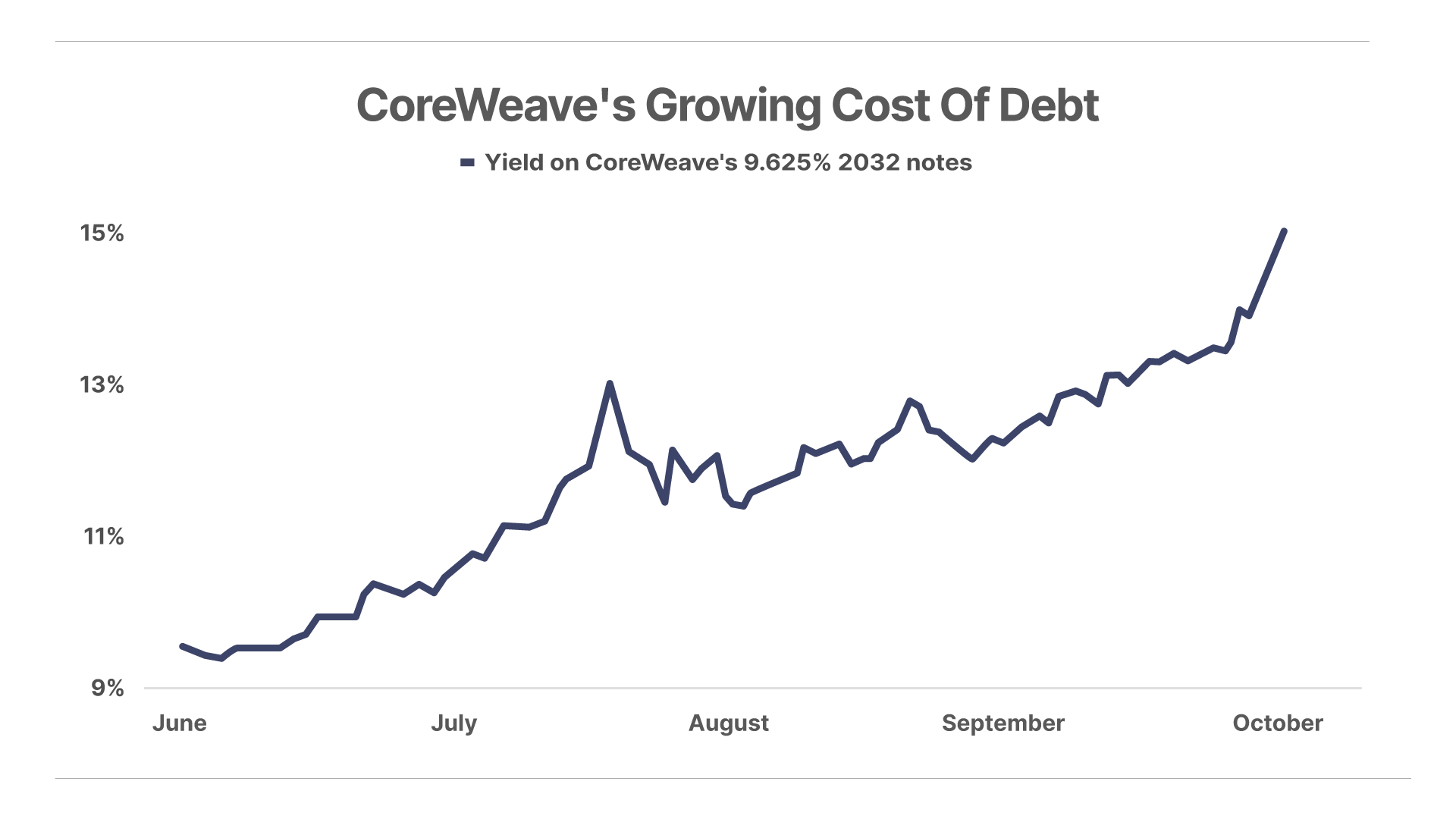
1. The canary in the AI coal mine. CoreWeave (CRWV) sits at the center of the AI boom as a highly-leveraged "neocloud" that rents Nvidia GPUs to AI labs. It’s an incredibly capital-intensive business, burning through $15 billion in cash in the last year and sitting on $45 billion in net debt. Now, the cost of its debt is exploding, with yields approaching 15%. Meanwhile, Coreweave’s five-year credit default swaps (insurance against bond default) trade at 980 basis points, implying a 56% chance of default in the next five years. With similar levels of distress across the neocloud sector, it appears the market is throwing up a warning sign about the business models at the heart of today’s AI infrastructure build out. See Porter’s recent warning about this.
2. Inflation is pushing the Fed to hike rates, but hikes are unlikely to help. Core inflation, which excludes volatile food and energy prices, rose 0.3% in September versus the 0.2% economists expected. Including gas, prices rose 3.7% from a year ago. Following the news, the odds of an October 28 rate hike roughly doubled to 45%. However, while rate hikes may slow interest-rate-sensitive sectors, they also increase the interest the federal government pays its bondholders. In the 2022–2023 hiking cycle, that added income exceeded the added interest private borrowers paid. This is known as “fiscal dominance” – government debt so large that it blunts the Fed’s primary tool. Hikes will also do nothing to fix the real price driver… the energy supply crunch from the Iran war.
3. AI is getting cheaper faster than computers or batteries ever did. The cost of reaching a fixed level of AI performance has fallen about 47% per quarter since 2023, or roughly 13-fold a year, according to research group Epoch AI. Computing costs fell about a third a year from 1940 to 2001, and lithium batteries about 13% a year from 1991 to 2024. Yet Moody’s expects U.S. and Chinese tech giants to spend roughly $925 billion on AI infrastructure this year. That money earns a return only if AI use grows faster than 13-fold its price falls.
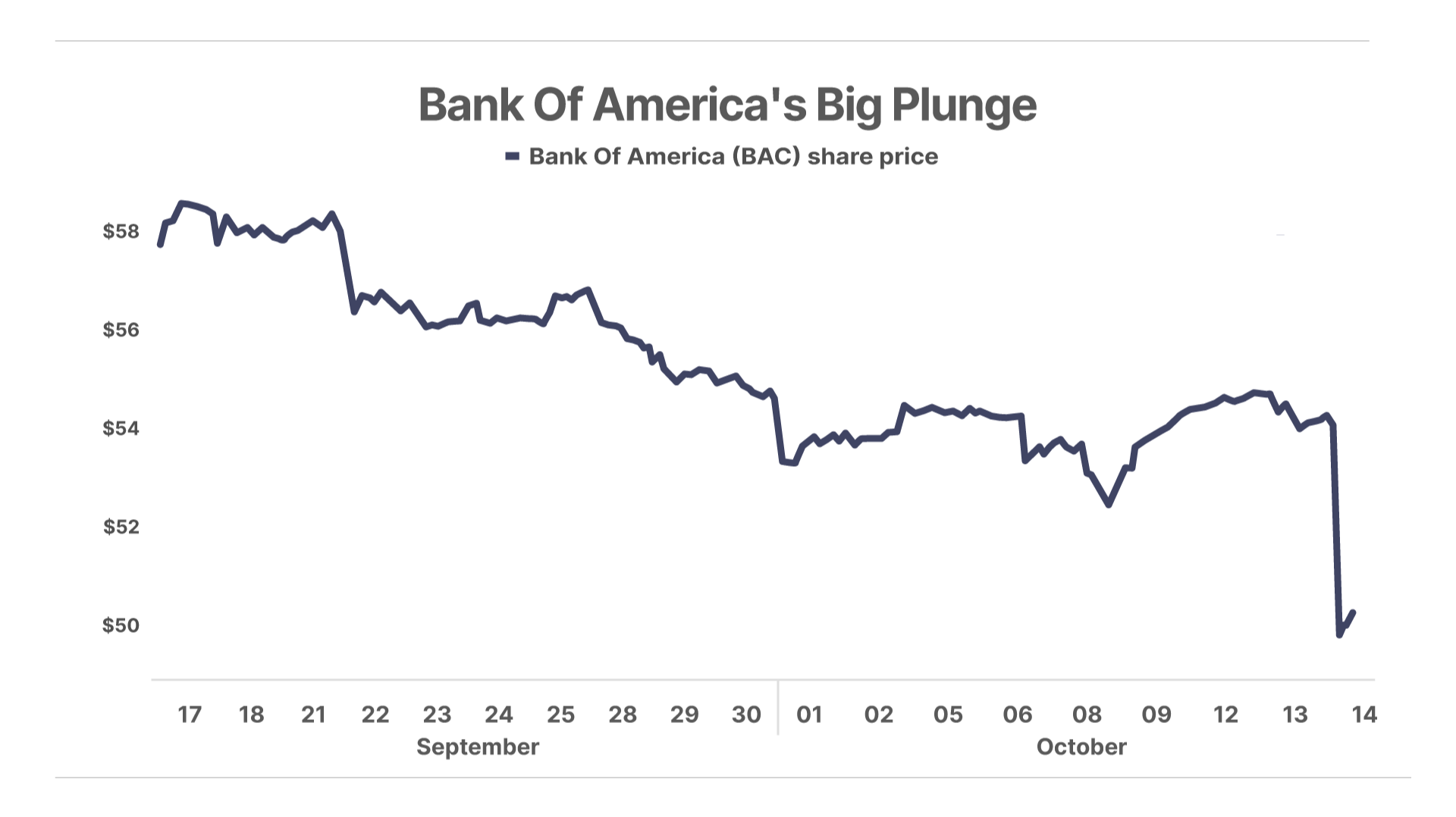
Bank of America (BAC) fell 8% this morning on a Q3 earnings miss driven by weak bond trading and a $1.2 billion anti-money-laundering settlement. But what the market has not digested: unrealized losses on the bank's held-to-maturity bond portfolio jumped from $82 billion to $104 billion in a single quarter, equal to 52% of its prime holdings. CEO Brian Moynihan's 2020 decision to plow $500 billion into low-interest mortgage bonds remains one of the worst bets in banking history. Need proof? Those bonds are now trading at 76 cents on the dollar.
“These Bonds Can Outrun Inflation”
Opher L. writes:
TIPS could be great, but as Porter mentioned on several occasions, the CPI tends to understate the real inflation rate. Therefore, the TIPS may not compensate their holders sufficiently to keep up with prices, let alone provide some kind of gain.
Bruce L. writes:
Tips are a loser as usual – another update with NO positions recommend [sic] to buy and profit from.
Porter & Co. Comment: We don’t make formal recommendations in Daily Journal. As mentioned in yesterday’s Journal, paid-up subscribers to Distressed Investing had access to a list of distressed debt that returned 25% to investors – with numerous open positions available to jump into. Complete Investor will be recommending a Forever Stock on Saturday, October 17 – three days from now. There is still time to subscribe and be part of that.
“2029: The End Of America”
Stanley W. writes:
In your book 2029: The End Of America, you talked about Weyerhaeuser (WY) and its place in an investment portfolio. Will you be tracking WY or giving updates on it from time to time?
Porter Comment: Yes, I’ll report on that strategy in my Daily Journals.
Porter & Co. Market Snapshot
*A Complete Investor risk rating of 1 is defined as a "low risk, high allocation" security, while positions rated closer to a 5 are higher risk. Porter & Co.'s top-ranked positions include those rated either 1 or 2 in Complete Investor portfolio.
Porter & Co. Top Positions
Prices as of 4:00 pm ET October 13, 2026
Please note: The investments in our “Porter & Co. Top Positions” should not be considered current recommendations. These positions are the best performers across our publications – and the securities listed may (or may not) be above the current buy-up-to price. To learn more, visit the current recommendations page of the relevant service, here. To gain access or to learn more about our current recommendations, call our Customer Care team at 888-610-8895 or internationally at +1 443-815-4447.