The World Needs The LNG That It’s Efficiently Producing
Inside Today's Issue
One month ago, I wrote a detailed analysis of CoreWeave (CRWV) and showed you why Jeff Bezos shorted the data-center build-out firm.
Well, sorta.
In his 2004 shareholder letter, the Amazon founder described a business much like CoreWeave and demonstrated why businesses with heavy capital investments always fail if they’re not earning their cost of capital. In these situations, revenue growth simply leads to a bigger failure.
Today I want to examine Venture Global (VG), which is in the process of building out one of America’s largest ever capital projects – a series of enormous liquefied natural gas (“LNG”) export facilities that have already cost almost $50 billion.
The question for investors is: is Venture Global a Bezos “teleport machine,” that like CoreWeave is doomed to fail?
Bezos's teleportation machine turned $160 million of equipment into $100 million of annual revenue. His machine was generating 62 cents on the dollar of its initial cost. But it was hopeless because the machine was scrap in four years. Lifetime revenue: $2.48 for every dollar of capital.
As I showed in the August 31 Journal, CoreWeave is much worse. It only gets 16 cents on the dollar out of assets. And they’re worthless even faster: new Nvidia (NVDA) architecture every 12 months.
Venture Global turns $53.9 billion of plant into $17.0 billion of trailing revenue – 32 cents on the dollar. Better than CoreWeave, but worse than Bezos’ teleport machine, which was doomed to fail.
But there’s a critical difference: a natural-gas liquefaction plant does not become scrap after four years like Bezos’ teleport machine. Venture Global charged $941 million of depreciation last year against $47.3 billion of property and equipment, a schedule that implies a useful life of 30 years – 7.5x the teleport machine.
That time frame changes the math dramatically – 31 cents a year for 30 years is $9.30 of revenue for every dollar of capital, nearly 4x the lifetime output of Bezos’ teleport machine. And investors should remember that this year’s $17.0 billion of revenue doesn’t include anything from Venture Global’s newest facility, Calcasieu Pass 2 (“CP2”), a huge plant in Cameron Parish, Louisiana, that’s mostly finished but has not yet produced a molecule of gas or a dollar of revenue.
Bezos’ machine spent $500 of every $1,000 trip on energy, materials, and labor. Half the ticket, gone.
Venture Global spends about 45 cents to liquefy a million British thermal units of natural gas (“MMBtu”). It is currently selling that service on its uncontracted cargoes at $12.50 to $13.50 per MMBtu. On those cargoes, running the machine costs under four cents of every dollar of revenue.
And Venture Global's cost per unit keeps falling.
Calcasieu Pass produces at 45 to 50 cents and heads below 40 cents at full capacity. Another plant, Plaquemines, runs at 44 cents on a nameplate basis and heads into the low 30s. The company calls it a high-fixed, low-variable cost model, and says running one fleet across every site compounds the benefit.
That is like Amazon's (AMZN) warehouses, not Bezos’ teleport machine. Amazon's fulfillment centers kept working while revenue tripled around them and the cost per package fell. Venture Global's trains do the same thing.
One other big difference between CoreWeave’s massive capital spending and Venture Global’s: who’s paying for the build?
Amazon's customers financed most of Amazon’s operations. The credit card cleared the day the book shipped and the publisher waited 60 days to get paid. Likewise, Venture Global's customers finance it. Before a shovel moved at Calcasieu Pass or Plaquemines, the company signed 20-year sale and purchase agreements with its customers. These are contracts under which the buyer pays a fixed liquefaction fee whether it takes the cargo or not. The project debt was then underwritten against those contracts. Today 100% of the nameplate capacity across the first three projects is contracted.
That is the reverse of CoreWeave, which builds, powers, and staffs a data center first, then goes looking for someone to rent it. As a result CoreWeave pays 25 cents of every dollar it bills to a lender in interest. That’s an enormous tax on profits and one of the main reasons I do not believe CoreWeave can earn its cost of capital.
Meanwhile, Venture Global is producing both huge revenue growth and outstanding operating margins. In the most recent quarter, released August 11:
Revenue of $4.58 billion, up 48%. Income from operations of $2.18 billion, a 48% operating margin. Net income attributable to common stockholders of $1.35 billion, up 266% from $368 million. Consolidated adjusted earnings before interest, taxes, depreciation, and amortization (“EBITDA”) of $2.49 billion, up 79%, at a 54% margin.
Management raised full-year guidance for the second straight quarter, to $8.7 billion to $9.1 billion of adjusted EBITDA from $8.2 billion to $8.5 billion.
And, yes it is earning its cost of capital: it repaid $1.4 billion of debt through July, cutting more than $100 million a year off its interest and preferred coupon obligations. It raised the dividend 122%.
Interest expense at Venture Global was 10.6% of revenue last year and it is falling. Amazon's peaked at 3.6%. CoreWeave's is 25%.
So why does Venture Global stock trade at $13 – less than 10x earnings?
Because Wall Street hasn’t figured out that Venture Global is building the world’s most in-demand energy infrastructure. They don’t believe these results can continue. They think there will be a glut of LNG supply and that prices for cargoes will collapse.
Consensus has 2027 EBITDA at $7.00 billion, down 21% from this year's $8.85 billion.
Next year, as it opens its third enormous facility, Venture Global's loadings will more than double. And Wall Street thinks it will make less money. Volume doubles and profit falls. How?
Cargoes produced before a plant reaches commercial operations date, the moment its long-term contracts switch on, are sold at whatever the spot market pays. Those are commissioning cargoes, and the spot market is currently paying extraordinary money for them. After that date the same cargo earns the 20-year contracted fee instead. Venture Global has not published that fee, but we believe it’s about half the 16-year average, which is about $6 per MMBtu. That puts our estimate of the long-term contract rate at around $3 per MMBtu.
So Wall Street assumes every cargo converts to $3 gas, on schedule, forever.
That assumption was reasonable in January. It is absurd today.
On February 28, American and Israeli forces struck Iran. Iran closed the Strait of Hormuz, and roughly 20% of the world's LNG supply stopped moving. Seven months later, the Strait is still not fully open. Lloyd's List Intelligence counted an average of 88 transits per week in September against a normal baseline near 88 per day – 22 LNG cargoes have exited the Gulf since mid-April. The two countries do not seem to be on a path to a peace agreement that would lead to the opening of the Strait Of Hormuz.
On March 18, Iranian missiles hit Ras Laffan.
Two of Qatar's 14 LNG trains are gone. Trains 4 and 6, 12.8 million tonnes a year, 17% of Qatari export capacity, offline for three to five years – $26 billion of construction cost, $20 billion a year of lost revenue. QatarEnergy has declared force majeure for up to five years on supplies bound for Italy, Belgium, South Korea, and China. ExxonMobil (XOM) owns 34% of one train and 30% of the other.
Qatar's 32 million tonne North Field expansion has slipped to 2028.
The International Energy Agency now models about 120 billion cubic metres of global LNG supply lost between 2026 and 2030, and says tighter conditions persist through the end of the decade. BloombergNEF pushed its expected global glut from 2027 to 2028, with peak surplus arriving in 2031 or 2032.
Asian spot gas trades at $21.19 per MMBtu. Henry Hub, the American benchmark that sets Venture Global's feedstock cost, trades at $2.81.
Just ask yourself this simple question: who replaces 12.8 million tonnes a year of Qatari gas between now and 2031?
Not Qatar, for at least three more years. Not Iran, which is under an American naval blockade. Not Russia. Every utility in Europe and Northeast Asia that believed a 20-year Qatari contract was the safest supply arrangement on Earth watched it fail on a Wednesday morning in March.
They are shopping for term contracts now, and there are very few sellers with anything to sell.
Venture Global has 32 million tonnes a year of uncommitted capacity, on purpose. Of an eventual 85 million tonne run-rate across its three facilities (Calcasieu Pass, Plaquemines, CP2) and the bolt-on expansions at the latter two, 53 million tonnes are committed and the rest is deliberately open. Sabel's plan is to contract that excess on a multi-year rather than 20-year basis, and to shift the emphasis toward shorter deals that clear at much higher prices.
He is doing it into a market that has lost a fifth of its supply!
If you assume that Wall Street is right and Venture only ends up earning $3.00 on its cargoes after CP2’s commissioning next year, then it will produce an annual run rate EBITDA of around $14 billion. But if you expect there to be a lot higher prices because of the ongoing disruption to the world’s LNG markets and you assume Venture is able to get the full average price ($6) as a result on a mix of contract, spot market, and shorter-term cargoes… then annual EBITDA should be more than $25 billion.
At the 85 million tonne run-rate, Venture Global sells about 4.4 billion MMBtu a year. Take the fee it captures net of gas and shipping, subtract 35 cents of production cost, capitalize the result at 8x, subtract the debt, and discount five years at 11%.
Every dollar per MMBtu of sustainable fee is worth roughly $8 a share of present value.
Wall Street thinks present value is worth about $12 a share. But at $6 cargoes instead of $3 cargoes, that present value goes to $35 per share. And… if the war gets worse… that $6 price could easily go to $10 or $12.
At $13, the market is discounting a sustainable liquefaction fee of about $3.55 per MMBtu. That is 55 cents above the 20-year contract floor.
Venture Global trades at 8.2x this year's EBITDA. Cheniere Energy (LNG), which sells the same molecule off the same coast to the same customers, trades close to 12x.
I think it’s worth at least $25 a share. And I think in the event of any significant further damage to Qatari LNG infrastructure, it could easily trade up to $50.
Share your ideas about today’s Daily Journal: porterstansberrydirect@gmail.com
Good investing,
F. Porter Stansberry
Stevenson, Maryland

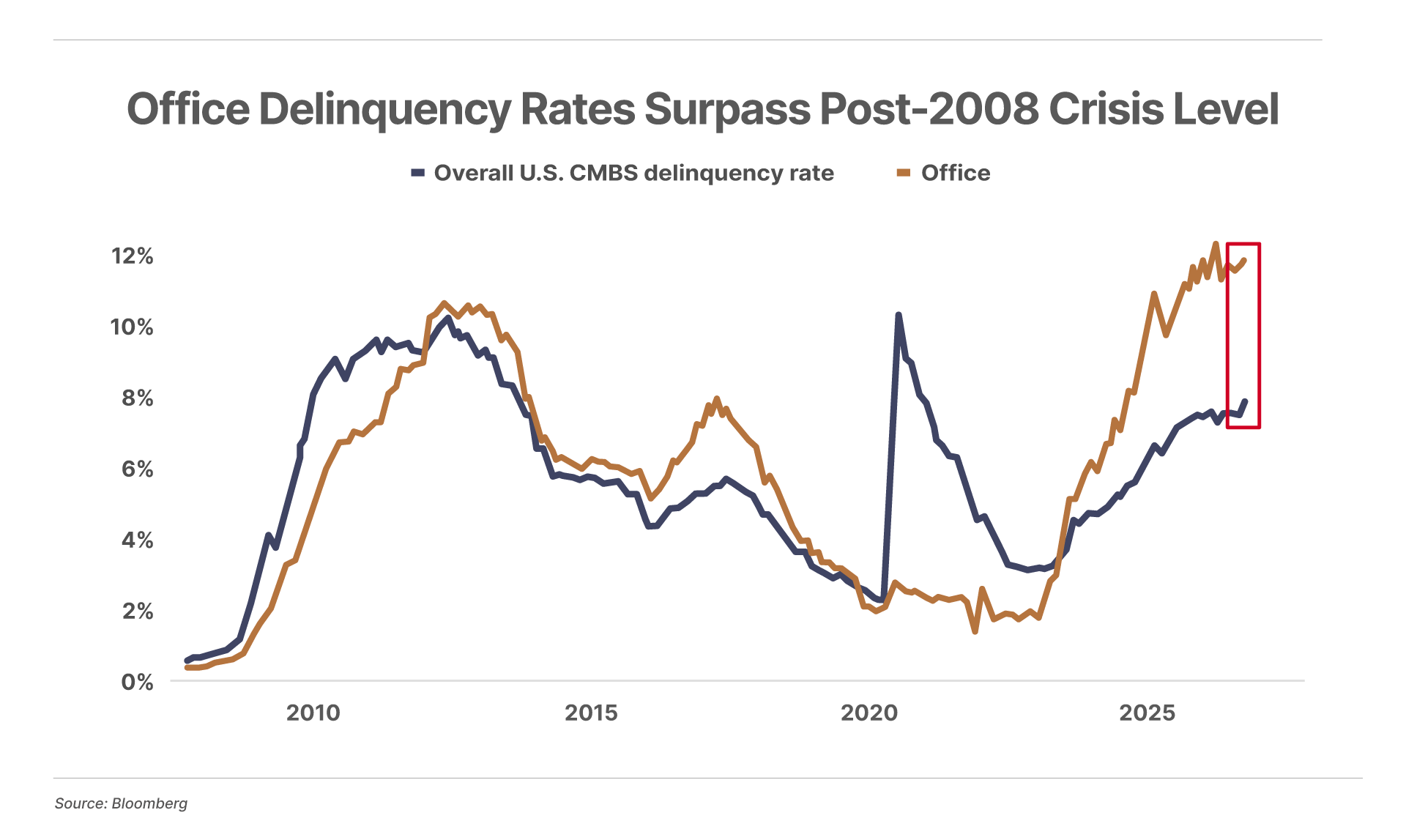
1. Office delinquencies are back at 12%. The delinquency rate on office loans in commercial mortgage-backed securities ("CMBS") rose nine basis points in August to 12.0% – the second-highest reading on record and just below January's 12.3% peak. The post-2008 high was 10.8%. Office delinquencies are now 6x early-2023 levels, and the overall CMBS rate has doubled since 2022 to 7.9%. The credit picture in commercial real estate is still worsening, three years after office values peaked.
2. An early look at Anthropic’s financials. Yesterday, Reuters published a preview of the initial public offering (“IPO”) prospectus from Anthropic, the leading AI company and owner of Claude. The report showed Anthropic brought in $4.6 billion in revenue last year, while generating $8 billion in operating losses and $42 billion in total losses. Meanwhile, the company plans an annual spend of $518 billion on computing infrastructure. Both Anthropic and OpenAI (owner of ChatGPT) – the two companies at the heart of today’s AI boom – remain deeply unprofitable and reliant upon raising capital to fund the data-center build-out.
3. Inflation is a global problem – and it's getting worse… 23 of 33 major economies reported higher inflation than the prior reading, three were unchanged, and only seven came down. The U.S. is at 3.4%, the Eurozone at 3.2%, the UK at 3.1%, and Germany at 2.9%, while Spain is at 4.9% and India at 4.8%. Apart from Japan and Switzerland, no major developed economy is at its 2% target, and most are moving away from it.
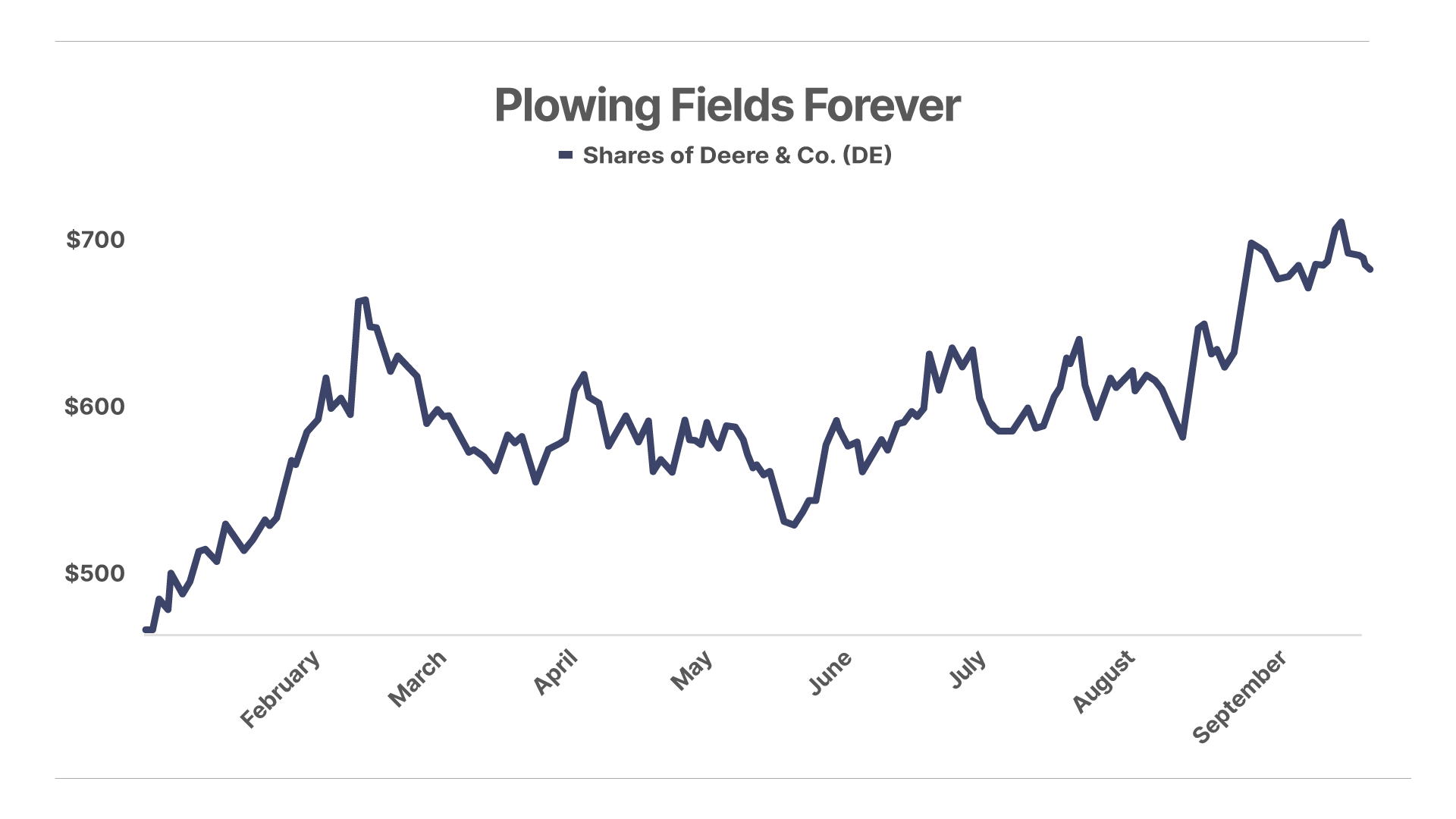
Recent earnings have revealed solid revenue and earnings-per-share growth for agricultural equipment maker Deere & Co. (DE) – shares have responded… up 8% for the month, 47% year to date, and 74% since we added them to Complete Investor.
“Big-Time Losses”
Larry K. writes:
I am in my first year with Porter & Co. So far I've had significant LOSSES! I understand that you publish research and it is the members’ choice what to select. Going by your recommendations, for example, TPL entered at $530.00/share and it is currently at 339.00/share.
I am sure you want all members to be doing well, but that is not the case. But I cannot afford to follow your advice/recommendations any longer.
Based on the above, with the losses and sleepless nights, I wish to not renew for another year.
Porter & Co. Comment: We recommended Texas Pacific Land (TPL) at $309.24 per share on September 25, 2024, and yesterday, September 28, 2026, it closed at $341.07 – for a gain of 10.3% over two years. Not its best span – it’s up 127% over the last five years – but still pretty good. And to be clear, if you bought at $530 per share, as you say, you got into Texas Pacific at a price above our buy-up-to price of $524.07.
And while we placed Texas Pacific in our Energy & Commodities section of Complete Investor because of its dealings with oil producers in the Permian Basin, it could very well have been placed in Forever Stocks – which are stocks to buy and hold… well… forever.
It's also worth pointing out that the vast majority of all stocks are in a bear market, primarily due to the impact of interest rates breaking out to 20-year highs, which is something Porter’s been writing (and warning) about.
“P&C Stocks And Porter’s Permanent Portfolio”
Matt M. writes:
I am curious why you sold all the P&C stocks due to the risk of rising rates and bought them back in the rebalance. I see the six holdings from 2025 are different allocations, and you added four additional stocks.
I want to make sure I did not miss something. I have a lot of money allocated to this portfolio, and I want to make sure I am allocating properly. I assumed when you sold the entire positions and generated capital gains, you would not be buying them again in the next allocation.
I appreciate your explanation and clarification.
Porter & Co. Comment: When Porter announced two weeks ago that he was removing property-and-casualty (P&C) insurance stocks from Porter’s Permanent Portfolio because the yield on 10-year Treasuries had risen above 5%, he made it very clear that this was a recommendation for conservative investors at or near retirement.
When he reallocated Porter’s Permanent Portfolio at the Annual Conference last week, he created three versions of it: conservative, moderate, and aggressive. The conservative version does not hold any P&C stocks.
Partners and paid-up subscribers to Complete Investor can access the new allocations (and the old ones) while logged in to your account on our website.