Issue #115, Volume #3


The Fed Is Focused On The Volcker Myth, Excluding Other Policies
Inside today’s Daily Journal…
|
Editor’s note: Today, Porter turns the Journal over to his longtime friend, Jim Rickards. Jim serves as an editor and lead research voice for Paradigm Press, where he publishes analysis examining the intersection of economic policy, geopolitics, and national strategy through the publication Strategic Intelligence… Over the course of his career, Jim has served as an advisor to the CIA, the Pentagon, and the White House on matters related to economic risk, financial security, and geopolitical strategy.
The swearing-in of Kevin Warsh as the new chair of the Federal Reserve on May 22, 2026, prompted a great deal of reflection on the tenure of prior Fed chairs and speculation about Kevin Warsh’s interest-rate policies.
One of the more interesting analyses was a post on X by Bloomberg reporter Lisa Abramowicz on the day Warsh was sworn in. She prepared a chart showing the yield-to-maturity on the 10-year Treasury note on the day each of the last seven Fed chairs was sworn in, going back to Arthur Burns in 1970. Here are the results of her research:
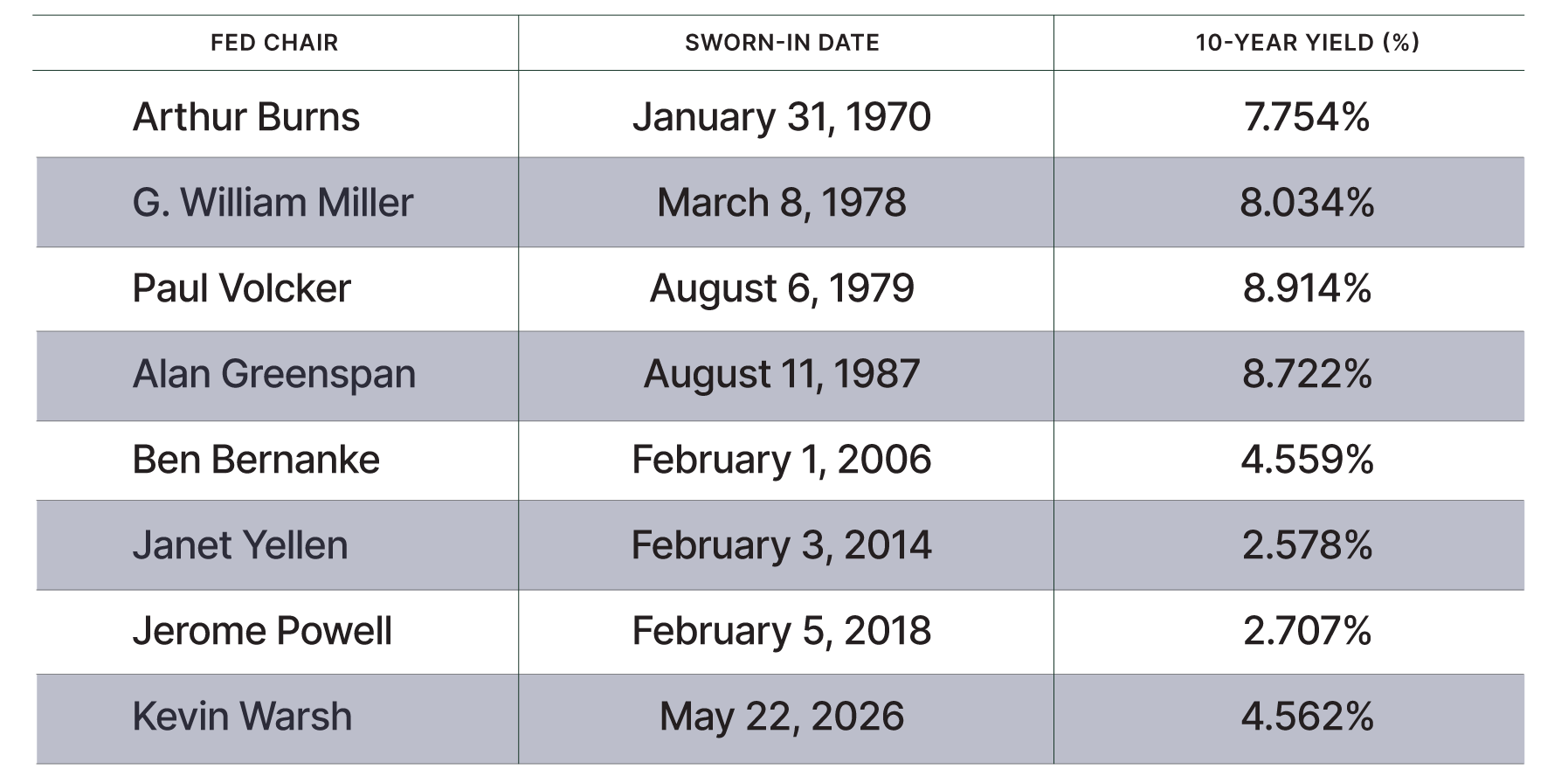
The 10-year Treasury note yield is not a rate controlled directly by the Fed. That rate is dictated by the market. Still, it is a good proxy for mortgage interest rates and corporate debt. Mortgages and corporate debt are important drivers of the real economy, and their yields reflect economic conditions generally. As a compendium of rates that each incoming Fed chair has faced over the past 56 years, the chart is useful.
Discussion of the chart noted that rates were much higher in the 1970s and early 1980s than they are today. The observation was also made that Warsh’s hands may be tied because rates have climbed recently from the relatively low levels faced by past chairs Janet Yellen and Jerome Powell.
The conclusion was that Warsh will be fighting a battle against rising inflation and may even have to raise rates in the near future to contain it. Is Warsh headed back to the environment that his predecessors Paul Volcker and Alan Greenspan faced?
That may well be the case but, if so, it will be another historic blunder by the Fed. Abramowicz’s data is exactly right, but it hides as much as it reveals. What’s hidden holds the key to interest-rate policy going forward.
The interest rates Abramowicz shows are nominal. They represent the actual coupon on the note – the amount of interest you will receive as a holder. But they are not real. A real interest rate is what you get when you take the nominal rate and subtract inflation. The difference can be positive or negative, but the real rate is what you receive (or lose) once the devaluation of the dollar due to inflation is taken into account.
It’s just fifth-grade math, nothing difficult. If the nominal rate is 5% and inflation is 3%, then the real rate is 2% (5% – 3% = 2%). If the nominal rate is 5% and inflation is 6%, then the real rate is negative 1% (5% – 6% = -1%). Higher real rates are good for lenders and bad for borrowers, and vice versa.
When you talk about “high rates” or “low rates,” you have to look at real rates to see what’s happening to the economy. Of course, nominal rates still matter when you have to write a check. That’s important for cash-flow purposes, but less important for economic analysis.
Let’s look at the Abramowicz data again after adjusting for inflation at the time:
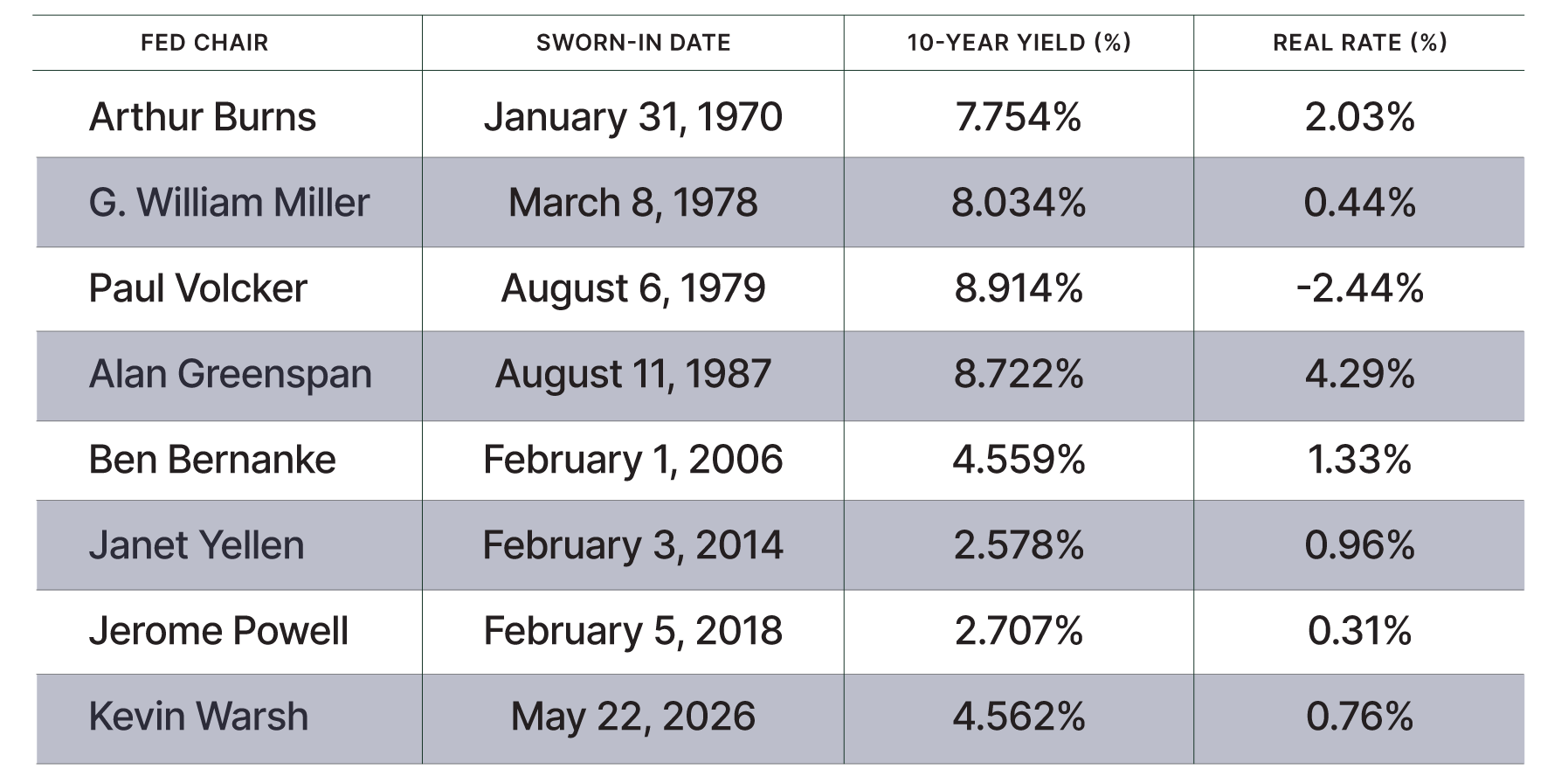
Note: Real rates are calculated as the 10-year Treasury yield minus the year-over-year CPI inflation rate prevailing at the time each Fed Chair assumed office
The chart revised for real rates shows some interesting data. Kevin Warsh is starting as Fed chair with the fourth-lowest nominal rate and the fourth-lowest real rate (out of eight chairs) in the past 56 years. Paul Volcker, Arthur Burns, and Jay Powell all took the chair with lower real rates. Kevin Warsh is in the middle of the pack in terms of nominal and real rates.
(The adjusted data above is accurate, but does not tell the whole story. By 1980, inflation under Volcker was 14% while the yield-to-maturity on Treasury securities was only 8.5% as late as June 1980. That meant the real rate was negative 5.5%. That’s better than free money if you’re a borrower and a huge loss for lenders.)
This adjusted data has some important policy implications. The first is that real rates are not particularly high as Warsh enters office. In fact, they are tame compared to Burns, Greenspan, Ben Bernanke, and Yellen. If inflation rises from here (which is likely in the short run), then real rates could actually go negative unless Warsh raises nominal rates. That’s the case for a policy-rate increase by the Fed in the coming months.
But that knee-jerk reaction to inflation is not the right course. The reason is that inflation has two causes.
-
Supply-chain disruption, or what economists call cost-push inflation. In effect, higher commodity costs push higher costs up the supply chain until they reach the consumer.
-
Consumer behavior, or demand-pull inflation. The idea is that consumers pull purchases forward to avoid future price increases. This increases the velocity of money and causes price increases in a way that feeds on itself.
The difference is critical in terms of policy. The cure for cost-push inflation is simply to wait. Higher costs tend to extinguish themselves through demand destruction and substitution. It’s self-negating.
The cure for demand-pull inflation is to raise interest rates. That tends to lower velocity and raise the cost of using credit. Demand-pull inflation is self-reinforcing unless some force intervenes to change behavior. That force can be higher rates.
Fed Chair Burns responded to an oil-price shock by raising rates, a decision many economists believe worsened the 1974 recession. He would have done better to keep real rates lower and let the price of gasoline stabilize, which it eventually did.
Fed Chair Paul Volcker caused two of the worst recessions in U.S. history in 1980 and 1981–82 when he raised interest rates to 20% to combat an extreme case of demand-pull inflation. That was needed to some extent, but he could have avoided the worst effects by raising rates sooner.
Burns and Volcker both presided over recessions, but for entirely different reasons. Burns raised rates when he should have refrained. Volcker raised rates but waited too long to do so. The difficulty was that Burns faced a supply-chain disruption while Volcker faced a change in consumer behavioral psychology.
Where We Are Today
Warsh finds himself in a situation similar to the one Burns encountered. Inflation is being caused by supply-chain disruptions. Warsh should cut rates to help the economy while the cost-push inflation cools down on its own. Instead, Warsh is being urged to apply the Volcker remedy of higher rates. That may bring down inflation, but at the cost of a severe recession.
As usual, the Fed staff and mainstream media are focused on the myth of Volcker to the exclusion of other analyses and policy choices.
Curiously, the only person in the White House who seems to understand what I’ve described here is Donald Trump. That’s not because he’s a financial genius. It’s because he’s a real estate developer. People in the real estate business practically live or die by interest rates.
A fully leased office building functions a lot like a bond financed in the repo market. The steady stream of rents is like the coupon on the note. The interest expense on the mortgage is like the repo rate. If the rental stream, minus operating costs, exceeds the mortgage expense, then you are making money. Trump has an excellent intuitive grasp of this real estate equation. Government finance is not much different.
This is why Trump is so frustrated with the Fed. He gets it, and the Fed does not, because of flawed models and a strange inability to think about real rates and what’s actually causing inflation. That’s why the Fed is on its way to another historic blunder. U.S. consumers and investors will pay the price.
To see the latest from Jim and his team at Paradigm Press, click here.
Jim Rickards
Paradigm Press
Keep in mind, we at Porter & Co. only publish guest essays from publishers we know to offer well-researched ideas vetted by a legal team, excellent customer service, and reasonable refund policies. Paradigm Press is one such partner. We do not, however, under any circumstances, make any representations about their investment ideas or strategies, nor will we warrant them as equal to our own. We do recognize that the markets are tempestuous and, at times, ideas that we may not endorse prove valuable.
Tell us what you think of today’s Daily Journal: porterstansberrydirect@gmail.com

3 Things To Know Before We Go…
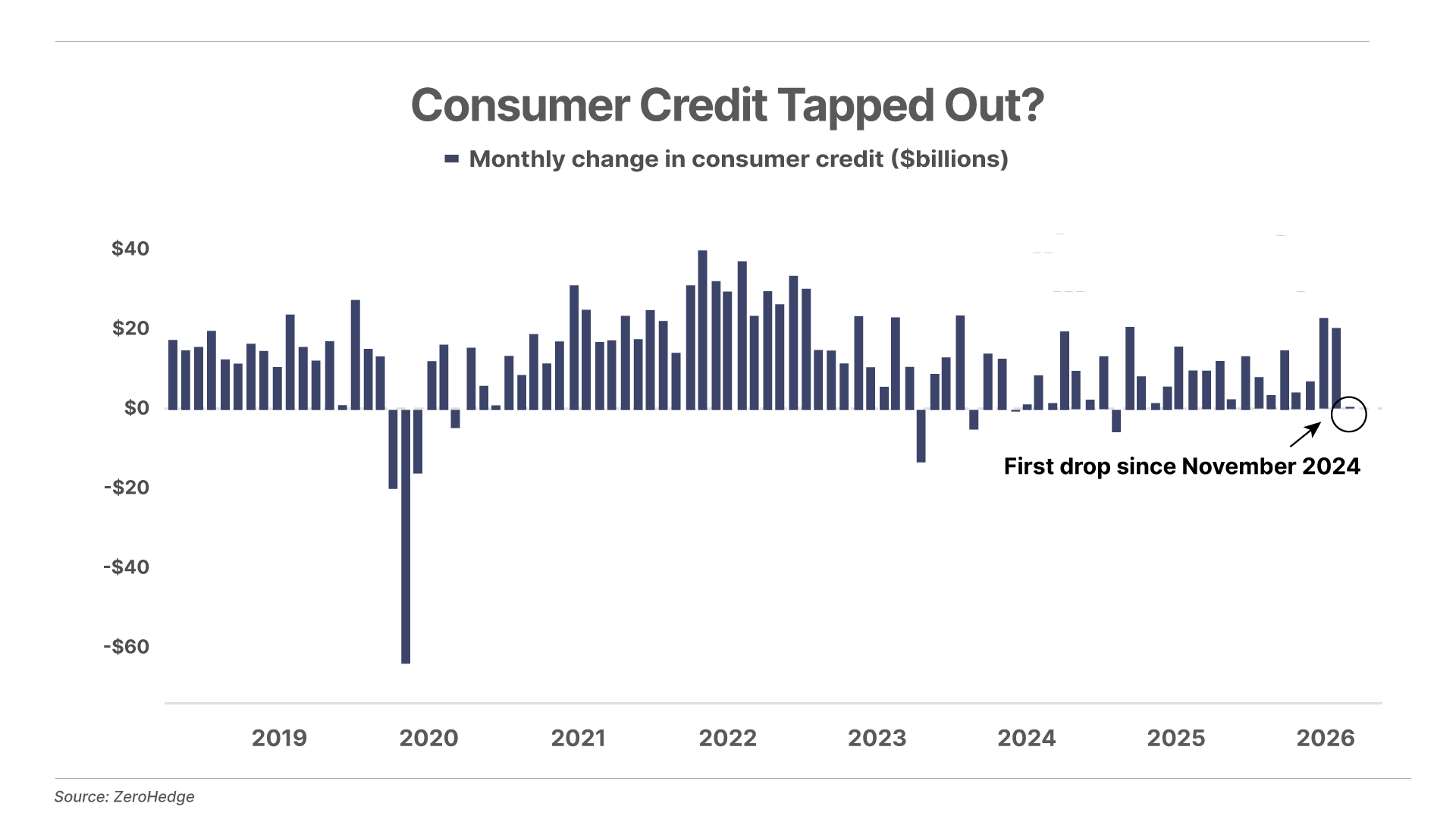
1. U.S. consumer credit shrank in May for the first time since November 2024. Total credit fell by $182 million, well short of consensus estimates for a $17.5 billion gain, due to a $5.3 billion drop in revolving credit (mainly credit cards) – the second-largest monthly decline since November 2020. One month does not make a trend, but it is the first potential crack in a data series that’s been unusually strong for well over a year.
2. Tech insiders buying their own stock… 28 execs at companies within the State Street Technology Select Sector ETF (XLK) have purchased their own shares on the open market this year, the highest count on record. SentimenTrader reports that this figure has doubled since the start of 2026… in early 2025, there were just five such buyers.
3. Renowned UK fund manager Terry Smith just abandoned buy-and-hold. The Fundsmith founder, who spent years telling investors to buy quality stocks and “do nothing,” has overhauled his flagship fund after five straight years of underperformance. In his latest investor letter, Smith said the fund will now trade far more actively, buying and selling on price momentum rather than fundamentals, and will stop scooping up quality names when they stumble. When funds like this change course – in this case, with assets down from a £29 billion peak to just £12 billion today – it usually signals redemption pressure from investors, rather than fresh conviction. Historically, this kind of capitulation often occurs near sentiment extremes.
Chart Of The Day… SK Hynix (SKHYV)
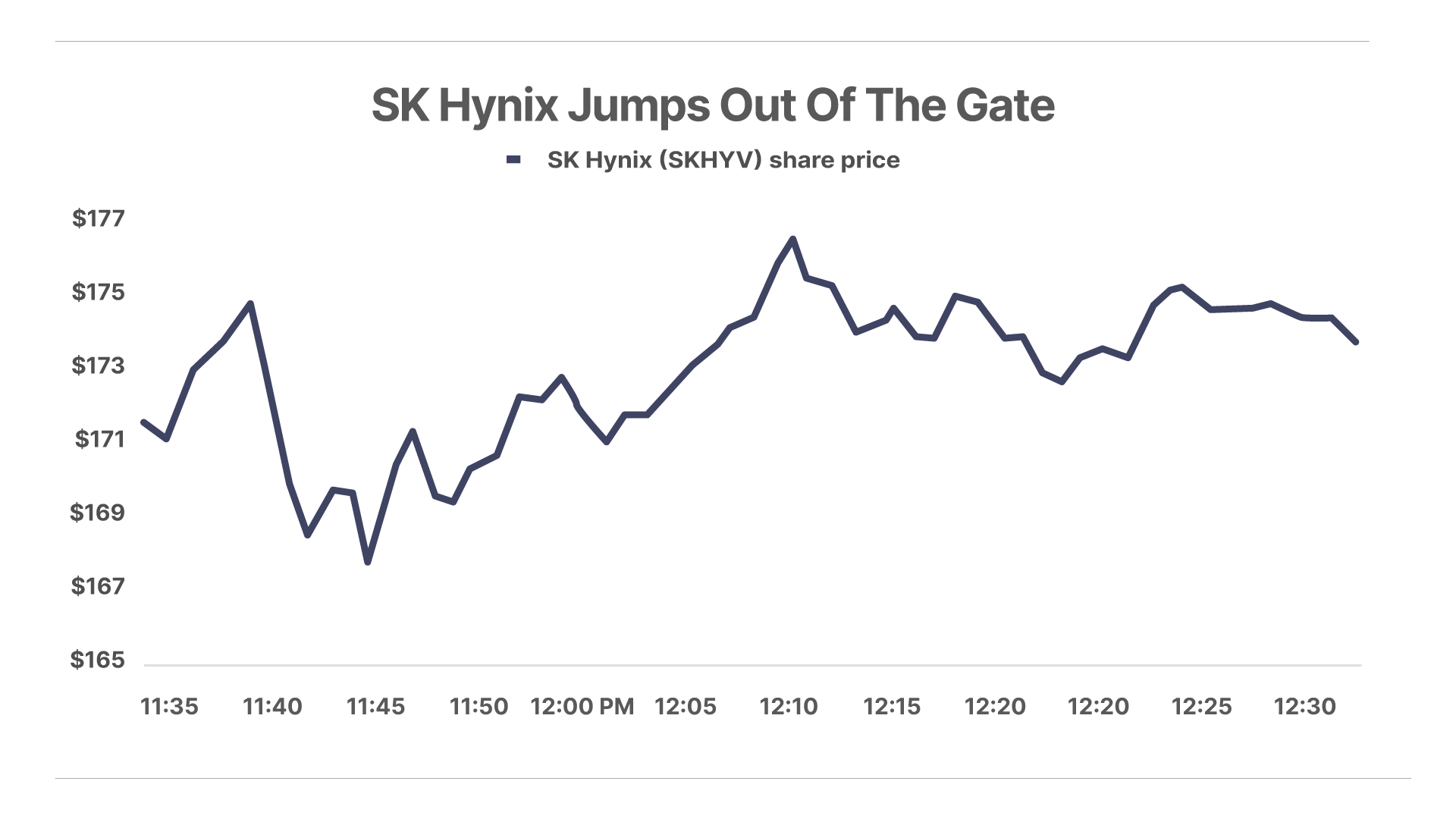
The American Depositary Receipts (“ADR”) of popular South Korean memory chipmaker SK Hynix – temporarily trading on Nasdaq under the ticker SKHYV until the offering completes settlement on July 13 – opened at $170 this morning, roughly 14% above the $149-per-share offering price. Porter first alerted readers to this under-the-radar opportunity in October 2025.
Mailbag
In yesterday’s Journal, Porter extolled the virtues of emerging markets, highlighting one company in particular… BB Seguridade Participações S.A. (BBSEY). He also announced the future launch of Porter & Co. Emerging Investor.
“Looking Forward…”
Mario M. writes:
Looking forward to Emerging Investor!
“Too Good To Be True”
Cliff D. writes:
Hi Porter,
BBSEY sounds too good to be true. Unless I am missing something, I do not see it included in any of the Partner Pass recommendations. Is there any particular reason?
Porter Comment: Hi Cliff –
We haven’t included the stock in any of our portfolios or indexes yet. We’re still in the process of building our emerging-markets research team. And I anticipate launching our formal research on these kinds of opportunities before the end of the year. Yesterday’s Journal simply touched on why we plan to launch such a product and provided the Brazilian insurance company BB Seguridade Participações S.A. (BBSEY) as an example of the kinds of businesses we’ll be searching for.
By the way, when something sounds too good to be true, it always is! BBSEY is in Brazil, a country with a notoriously corrupt government run by a socialist. There’s a lot that can go wrong with investments in that country! That’s why it’s so important to make sure you’re getting paid substantial dividends when you invest in these countries.
Regards,
Porter
“Oh, My Goodness”
In yesterday’s “Mailbag,” Porter provided an extensive response to reader Dr. James M.’s comments regarding Porter’s earlier Journal essay about Obamacare.
Sherwin R. writes:
I found your debate with Dr. James M. about American health care to be fascinating. I share the view that American healthcare is a mess. Who wouldn’t? I come at this from a very narrow focus, though. My wife is a cancer survivor. It’s my view that any healthcare program that permits citizens to be denied coverage due to pre-existing conditions is unfair and unacceptable. It’s telling people that their lives aren’t worth anything, just go ahead and die. You made an effort to address this, but the devil is in the details.
How would “ruinous” conditions be determined? It seems to me if the consumer can’t get coverage, that’s ruinous enough. Dr. James M. didn’t seem to think that your plan would work, and presented an option. You, while praising some aspects of his plan, also made quite clear your view that his plan would not work. I would love to see a broad national debate on this, but that seems hopeless, as on one side you have an administration that has been constantly critical of Obamacare, but unable to present any kind of alternative for going on six years, and on the other side you have a large clambering for universal health care, which also hasn’t seemed to work too well – but is it better than what we now have.
Porter Comment: Sherwin —
You wrote:
It’s my view that any health care program which permits citizens to be denied coverage due to pre-existing conditions is unfair and unacceptable.
You are entitled to your opinion, but what you’re saying is nonsensical – that isn’t how insurance works. There’s a reason 16-year-old boys pay more for car insurance than 50-year old women.
If you don’t allow underwriters to handicap risk, then it isn’t insurance. It is a transfer payment scheme. And government-backed transfer payment schemes rapidly lead to disaster – every time. Look at Social Security. Look at college “loans.”’ Costs soar. Benefits disappear. The political class wins. Everytime.
You’re saying something is unfair or unacceptable and you’re pointing at health insurance. You should be pointing at God.
Life isn’t fair.
Porter & Co. Top Positions
| Publication | Ticker | Description | Total Return |
|---|---|---|---|
| Tech Frontiers | QURE | uniQure | 237% |
| Complete Investor | BWXT | BWX Technologies | 228% |
| Tech Frontiers | TGTX | TG Therapeutics | 166% |
| Tech Frontiers | ROIV | Roivant Sciences | 163% |
| Complete Investor | SKWD | Skyward Specialty Insurance | 144% |
| Tech Frontiers | NUVB | Nuvation Bio | 141% |
| Tech Frontiers | SGMT | Sagimet Biosciences | 136% |
| Complete Investor | BTC/USD | Bitcoin | 134% |
| Tech Frontiers | QURE | uniQure | 131% |
| Complete Investor | PM | Philip Morris | 126% |
Prices as of 4:00 pm ET July 9, 2026
Please note: The investments in our “Porter & Co. Top Positions” should not be considered current recommendations. These positions are the best performers across our publications – and the securities listed may (or may not) be above the current buy-up-to price. To learn more, visit the current recommendations page of the relevant service, here. To gain access or to learn more about our current recommendations, call our Customer Care team at 888-610-8895 or internationally at +1 443-815-4447.