Issue #108, Volume #3


Buffett’s “Circle Of Competence” Is A Lot Smaller Than He Thought
Inside today’s Daily Journal…
|
Editor’s note: Porter’s new book, 2029: The End of America, is quickly moving up the best-seller list on Amazon. To get your own copy now, just click here to order it.
It’s finally dawning on Warren Buffett that Bill Gates isn’t a good man.
Buffett has delayed this year’s multibillion-dollar gift to the Gates Foundation pending the foundation’s own internal review of the fact that Bill Gates was mentioned thousands of times in the Jeffrey Epstein files. The review, which is being conducted by an outside law firm, WilmerHale, follows Gates being called to testify in front of the House Oversight Committee.
Both Gates and Buffett say the last time they spoke was in January, before the release of the Epstein files. And sources told The Wall Street Journal that Gates was not invited to sit among the other CEOs at Berkshire Hathaway’s annual meeting in May. Gates – a Berkshire Hathaway board member until 2020 – did not attend for the first time in many years.
Seems like Buffett is having serious “giver’s remorse.”
On June 26, 2006, Buffett pledged 10 million shares:
I am irrevocably committing to make annual gifts of Berkshire Hathaway B shares throughout my lifetime for the benefit of the Bill and Melinda Gates Foundation… In July of every year, 5% of the balance of the earmarked shares will be contributed.
There were only three conditions:
-
Either Bill or Melinda had to be personally involved in running the foundation
-
The foundation had to remain a charitable foundation, such that Buffett’s donations could be given tax-free
-
The foundation had to spend the money on its charitable activities within a set time period, which Buffett described in detail
Buffett has now given the foundation almost $50 billion. And while Melinda Gates left the foundation in 2024, Bill Gates remains chairman… for now. Gates’ association with Epstein is deeply troubling. First, he established the relations five years after Epstein was sentenced to jail for soliciting minors. Among the disclosures in the Epstein files were emails disclosing that Gates had numerous affairs, including with Russian prostitutes who gave him a venereal disease. Emails from Epstein include allegations that Gates was secretly giving his wife antibiotics to treat the infection he passed to her.
It’s hard to believe Buffett needs a WilmerHale investigation to determine that Gates’ behavior in these matters was so egregious that he should step down from the Gates Foundation, which in turn would trigger a condition allowing Buffett to cease his charitable gifts.
Buffett’s friendship with Gates calls into question his own judgment. And while his bad judgment about Gates has only harmed his reputation (and cost him $50 billion), his bad judgment about other business leaders has cost Berkshire shareholders hundreds of billions.
And this is the part of the story that the mainstream media will not tell you.
Buffett has long been celebrated for his ability to close huge transactions in a matter of hours – without requiring any formal due diligence. How? His own genius.
In October 2015, six weeks before the $37 billion deal to acquire Precision Castparts (“PCC”) closed, Buffett described his process for vetting the deal, Berkshire’s largest ever, in a Fortune magazine interview:
I probably met [PCC CEO Mark Donegan] maybe a total of 80 minutes now or so… we didn’t do one piece of information… we do not do formal due diligence. My due diligence is to look into their eyes basically.
So an 85-year-old man spent 80 minutes talking to the CEO of a major U.S. corporation and decided to write the largest check of his life, using the funds of a public company – because he looked into his eyes. Does this seem like a good idea to you…?
What does the late Charlie Munger say about incentives?
Well, I think I’ve been in the top 5% of my age cohort all my life in understanding the power of incentives, and all my life I’ve underestimated it. And never a year passes but I get some surprise that pushes my limit a little farther.
This situation didn’t take a lot of imagination to figure out. CEO Donegan, when the Berkshire deal closed, received $51.8 million in accelerated stock options plus retention payments. Do you think he might have misled Buffett in order to get the deal done?
What happened next was the biggest loss in the history of Berkshire Hathaway.
On August 7, 2020, Berkshire Hathaway disclosed in its Q2 10-Q an approximately $11 billion pre-tax goodwill impairment on PCC. Six and a half months later, in his February 27, 2021, letter to shareholders covering fiscal year 2020, Warren Buffett described the massive loss:
The final component in our GAAP figure – that ugly $11 billion write-down – is almost entirely the quantification of a mistake I made in 2016. That year, Berkshire purchased Precision Castparts (“PCC”), and I paid too much for the company. No one misled me in any way – I was simply too optimistic about PCC’s normalized profit potential… PCC is far from my first error of that sort. But it’s a big one.
Buffett, as always, claims he wasn’t misled. If that’s so, then you’d also have to believe that Buffett didn’t even bother reading any of the trade press about the company.
Bloomberg’s Noah Buhayar published the seminal article describing PCC’s management culture:
Behind the numbers, though, something more brutal is going on. For years, Donegan has traveled the globe, sometimes bullying staff during quarterly reviews at Precision plants.
Bloomberg documented that Donegan had cultivated a famously aggressive operating culture: bottom-decile employee terminations every cycle, supplier-payment-term extensions designed to push working capital onto smaller vendors, and quarterly performance reviews described by former participants as adversarial in the extreme. None of this was secret. None of it was hidden. The pattern of conduct was visible to every Tier-1 aerospace supplier, every regional press outlet in Portland, Oregon – where PCC is headquartered – and every industry analyst who covered the sector.
It was not apparent to the 85-year-old man looking into Mark Donegan’s eyes.
Some of our subscribers have asked why I continue to report on Warren Buffett’s mistakes. It’s because they have inflicted massive harm on investors, who for decades trusted Buffett to be an outstanding steward of their capital. But long after that wasn’t true anymore, the press continued to spread the myth. And Buffett continued to trade upon it.
To fully understand how disastrous the PCC deal was to Berkshire’s shareholders, consider that an identical $37 billion position in GE (GE) common stock, taken on the same day Berkshire closed the Precision Castparts acquisition, would have occurred just before GE’s spectacular collapse: The dividend cut. The CEO change. The Alstom write-downs. The Power-segment collapse. The Securities And Exchange Commission investigation. The capital-structure repair. The Larry Culp turnaround. The January 2023 GE Healthcare spinoff. The April 2024 GE Vernova spinoff. The complete reorganization of one of the largest industrial conglomerates in American history.
With full reinvestment of all spinoff distributions and dividends, an investment into GE at the worst possible time would have compounded at approximately 8.5% annually. That means, a similar investment into the worst-managed, worst-positioned, most visibly troubled major industrial company available to Berkshire on the day of the PCC closing would have produced approximately $40 billion more terminal value than Precision Castparts produced inside Berkshire!
Buffett literally couldn’t have made a worse investment in any large American industrial company. But he wasn’t misled by a CEO who got a $50 million deal bonus? Impossible.
There is a rule about due diligence in capital allocation, and Buffett wrote it himself, repeatedly, across 40 years of annual letters and shareholder meetings.
The rule is that you do the work. You read the filings. You build the financial model. You walk the plants. You interview the customers, the former employees, the competitors. You examine the litigation history. You stress-test the working-capital assumptions. You look at the supply-chain payment terms. You check the executive-compensation arrangements for the alignment of incentives. You read the proxy statements.
And, most importantly, you assume that the seller knows something you do not, and you do the work to find out what it is.
You do not, on a $37 billion acquisition, conduct due diligence by spending 80 minutes looking into the chief executive’s eyes.
Buffett was wrong about Mark Donegan in ways that the trade press had documented for years. Buffett was wrong about the earnings multiple in ways that his own writing on capital allocation had explicitly warned against for decades. Buffett was wrong about the cyclicality of the business in ways that any aerospace analyst with a five-year history of covering the sector could have told him in 15 minutes.
And yet Berkshire Hathaway’s board, which included Bill Gates, did nothing to vet the deal or to prevent it.
If you want to become a great investor, or you hope to teach your children to become great investors, the very best way to learn is by reading Buffett’s annual letters and learning from his mistakes.
That’s why I wrote Warren’s Mistakes. It’s the only book ever written that breaks down exactly how Buffett’s investments went from the all-time best in the history of capitalism to many of the worst in the last decade. The point of the book isn’t merely to criticize Buffett. It’s to teach you the secrets behind his amazing success by analyzing his failures.
I believe it’s the best book ever written about Warren Buffett – and so do the folks who’ve read it. It’s getting all five-star reviews at Amazon. Buy your copy here.
Tell me what you think of today’s Daily Journal: porterstansberrydirect@gmail.com
Good investing,
F. Porter Stansberry
Stevenson, Maryland

3 Things To Know Before We Go…
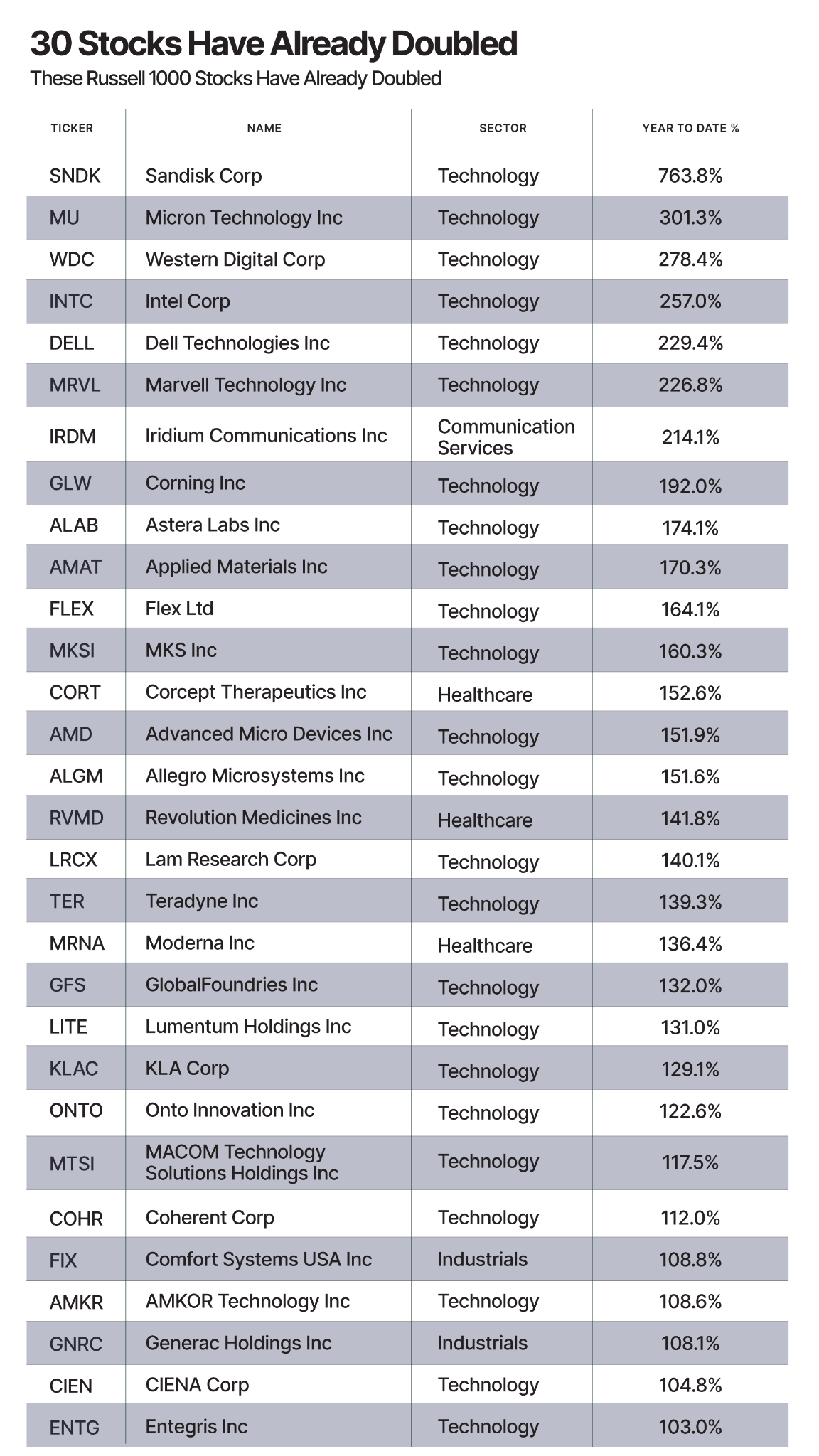
1. Thirty Russell 1000 stocks have already doubled in 2026. With half the year still to go, Sandisk (SNDK) leads at 764%, and Micron Technology (MU), Western Digital (WDC), and Intel (INTC) have each cleared 250%. Technology accounts for 24 of the 30, with semiconductor designers, equipment makers, and materials suppliers forming the core of the list. More striking is who’s absent: not one Magnificent 7 name made it.
2. Trade uncertainty eases, the Strait of Hormuz opens… for now. Trade-policy uncertainty has dropped from its 2025 record near 8,000 (tariffs!) on the Baker-Bloom-Davis index, but at roughly 1,800, it still sits around the 2018-19 trade-war peak. Meanwhile, the Strait of Hormuz, which had been closed since late February, now has roughly a quarter of the 100-plus daily transits seen before the war – however, the strategic passage is still mined, and war-risk insurance is running 8x pre-crisis levels.
3. Major AI infrastructure fund goes big on a GPU-rental upstart. Leopold Aschenbrenner – the former OpenAI researcher whose AI-focused Situational Awareness fund has ballooned past $20 billion in assets – disclosed a 19.9% stake in SharonAI (SHAZ), an Australian firm that rents out Nvidia (NVDA) computing power to AI developers who don’t want to build their own data centers. It’s a vote of confidence when the most plugged-in investor in AI infrastructure jumps in.
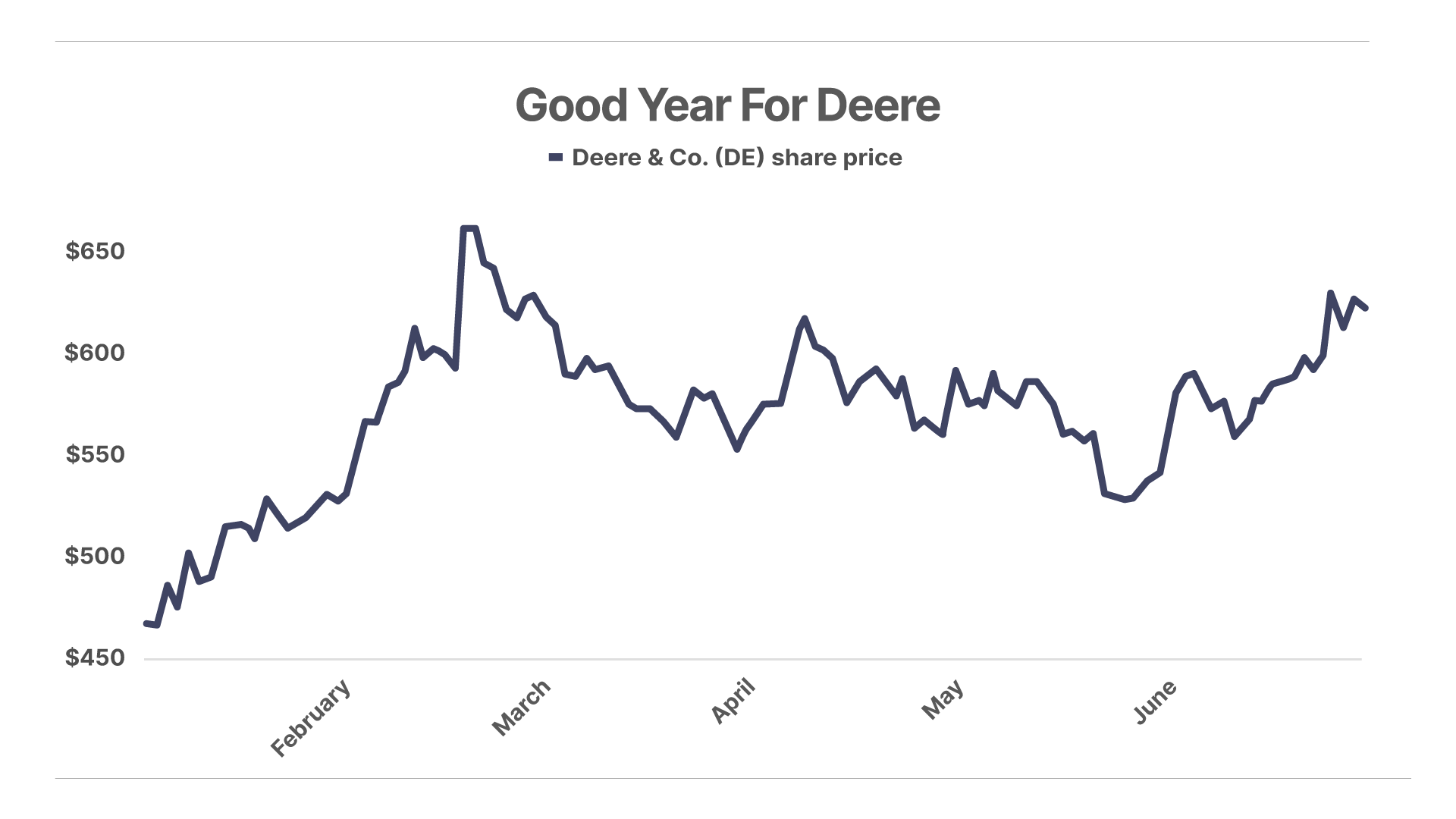
Chart Of The Day… Deere & Co. (DE)
Shares of leading agricultural equipment manufacturer Deere & Co. have risen 35% year to date – and are up 56% since our August 2023 Complete Investor recommendation.
Mailbag
In yesterday’s Daily Journal, Porter reported that he and his wife had a baby girl, Briar.
He also shared his thoughts on the role former Fed Chair Alan Greenspan played infusing endless amounts of capital into the U.S. economy.
“Greenspan Was The Worst Central Banker”
There was a foolish Congressman that you quoted who said that Alan Greenspan “was the best central banker in the world” for his Herculean efforts to save the world’s fiat money system in 1999.
In my opinion, Greenspan was the worst central bankster, except for all the others that were his competition.
He created the conditions for ever-expanding asset bubbles, since the Federal Reserve pledged to backstop every security on the planet. And he did all that without seeking the permission of every person who was destined to suffer from his banksterism.
Interest rates, when operating correctly, serve as a means-test for whether an investment is good or bad. If a business can’t earn more than its cost of capital, it should not be entered into. But when a fool lowers the cost of capital to near-zero, it guarantees that many useless businesses will be created. And not every business needs to exist!
During my lifetime of close to 60 years, there was only one above-average central banker: Paul Volcker. Not that he was always right, but he prevented more messes than he caused, which is more than can be said for all the others. But now, the problems are too big for even a person of his wisdom to solve.
P.S. – Congratulations to you and Shannon for bringing a newborn into the world. May she be a true blessing!
Trish J. writes:
First, I want to congratulate you and your lovely wife on your precious daughter. She is blessed to have you both as parents. I have read your writings and continue to know your wisdom financially is always right on. Maybe you might be a little early, but never wrong – thank you for continuing to take the horse to meet water.
Tom D. writes:
Many congratulations to you and your wife on the birth of your daughter. Wishing you great happiness holding and eventually playing with the little one.
“I Used To Be Proud That I Went To Harvard Law School”
David M. writes:
I’ve been a member/partner for about the last 10 to 12 years. Thank you for the honesty of your work, which truthfully is as important to me as your financial advice. You have a very articulate ability to connect the dots that others are either unable or, more likely, politically unwilling to connect. Your book, 2029 – The End of America, was a fantastic eye opener. It’s not that I have been unable to see the erosion of America that has been occurring over my working lifetime (I’m 71), but to be able to trace our destruction so clearly to the calamitous events of 1971 gave me a clarity of thinking that I had never expected.
I used to be proud of the fact that I went to Harvard Law School (“HLS”). I graduated in 1980. HLS was supposed to be a beacon of education and the desire to protect personal liberties. Of course, to HLS professors, that meant being radical liberals, always willing to override the protection of private property with the desires of “oppressed’ individuals. I grew up in a lower middle class family, working in the family construction business from the day I graduated eighth grade until I moved to Boston for HLS. My dad never made more than $25K in any year in his life, yet he raised five kids in a single-income home. I did use the HLS diploma to further my career, and I made a good living, but I’m ashamed to tell people I went there. There is no bigger collection of frauds, political cronies, and dishonest intellectual elites anywhere on Earth.
One would have thought that, with all of the brilliant legal minds at HLS, the 1971 “disparate impact” case would have received some attention. Nada. I think the liberal agenda has always been to disguise and/or hide intellectual dishonesty and legal theories that clearly subvert common sense, kind of like calling currency debasement QE or child mutilation gender affirming care. I believe HLS has betrayed every alum and every American.
I hope your optimism for America can be reality. America is no longer even pretending to be a meritocracy. Every incentive is to be a victim and claim oppression by the white man. With that backdrop and New York electing avowed socialists, Democrats refusing to enforce laws, Trump and Sanders both promising to steal AI ownership “for the people,” and politicians refusing to adopt laws that require citizenship to vote in federal elections, I don’t really know where you find the optimism. In any event, congratulations on the new baby!
Best regards,
“I Recommended Your Book”
Luis E. writes:
Hi. I participated in the Mastermind conference in May at your beautiful farm. Best event I have participated in. Your book 2029: End of America is just great. I am reading it again as all the information is valuable and enlightening. Have recommended several friends and family members to purchase the book and read it very carefully.
Porter & Co. Comment: Porter’s new book, 2029: The End of America, is quickly moving up the best-seller list on Amazon. To get your own copy now, just click here to order it.
Porter & Co. Market Snapshot
| Price | Yesterday’s Return | Year-to-Date Return | |
|---|---|---|---|
| S&P 500 Index | $7,440.43 | 1.18% | 9.3% |
| Gold per ounce | $4,015.91 | -1.56% | -7.0% |
| Bitcoin | $60,214 | 1.08% | -33.0% |
| Oil (West Texas Intermediate) per barrel | $70.75 | 0.35% | 23.7% |
| Berkshire Hathaway (BRK) | $743,510.00 | -0.22% | -1.5% |
| Porter’s Permanent Portfolio | – | 0.24% | 0.0% |
| The Better Than Berkshire Index | – | 0.84% | 6.6% |
| Total Return | Annual Return | ||
| Porter & Co’s Top Ranked* | 34.0% | 15.7% | |
| Yield | Yesterday’s Change | Change Year-to-Date |
|
| U.S Treasury 30-Year Yield | 4.86% | 0 bps | 2 bps |
*A Complete Investor risk rating of 1 is defined as a “low risk, high allocation” security, while positions rated closer to a 5 are higher risk. Porter & Co.’s top-ranked positions include those rated either 1 or 2 in Complete Investor portfolio.
Porter & Co. Top Positions
| Publication | Ticker | Description | Total Return |
|---|---|---|---|
| Tech Frontiers | QURE | uniQure | 237% |
| Complete Investor | BWXT | BWX Technologies | 232% |
| Tech Frontiers | TGTX | TG Therapeutics | 157% |
| Tech Frontiers | ROIV | Roivant Sciences | 154% |
| Complete Investor | ARM | ARM Holdings | 148% |
| Tech Frontiers | SGMT | Sagimet Biosciences | 144% |
| Complete Investor | SKWD | Skyward Specialty Insurance | 144% |
| Tech Frontiers | QURE | uniQure | 131% |
| Complete Investor | PM | Philip Morris | 128% |
| Complete Investor | BTC/USD | Bitcoin | 123% |
Prices as of 4:00 pm ET June 29, 2026
Please note: The investments in our “Porter & Co. Top Positions” should not be considered current recommendations. These positions are the best performers across our publications – and the securities listed may (or may not) be above the current buy-up-to price. To learn more, visit the current recommendations page of the relevant service, here. To gain access or to learn more about our current recommendations, call our Customer Care team at 888-610-8895 or internationally at +1 443-815-4447.