Issue#126, Volume#3

The Third In A Series On Great American Brands That Forgot What They Really Sell
Inside Today’s Issue
On Thursday, I told you about Ralph Lauren (RL), a company that finally remembered it was in the dreams business. And then I showed you The Walt Disney Company (DIS), which owns the most valuable dream-world in entertainment and keeps forgetting that its dream is animation.
Today is the third example… and this one is the most maddening because the problem and its solution are so obvious.
What does Ford Motor (F) actually sell? It sells cowboys. No, not the same kind of cowboys that Ralph Lauren sells. Ford sells the real, hard-nosed, down-in-the-dirt cowboy. Ford sells really tough, capable trucks – to modern cowboys. That is the whole brand and it is one of the most durable, valuable brands in business. Ford is the American work truck. Capable. Unkillable. Sold to people who define themselves by what they can haul, tow, and build.
Ford’s F-Series has been America’s best-selling pickup for 48 years. The F-150 has been America’s best-selling vehicle of any kind for more than four decades, moving over 700,000 units a year. Analysts have long estimated the F-Series alone generates 90% of Ford’s global automotive profit. But the F-Series is only about a third of Ford’s revenue.
In 2018, under CEO Jim Hackett, Ford seemed like it finally remembered what business it’s in. It killed almost its entire North American car lineup. Fusion, Taurus, Fiesta, Focus, all gone. Only the Mustang, the trucks, and SUVs survived.
Hackett’s language could have come straight from Ralph Lauren CEO Patrice Louvet’s playbook:
We’re going to feed the healthy parts of our business and deal decisively with the areas that destroy value.
Ford should not bother selling commodity sedans it loses money on, competing head-on with Toyota and Honda. It should only sell the thing Ford sells better than anyone: trucks.
And then… a colossal mistake.
Ford decided, perhaps for political reasons, that it needed to build electric trucks. But who was asking for this product? Electric vehicles are a Silicon Valley effete man’s dream. It is not what a man who works for a living every single day in one truck wants to buy.
Just look at the marketing. Tesla (TSLA) sells its truck by bragging about how fast it will go. People buy trucks to work in because of how much they can carry, for how long, and for how far (duration without a breakdown). Batteries are extremely heavy. That reduces towing and carrying capacity enormously. Batteries have to be recharged, constantly. And nobody knows how long those batteries will last.
The Model e division – Ford’s dedicated electric vehicles (“EV”) business – lost $2.1 billion in 2022, $4.7 billion in 2023, $5.1 billion in 2024, and $4.8 billion in 2025. That is a cumulative $16.7 billion bonfire in four years.
At the 2020 low, Ford’s entire market cap was worth less than $16 billion.
In other words, Ford destroyed a value equivalent to its entire existing business by building something it should have known its core customer would never buy.
Everyone responsible should be shot. (I’m kidding… sorta).
Where does Ford make all of its money? Trucks.
Super duty trucks, Transit vans, and the software and service subscriptions that ride on top of them earned $9.0 billion of pre-tax profit in 2024 at mid-teens margins, and $6.8 billion in 2025. Ford Blue, the traditional trucks-and-SUVs business, added $5.3 billion.
How to fix Ford? Nothing could be simpler.
Just keep selling the toughest, most capable, most profitable trucks on Earth to the people who love them. Wrap them in software and services with high margins through Ford Pro.
Stop selling everything else.
Tell me what you think of today’s Journal – good or bad: porterstansberrydirect@gmail.com
Good investing,
F. Porter Stansberry
Stevenson, Maryland

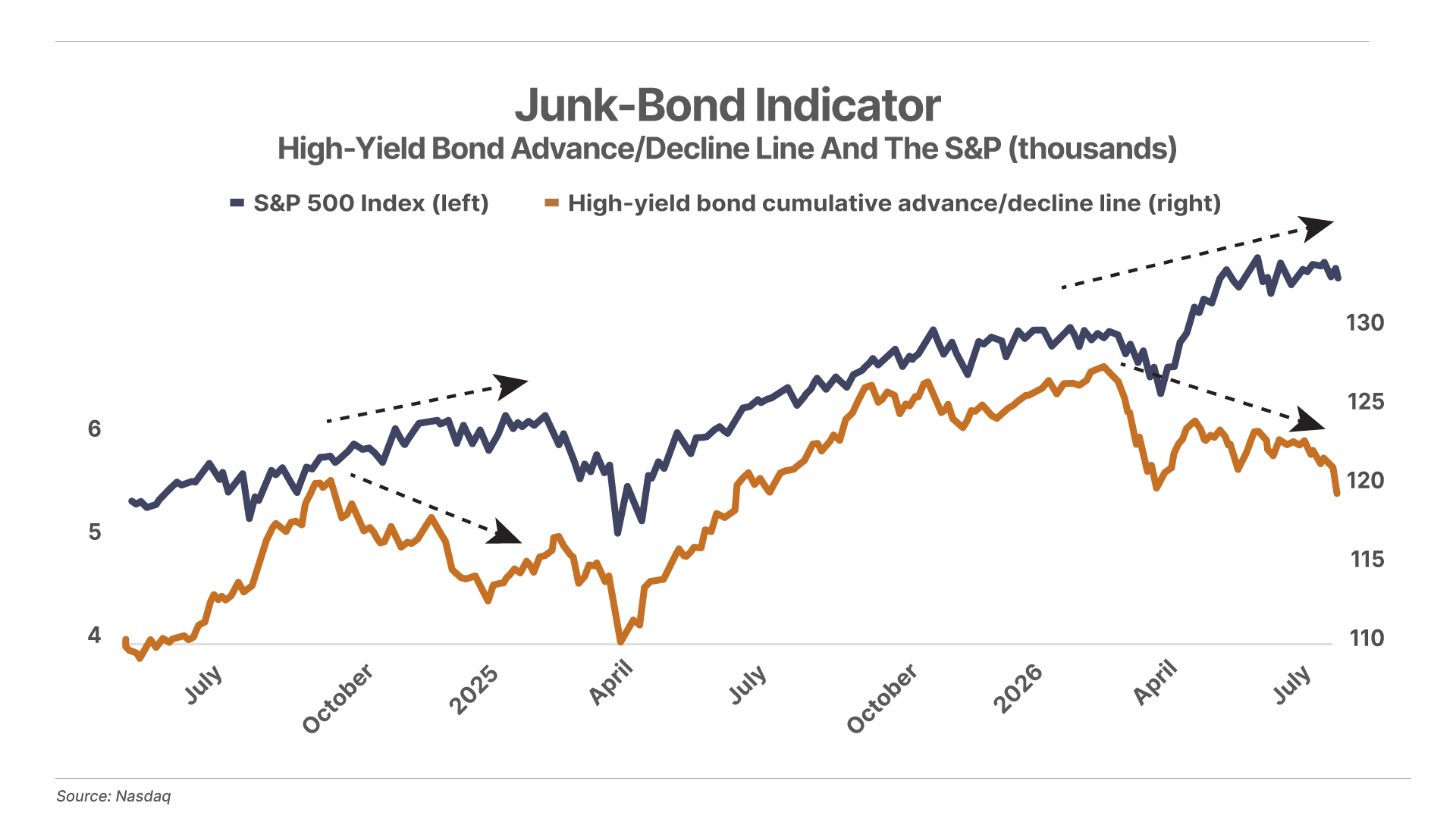
1. Junk bonds are quietly breaking down. More high-yield corporate bonds are hitting 52-week lows than highs, and the advance/decline line – a running tally of how many bonds rise versus fall each day – sits near a one-year low. This market has historically been a strong leading indicator for the stock market – which follows its path up or down – particularly near highs. The last time a similar junk-bond pattern appeared, in October 2024, they slid through January 2025. The S&P 500 peaked on February 19, 2025, then fell nearly 19% over the next seven weeks.
2. The copper-to-gold ratio is testing a 20-year downtrend. Copper closed Friday near its all-time high, at $6.30 per pound. Meanwhile, gold has fallen 28% from its January 29 peak of $5,595. Gold spent three years stalling at $2,000 before its 2024 breakout – if copper breaks out it could mean the market is repricing real-economy demand – grid, electrification, and data center buildout.
3. Another circular AI financing deal. The Wall Street Journal reports that Nvidia (NVDA) is looking to provide a $250 billion funding backstop for a proposed OpenAI data center project in Ohio. According to the report, the backstop to the $500 billion, 10-gigawatt facility would involve the leading chipmaker guaranteeing a series of financing vehicles designed to increase lender confidence. The upside for Nvidia would be hundreds of billions in chip sales going into the facility – representing yet another version of circular, vendor financing supporting today’s AI boom.
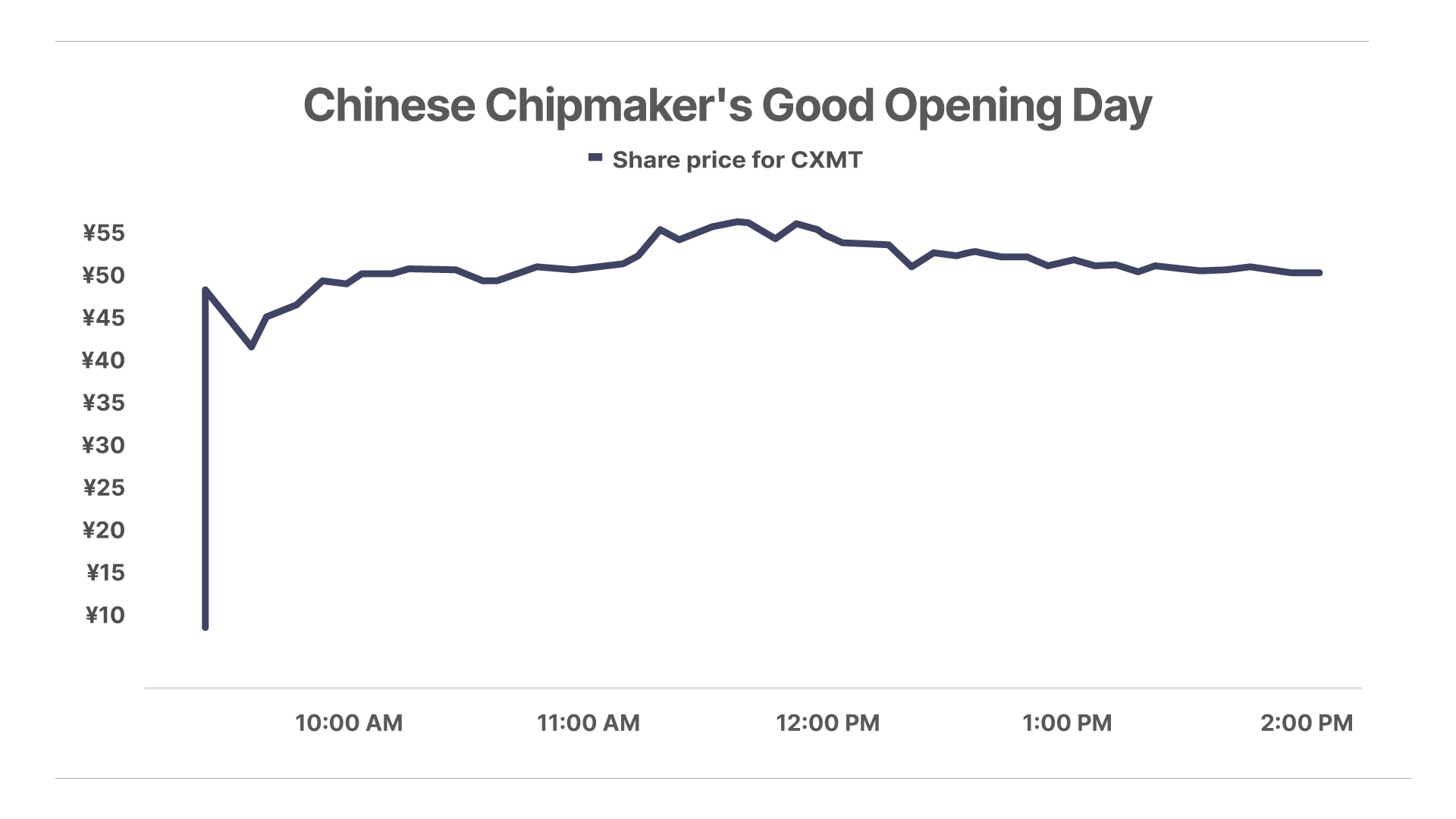
Chinese memory chipmaker CXMT soared 465% in its first day of trading today – reaching a $500 billion market cap versus its initial public offering (“IPO”) valuation of $86 billion – making it the most valuable company listed in China.
“Characters People Care About”
Meadowdale Fellowship member Roger C. writes:
Loved the Journal. I think Disney also needs to get out of the woke storytelling business and focus more on developing real characters people care about. I’d have a hard time pushing the buy button until then.
Laura O. writes:
“Disney Has Been Part Of My Life”
Disney has been part of my life since I was a little girl watching the Mouseketeers on our old black-and-white TV, but it took many years and another visit to the park in Anaheim for me to sit and wonder why I didn’t own stock in this amazing company. A little research through my various Stansberry subscriptions told me it was simply too expensive. OK. The company wasn’t doing well enough to justify the price.
That was in 2014, and while continuing to enjoy the movies, the parks, the streaming service, and even one of the cruises, I’ve barely thought about investing in it since then.
Now I know why no one is recommending it, why it’s “too expensive,” thanks to the joy you get from digging into these stories, “Because telling you this story is the most fun I’ve had in years.”
I’ve always known you’re a man of great character, and this is yet another example of what I appreciate about you and why I trust you to tell me what you always promise, to give me the information you’d want if you were me. This story about Disney, along with the one about Ralph Lauren and cowboys, fascinated me, showing me another of the lenses you look at the world through, a lens I never knew even existed.
Thank you.
Larry H. writes:
Your plan regarding Disney is solid and makes perfect sense. You’ve sold me. Sad to say, though, Disney ownership is determined to hang on to those underperforming assets due to their stubborn political views. That recipe will turn them into the next company that people don’t want anything to do with.
Porter & Co. Market Snapshot
| Price | Friday’s Return | Year-to-Date Return | |
| S&P 500 Index | $7,411.98 | 0.06% | 9.0% |
| Gold per ounce | $4,052.79 | 0.07% | -5.5% |
| Bitcoin | $64,596 | 0.49% | -25.8% |
| Oil (West Texas Intermediate) per barrel | $89.31 | -3.50% | 46.6% |
| Berkshire Hathaway (BRK) | $744,999.99 | 1.14% | -1.3% |
| Porter’s Permanent Portfolio | – | 0.91% | 1.9% |
| The Better Than Berkshire Index | – | 0.88% | 8.6% |
| Total Return | Annual Return | ||
| Porter & Co’s Top Ranked* | 36.1% | 16.8% | |
| Yield | Friday’s Change | Change Year-to-Date |
|
| U.S Treasury 30-Year Yield | 5.16% | 0 bps | 31 bps |
| Prices as of 4:00 pm ET July 24, 2026 | bps = basis points (or 0.01%) | |||
| *A Complete Investor risk rating of 1 is defined as a “low risk, high allocation” security, while positions rated closer to a 5 are higher risk. Porter & Co.’s top-ranked positions include those rated either 1 or 2 in Complete Investor portfolio. | |||
Porter & Co. Top Positions
| Publication | Ticker | Description | Total Return |
| Tech Frontiers | QURE | uniQure | 237% |
| Complete Investor | BWXT | BWX Technologies | 207% |
| Tech Frontiers | TGTX | TG Therapeutics | 158% |
| Tech Frontiers | ROIV | Roivant Sciences | 155% |
| Tech Frontiers | NUVB | Nuvation Bio | 153% |
| Complete Investor | SKWD | Skyward Specialty Insurance | 145% |
| Complete Investor | BTC/USD | Bitcoin | 142% |
| Complete Investor | PM | Philip Morris | 139% |
| Tech Frontiers | QURE | uniQure | 131% |
| Tech Frontiers | SGMT | Sagimet Biosciences | 131% |
| Prices as of 4:00 pm ET July 24, 2026 | |||
Please note: The investments in our “Porter & Co. Top Positions” should not be considered current recommendations. These positions are the best performers across our publications – and the securities listed may (or may not) be above the current buy-up-to price. To learn more, visit the current recommendations page of the relevant service, here| New Window. To gain access or to learn more about our current recommendations, call our Customer Care team at 888-610-8895 or internationally at +1 443-815-4447.