Issue #85, Volume #3


Porter’s Bitcoin Pricing Model Shows It 43% Undervalued
Inside today's Daily Journal…
|
It was the greatest investment I have ever seen – or will ever see.
In September 2010 Steve Sjuggerud, writing for Stansberry Research, published "The Greatest Unknown Investment Story On Wall Street."
It wasn’t a stock he was talking about. It wasn’t even a company. It didn’t have any employees. It was a trust set up in 1888 to liquidate the assets of a failed railroad: 3.5 million acres of West Texas desert.
By 2010, the Trust still held nearly 1 million acres — and had accumulated 110 consecutive years of positive earnings, 53 straight years of cash dividends, no debt, no employees to speak of, and no investment-banking business for any Wall Street firm to chase. CEO Roy Thomas told Steve on the phone: "Well… I don't remember ever losin' money, if we did."
Steve understood the key, driving principle that had safeguarded the investors in the Trust for more than a century: by law, the Trust had to return every dollar of after-tax cash to shareholders — through dividends or buybacks. Management chose buybacks. With 10 million shares outstanding and 300,000 shares retired every year out of oil and gas royalty cash, every existing holder's slice of the land base grew at roughly 3% per year — tax-free.
And then Sjug walked our subscribers through what this would mean through time:
$10,000 could turn into over $600 million… safely.
He was publicly mocked by a competitor for that logic. But, of course, Sjug was damn good at math. And he was exactly right. The mechanism was simple arithmetic. Fewer shares every year. Compounded for 30 years. The chart in the issue projected a single share by 2040 worth more than $600 million.
Stansberry Research told subscribers to buy Texas Pacific Land (TPL) at $27 (pre-split) in September 2010. TPL has split twice since the recommendation — a 3-for-1 in March 2024, and a 3-for-1 in December 2025. Every share Sjuggerud's readers bought is now nine shares. Today TPL trades near $300. A $10,000 stake at the September 2010 issue price — 370 shares at $27 — is now 3,333 shares worth roughly $1.0 million. A hundred-bagger. In 15 years. That is a 34% compound annual return. The S&P 500 over the same window compounded around 12%. Sjuggerud's readers beat the index by roughly 22 percentage points a year, every year, for a decade and a half. And it continues to compound.
A perfect investment.
And Steve wasn’t the first great investor to notice. Murray Stahl personally began buying Texas Pacific shares in the 1970s. The stock then traded around $0.36–$0.65 on a split-adjusted basis.
And Murray didn’t tell a soul about it until May 8, 1995. That’s when his Contrarian Research Report published "How To Buy 1 Million Acres Of Fine Texas Grazing Land For $20." That was Texas Pacific: 3.075 million shares outstanding, $62 million market cap, ~$54 per acre implied.
By June 2025, Securities And Exchange Commission (“SEC”) filings showed Murray Stahl personally controlling roughly 1.17 million shares. And his newsletter had become a mutual fund – Horizon Kinetics. Its affiliated vehicles owned more than 10 million shares of Texas Pacific. At pre-split prices above $900, Murray’s personal stake exceeded $1 billion. He died earlier this year, still holding every share.
That’s the art of investing.
Investments only look rational in hindsight. In real time they run on three emotions – fear of missing out, envy of the neighbor's returns, and terror of underperforming the benchmark. The poor investor only learns, far too late, that the head is the dupe of the heart.
What’s driving investors’ emotions today is the artificial intelligence (“AI”) infrastructure buildout. As I’ve written about recently, the PHLX Semiconductor Index (SOX) just logged one of the longest streaks of consecutive up days in its history. Chip ETFs have compounded more than 1,000% over the past decade – and another 40% to 50% in the last 12 months. A tiny cluster of AI-linked names – Nvidia (NVDA), Broadcom (AVGO), SK Hynix, Micron Technology (MU), Taiwan Semiconductor (TSM) – drives a disproportionate share of every benchmark return on Earth.
When investors panic buy, capital gets pulled out of every other corner of the markets. This happens through unemotional mechanics too, through ETF flows and benchmark-hugging mandates. What have investors been selling to fuel the chip stock mania?
Bitcoin.
Much like Texas Pacific Land, Bitcoin doesn’t have any employees. It doesn’t allocate capital. It can’t go bankrupt. It can’t issue more shares. There can only ever be 21 million Bitcoins. This is merely a math problem. And while I’m no Steve Sjuggerud, I’m no slouch.
There are two variables. One is a strictly limited globally recognized digital proof of work (aka, real money) that enables virtually unlimited transfers of value, globally and instantly. And the other is the failed paper money system of the debauched western democracies.
I built a Bitcoin Pricing Model. Its philosophical roots are in the Austrian gold-credit model that Kurt Richebӓcher taught me in the late 1990s. It measures the four macro liquidity factors that drive Bitcoin’s price:
-
Fed Net Liquidity – the Fed balance sheet, minus the Treasury General Account, minus reverse repos
-
Global M2 (USD) – combined M2 of the U.S., Eurozone, Japan, China, and the UK, year-over-year, in dollars
-
Stablecoin supply – USDT plus USDC circulating supply
-
Stablecoin 30-day change – short-term flow into and out of that dry powder
Weekly data, 478 observations back to 2017 – the earliest date the stablecoin series exists in meaningful size. R² of 0.89. Every macro liquidity factor is statistically significant at p<0.05.
Important caveat: Fed liquidity and stablecoin supply both move concurrently, so the model cannot disentangle them. That is not a bug; it is a natural restraint. A model is not the real world. This is a nine-year-old asset class with multiple, correlated macro variables. The wide bands of the price model are an honest expression of this limitation.
Here is what the model says today…
-
Bitcoin actual: $77,470
-
Model fair value: $136,050
-
± 1σ band: $94,092 – $196,718
-
± 2σ band: $65,074 – $284,439
-
Discount to fair value: −43.1%
Bitcoin trades 43% below where the liquidity backdrop says it should trade. The z-score sits below −1.5, territory the model has visited only a handful of times in 11 years. And the liquidity backdrop is not tight. Fed Net Liquidity runs near $5.9 trillion. Global M2 expands at +8.2% year-over-year in dollar terms. USDT plus USDC circulating supply sits at $266 billion – down roughly $40 billion from the February 2026 peak, as marginal dry powder rotates out of crypto and into AI equities.
That last point is worth noting. Stablecoin supply has contracted by 13% over the past three months. By every conventional read, that should be punishing Bitcoin. It has not. BTC has held in a tight range while its largest source of incremental demand has been draining. That is what a structural floor looks like – the marginal seller is exhausted.
And global liquidity is going to explode higher over the next seven years.
How do I know?
The U.S. federal debt has crossed $38 trillion and compounds faster than nominal GDP. The Congressional Budget Office projects net interest expense will exceed defense spending every year through the next decade. The dollar's share of global FX reserves keeps drifting lower – 58% and falling. Real yields on long Treasuries might look attractive today, but they are structurally negative once you weigh the political imperative to inflate the debt away.
In 2010, Steve Sjuggerud wrote that Texas Pacific was a secret compounding machine hiding in plain sight. No one cared.
Today, Bitcoin trades at the widest discount to liquidity-implied fair value that I have ever seen. The crowd is busy with Nvidia, Broadcom, and memory chips. No one cares.
Murray Stahl built an institution, and one of America’s greatest fortunes, out of one principle: find the structurally superior asset the crowd will not own, build a model of its economics, and then sit still.
The head is the dupe of the heart. But it doesn’t have to be.
Tell me what you think of today’s Journal… good, bad, or anything in between: porterstansberrydirect@gmail.com
Good investing,
F. Porter Stansberry
Stevenson, Maryland

3 Things To Know Before We Go…
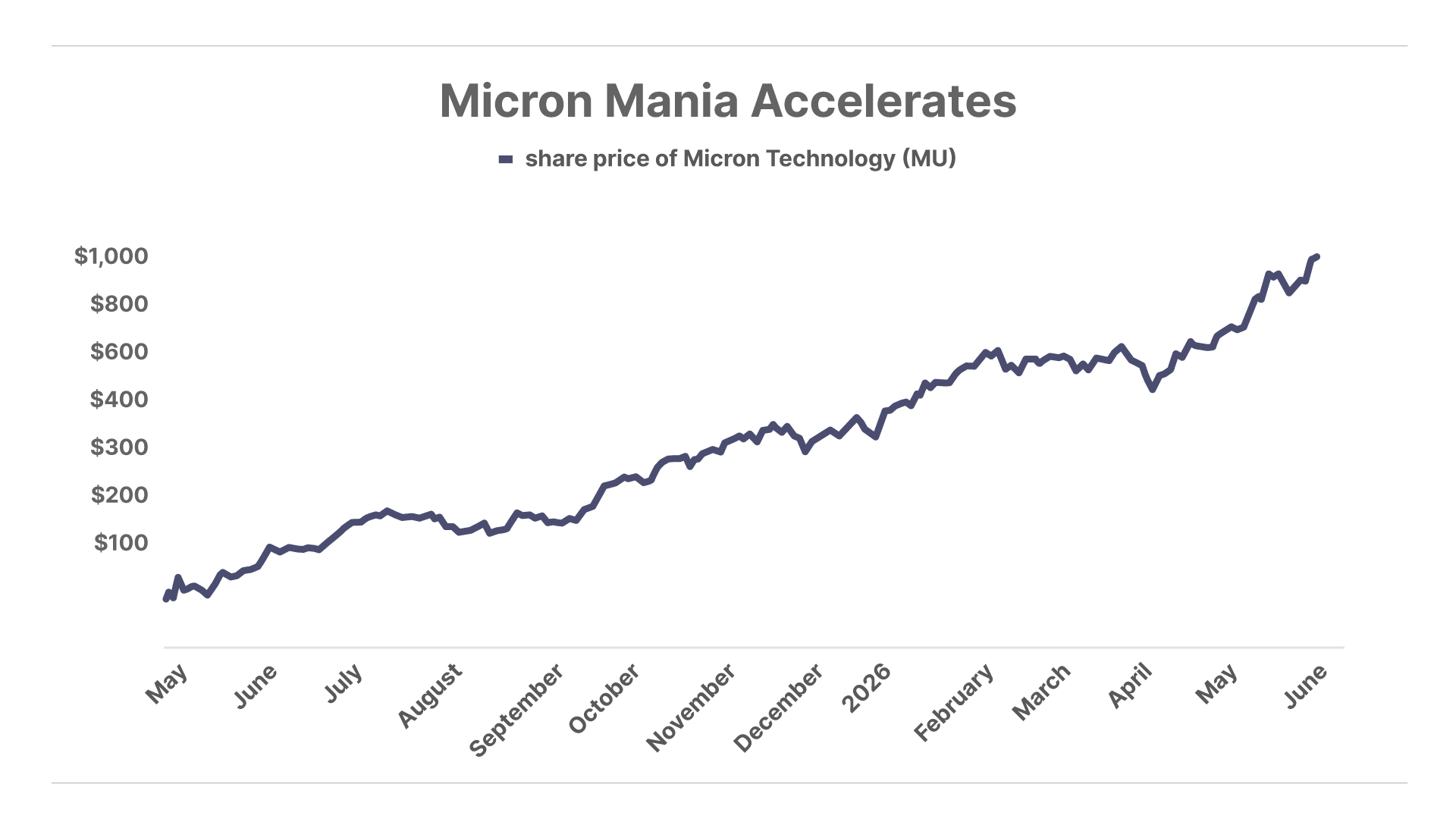
1. Three words from Trump push Micron past $1 trillion. On Friday, the president simply said “Micron is great” and noted the company could invest "over $100 billion" in New York – a commitment first announced in 2022. When markets reopened on Tuesday, Micron surged 19%, adding $150 billion in market cap in a single session. The stock has now surged from a $70 billion market cap in April 2025 to over $1 trillion today – a 1,300% gain in just 13 months – as one of the best-performing AI stocks to date.
2. There is a surge in construction-material costs. Raw input prices rose more during the first four months of 2026 than over the prior three years combined – leading to higher home prices going forward. Grid buildout and data center demand have sent copper on a tear, while tariff dynamics and supply-chain frictions have piled onto lumber and aluminum. And mortgage rates might climb even higher than they are. The affordability math gets worse before it gets better.
3. Nvidia to invest $150 billion in Taiwan. Nvidia (NVDA) CEO Jensen Huang announced today that the company will invest $150 billion a year in Taiwan – focusing on procurement, infrastructure, and manufacturing capacity for Nvidia’s semiconductor chips. Huang called Taiwan the "epicenter" of the artificial intelligence (“AI”) revolution and predicted it will be the world's leading technology manufacturing hub for a long time.
Chart Of The Day… Celsius Holdings (CELH)
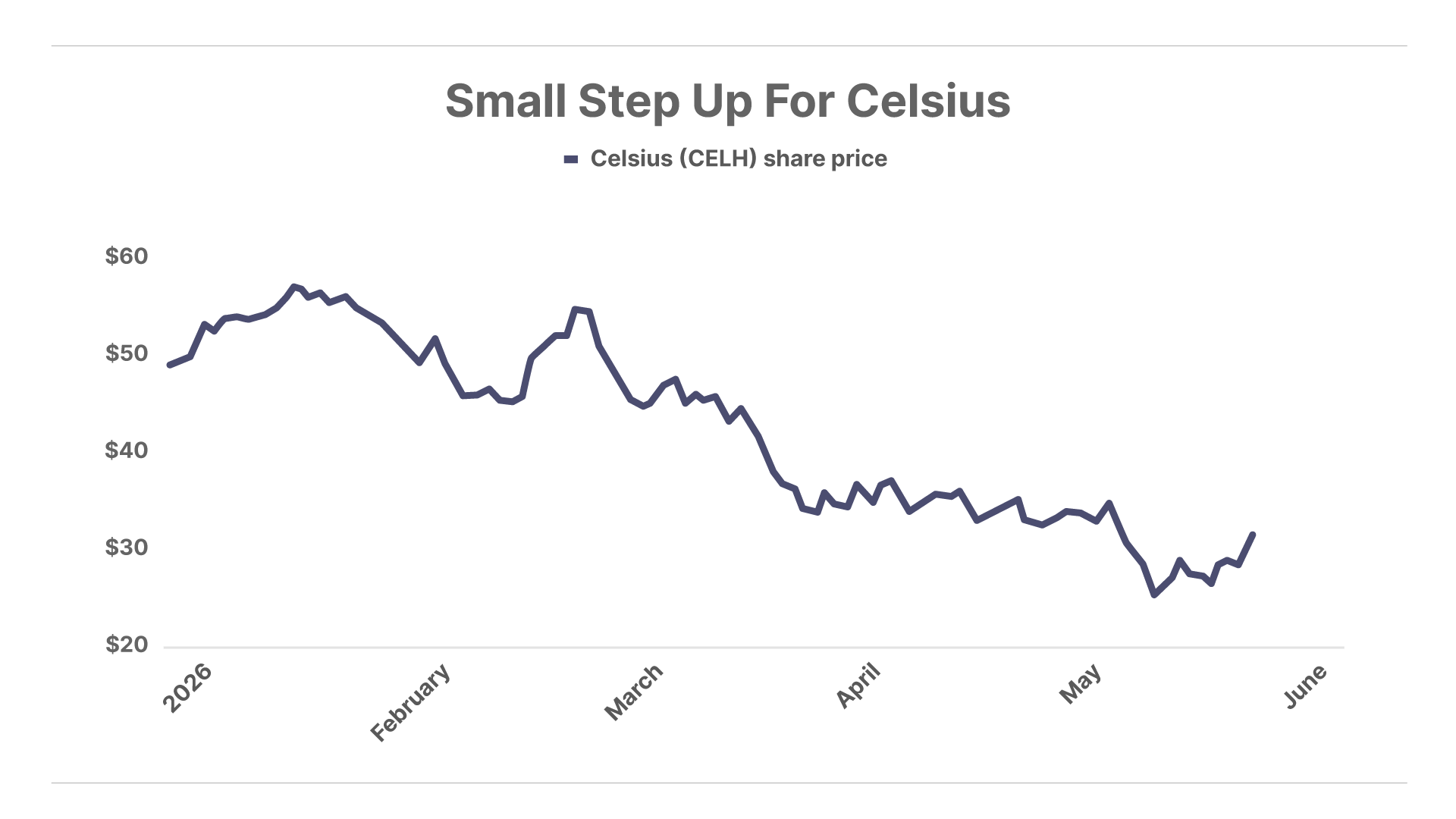
Shares of Complete Investor recommendation Celsius Holdings (CELH) traded as much as 10% higher today after a cluster of insider purchases came to light – CEO John Fieldly disclosed a $249,000 open-market buy, joined by the company's president and a director adding similar-sized stakes of their own. Like us, management appears to see value at current levels.
Mailbag
“Question About Honeycomb Portfolio”
Tom A. writes:
Hi Porter,
I've been a subscriber for 20 years or so. Made money and lost money. Didn't "get" position sizing for quite a while. My investing style was like many others, Greedy and Fearful. But the Alliance partnership and now Partner Pass have calmed me down. I've a lot of our assets in gold coins, a chunk in the Permanent Portfolio, and just now a chunk in Prophet (MyWallSt). Is the new Honeycomb portfolio you have written about in the Journal complementary to Porter’s Permanent Portfolio or should it replace it? I'm 82 but may well live to 95 or so as my parents and grandparents did. I know you can't give individual advice, but maybe some guidance on risk/reward scenarios for the three portfolios could be helpful to many subscribers.
Porter Comment: I can’t comment on the risk dynamics of the MyWallStreet product because I haven’t studied it that closely (it isn’t my product). Our safest approach is Porter’s Permanent Portfolio, as it uses non-correlated assets to control risk. It will have volatility and max drawdowns that are roughly half the stock market’s. The next safest approach is an unleveraged Honeycomb Portfolio, as it uses non-correlated equities to control risk. However, at market extremes, all equities correlations bend toward 1.0, which means I expect the Honeycomb to only be relatively less volatile than the market with somewhat smaller drawdowns. And the highest risk approach we publish as a full portfolio is Better Than Buffett, which I would expect to roughly match the market’s volatility with substantially higher annual returns.
“Honeycomb Portfolio And Best Buys”
Kevin O. writes:
I am currently subscribed to your Best Buys. Will you be recommending any of the Honeycomb Portfolio for Best Buys?
Can’t wait to read your book. I’ve learned a lot from your Daily Journals. Thanks again for everything you do. I always look forward to reading whatever you write about.
Porter Comment: Hi Kevin —
Thanks for your support of my business.
The Honeycomb is, pretty much, the most elite version of what we do. As such, we reserve our precise portfolio for our Partner Pass member.
But, as you’ll see in the book, I give away the full “recipe” so that you can build it yourself. And… it’s only $4.99 this week.
Regards,
Porter
“2029: The End of America”
Kathy D. writes:
Porter,
I just bought your book and read it in one sitting. Thank you for writing this so that even those who financially have their heads buried in the sand (too many of my family and friends) understand the fiscal cliff we are teetering upon. I have purchased the book for those closest to me with the hope they read it.
Thank you.
“The Violent Lives Of Black Americans Debate”
David E. writes:
Hi Porter,
I read your essay on the captioned subject and felt prompted to forward it it my youngest son, as I hoped it would challenge some of the "progressive" liberal politics that he, along with so many of Western democracies younger generations have been captured by these past two decades or so (thanks in no small part to the total capture of educational institutions by similar political dogma).
Far from agreeing with any of the (in my view) valid rationale in your piece, he has responded with an all but total rebuttal. As you concluded with an open offer to let you know what we think, I am forwarding my son's reply to me (see below) and hope you will consider it warrants a reasoned response to the issues he so clearly feels justified in raising as a critique of views.
Yours always in the name of open and free debate:
I read this through – what a dismal waste of time.
Another poor analysis by an idiotic commentator. Yes, he points out the problem of violence committed by Black Americans and black people in other countries.
The list...
"The countries at the top of the global homicide rankings – year after year, decade after decade – are the countries of sub-Saharan Africa, the Caribbean, and the African-descended population centers of Central and South America: El Salvador, Honduras, Jamaica, South Africa, the Bahamas, Belize, Venezuela, and Brazil."
He is even duplicitous enough to claim that “American slavery” has nothing to do with violence in these other countries. What sort of weak-minded person would nod in agreement or think he is a credible person? Does that mean slavery per se has nothing to do with intergenerational violence? He is clearly trying to slip that idea into the reader's mind.
Look at the list.
With the exception of “sub-Saharan Africa,” the black populations in all of those countries are the descendants of slaves or people subjected to apartheid. What does he think happens to people who are forcibly removed from their homelands, treated with incomparable brutality, robbed of autonomy, left barely educated and once they are “emancipated” they are let loose into a cut-throat economy with barely any “welfare state”? Does slavery not cause enormous problems and deform peoples' cultures for generations? Seems obvious that it does. It's a wonder that the descendants of slaves have done as well as they have done.
And at the end of his analysis, what sort of solution does he offer?
Not much apart from lock people up (which needs to happen of course) and don't go near welfare. That's it. Nothing about how local economies or food systems could be improved. Nothing about education. Just the usual dull and ideologically rigid Republican talking points, which I expected from the beginning and wasted too much time reading about at the end.
And as well – he claims that the primary issue he raised is taboo. No it's not. It gets spoken about all the time in America – just not often as stupidly as people like this writer manages.
Porter Comment: When your son wrote: “What does he think happens to people who are forcibly removed from their homelands, treated with incomparable brutality, robbed of autonomy, left barely educated and once they are 'emancipated' they are let loose into a cut-throat economy with barely any 'welfare state’” – was he referring to the Irish immigrants of the 1840s who fled the slave labor economy of the British land owners and a horrific famine?
When your son writes that “nothing” has been done to invest in “local economies,” “food systems,” or “education,” is he unaware that since 1970 more than $2 trillion (yes, with a t) has been spent on food assistance, housing assistance, healthcare, and public education in only seven cities: Baltimore, Detroit, Memphis, Houston, Oakland, New Orleans, and Philadelphia? On a cumulative basis, that’s about $700,000 per black resident. Is your son unaware of the truly incredible sums currently being spent on education ($28,000 per student, per year, in Baltimore) and the utterly dismal results of these huge investments? In Baltimore, in most of the schools, virtually every student is functionally illiterate. And this is a school system completely controlled by black people, which employs virtually all black people. This isn’t a racist outcome. And it has nothing to do with a lack of spending. It is something far more complex to explain.
Has your son stopped to consider that in Haiti, the slaves overthrew their French masters more than 200 years ago? Does he not know that the newly independent slaves killed every single white and mulatto person on the entire island? "For our declaration of independence, we should have the skin of a white man for parchment, his skull for an inkwell, his blood for ink, and a bayonet for a pen!" Haiti was the first independent nation in Latin America, the first post-colonial independent Black-led nation in the world, and the only nation whose independence was gained as part of a successful slave rebellion. Are we to blame the white masters, who were massacred more than 200 years ago, for the fact that Haiti is the poorest, the most violent, and the most ignorant nation in the Western world – 200 years later? For how long should we, by association, suffer this guilt? For how many centuries will the slavery card remain valid? Does your son not understand that everyone – every Western nation – was, at one time or another, enslaved?
Over the last 50 years, black people have destroyed Baltimore. They have wrecked their neighborhoods. They have filled the city with violence, drugs, and trash. They have likewise destroyed half a dozen of America’s best cities. I do not believe that is the fault of slavery, which was ended in 1865 by white men fighting a war that is still, to this day, the most violent episode in our nation’s history. Our country – and most notably, Republicans – made enormous sacrifices to end slavery. Somehow that is always forgotten.
Likewise, I do not believe that it is the fault of segregation – which ended more than 60 years ago. Why not? Well, how do you think your son would explain that, during segregation, the black community, by virtually every measure, was far safer and more prosperous than it is today?
And, finally, I do not believe it is the fault of “systematic racism,” as during my lifetime enormous racial preferences and trillions in capital have been spent trying to lift black people out of ignorance, violence, and poverty.
But I remain open to all of the facts and the data. I remain willing to change my mind.
I think it will always boil down to a simple fact: you cannot make a man learn to read. You cannot make a man love his wife and his children. You cannot make a man avoid drugs and debauchery. You can only provide carrots and sticks. Ultimately, in America, you will earn your just dessert. Study after study has shown that anyone can escape poverty in America if they do three simple things: 1. Graduate from high school. 2. Avoid having children until after marriage. 3. Maintain full-time employment. Those opportunities remain completely open to every black person in America and, of course, millions take advantage of this reality and succeed.
But for the millions of black (and white) people who will not get an education, who will not keep a job, who will not take care of their families, and who insist on engaging in crime and violence, we are going to have to build a lot of prisons. There is no other way to achieve peace and reconstruction. No more excuses. As a nation, we must adopt an absolutely ruthless prohibition against all violent crime.
Finally, in regards to your son’s writing and thinking. It’s fascinating that people on the left, bereft of facts and logic, always resort to name-calling and insults. It is quite interesting that your son believes someone who started his own business at 26 years old, built one of largest financial research companies in the world, and became a self-made billionaire, is “stupid.
Porter & Co. Market Snapshot
| Price | Yesterday's Return | Year-to-Date Return | |
|---|---|---|---|
| S&P 500 Index | $7,519.12 | 0.61% | 9.84% |
| Gold per ounce | $4,500.40 | -0.37% | 3.65% |
| Bitcoin | $75,825.73 | -1.32% | -14.49% |
| Oil (West Texas Intermediate) per barrel | $93.89 | -5.30% | 54.84% |
| Berkshire Hathaway (BRK) | $724,500.00 | -0.57% | -4.01% |
| Porter's Permanent Portfolio | - | -0.07% | 0.07% |
| The Better Than Berkshire Index | - | -0.27% | 2.63% |
| Yield | Yesterday's Change | Change Year-to-Date |
|
| U.S Treasury 30-Year Yield | 5.03% | -4 bps | 19 bps |
*A Complete Investor risk rating of 1 is defined as a "low risk, high allocation" security, while positions rated closer to a 5 are higher risk. Porter & Co.'s top-ranked positions include those rated either 1 or 2 in Complete Investor portfolio.
Porter & Co. Top Positions
| Publication | Ticker | Description | Total Return |
|---|---|---|---|
| Complete Investor | BWXT | BWX Technologies | 258% |
| Tech Frontiers | QURE | uniQure | 237% |
| Complete Investor | BTC/USD | Bitcoin | 181% |
| Tech Frontiers | SGMT | Sagimet Biosciences | 134% |
| Complete Investor | ARM | ARM Holdings | 132% |
| Tech Frontiers | ROIV | Roivant Sciences | 131% |
| Tech Frontiers | QURE | uniQure | 131% |
| Complete Investor | PM | Philip Morris | 125% |
| Tech Frontiers | TGTX | TG Therapeutics | 114% |
| Distressed Investing | PTON | Peloton Interactive | 105% |
Prices as of 4:00 pm ET May 26, 2026
Please note: The investments in our “Porter & Co. Top Positions” should not be considered current recommendations. These positions are the best performers across our publications – and the securities listed may (or may not) be above the current buy-up-to price. To learn more, visit the current recommendations page of the relevant service, here. To gain access or to learn more about our current recommendations, call our Customer Care team at 888-610-8895 or internationally at +1 443-815-4447.