Issue #107, Volume #3


How Big Will The Current Bubble Grow?
Inside today’s Daily Journal…
|
Editor’s note: On Saturday, June 20, Briar Rochelle Stansberry was born in New York City. Mother and baby are doing great. And your editor is over the moon.
Last week, Alan Greenspan died.
Greenspan became chairman of the Federal Reserve on August 11, 1987. Two months later, on Monday, October 19, 1987, the stock market fell 22.6% in a single trading session. That one-day loss remains, in percentage terms, the largest single-day decline in the history of the Dow Jones Industrial Average. Larger than anything in 1929. Larger than anything in 2008. Larger than the worst day of 2020, during the COVID bust. It was, by a considerable margin, the worst day the American stock market ever had.
Greenspan was on a plane to Dallas when it happened. By the time he landed, a significant portion of the American investing public had been ruined on paper. He flew back to Washington that night. Over the next 12 hours, in a series of phone calls with Gerald Corrigan, the president of the Federal Reserve Bank of New York, Greenspan decided he would bail out the market.
At 8:41 a.m. on Tuesday, October 20 – before the market opened – the Federal Reserve issued a single sentence. It is one of the most consequential sentences in the history of American finance:
The Federal Reserve, consistent with its responsibilities as the nation’s central bank, affirmed today its readiness to serve as a source of liquidity to support the economic and financial system.
In the plain English Greenspan refused to use, he said: whatever investors need, we will print.
The market rallied. By the end of the year, stocks ended 2% higher than where they started the year. A new verb entered the language of Wall Street. Stocks were now, and would forever be, “Greenspanned.”
The lesson of 1987 was the Fed’s “put.” From that day forward there was a put option under the American stock market. It is written by the Federal Reserve. It was free. It was automatic. And it began an incredibly long period of asset inflation that continues to this day. Investors realized they cannot lose – as long as they buy the dip and hold.
Everything that followed over the last 40 years – the leveraged buyout boom, the junk-bond mania, the growth of derivatives into a hundred-trillion-dollar shadow-banking system, the dot-com bubble, the housing bubble, every successive episode of euphoric risk-taking that the next 40 years would produce – was built on that one sentence issued at 8:41 a.m. on October 20, 1987. None of it would have happened in a world where the central bank was not standing behind every asset price with a printing press.
And then, in 1998, there was an even bigger expansion of the Fed’s guarantee. It was used, for the first time ever, to bail out a private investment fund.
A Connecticut hedge fund called Long-Term Capital Management (“LTCM”) – staffed by two Nobel laureates and the former head of bond trading at Salomon Brothers – blew up over the course of a single month after betting, with 30-to-1 leverage, that the spread between Russian government bonds and U.S. Treasuries would narrow.
It did not narrow.
It widened, catastrophically, after Russia defaulted on its debt in August 1998. By the middle of September, LTCM was sitting on $4.8 billion of equity supporting more than $125 billion of positions and another trillion dollars of notional derivatives exposure. If it collapsed in a disorderly fashion, it would take half of Wall Street down with it.
On Sunday, September 20, 1998, a team from the Federal Reserve Bank of New York, led by Peter Fisher, drove out to LTCM’s offices in Greenwich, Connecticut, and looked at the books. What they saw horrified them. Two days later, William McDonough, the president of the New York Fed, summoned the CEOs of the three largest investment banks in the world – Goldman Sachs, Merrill Lynch, and JPMorgan – to his office at 33 Liberty Street. By the evening of September 23, 14 of the largest financial institutions on Earth had been pressured into a $3.625 billion private-sector recapitalization of LTCM.
How did the Fed force the banks to contribute huge amounts of capital to bail out a private fund? By ensuring they wouldn’t lose any money – by promising to cut interest rates, which the banks knew would move the value of LTCM’s fixed-income portfolio higher.
Don’t listen to what the Fed says. Watch what it does. It cuts rates after every crisis. Greenspan cut them after the 1987 crash. He cut them after the LTCM fiasco. He cut them after the dot-com implosion in 2001. He cut them and cut them and cut them…. So much so that between June 2003 and June 2004 the federal funds rate stood at 1% – at the time, the lowest level in nearly half a century.
Greenspan cut rates to 1%. For 12 straight months. With the economy already recovering. With unemployment already falling. With the housing market already showing every symptom of a historic bubble. Greenspan, the man who had been called the greatest central banker who ever lived, kept the punch bowl on the table long after the last guest had slid under it.
The result was the largest credit bubble in human history, to that point.
Home prices doubled nationally between 2000 and 2006, and tripled in some markets. The share of American gross domestic product (“GDP”) accounted for by the financial sector went from roughly 4% in 1980 to nearly 8% by 2007. Household debt as a percentage of disposable income rose from 60% in 1980 to 136% in 2007.
Every one of these numbers was a direct, measurable consequence of the Greenspan Put – of a central bank that had made it unmistakably clear, to every rational actor in the financial system, that the cost of taking risk had been socialized and the benefits had been left with the risk-taker.
Greenspan retired in January 2006. At his final testimony, more than one congressman called him “the greatest central banker who ever lived.”
And within two years, the system he had built collapsed.
AIG, the world’s largest insurance company, was nationalized. Fannie Mae and Freddie Mac, the two quasi-private mortgage giants, were placed into conservatorship. Bear Stearns and Lehman Brothers were dead. Wachovia was absorbed by Wells Fargo over a weekend. Citigroup was propped up with a second round of capital injections.
By the end of 2008, the federal government had committed, directly or indirectly, somewhere between $7 trillion and $12 trillion of public support to the American financial system, depending on how you counted.
Alan Greenspan’s actual legacy is September 2008 – a legacy of ashes. The “prosperity” Greenspan claimed to engineer was a mirage – a house of cards built on bad debt. And our country, rather than acknowledging this by writing off the bad debt and building back with a stable economic foundation, chose instead to re-inflate the bubble by moving private obligations onto public balance sheets. Going forward, profits would be private. Losses would be public.
Beginning in the fall of 2008, Ben Bernanke, who replaced Greenspan as Fed chair, would print money on a scale no central banker in the history of the English-speaking world had ever contemplated before. In November 2008, the Fed announced the first round of what came to be called quantitative easing – or QE, the most harmless-sounding acronym ever attached to a policy of outright monetary debasement. The Fed would purchase $600 billion of mortgage-backed securities with money it had simply invented in a computer at the Federal Reserve Bank of New York. The purchases were described as temporary, of course.
In March 2009, they were expanded to $1.25 trillion. That was QE1. In November 2010, Bernanke announced QE2 – another $600 billion, purchased over eight months. In September 2012, he announced QE3 – open-ended purchases of $40 billion of mortgage securities per month, later expanded to $85 billion per month. By the time QE3 was wound down in October 2014, the Federal Reserve’s balance sheet had grown from less than $900 billion before the crisis to more than $4.5 trillion – five times its pre-crisis size. More than a fifth of the entire annual GDP of the United States, held as Treasury bonds and mortgage securities, financed with dollars the Fed had created by keystroke.
QE took President Richard Nixon’s thesis – the idea that the dollar could be detached from any external discipline – and pushed it to its logical conclusion. The Federal Reserve was now the buyer of last resort not just for the banking system, but for the federal government itself. Every bond the Treasury issued, the Fed stood ready to absorb. Every trillion dollars of new deficit, the Fed stood ready to monetize. The distinction between monetary policy and fiscal policy – the distinction that had been the single most important guardrail of the postwar financial system, the firewall between the men who print money and the men who spend money – was quietly erased over the six years between 2008 and 2014.
The house of cards became an entire global financial system built on nothing.
Not one American in a thousand understands what this has done to our wages, to our savings, to our culture, and to the economy that our children will inherit. If you don’t understand why our kids cannot afford to marry and have children… if you don’t understand why gambling, prostitution, and deaths of despair have soared… if it hasn’t occurred to you yet what’s really driving the radical politics (communists in power in America!)… or the bizarre sexual deviancy that’s consumed the popular culture… then you haven’t studied what happens to every society when its money is debauched and its currency is destroyed.
No one realized how fast and how far the standard of living was declining in America because everyone was using a yardstick – the dollar – that simply doesn’t mean what it used to.
If you measure the American economy through the stock market but use ounces of gold instead of dollars, you can see that since the first private bailout (of Long-Term Capital Management in 1998), America’s economy has declined by about 75%.
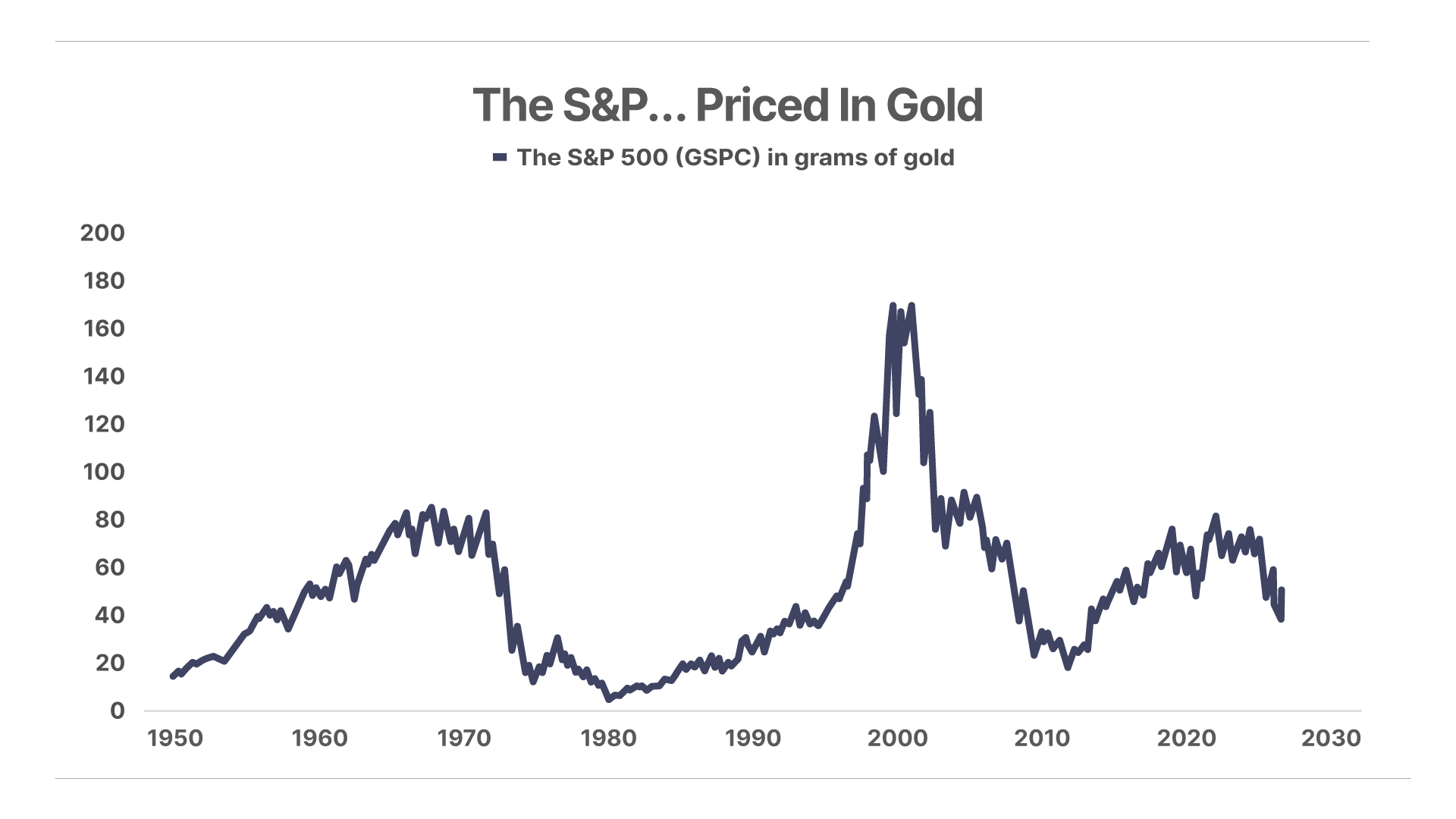
But you don’t have to look through the lens of gold. Just look at any of these real-world indicators of wealth and prosperity.
-
Suicide rates up 30%
-
Sustained decline in prime-age male labor participation rates, to below 90%
-
Huge increase to multi-generational households (adults living with parents) from 7% to 18%
-
Social cohesion has collapsed: the percentage of people saying “most people can be trusted” declined from 46% in the 1970s to 34% today
-
Adult obesity rose from 30.5% in 1999-2000 to 42%
-
Overall life expectancy declined
-
General fertility at all-time lows (56 births per 1,000 women ages 15-44 by 2022)
You might argue that the costs of these policies don’t overshadow the wealth that’s been created. But sooner or later, the current house of cards will collapse again – just like it did in 1987, 1998, 2001, 2008, and 2020. The wealth isn’t real. It’s just more bad debt.
But when the next collapse occurs, the printing won’t work. Central banks around the world have begun to stockpile gold, not Treasury bonds. Our creditors are abandoning Treasury bonds, as the current bear market in bonds (the longest such bear market ever) proves.
A real monetary reset is coming.
I’ve written an entire book about it. Please read it. It could mean the difference between wealth and poverty for several generations of your family. And if you’ve already read it, please consider sending a copy to your children. They might dismiss it. But at least they’ll have some inkling of the risks we all face.
It’s available at Amazon.
Tell me what you think of today’s Daily Journal: porterstansberrydirect@gmail.com
Good investing,
F. Porter Stansberry
Stevenson, Maryland
3 Things To Know Before We Go…
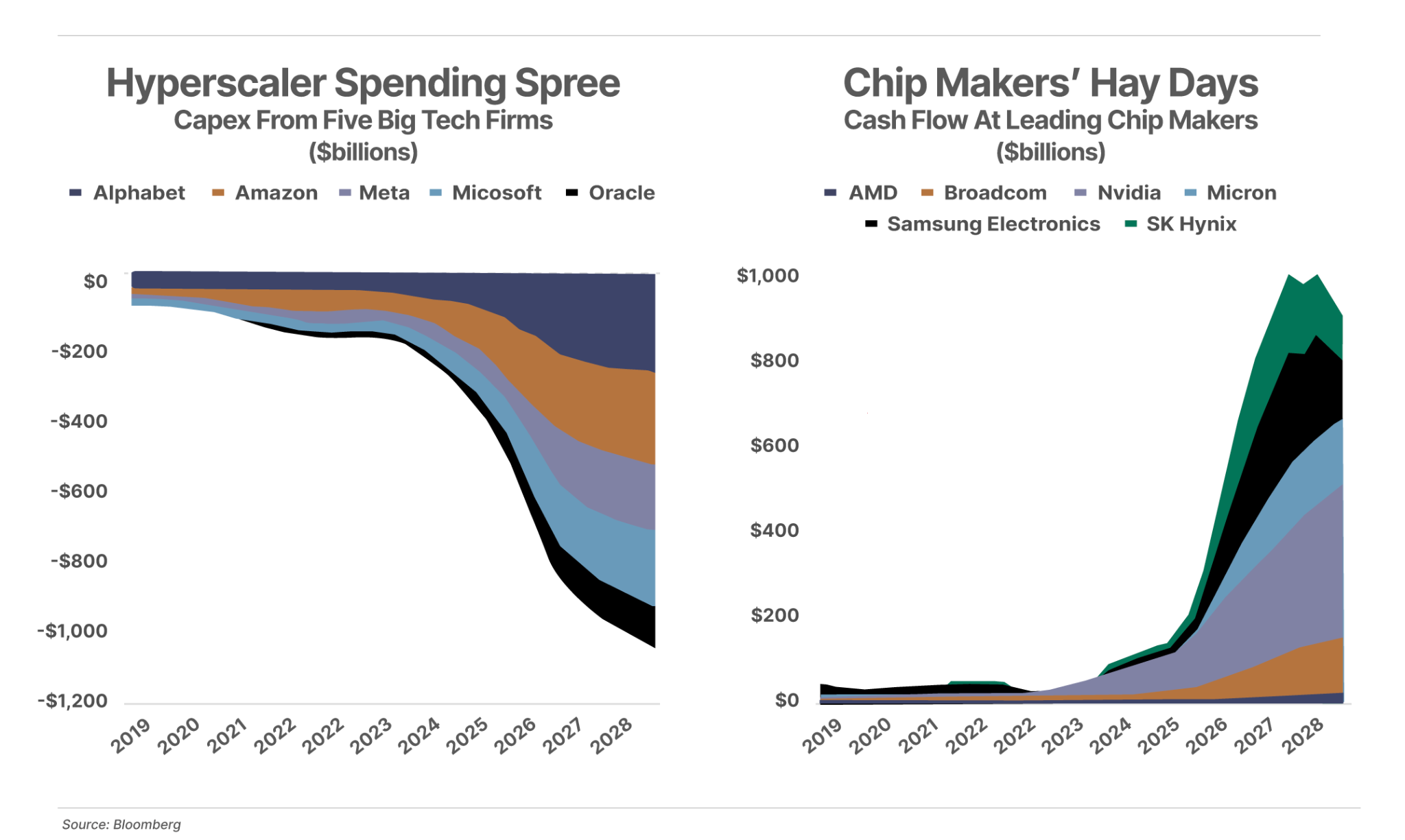
1. One man’s capex is another’s FCF. Alphabet (GOOGL), Amazon (AMZN), Meta (META), Microsoft (MSFT), and Oracle (ORCL) are on track to spend north of $1 trillion on capex by 2028. The mirror image is the supply side – AMD (AMD), Broadcom (AVGO), Nvidia (NVDA), Micron Technology (MU), Samsung Electronics (SSNLF), and SK Hynix are forecast to generate roughly $1 trillion in combined free cash flow as soon as next year.
2. Americans are relying more on credit. Total consumer credit jumped $24.9 billion to a record $5.14 trillion – a 5.8% annualized pace versus just 2.1% in February. Credit card balances rose $10 billion – the largest one-month jump since February 2024 – to $1.3 trillion, while autos and student loans pushed non-revolving to a record $3.8 trillion. The savings rate has dropped to 4.0% from 6.2% two years ago as prices keep grinding higher – with wages no longer keeping pace, households are increasingly bridging the gap by borrowing.
3. Investors have been dumping gold and Bitcoin and rushing into semis. Since April, U.S. semiconductor exchange-traded funds (“ETFs”) have taken in roughly $20 billion while gold and Bitcoin funds have seen $12 billion flow out. Over the same window, the largest gold ETF (GLD) and the largest bitcoin ETF (IBIT) have fallen 16% and 13%, respectively, while the largest semiconductor ETF (SMH) has surged 62% – including a 32% gain in April, its best month on record.
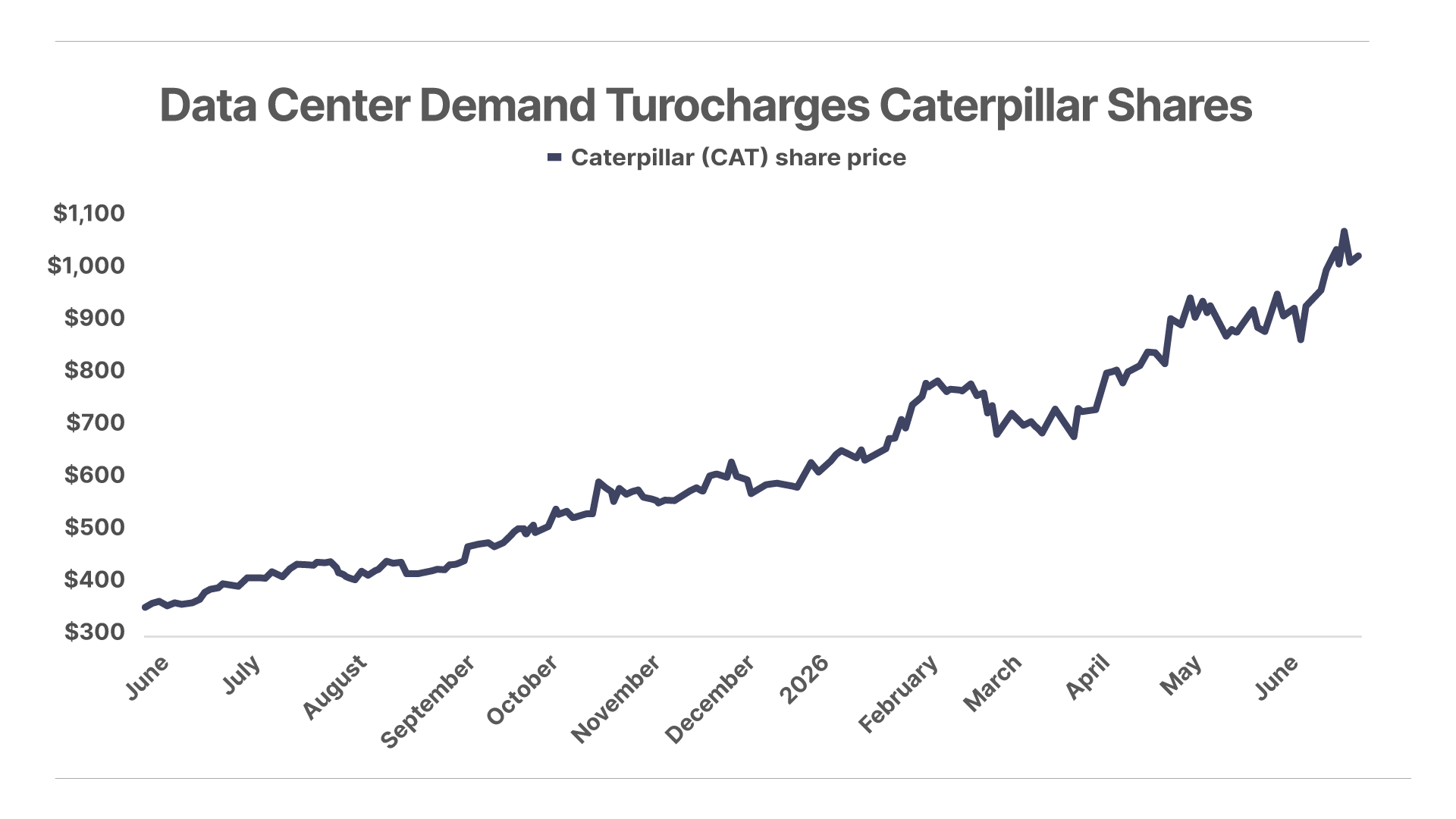
Chart Of The Day… Caterpillar (CAT)
Caterpillar has quietly become one of the best-performing stocks in the market this year, with its power-generation business in high demand from data centers. Shares have rallied 79% so far this year, and are up 114% since our inclusion into Porter’s Permanent Portfolio in September 2025.
Poll Results
Because of the on-and-off peace agreements in the Middle East, there is little certainty on energy pricing. So on Friday, we ask readers if the price of a barrel of oil will be higher than $75 on Labor Day or lower than $75… A vast majority – 69% – believe oil will be higher than $75 per barrel at the end of summer, while 31% believe it will be lower.
Mailbag
I Enjoy The Journal”
Bill B. writes:
I enjoy reading through the Journal. Excellent compilation of materials. Some of the stories I am familiar with, other facts brought additional light on the issues.
“Another Great Depression”
John M. writes:
Scary article but impressively researched and written!
“Friday’s Journal About Bitcoin”
Kendrick W. writes:
Great history lesson, thanks. You can have all the Bitcoins (tulipmania), and I’ll take farmland, and mineral rights.
Porter & Co. Market Snapshot
| Price | Friday’s Return | Year-to-Date Return | |
|---|---|---|---|
| S&P 500 Index | $7,354.02 | -0.04% | 8.0% |
| Gold per ounce | $4,088.74 | 1.54% | -6.4% |
| Bitcoin | $59,572 | -1.07% | -31.7% |
| Oil (West Texas Intermediate) per barrel | $69.23 | -3.09% | 22.0% |
| Berkshire Hathaway (BRK) | $745,140.03 | 1.60% | -1.3% |
| Porter’s Permanent Portfolio | – | 1.76% | -0.2% |
| The Better Than Berkshire Index | – | 0.95% | 5.7% |
| Total Return | Annual Return | ||
| Porter & Co’s Top Ranked* | 35.5% | 15.1% | |
| Yield | Friday’s Change | Change Year-to-Date |
|
| U.S Treasury 30-Year Yield | 4.86% | 0 bps | 2 bps |
*A Complete Investor risk rating of 1 is defined as a “low risk, high allocation” security, while positions rated closer to a 5 are higher risk. Porter & Co.’s top-ranked positions include those rated either 1 or 2 in Complete Investor portfolio.
Porter & Co. Top Positions
| Publication | Ticker | Description | Total Return |
|---|---|---|---|
| Complete Investor | BWXT | BWX Technologies | 247% |
| Tech Frontiers | QURE | uniQure | 237% |
| Tech Frontiers | TGTX | TG Therapeutics | 157% |
| Tech Frontiers | ROIV | Roivant Sciences | 151% |
| Complete Investor | ARM | ARM Holdings | 142% |
| Complete Investor | SKWD | Skyward Specialty Insurance | 140% |
| Tech Frontiers | QURE | uniQure | 131% |
| Tech Frontiers | SGMT | Sagimet Biosciences | 131% |
| Complete Investor | PM | Philip Morris | 126% |
| Tech Frontiers | NUVB | Nuvation Bio | 122% |
Prices as of 4:00 pm ET June 26, 2026
Please note: The investments in our “Porter & Co. Top Positions” should not be considered current recommendations. These positions are the best performers across our publications – and the securities listed may (or may not) be above the current buy-up-to price. To learn more, visit the current recommendations page of the relevant service, here. To gain access or to learn more about our current recommendations, call our Customer Care team at 888-610-8895 or internationally at +1 443-815-4447.