How To Explain 131-Point Increase In Seven Months
Inside Today’s Issue
Editor’s note: Today, Porter turns the Journal over to his colleague Marty Fridson, who spent years researching bond yields at Salomon Brothers, Morgan Stanley, and Merrill Lynch and became known for his innovative work in credit analysis and investment strategy.
The old maxim that “all news is good news” does not apply to interest rates on U.S. Treasury bonds.
Rising Treasury yields are big news these days. Here are just a few recent headlines…
“U.S. Government Debt Rout Triggers ‘Vicious Loop’ of Selling”
(Financial Times, September 30)
“Why Bond Yields Are Surging To Fresh 24-Year Highs”
(Barron’s, October 7)
And after yesterday’s Treasury bond auction:
“U.S. Treasury Pays Highest Borrowing Cost Since 2000”
(Wall Street Journal, October 7)
From its monthly low of 3.96% in February, the benchmark 10-year Treasury’s yield jumped to 5.27% in September. A 1.31 percentage-point move may not sound like a big deal to stock market followers, but it’s a major move in the bond world. In only two of the last 30 years has there been a comparably large rise over a seven-month period.
So what’s behind that 131-basis-point upsurge? (1 basis point = 1/100 percentage point)
Suspicion immediately falls on inflation. Way back in 1896, economist Irving Fisher explained that interest rates incorporate a premium that lenders demand for the loss of purchasing power they expect to suffer between lending the money and getting it back when the loan matures. Notice that we’re not talking about the current inflation rate, but what matters more to famously forward-looking financial markets – what inflation is expected to be in the future.
Nowadays we have a direct, market-based measure of the inflation rate that investors expect and incorporate into the rates they charge. It’s the TIPS breakeven rate. That’s the yield difference between conventional Treasury bonds and Treasury Inflation-Protected Securities (“TIPS”). Between February and September, the 10-year TIPS breakeven rate increased, but by only eight basis points.
That leaves 123 basis points still to be explained.
A rise in the term premium on 10-year bonds, as calculated by Federal Reserve Bank of New York economists, accounts for 29 basis points. That’s the extra yield that lenders require for locking up their money for an entire decade rather than rolling over a long series of one-month loans.
A lot of digital ink has been spilled over a frightening explanation that’s been proposed for the remaining 94 basis points of increase in the 10-year Treasury yield since February. Pundits have pointed with justice to relentless U.S. fiscal deficits and the mounting federal debt load. They conclude that the bond buyers are charging a bigger risk premium on Treasury bonds out of fear that Uncle Sam will ultimately renege on its financial promises… that is, default on its bonds.
The problem with that story is that interest rates aren’t up only on U.S. sovereign debt. It’s happening all over. Germany is internationally regarded as a paragon of fiscal prudence, yet its 10-year government bond yield soared by 87 basis points between February and September. Furthermore, if investors’ fears of a U.S. default had increased substantially between February and September, the market would have reacted by sharply raising the price on the country’s 10-year credit default swaps – which enable investors to buy insurance against default. But the price of those contracts edged up by just three basis points, from 45 to 48 during the period, too small a rise to explain the upturn in Treasury yields.
By process of elimination of the other factors, the remainder of the very substantial February-to-September climb in the 10-year U.S. Treasury yield consists of a rise in the real rate of interest. That’s the basic cost of borrowing money, determined by the supply of bonds and the investor demand for them.
It’s not a huge leap to infer that the supply of newly issued bonds has been overpowering demand lately. Tech companies are borrowing ferociously to finance data-center construction, artificial-intelligence (“AI”) computing equipment, factory automation, and robotics. U.S. corporate bond issuance is up a staggering 24.5% year-over-year, according to the Securities Industry and Financial Markets Association.
And it’s not just a U.S. phenomenon. The global total of corporate bond issuance is projected to set a record of $6.9 trillion this year, according to the Organization for Economic Co-Operation and Development. Neither is burgeoning supply restricted to the private sector. Syndicated sovereign bond issuance hit a record in 2026’s first half, according to Finance Biggo.
Looking On The Bright Side
While nobody is rejoicing about national governments sinking deeper into debt, investors can take heart from some key implications of the data. This year’s substantial escalation in long-term interest rates wasn’t driven to any large extent by rising inflation expectations or mounting fears that the U.S. will become a deadbeat. To the extent that expanded private-sector borrowing is responsible, it represents spirited investment in the economy that could provide huge future benefits in productivity and wealth creation.
Like any other investment, the huge debt-financed bet on AI’s promise carries risks. The payoffs could turn out to be much smaller than corporate leaders are counting on. What’s more, Nobel Prize-winning economist Paul Krugman has recently argued that the massive borrowing for the AI buildout is crowding out other potentially productive business investments.
The answers to these questions will be clearer in hindsight. But for now, we can take some comfort from the finding that good old-fashioned supply-and-demand, rather than nightmarish economic scenarios, are behind the conspicuous rise in interest rates.
Tell us what you think of today’s Daily Journal: porterstansberrydirect@gmail.com
Martin Fridson
New York, New York

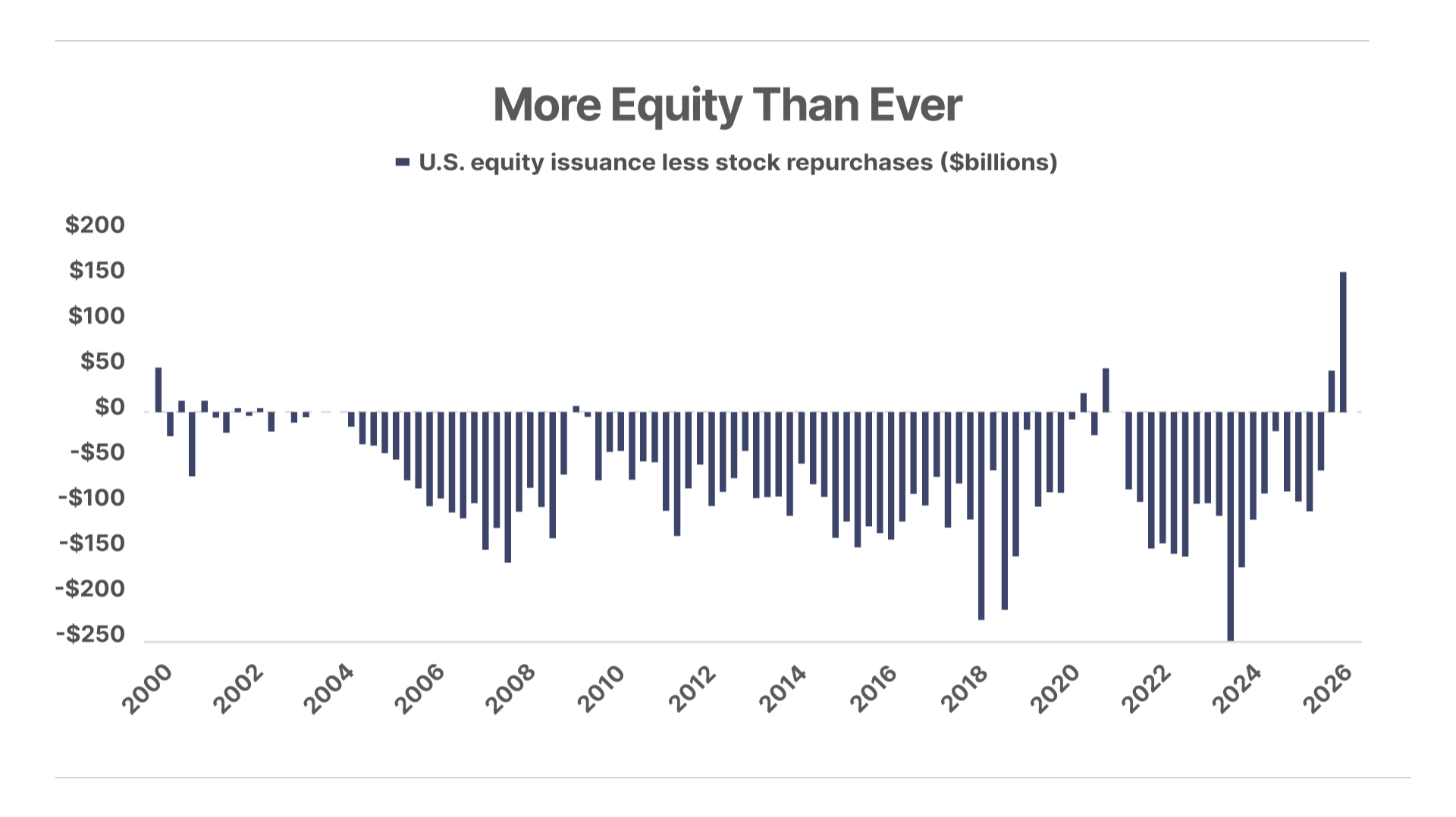
1. U.S. equity supply inverts. For much of the last 25 years, the amount of equity in the U.S. financial markets has declined due to the persistent pace of share buybacks. But a flood of new equity issuance this year has reversed that trend – with $45 billion in Q1 followed by a record $152 billion in share issuance in Q2. And with the upcoming Anthropic IPO adding another $100 billion in a record-setting public offering, 2026 is shaping up to be the biggest year of new equity supply of all time.
2. A growing share of home buyers can’t cover even a small down payment. In 2025, 42.3% of home purchases insured by the Federal Housing Administration (“FHA”) used down-payment assistance – the highest share since 2010. The FHA insures mortgages for buyers with lower credit scores and little savings. Its minimum down payment is just 3.5% of the purchase price, and 83% of its home-purchase borrowers are first-time buyers. The share has continued to rise, to 44.6% in Q1 of 2026.
3. Inflation punishes incumbents. In the 2022 and 2024 elections, high prices hurt Democrats. Now, everyday goods are 30% more expensive than they were in 2020. The prices of new cars, child care, beef, and gas are higher. Mortgage rates are above 7% and record home prices have made it harder to buy a new home. And over the past six years, prices have, on average, risen faster than wages. In a recent Wall Street Journal poll, 60% of respondents said President Donald Trump’s policies had made the economy worse.
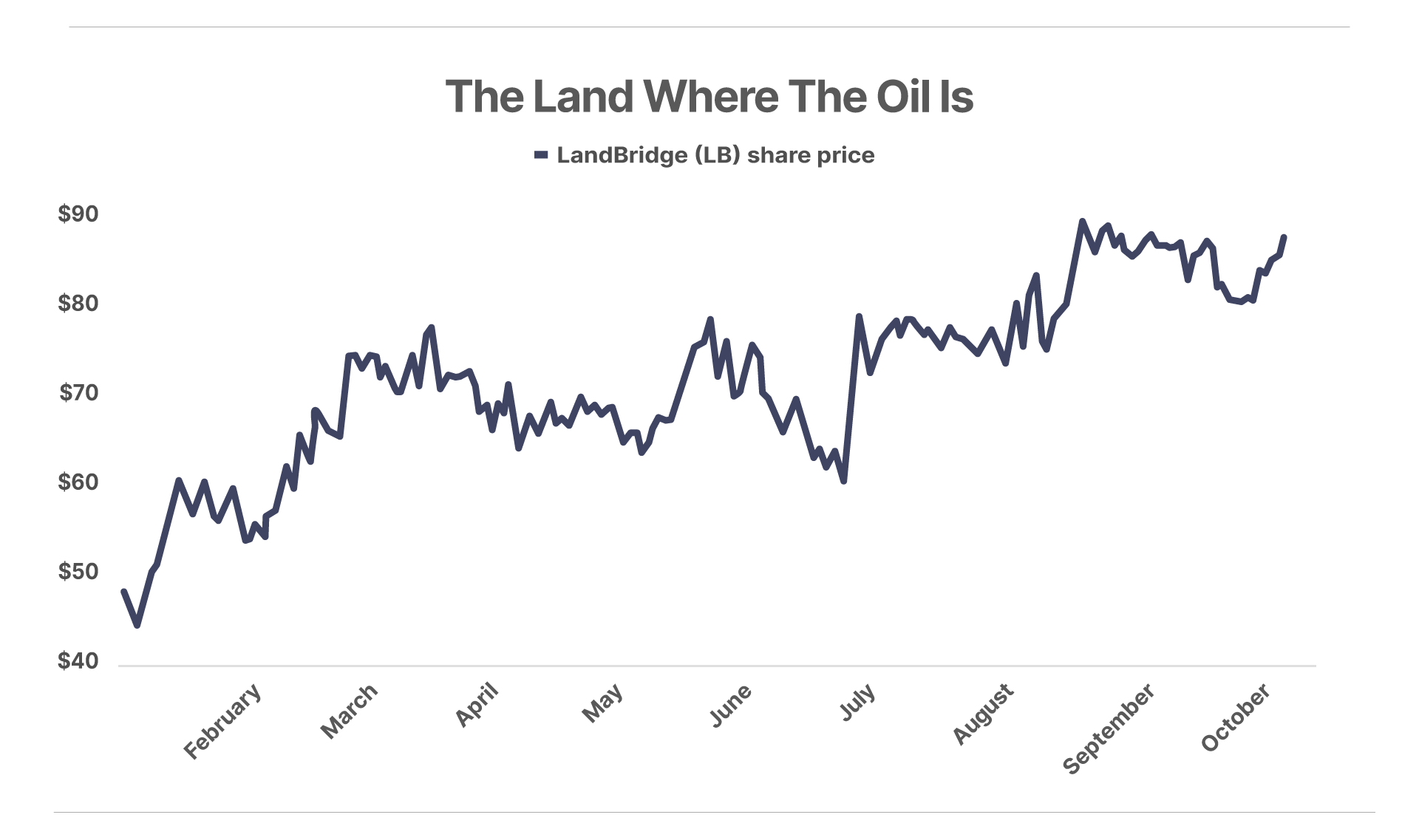
Shares of Permian Basin land-management company LandBridge (LB) are up sharply today – and are now up 79% year to date and 26% since we recommended them to Complete Investor subscribers in March.
“Burnham’s Laws”
Great piece [on Monday] by Geoffrey Morris on Burnham’s Law “who says A must say B.” I had never heard of this before. Whenever an article compels someone to dig deeper and research more on the subject, that’s the sign of a good article. This one fit the bill.
“Porter Wannabes?”
Dave G. writes:
Saw this article on Yahoo! Finance yesterday: “By 1873, The Railroad Boom Had Built Some Of The Largest Fortunes In American History. Then A Brutal Crash Bankrupted More Than 100 Railroads And Brought A Five-Year Depression. Now, Brookings Projects The AI Buildout Will Be An Even Larger Share Of The Economy Than The Railroad Mania,” by A.J. Tiarsmith. Looks like A.J. Tiarsmith is a couple of weeks behind you… Maybe he reads your articles!
David J. writes:
I wanted to use some of my Google points so I searched for your book Warren’s Mistakes on Google books and it appears that somebody is trying to steal your book electronically. I’ve attached a screenshot of it showing your book with the author Rafael Sousa. Notice it has the same cover imagery and formatting. Just wanted you to be aware of possibly some asshole stealing your work. Thanks.

Porter & Co. Comment: To order Warren’s Mistakes: How America’s Greatest Business Became Just Another Failed Conglomerate That Can’t Beat the S&P 500 — And Why It Must Be Restructured, by Porter Stansberry, click here.