
Good News For Our Portfolio And A Positive Signal For The U.S. Economy
This is the free version of Complete Investor, which provides analysis and insights. Paid subscribers get access to the full issue, including investment recommendations with buy-up-to prices, a real-time portfolio, and more. Click here for details.
Energy was our top investment theme entering 2026, and we haven’t been disappointed.
The broad energy sector – as tracked by the State Street Energy Select Sector SPDR ETF (XLE) – broke out to an all-time high in January. And our Complete Investor energy recommendations have performed well, up an average of 13% year-to-date (“YTD”) versus a decline of around 1% in the S&P 500.
But energy isn’t the only notable outperformance YTD. As market darlings like technology and software stocks have cooled off or worse – see our update on customer-management platform Salesforce (NYSE: CRM) below – there has been a rotation into stocks in less popular sectors and industries like materials, industrials, transportation, and consumer staples, all of which have also broken out to all-time highs this year.
For the first time in years, we’re seeing significant outperformance in “real economy” stocks – those that produce tangible goods and services – that have been largely forgotten during the Big Tech and AI boom. This week’s list of 52-week highs includes such “boring” names as Coca-Cola (KO), Johnson & Johnson (JNJ), FedEx (FDX), and Caterpillar (CAT), as well as several of our favorite Complete Investor Forever Stocks like British American Tobacco (NYSE: BTI), Deere & Company (NYSE: DE), and The Hershey Company (NYSE: HSY).
This is good news for our portfolio, but it’s also a positive signal for the U.S. economy. Unlike the broad market indexes – which due to their heavy market-cap weighting to technology can diverge significantly from the real economy at times – these stocks are more directly tied to economic activity and consumer spending. And while they aren’t necessarily dependent on a strong economy to perform, they tend to do better when the economy is humming along.
Since the COVID-19 pandemic, we’ve heard frequent talk of the “K-shaped” economy. This is the idea that the fortunes of wealthy and higher-income Americans have recovered and improved (the top arm of the “K”), while those of lower- and middle-income earners have deteriorated (the bottom arm of the “K”).
Intuitively, this makes sense. Those at the top have benefited tremendously from higher asset prices over the past several years. They’ve also benefited from the Fed’s aggressive rate hikes, which have allowed them to earn relatively high, risk-free yields by parking excess cash in short-term Treasury bills. On the other hand, those on the bottom – who naturally own far fewer assets – have seen their wages eroded by inflation without the offsetting benefit of higher asset prices. Meanwhile, the Fed’s “higher for longer” interest rate policy has made credit much more expensive and difficult to access.
The net result of this divergence has been an economy that has “muddled along” for the past several years. Growth has remained tepid at best, yet the economy has also continued to defy many economists’ predictions of a recession.
The following chart of the Institute of Supply Management’s (“ISM”) Manufacturing Purchasing Managers’ Index (“PMI”) illustrates this point. As you can see, rather than the sharp V-shaped recovery we’ve seen following previous slowdowns, this indicator of economic activity has remained in slight contraction (below 50 on the chart) for most of the past three years.
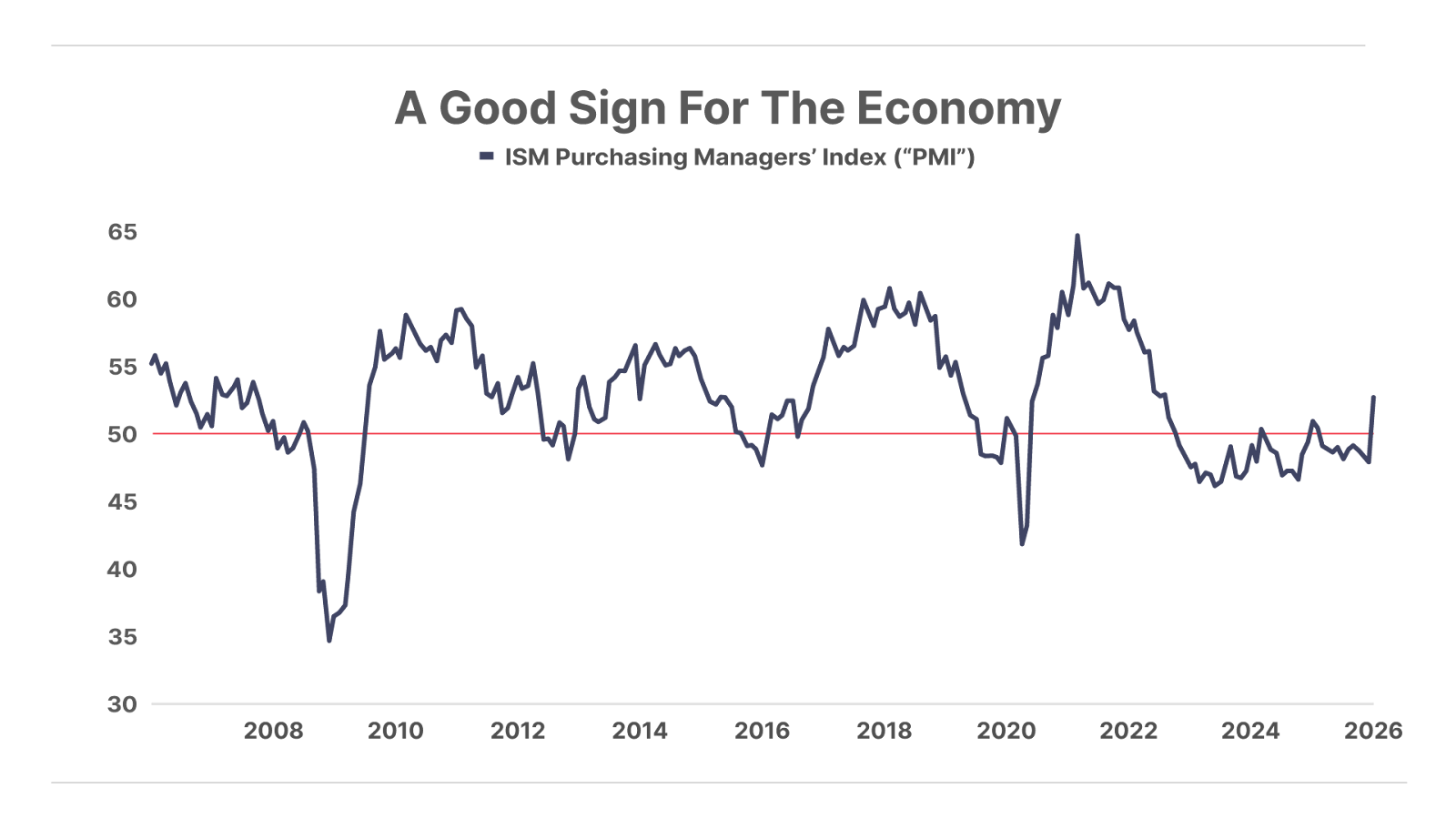
But this may finally be changing. Earlier this week, the ISM reported that the PMI moved sharply higher into expansion territory (52.6) in January for the first time since 2022.
While one month does not make a trend – and commentary from purchasing managers suggest at least some of this improvement was due to post-holiday restocking and customers trying to “get ahead” of tariff-related price increases – this report adds further credence to the breakout in “real economy” stocks. It suggests the U.S. economy could be re-accelerating for the first time in years.
Of course, plenty of risks to both the economy and markets remain. The U.S. government’s runway spending shows no signs of slowing. Inflation remains “sticky.” And while the Trump administration has taken some positive steps – via deregulatory efforts and pro-growth initiatives in the One Big Beautiful Bill Act, such as no tax on tips and 100% bonus depreciation for businesses – its aggressive tariff policies are still a significant headwind.
Kevin Warsh, President Trump’s nominee for the next chair of the Federal Reserve, is also a wildcard. Warsh has publicly agreed with the president on lowering interest rates further, arguing that AI-fueled productivity gains will give the Fed room to cut rates without stoking inflation.
However, as Porter explained in a recent Daily Journal, Warsh has also been a harsh critic of the Fed’s quantitative easing (“QE”) programs, and has advocated winding down its “bloated” balance sheet and limiting the central bank’s purchases to short-term Treasury bills in emergencies only.
Warsh still has to be confirmed as chair… and it’s not yet clear to what extent – or how quickly – he would seek to enact this kind of “regime change” at the Fed. But as Porter noted, if Warsh is determined to unwind the Fed’s balance sheet and end the “Greenspan put,” a severe recession may be unavoidable.
For now, we see no reason to make significant changes to our portfolio. We continue to recommend focusing on high-quality companies with attractive valuations and healthy free cash flows that can generate strong risk-adjusted returns in any market environment.
In this issue of Complete Investor, we provide updates on 11 stocks in our recommended portfolio, including three of our favorite property and casualty (P&C) insurance firms, an under-the-radar company poised to return to growth, and a fast-growing e-commerce giant trading at a distressed valuation due to overblown regulatory fears.
If you don’t have access to the full issue below, click here to subscribe to Porter Stansberry’s Complete Investor.
This content is only available for paid members.
If you are interested in joining Porter & Co. either click the button below now or call our Customer Care team at 888-610-8895.