Issue #72, Volume #3


Just Because The T-Bill Is Collapsing Doesn’t Mean You Can’t Win
Inside today's Daily Journal…
|
Editor’s note: In last Tuesday’s Daily Journal, Distressed Investing analyst Marty Fridson reported that the U.S. government has spent its way into a collapse of the sovereign U.S. Treasury debt regime. He wrote: “It’s not surprising that America’s debt has lost its elite investment status.”
Today, he explains what actions income-hungry investors can take to avoid this coming collapse of the U.S. Treasury bill.
Marty takes it away from here…
As I explained in “The Coming T-Bill Collapse” last week, our elected officials’ financial profligacy has ended America’s privileged status in the global debt market.
In earlier times, investors accepted a lower yield on a U.S. Treasury bond than, for example, on a German sovereign bond for which the Euro-denominated interest payments were swapped into dollars. That was because bond buyers valued the superior liquidity of Uncle Sam’s debt instruments.
But this fortunate state of affairs ended after 2008. And since 2023, the yield comparison has even turned unfavorable on the government’s shortest-dated issues, known as T-bills.
This is a serious problem for the U.S. government – it can’t afford the extra interest cost imposed by losing the laurels for being the most-admired sovereign borrower.
So what’s an alternative?
Income-seeking investors don’t need to limit their sights to U.S Treasuries. To mention just one available alternative, over the past 25 years BBB-rated corporate bonds have yielded 2.28 percentage points more, on average, than U.S. Treasury bonds, as measured by the respective ICE BofA Indexes.
An even better approach is to diversify across several income categories. Here’s why.
Conventional Treasury bonds basically represent a pure play on interest rates. When rates go up, their prices go down. It’s also true that Treasury bond prices rise when yields go down. But the key point is that if you concentrate your fixed-income portfolio entirely in ordinary Treasury bonds, you’re taking on 100% exposure to a single factor, the direction of interest rates.
That didn’t work out so well between July 2020 and October 2023. Over that three-year interval, the benchmark 10-year Treasury yield shot up from 0.54% to 4.91%. The ICE BofA U.S. Treasury Index lost value at an 8.19% annualized rate over the period. Even taking into account interest they received during the period, pure Treasury investors lost money at a painful 6.32% annualized rate.
Ouch!
Porter & Co.’s Income Streams service – which falls under my Distressed Investing advisory – points to a smarter way to generate investment income. In Income Streams, we recommend an ETF in each of eight categories – BBB corporate bonds, high-yield bonds, preferred stocks, utility stocks, dividend growth stocks, closed-end funds, master limited partnerships (“MLP”), and real estate investment trusts (“REIT”).
An equally weighted portfolio of these eight ETFs significantly cushioned the downside during that July 2020-October 2023 span. The diversified ETF income portfolio sustained just a 0.68% annualized loss versus the Treasury index’s 8.19% annualized price erosion. And taking into account the interest payments, dividends, and distributions received during the period, owners of the diversified ETF portfolio would have enjoyed a 3.98% positive annualized return.*
Contributing to that result was a staggering 30.08% annualized return on the MLP ETF. It benefited from a doubling of the Brent crude oil price per barrel, from $43.30 to $87.41. So while the Fed was hiking interest rates to combat soaring inflation, a diversified income portfolio was actually profiting from a major component of that inflationary spike.
Other ETFs in our recommended array of income investments are not entirely at the mercy of upsurges in interest rates. For example, high-yield corporate bonds thrive when the economy booms, exactly when increased demand for investment capital typically drives up interest rates. The ICE BofA U.S. High Yield Index registered its best year ever in 2009. As the recovery from the Great Recession began, “junk bonds” posted an astounding 57.51% total return. The Treasury Index’s return for that year was negative 3.72%.
But wait, there’s more!
Seven of the eight recommended ETFs had higher dividends on October 31, 2023, than they did on July 31, 2020, the beginning of the above-described interest rate surge. This fact highlights another advantage over depending entirely on conventional Treasury bonds. If you buy one U.S. Treasury 4.75% bond due February 15, 2056, for $1,000, you’ll receive $47.50 of interest annually for the next 30 years. Your income will never rise, but your purchasing power will surely decline due to inflation. Our recommended ETFs are designed to maintain your purchasing power. Unlike the coupons on Treasury bonds, their payments aren’t fixed.
Income Streams constitutes the non-distressed component of our Distressed Investing service. Corporate bonds are a primary focus of distressed research, but not with the modest objective of delivering reliable income plus stable principal value. Instead, we target issues of companies that have suffered genuine financial strains, but that the market has marked down more severely than warranted by asset values and potential for corrective action. With a 90% success ratio to date, these bonds – sometimes recommended in conjunction with related stocks – have delivered very substantial capital gains on top of their high income.
Bottom line, as citizens and taxpayers we should absolutely be concerned about runaway federal spending and its impact on the cost of financing the government’s operations. But as investors seeking income from our investments, we have attractive alternatives to booking passage on a foundering ship of state.
Tell us what you think of today’s Journal: porterstansberrydirect@gmail.com
Martin Fridson
New York, New York
*Our recommended BBB corporate bond ETF, with the ticker MBBB, didn’t launch until November 30, 2020, so for this calculation we used in its place the return of the ICE BofA BBB U.S. Corporate Index.
Special Editor's Note: Marty has spent almost five decades studying the credit markets. Like the distress in T-bills he outlines above, he sees distress in the corporate bond market all the time. And while that distress might be alarming for most investors… it's precisely the kind of scenario that can send Marty's own strategy into overdrive – triggering a signal that has appeared before some of the biggest stock price surges in recent market history. Over the past three years, Marty has been tracking this signal to deliver a 90% win rate for our readers. If you haven't yet seen Porter's special video on this signal (and the stock it just fired on), you can watch it here.
Presented by Brownstone Research
Introducing "Elon Musk's Day-One Retirement Plan"

What if you could compress a lifetime of wealth-building…
Ten… 20… even 30 years…
Into a single 24-hour window?
It sounds absurd.
But Elon Musk is about to make it a reality with something I'm calling…
"Day-One Retirement Plan." Click here to see the details.
Editor’s Note: Keep in mind, we only accept advertising from publishers we know to offer well-researched ideas vetted by a legal team, excellent customer service, and reasonable refund policies. Brownstone Research is one such partner. We do not, however, under any circumstances make any representations about their investment ideas or strategies, nor will we warrant them as equal to our own. We do recognize that the markets are tempestuous and, at times, ideas that we may not endorse prove valuable.
3 Things To Know Before We Go…
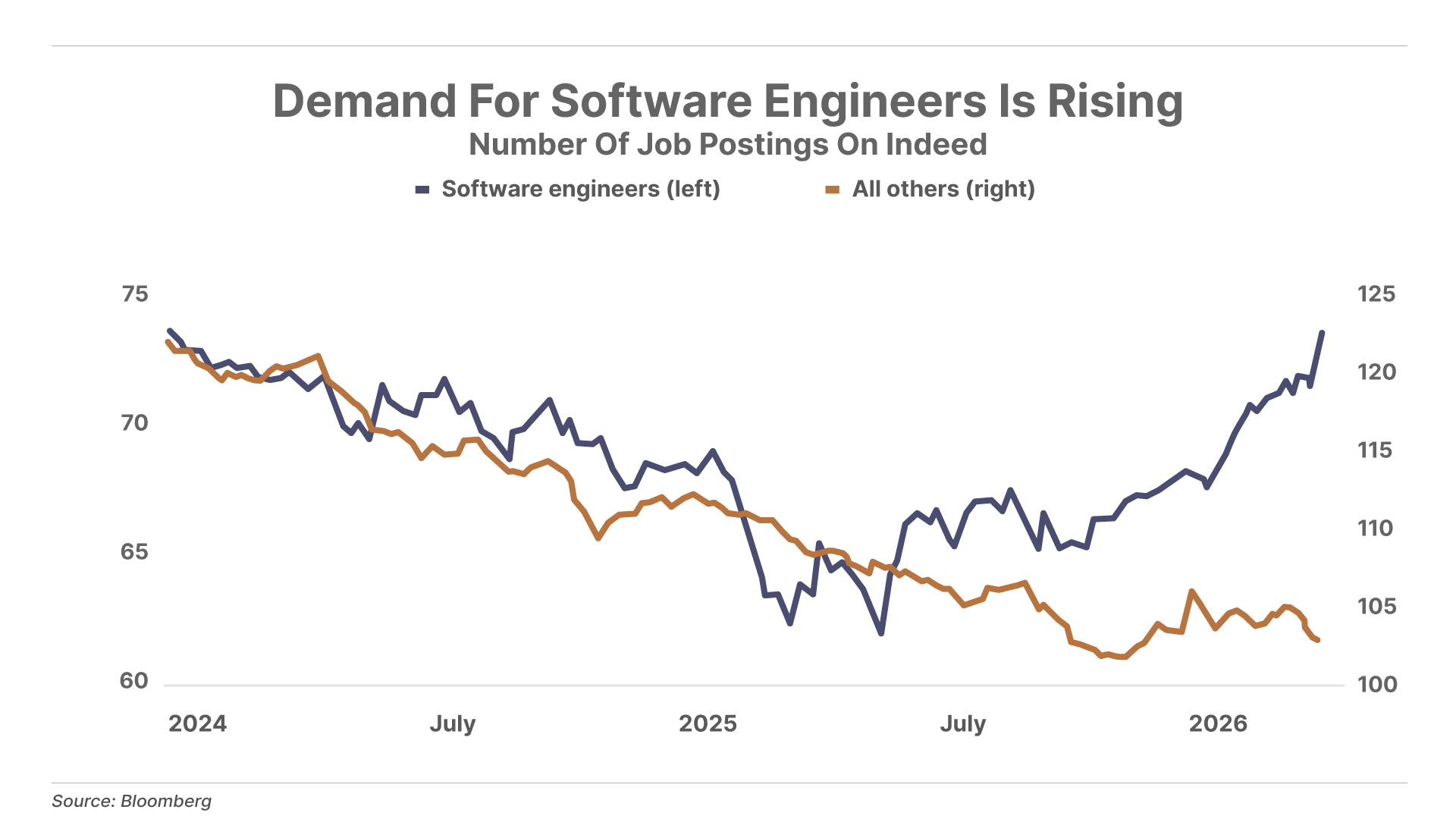
1. AI isn’t killing software jobs. Postings for software engineers on job site Indeed have increased sharply since mid-2025, even as overall labor market postings have fallen, according to data from Citadel Securities and venture capital firm Andreessen Horowitz. Contrary to the bearish narrative, it appears that AI is making developers more productive, enabling companies to build more software and hire more engineers.
2. Celsius soars on stellar earnings. Energy-drink brand Celsius Holdings (CELH) reported blowout Q1 results this morning – revenue jumped 138% year over year to $783 million, while earnings per share increased 128%. And with Celsius’ three brands increasingly dominating shelf space as part of the Pepsi distribution network, they make up a commanding 20.9% market share. The stock rallied 7% today, but trades at just 22x this year’s expected earnings. We see more upside ahead.
3. The debt burden intensifies. Interest payments on personal debt in the U.S. surged to a new all-time high, marking a relentless upward trajectory that has persisted since 2021. Not coincidentally, this rise in the cost of debt service has occurred alongside the first significant structural rise in interest rates since the late 1970s, as consumers grapple with the compounding pressure of elevated borrowing costs and persistent inflationary trends.
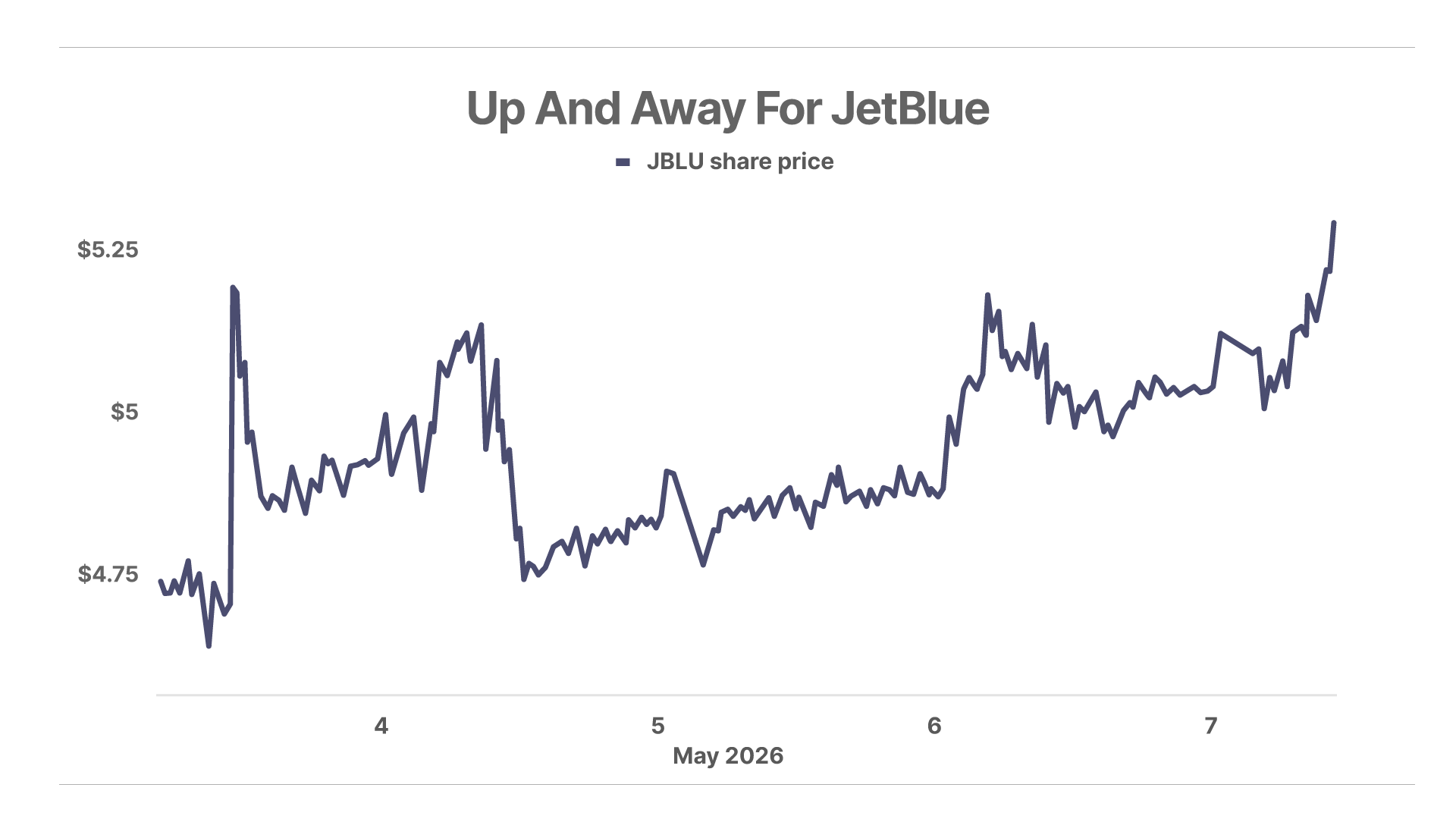
Chart Of The Day… JetBlue Airways (JBLU)
One beneficiary of discount flyer Spirit Airlines shutting down over the weekend is JetBlue Airways (JBLU), which the Distressed Investing team recommended to readers in March 2025. JBLU shares are up 13% this week.
Poll Results
Yesterday, following Porter’s essay “Warren Isn’t A Great Stock Picker,” in which he detailed the real secret behind Buffett’s success in investing, we asked readers: “Will Berkshire Hathaway outperform the S&P 500 in calendar year 2026?”... 85% selected “no.”
Mailbag
“Insider Trading At Venture Global”
Raymond K. writes:
I would be interested in hearing what Porter has to say about the insider sales taking place recently in Venture Global (VG).
Over 18 million shares were sold in the last six months, totaling over $230 million from their top executives. I'm curious as to why the selling has occurred, especially since we started bombing Iran.
Porter Comment: There are lots of reasons insiders sell shares, especially when it’s a very successful company that’s been in development for a decade, like Venture Global. But there’s only one reason insiders buy shares.
“What Is The Risk For Short-Duration T-Bills”
John L. writes:
Marty, Porter…
Hello!
A question about Marty's T-bill collapse essay: I can see how a collapse in demand for T-bills can cause the current market value of longer-dated T-bills (i.e., 26- and 52-week T-bills) to significantly decline. However, what is the risk to the extremely short-term T-bills? With the four-week, six-week, and eight-week T-bills, the holder can simply hold them to maturity. While there is a risk that the dollar itself "collapses," usually what is considered a "collapse" is just a few basis points over the course of four to eight weeks. In fact, for the most extreme recent dollar "collapse," from May 1985 to December 1987, a four-week T-bill holder would have had 18 four-week periods to figure out what to do. So what is the risk for short-duration T-bills?
Porter Comment: The risk in owning T-bills is the loss of purchasing power.
“Feedback And Questions On Porter’s Book 2029: The End Of America”
Chuck H. writes:
Porter,
I just finished reading 2029: The End Of America. As a 64-year-old who just retired in February and rolled over my pension into my Fidelity 401(k) IRA, I can’t tell you how valuable reading this is to me, along with the other great work your team does to help dummies like me protect and grow what wealth I have. I strongly recommend that anyone who is in my shoes, or really anyone, should make this a required read! I have split up my recently rolled over money into the MyWallSt’s Prophet and Nova and a big basket of gold streamers and some gold based on Garrett Goggin’s recommendations in his Golden Portfolio.
So those in total to about 50% of my account, with the other half sitting in cash. I’m on pace to yield 20% this year.
So I am using your work, and it is working well. I’m doing it with my eyes wide open to the risk following your tutelage on how to build a portfolio that reduces beta, considers correlations, and aims to improve my CAPE.
Once again, I can’t thank you and your team enough.
To order a copy of 2029, click here. Meanwhile, Porter is not done with his examination of Warren Buffett and Berkshire Hathaway in the Journal. If you've been following along here about Berkshire's recent troubles, you may be interested in his new book: Warren's Mistakes. This is a book Porter has been writing for 10 years. But the book isn't only about where Berkshire has gone wrong. It's also the most thorough explanation yet published about how Buffett compounded at 24% a year for 50 years. If you want to become a great investor, you must know how he did it – and why it all went wrong. That's exactly what Porter's new book – which will surely become a best-seller – delivers. Get your copy here.
Porter & Co. Market Snapshot
| Price | Yesterday's Return | Year-to-Date Return | |
|---|---|---|---|
| S&P 500 Index | $7,365.12 | 1.46% | 8.0% |
| Gold per ounce | $4,691.36 | 2.88% | 10.0% |
| Bitcoin | $81,421 | -0.28% | -7.5% |
| Oil (West Texas Intermediate) per barrel | $95.08 | -7.42% | 57.7% |
| Berkshire Hathaway (BRK) | $705,940 | 0.85% | -6.5% |
| Porter's Permanent Portfolio | - | 0.80% | -0.3% |
| The Better Than Berkshire Index | - | -0.09% | 1.2% |
| Total Return | Annual Return | ||
| Porter & Co's Top Ranked* | 32.9% | 15.2% | |
| Yield | Yesterday's Change | Change Year-to-Date |
|
| U.S Treasury 30 - Year Yield | 4.94% | -5 bps | 9 bps |
*A Complete Investor risk rating of 1 is defined as a "low risk, high allocation" security, while positions rated closer to a 5 are higher risk. Porter & Co.'s top-ranked positions include those rated either 1 or 2 in Complete Investor portfolio.
Porter & Co. Top Positions
| Publication | Ticker | Description | Total Return |
|---|---|---|---|
| Complete Investor | BWXT | BWX Technologies | 276% |
| Tech Frontiers | QURE | uniQure | 237% |
| Complete Investor | BTC/USD | Bitcoin | 201% |
| Tech Frontiers | SGMT | Sagimet Biosciences | 155% |
| Tech Frontiers | QURE | uniQure | 131% |
| Tech Frontiers | ROIV | Roivant Sciences | 128% |
| Tech Frontiers | TGTX | TG Therapeutics | 120% |
| Complete Investor | PM | Philip Morris | 113% |
| Tech Frontiers | SGMT | Sagimet Biosciences | 105% |
| Distressed Investing | HLF | Herbalife | 102% |
Prices as of 4:00 pm ET May 6, 2026
Please note: The investments in our “Porter & Co. Top Positions” should not be considered current recommendations. These positions are the best performers across our publications – and the securities listed may (or may not) be above the current buy-up-to price. To learn more, visit the current recommendations page of the relevant service, here. To gain access or to learn more about our current recommendations, call our Customer Care team at 888-610-8895 or internationally at +1 443-815-4447.