Bad Government Policy Led To Bad Capital Allocation In The Theater Business
Inside Today's Issue
- Essay: When The Super-Mega Multiplex Got Way Too Big
- Oil Higher For Longer?
- Giving Stocks To Kids
- More Home Repos
- Chart Of The Day… Herbalife (HLF)
- Today’s Mailbag
Editor’s note: Today, Porter turns the Daily Journal over to his colleague, Distressed Investing analyst Marty Fridson. Marty spent years at leading firms like Salomon Brothers, Morgan Stanley, and Merrill Lynch. He’s also reviewed mass-market films about finance – such as The Big Short and Margin Call – for Barron’s.
Here’s Marty…
Can we have too many movie theaters?
Well, the answer is yes, and here’s a story of why that is the case and what the consequences are to the industry and the economy as a whole.
The story begins with a term called malinvestment. When capital gets massively allocated to unproductive projects, it’s a case of malinvestment. It’s the economic equivalent of a 15-yard penalty in football that puts the team out of field-goal range when it’s down by two points with just 30 seconds left on the clock. You were so close, then one little mistake put you so far away.
Malinvestment doesn’t happen by accident. It requires a big-time government screwup. For example, the Fed might keep interest rates below their natural market level. Or the U.S. Congress could create subsidies, provide loan guarantees, or for political reasons try to steer investment toward chosen sectors. Whatever the specific trigger, incautious investors wind up getting a big portion of their net worth blown away.
I’m not talking about certain behaviors that appear self-destructive at first glance. For instance, venture capitalists (“VC”) expect that 75% of the startups they invest in will never return any cash. They figure on losing 100% of their money on about one-third of their endeavors. But upon closer examination, VCs are acting rationally. They earn highly attractive returns – 10x to 1,000x their capital outlay – on around 10% of their investments. These huge gains offset their losses on the vast majority of their deals.
Ill-advised government behavior – such as artificially low interest rates – allows for objectively irrational activity, even without the benefit of hindsight. A classic case is the colossal overinvestment in movie-theater construction in the 1990s.
Spectacular boom/busts in dot-coms and early-stage telecoms in the same years received far more media attention. But between 1990 and 2000, the total number of movie screens in the United States increased 52% while the U.S. population grew just 14%.
How They Got Carried Away
The theater-construction frenzy wiped away the notion of a single-screen movie house as being economically viable. Progressing from miniplexes with up to seven screens, the chains started building megaplexes containing 16 screens. Rival operators sometimes erected such supersized entertainment centers in close proximity to one another, in one case just a football field’s distance apart.
The underlying cause of the movie theater overbuilding was the Fed’s unwillingness to rein in rampant speculation by raising interest rates. In the movie-exhibition business, irrational exuberance took the form of ignoring a long-established and well-founded industry rule-of-thumb: one screen per 10,000 people in the U.S. population. Incredibly, because of cheap money, lenders continued financing new construction even when the screen count reached a level 30% above that threshold.
When asked if they were perhaps getting carried away, the exhibitors explained that the new-style theaters would radically increase movie attendance. The magnificent facilities included such amenities as stadium-style seating (rows of seats on separate, elevated platforms) and armrests with built-in cupholders. Being in them was such a wonderful experience, exhibitors argued, that families would just decide to spend an evening at the megaplex. They wouldn’t even choose which movie to see until they got there. With as many as 24 films to pick from, they were guaranteed to find something that appealed to them.
What Happened As A Result
Things didn’t work out according to the industry’s rosy projections. As a consequence of the overexpansion, four of the six largest cinema chains filed for bankruptcy in 2000-2001 – Carmike Cinemas (CKEC), Loews Cineplex (LCP), Regal Entertainment (RGC), and United Artists. Smaller players such as General Cinema, Edwards, and Silver Cinema also went bust. One market leader that didn’t become insolvent during the bloodbath was AMC Entertainment (AMC), a current Porter & Co. Distressed Investing recommendation.
Compounding the woes of lenders who had participated in the excesses was the massive difficulty and expense of converting abandoned megaplex theaters to other uses. This meant their collateral was essentially worthless. Office buildings can become apartments, but the configuration of a multiplex does not allow for an easy transformation.
Motion picture exhibitors’ continued access to additional capital despite their defiance of longstanding industry capacity guidelines arose partly from a popular myth about the movie business. According to this longstanding canard, movies are immune to recessions. Attendance, it’s claimed, actually rose during the Great Depression of the 1930s because people flocked to fantasy-laden film musicals as a form of escapism.
Persistence of the fable that movies are recession-proof has helped the industry obtain favorable financing terms, but here’s the inconvenient reality: Studios and exhibitors in aggregate started to gush red ink in 1932. By the end of 1933, one-third of all movie theaters had shut down. Among the leading Hollywood studios, Paramount, RKO, and Universal were all in bankruptcy or receivership.
The lesson for debt investors is that financial facts matter more than stories passed down by alleged authorities.
Recounting this historical episode is sure to raise questions in investors’ minds about today’s hyperscale construction of data centers. One key difference is that unlike the movie-exhibition industry, for which there were decades of experience by which to judge capacity requirements, there’s no surefire way to determine how much computing power the artificial intelligence revolution will ultimately need. Also, with bond yields up substantially over the past month-and-a-half, it isn’t obvious that the excessively low interest rates are currently fueling overbuilding.
In any case, though, it’s valuable to understand the genuine lessons of financial history. That’s the secret sauce of some of the world’s most successful investors.
Martin Fridson
New York, New York
Tell us what you think of today’s Daily Journal: porterstansberrydirect@gmail.com
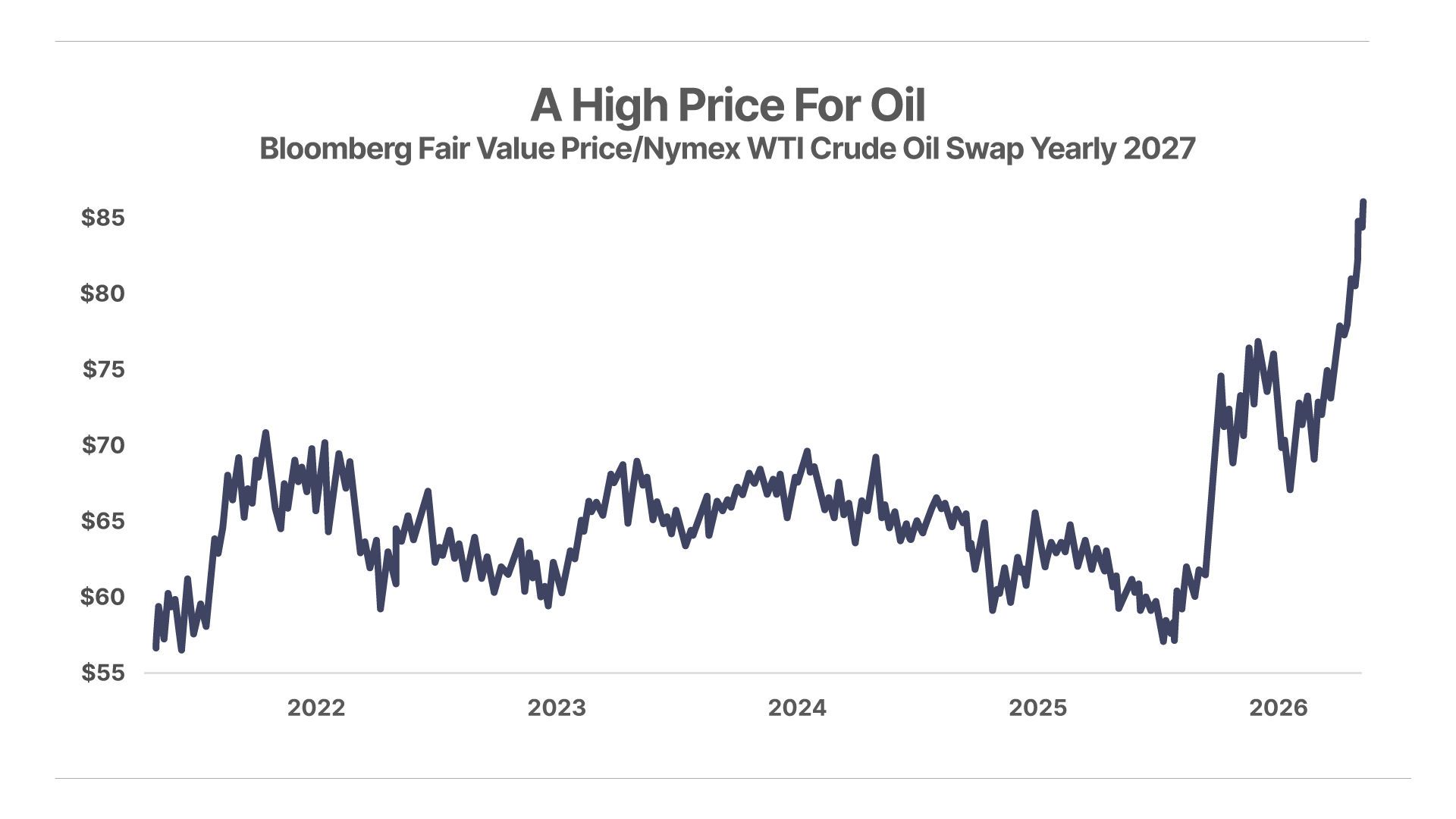
1. Oil traders now expect high prices to outlast the current supply shock. The 2027 WTI swap, a contract that fixes the average price of crude oil delivered across all of next year, jumped to $86 a barrel last week – up from $57 in January. That is its highest level in at least five years. Short-lived disruptions mostly lift prices for immediate delivery. When oil for delivery a year or more out rises this much, it suggests traders are expecting a more protracted supply deficit.
2. Elon Musk promises to give a SpaceX (SPCX) share to every child in America. The rocket company founder announced early this morning that the gift – worth about $10.5 billion at Friday’s close – will come next year and will be “the first of many.” Bloomberg analyst Eric Balchunas believes this type of stock donation to “Trump accounts” could help close the wealth gap. The shares give children a stake in the same compounding that built billionaire fortunes, and a reason to learn how markets work. The gift's full value also reaches the child, with no charity overhead and no capital gains tax for the donor.
3. Banks are taking back homes faster than borrowers are falling behind. Lenders repossessed 5,794 U.S. homes, up more than 42% from a year ago. Today's level is half of pre-pandemic levels – in August 2019, there were 11,493 repossessions. These aren’t recessionary numbers – volumes still remain low in absolute terms – but the trend shows that more homeowners are running out of time to sell before the bank does it for them, and more bank-owned inventory is hitting the market.
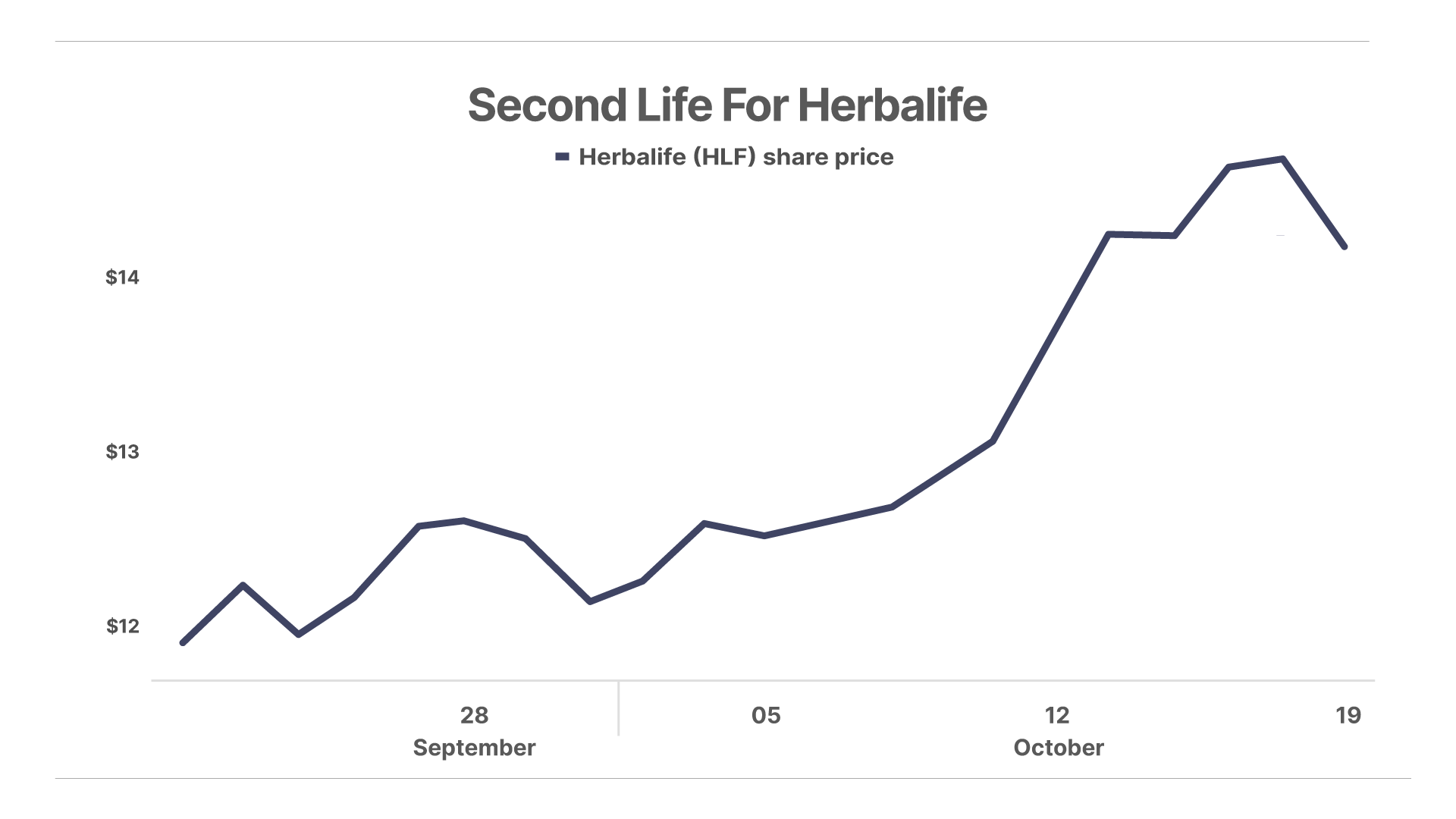
Shares of Herbalife (HLF) have risen nearly 20% over the last month and now sit above the buy-up-to price for Porter & Co’s Distressed Investing subscribers. It’s the second time Marty Fridson has recommended shares of the health-supplement maker. Last year, the stock rose more than 100% after the release of the June 2025 Distressed Investing report.
“Question About McDonald’s”
David H. writes:
I found your recent inflation status and warning articles this week to be very informative. I have also read and am implementing strategies from your book 2029: The End Of America.
I have one question: Why isn't McDonald’s in Porter’s Permanent Portfolio or the PCPP ETF?
Thanks for your insights.
Porter Comment: David –
Because at the time I built those portfolios and / or rebalanced them, McDonald’s (MCD) was trading at a price I believed would lead to poor future results.
A good investment requires both a great business and a reasonable price.
A useful mental model for you to understand this concept is to assume that a high-quality, mature business like McDonald’s will earn future returns that are roughly equal to its earnings per share growth rate (say 8%) plus its current shareholder yield. McDonald’s pays out 100% of its free cash flow over time, and current free cash flow yield is around 4.5%. As the price declines and the free cash flow yield improves, your annual future returns improve substantially.
And, over a decade, those differences become quite large. At its peak share price, McDonald’s was likely only going to compound capital at 6% to 8% a year. Not bad – but probably not market beating. Today, it’s likely to compound capital at 10%+ a year, which I suspect will be market beating.
Hope that helps!
Regards,
Porter