The Factors That Make Up This Measure Of Volatility
Inside Today's Issue
Editor’s note: With the market entering a period of volatility, we turn to Distressed Investing analyst Andrew Lipman to explain the movements of the VIX – the Volatility Index that all market watchers follow in times like these.
Wishing all of our readers a very Happy Thanksgiving. The Daily Journal will return on Friday.
Here’s Andy…
When stock markets get tumultuous, talk of the VIX kicks in…
Created by the Chicago Board Options Exchange, the Volatility Index (VIX) rises when investors worry about sharp market declines and falls when that level of concern subsides.
Launched in 1990, the VIX is a composite based on the trading price of stock options (puts and calls) on U.S. exchanges.
So what goes into the VIX mix? For reasons that include tax considerations and psychological factors like ego, investors find it harder to sell securities than to buy them. Shorting stocks is tricky and risky, and institutional investors have significant built-in advantages. As a result, investors sometimes turn to options for downside protection.
Options premiums are derived from five main variables that get run through the Black-Scholes pricing model. Three of the factors are intuitive: the current stock price, the strike price – the level at which the share can be purchased (calls) or sold (puts) – and the time until expiration. Because options have some embedded, loan-like traits, the fourth variable is the interest rate on U.S. Treasury bills maturing around the same time as the option.
The fifth and very significant factor is implied volatility, which is the market’s estimate of how much the value of the optioned stock can rise or fall through the expiration date. This is the factor that drives movements in the VIX. The implied volatility and options premiums ultimately decline – often as rapidly as they rose – as the fear eventually subsides. Curiously, they do not move nearly as much when the market is roaring.
The value of the VIX is derived from a weighted average of prices of “out of the money” options – those where the stock trades below a call’s strike price or above a put’s strike price. Said otherwise, the VIX looks at pure option value. The formula weighs options trading closest to their strike price most heavily.
The real-time value is available on most trading systems under the symbol VIX. Investors can trade it using futures, options, and ETFs.
Historic Trading Range
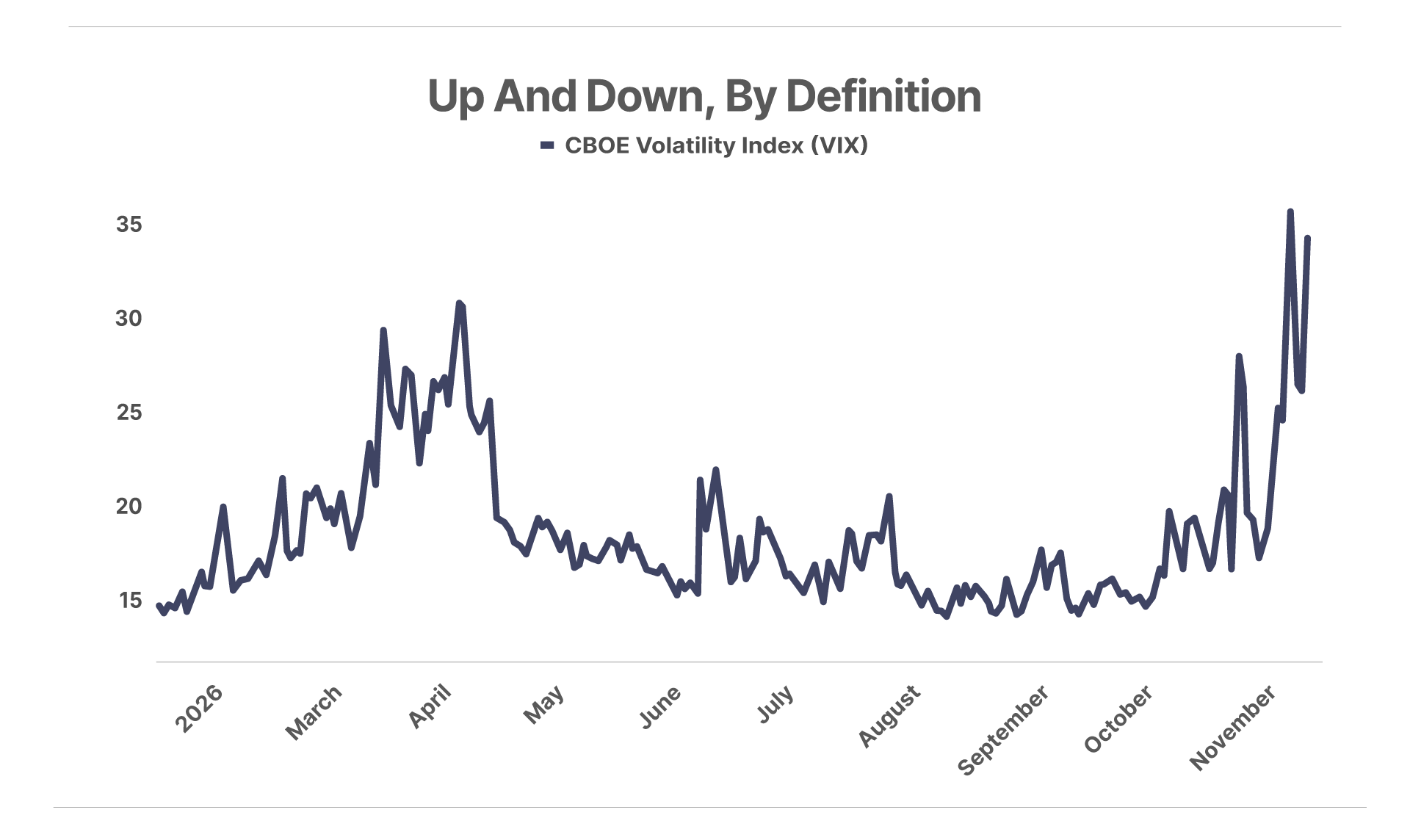
Over the last month – partly aided by the fall and rise of Nvidia (NVDA) CEO Jensen Huang – the VIX index has been extremely volatile. It hit a low of 16.3 on October 29 and a high of 38.2 during the tumultuous trading on Friday, November 20. This week it has traded as low as 27.0 and is currently around 35.
The two highest peaks during the period were tied to the greatest economic crises:
- The VIX topped out at 89.5 in 2008, during the market panic related to the Great Financial Crisis
- The index hit 82.7 at the start of the pandemic in 2020, when the fear of a gaping economic decline and massive pandemic-related unemployment were at its greatest
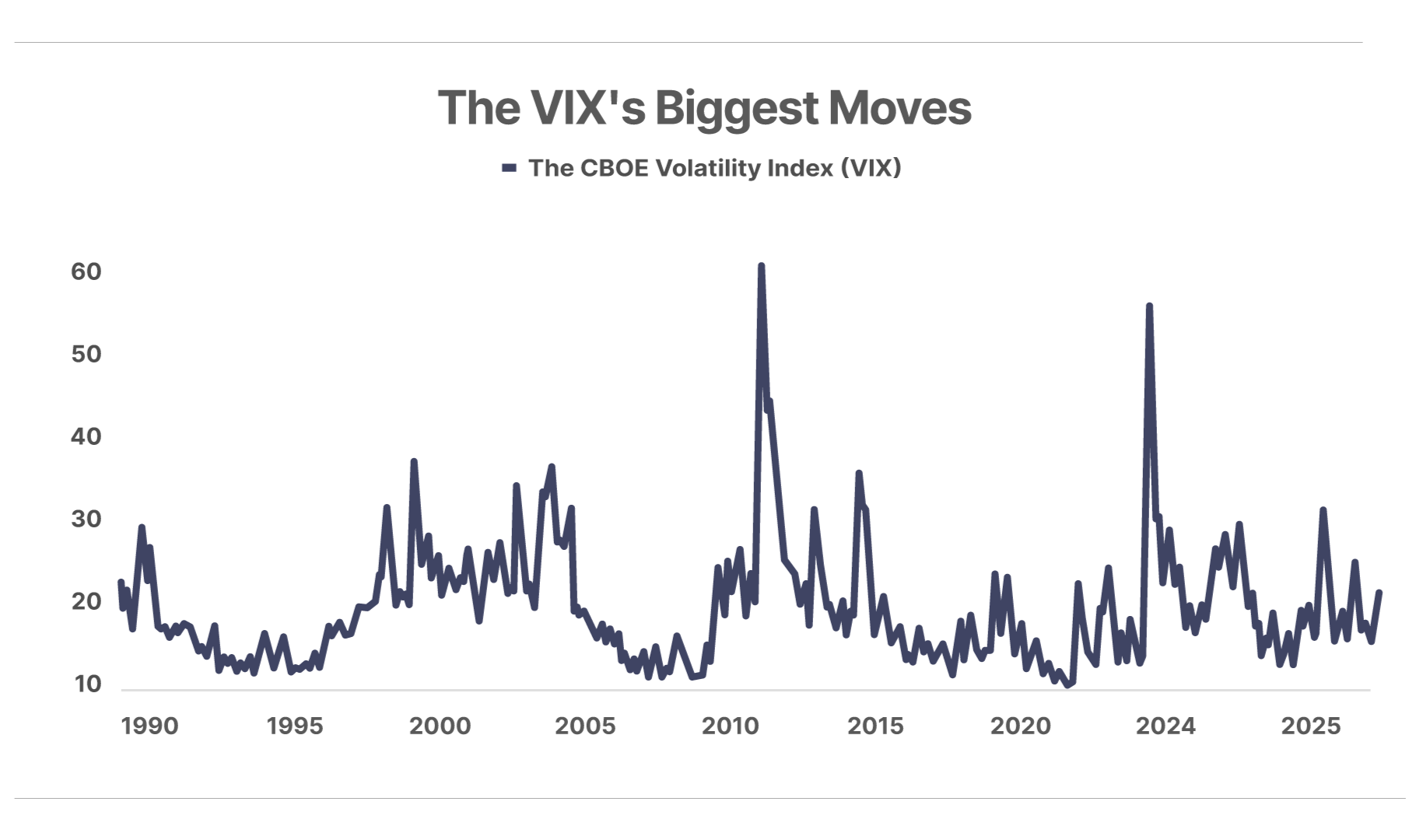
Not all the sharp increases in the VIX have signaled hard economic times to come. In retrospect, we can see that numerous, less extreme spikes were tied to events that triggered short-lived and/or modest declines – in the context of a longer-term bull market. Examples of these “false positives” include:
- The 36-minute “Flash Crash” in May 2010, when the Dow Jones Industrial Average fell 9% and the VIX hit 45.8
- Standard & Poor’s downgrade of U.S. Treasury debt from AAA to AA+ in August 2011, when the stock averages fell about 6% and the VIX hit 48
- When China devalued its currency in 2015, the markets fell about 11% over two weeks and the VIX rose to 53.3
- Spiking inflation and steps by the Federal Reserve Bank to raise interest rates in August 2022 led the markets to fall nearly 5% and the VIX to hit 45.1
- In August 2024 an increase in Japanese interest rates – which triggered the unwinding of “carry trades” in U.S. stocks – caused the VIX to hit 65.7
- The institution of tariffs in April 2025 led the markets to fall 11% over three days and the VIX to top out at 60.1
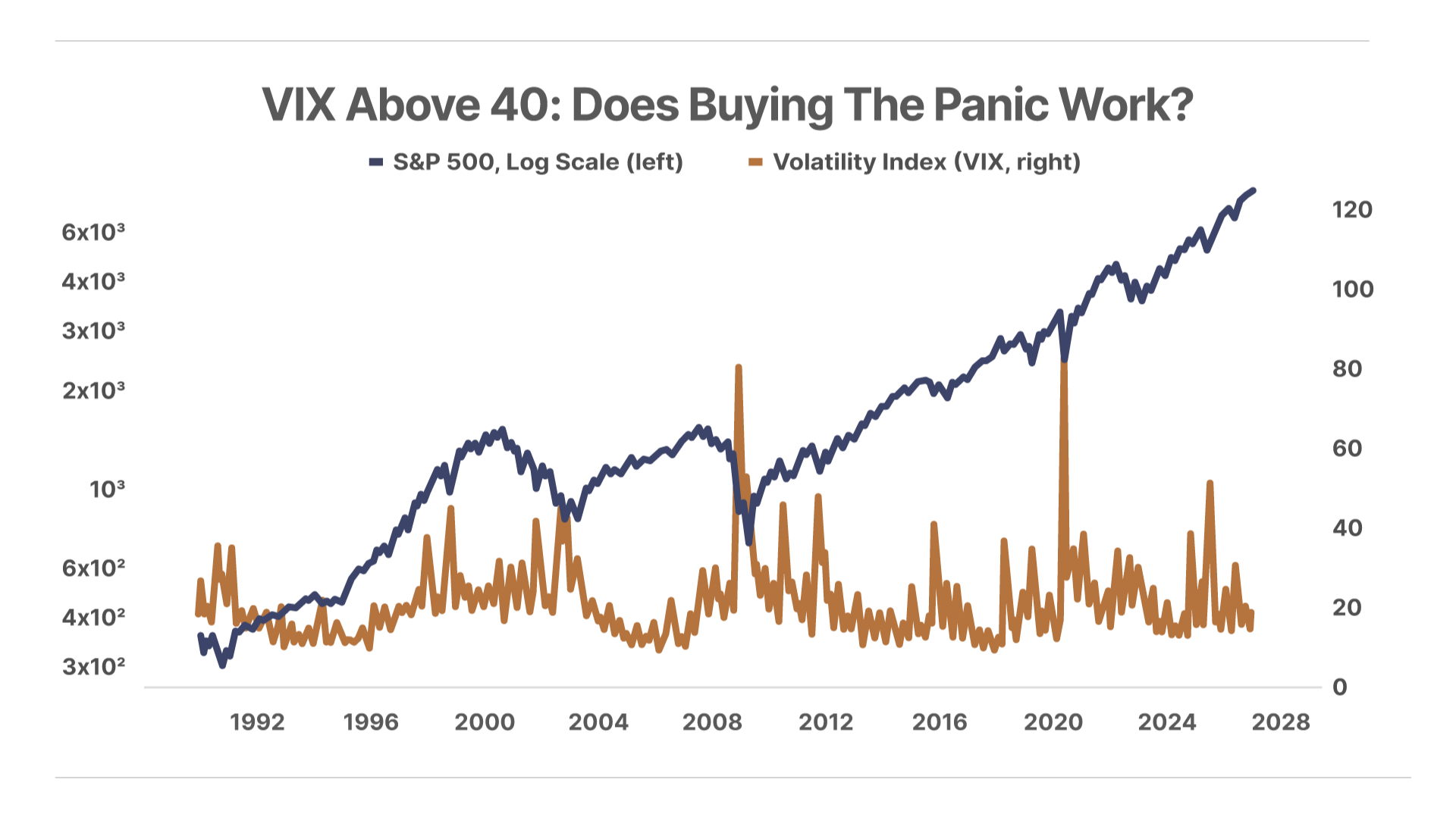
The VIX has proven to be a useful but imperfect indicator for signaling market vulnerability. Though opinions vary, the consensus is that trading strategies tied to the VIX – for instance, buying whenever it hits a particular level – have trailed those generated from “buy and hold” strategies over the long term.
What this chart seems to show is that the VIX identified the biggest declines, but over the long term, “buy and hold” wins.
Tell us what you think of the Daily Journal: porterstansberrydirect@gmail.com
Andrew Lipman
Southampton, New York
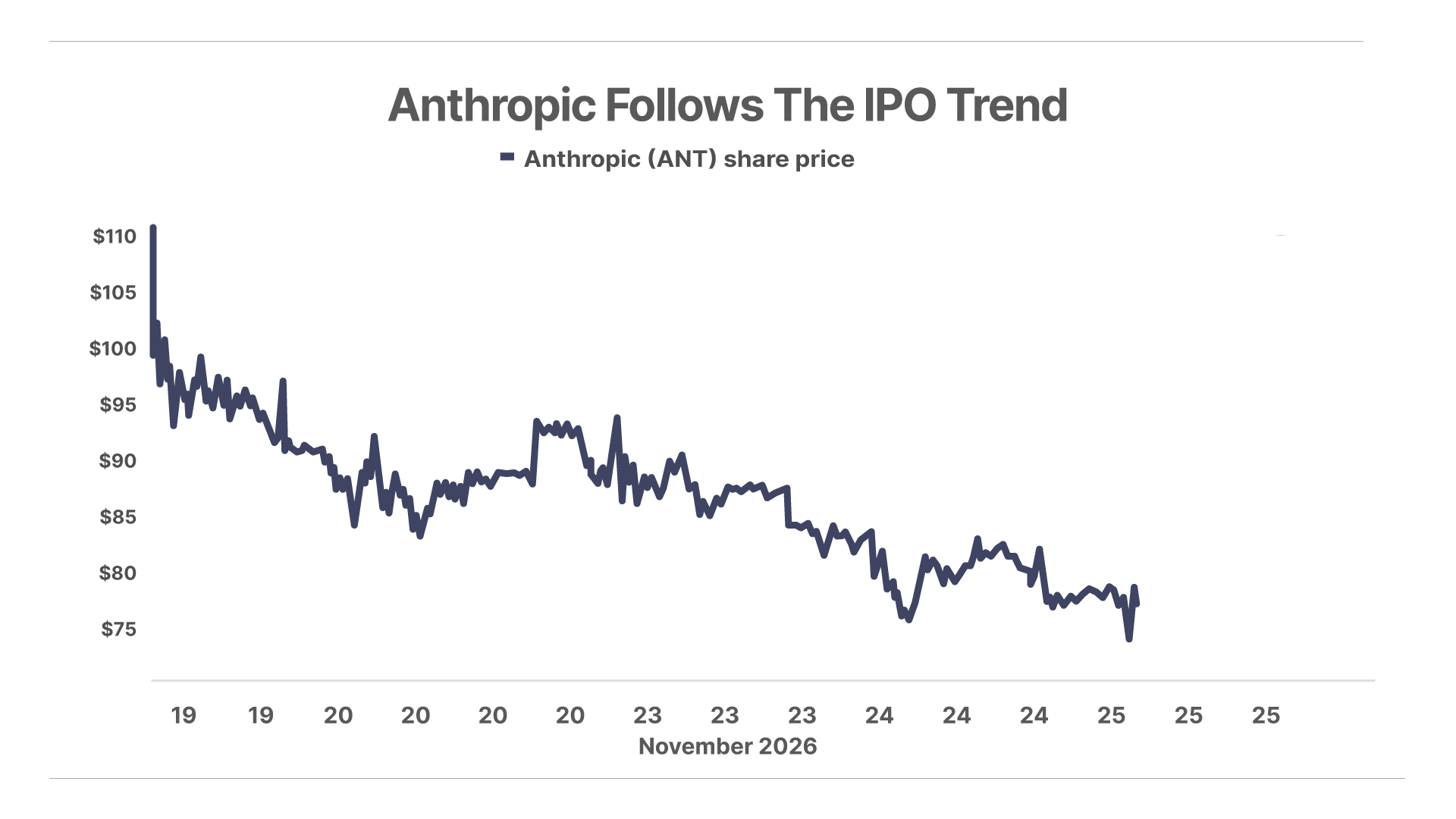
1. Silver's sell-off has hit a rare extreme. Near $41 an ounce, silver trades about 40% below its 200-day moving average, its average price over roughly the past 10 months. That has happened only three other times since 1966, and silver bottomed within eight days each time. In 1980, it more than doubled within four months. In 1981, it gained 37% in three months. And after 2008, it rose more than fivefold over the next two and a half years. 2. Capital for data-center construction is drying up. Europe’s ING bank is shopping for offers on a $500 million package of data-center bonds, while Société Générale is searching for buyers on $300 million in Oracle-related project debt. HSBC recently sold $300 million in loans linked to OpenAI’s Stargate project at a 15% haircut from face value. 3. Heading into Thanksgiving, food prices are rising sharply. Skirt steak costs 33.3% more than a year ago and red potatoes heated up 29.9% more, according to the Bloomberg Price Index – and the broader numbers are moving the same way. The Federal Reserve's preferred inflation gauge, the personal consumption expenditures ("PCE") price index, was up 3.8% in October from a year earlier, compared with 3.6% in September. Futures markets now price in a 95% chance that the Fed raises rates at its December 9 meeting. Anthropic (ANT) priced its IPO at $83 per share on November 18, opened at $111.50 the next morning, and traded near $77 today, 31% below the first trade and 7% below the offer. As we wrote on August 4 in "Mr. IPO's Two Laws," the first-day pop goes to institutions with allocations, and new issues tend to underperform the first year. Of course, it could also be a sign that the AI trade is unraveling. Yesterday we asked Journal readers where they thought shares of giant chipmaker Nvidia (NVDA) would be trading in six months – on May 28, 2027. Survey takers are bullish on the stock, it seems… 47% believe shares will be higher by 20% or more, while 27% expect NVDA shares to be 20% or more lower, and the final 27% expect little change in the share price. In yesterday’s Journal, Porter wrote that most people will never lose a billion dollars, like he did. But everyone suffers big setbacks. So in his essay, Porter asked… What if you could go back and do it all again? What if you could build a real Second Life? Rodger M. writes: I was a money manager running billions. Then the chair of the insurance company told the CIO to cut the budget and my entire division was fired. No job with six kids. But I realize the only way I would figure out my job was not who I am was to have it taken away. Fast forward – I have two beautiful grandchildren, have been retired for one year plus, and get to help people one on one behind the scenes. Tim J. writes: Thanks for sharing your personal story. I am so glad I found your writings. I bought my first stock when I was 17 in 1982. My uncle took me to the broker since I wasn’t 18 yet. It was Wendy’s. I used $1,400 of my earned dollars and sold two months later for $1,600. That’s gross. The broker got $50 each way, and I got $100. Christopher R. writes: Happy Thanksgiving!!! George W. writes: Well, Porter, I'm not sure I've heard a more amazing story of survival. Though I haven't been a "partner" at Stansberry, or Porter & Co., I've respected your thoughts and recommendations for years. Your recent talk at the Money Conference was great, and after listening to Felix Zulauf recently, the two of you have confirmed for me the direction of the next few years. Just wanted to let you know you're greatly appreciated. Quite a mind! Frank S. writes: Happy Thanksgiving to you and your family. You shared a lot of information and I knew a little bit. I did not realize all that you have suffered and lost. Mike H. writes: Porter: I read your essay on thankfulness. On one hand, I do believe you are very grateful and thankful. You have learned from your situations and have made the necessary changes. Everything seems to be working well for you and I am very happy for you and your family. David R. writes: Porter, John S. sent a card. Click here to view. 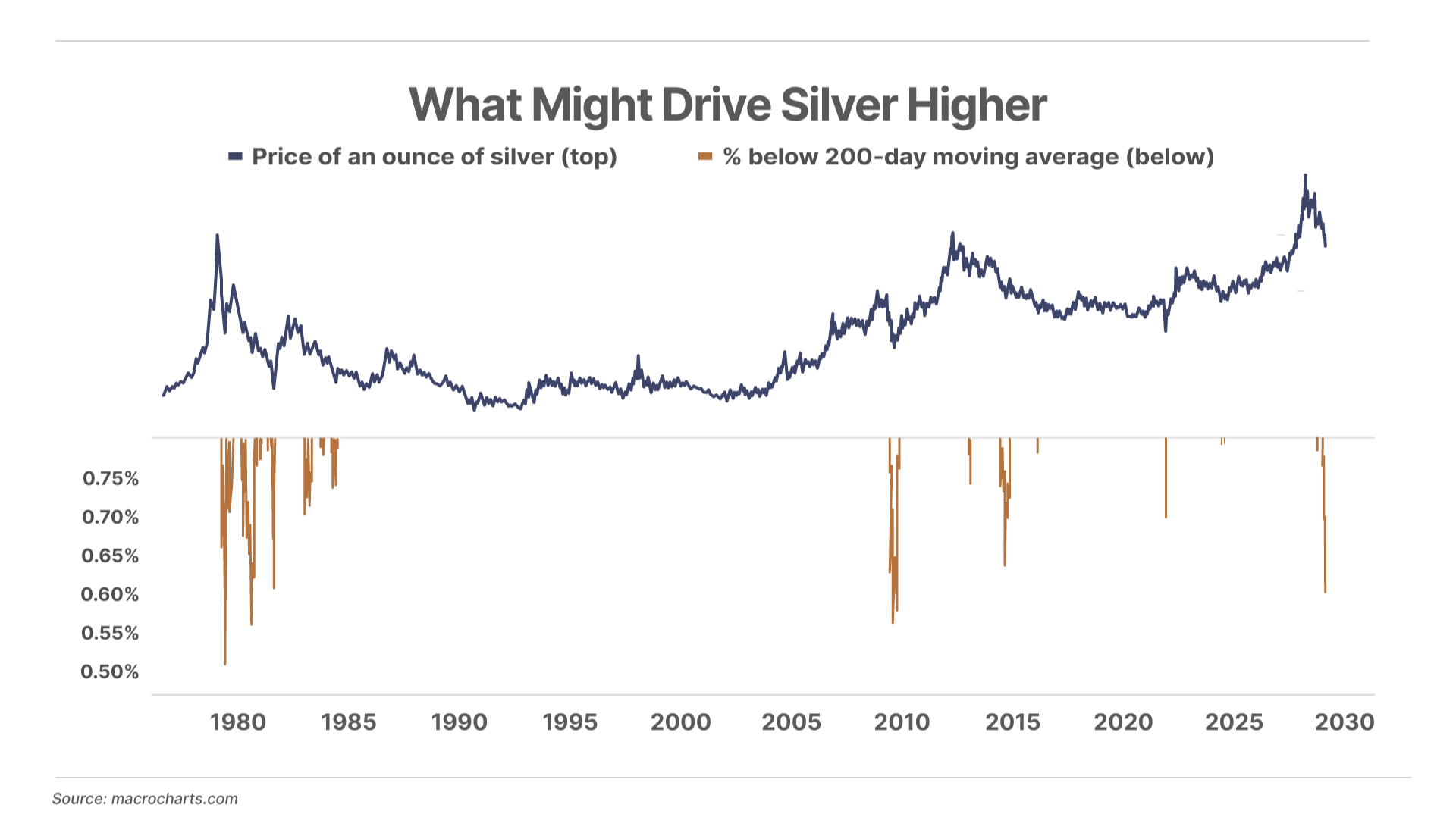
Poll Results – Nvidia (NVDA) Share Price
“Life Is Good – Enjoy It”
Life is so good – enjoy it!
I’m buying for the long term now and commissions are a dab smaller.
My personal story is less dramatic than yours, but it involves bouts of depression, not wanting to live, and eventual divorce 20 years ago.
I too am living my Happiest Most Thankful Second Life. I couldn’t be happier as I am at Dad’s waiting for my 32-year-old daughter and 30-year-old son and their partners to come for the big family PAR TAY.
Have a great Thanksgiving. And of course we both have a grasp on the reason for the season.
I’ll keep reading and learning and acting based on your and your team’s work.
Wow… did not realize how bad things had gotten for you... God bless.... your story sounds inspiring and also something of a novel for those of us who are Porter fans… Please enjoy the holiday and keep sharing your and your team’s hard work.
Anyway, all the best and enjoy your second life!
I have been a Stansberry Research member since around the year 2000.
I also have a Partner Pass with Porter & Co.
Between both of your companies I have made money to be able to take my wife to Hawaii for the first time. Attend the 80th anniversary of the D-Day invasion in 2024 in Normandy, France, to honor my father who was on that beach, and to take my first cruise ever in 2022 – the Viking River Cruise on the Rhine River in Germany.
My father was in WWII from 1940-1945 and was in every battle right to end at the Battle of the Bulge. He was a MP in the Army and rifleman in the Big Red One division. First in Battle. He came back with Shell Shock (PTSD). It upsets me hearing and seeing Democratic Socialist Communist winning election with the intent of changing the values of this country.
With two small grandsons, I plan to leave my son, their father, money for their future education and a head start in life.
At almost 76 years old, I am still learning.
Thank you for all you do and God Bless.
Kind Regards.
On the other hand, every time I read an essay like this from you it does not mention God. All of these things that have happened to you are a result of our creator. Do you have a spiritual life? Are you going to church? I believe those to be the foundations of life. After all, all of us will have a real second life after we die and wealth and status will not be important. I will say my prayers for you. Keep up the good work.
Thank you for sharing your story. In the late spring of 2022, I suddenly had a bout of AFIB (never had this before) and spent a night in the hospital. While there they ran some tests and sent me to a cardiologist who drew me a picture of a major blocked artery he called a widow maker. He said I could drop dead anytime. A week later my wife announced she wanted a divorce and ultimately left with half of our assets (that I had saved to retire). I was 69 years old and facing the same three horsemen with no idea what I should or even could do.
Porter & Co. Market Snapshot
Through Tuesday, November 24, 2026 close
Markets
Index or asset
Last
1-Day
YTD
1-Year
718.78
−0.49%
+6.2%
+8.6%
$3,561.90
−2.45%
−17.9%
−13.0%
$59,694.00
−2.38%
−31.8%
−33.0%
$82.05
+2.35%
+42.9%
+39.4%
$865,490.00
+0.73%
+14.7%
+13.4%
U.S. Treasury yields
Maturity
Yield
1-Day
YTD
1-Year
4.63%
0 bps
+116 bps
+117 bps
4.91%
−1 bps
+73 bps
+87 bps
5.30%
+1 bps
+46 bps
+62 bps
Porter & Co. strategies
Strategy
1-Day
YTD
Since start
Per year
+0.99%
+4.3%
+31.6%
+13.5%
+1.30%
+2.2%
+2.5%
+1.6%
−0.01%
+1.2%
+23.7%
+8.2%
Porter & Co. Top Positions
Through Tuesday, November 24, 2026 close
#
Position
Total return
1
+273%
2
+270%
3
+266%
4
+163%
5
+151%
6
+131%
7
+130%
8
+121%
9
+103%
10
+103%