Issue #54, Volume #3


Nothing Beats Contractual Cash Flows During A War
Inside today's Daily Journal…
|
Remember: the first casualty of any war is the truth.
In time, we’ll learn that nothing the government has told us about the war with Iran was honest. Nothing. Not the reasons for the war. Not the battles in the war. Not the three dozen times that President Donald Trump has claimed victory.
What is certain are the size of the various economies that haven’t received any additional crude feedstock from the Persian Gulf for more than 30 days, countries with billions of people in total that are going to run out of diesel.
But, so far, our stock market has remained mostly immune to the risk that this war escalates and has massive impacts on the global economy.
Since the United States and Israel launched Operation Epic Fury on February 28, the S&P 500 is off less than 1%.
I am virtually certain this false calm will not last.
Iran's 92 million people, its control of the Strait Of Hormuz, and its ballistic missile reach across the Persian Gulf are permanent risks that are not going away – despite what Trump will surely claim in his next post. And these risks are not “priced into” the market yet.
We’re investors – not generals. Our job is to help you make money in the stock market – even when a war in the Persian Gulf makes that a lot harder than normal. So far, many of the traditional safe havens, like gold, have actually traded lower on “risk off” days in the market.
The best-performing stocks in the S&P 500 have been concentrated in two narrow themes, both tied to the insatiable demand for artificial intelligence (“AI”) infrastructure.
-
Sandisk (SNDK), the flash memory pure-play, has been the most spectacular performer in the S&P 500 – up 282% year-to-date (“YTD”)
-
Ciena (CIEN), the optical networking company whose coherent optics technology underpins the ultra-high-speed data links connecting hyperscale data centers, has gained 106%
-
Corning (GLW), whose optical fiber and specialty glass sit at the physical layer of every major AI buildout, is up 98%
These are the picks-and-shovels beneficiaries of a structural capex cycle that has proven remarkably indifferent to geopolitics. But they are also volatile, richly valued, and offer no income.
Ciena trades at 303x earnings. Corning's P/E sits at 95. Sandisk is not yet profitable on a GAAP basis.
Could you trade these names? Maybe.
But that’s a game where we have no edge. For investors seeking durable cash flows rather than momentum, the war has clarified a different opportunity: Pharma.
Pharmaceutical companies generate revenue from patent-protected drugs purchased by hospitals and patients regardless of oil prices, shipping-lane disruptions, or whether a ceasefire holds in the Gulf. Their cash flows are contractual, recurring, and driven by medical necessity – not discretionary spending.
Here are three stocks that I believe will outperform the S&P 500 this year and provide your portfolio with some low volatility “shade.”
-
Novartis (NVS) is up 11.5% YTD, quietly compounding while the broader market whipsaws. The Swiss giant reported Q4 2025 earnings of $2.03 per share (“EPS”), beating consensus by $0.04 on $13.9 billion in revenue. Growth is being led by Kisqali in oncology (up 65% year-over-year), Cosentyx in immunology, and the rollout of its radioligand therapy platform. Analysts expect $8.45 in 2026 EPS, rising to roughly $9.70 in 2027. At 21.5x earnings with a 2% dividend yield, a return on equity north of 40%, and zero meaningful exposure to Middle Eastern supply chains, Novartis offers the kind of boring predictability that becomes precious when the world is not boring at all.
-
Merck (MRK) is up 14.5% YTD and trades at 16.6x earnings – inexpensive by any measure for a company generating $121 billion in net revenue with Keytruda, the world's best-selling cancer drug, which is still growing. The pipeline behind Keytruda includes the Moderna partnership on personalized cancer vaccine mRNA-4157, which showed a sustained 49% reduction in melanoma recurrence in five-year follow-up data released in January. With $7.28 in trailing EPS, a 3% dividend yield, and multiple near-term catalysts, Merck is both a value and a growth story sheltered from war risk.
-
And, there’s this “Lindy” stalwart – Johnson & Johnson (JNJ). J&J is the canonical defensive compounder: up 14.7% YTD, trading at 21.5x earnings with a 2% yield. Following its spin-off of Kenvue, J&J is now a pure pharmaceutical and medtech company with $95 billion in revenue and a diversified portfolio spanning immunology (Tremfya, Darzalex), oncology (Erleada), and surgical robotics. The balance sheet is among the strongest in the S&P 500. In a market defined by anxiety, J&J is the stock you own and forget about.
If you want to move a little further out on the risk curve, there’s another pharma name you should get to know… Royalty Pharma (RPRX) may be the single most compelling large-cap pharma business in America. It’s up 25% YTD because it operates a business model that is structurally designed to thrive in precisely this kind of environment. The company does not discover drugs, manufacture them, run clinical trials, or sell them. It buys royalties.
It purchases contractual rights to a percentage of future sales on approved and late-stage drugs, then collects cash as those therapies grow. No factories. No sales force. No supply-chain exposure to the Strait of Hormuz. And only 75 employees.
It owns royalties on more than 35 drugs, which produced over $3 billion in revenue last year. The portfolio spans oncology, immunology, rare disease, neuroscience, respiratory, hematology, and cardiology, including royalties on: Trikafta/Alyftrek, Trelegy, Tysabri, Evrysdi, Xtandi, Tremfya, Imbruvica, and 30 other drugs.
No single drug company's success or failure determines its fate.
Its customers? The richest global pharma companies. Vertex Pharmaceuticals (VRTX), GSK (GSK), Biogen (BIIB), Roche (RHHBY), Pfizer (PFE), J&J (JNJ), AbbVie (ABBV), Novartis (NVS), and Servier are all writing checks to Royalty Pharma every quarter. The diversification is not across three or four blockbusters – it’s across the entire pharmaceutical industry.
Yes, of course, these drugs all face patent “cliffs.” But that’s part of the business. Royalty Pharma deployed $2.6 billion in new royalty acquisitions in 2025 alone, adding nine new therapies to its portfolio. Management is guiding for around $3.5 billion in 2026 portfolio receipts.
Its development-stage pipeline, spanning 20 candidates with $43 billion in peak sales potential, includes pivotal 2026 readouts for daraxonrasib (pancreatic cancer, Revolution Medicines), pelacarsen (cardiovascular, Novartis), and litifilimab (lupus, Biogen).
In a market where oil prices can move 20% in a week, where a single Trump statement can send equities surging or crashing, and where the cost of uncertainty has been repriced upward across every asset class, the appeal of Royalty Pharma's model is straightforward.
Contractual cash flows. Royalties are written into licensing agreements. They are based on top-line drug sales, not operating margins that can be squeezed by energy costs or supply-chain disruptions.
Long-time readers know how much we admire the royalty business model. And as you’d expect, Royalty Pharma’s cash conversion is extraordinary – $2.5 billion in operating cash flow on $3.3 billion in portfolio receipts.
Unlike a static bond portfolio that amortizes to zero, Royalty Pharma continuously reinvests in new royalties, extending duration and replacing expiring streams. The company targets at least mid-teens total shareholder return over 2025-2030 and expects portfolio cash flow to reach $4.0 billion by 2030.
The cash flows power huge returns of capital to shareholders – $1.7 billion to shareholders in 2025 through buybacks and dividends, reducing the share count by 5%. The dividend is growing at mid-single digits, with a 7% increase announced for 2026.
The war in Iran has reminded investors of a lesson that bull markets tend to obscure: cash flow quality matters. When the world is uncertain, the market pays a premium for businesses whose revenue is not hostage to commodity prices, trade routes, or consumer confidence.
Tell me what you think: good, bad, or indifferent: porterstansberrydirect@gmail.com
Good investing,
Porter Stansberry
Stevenson, Maryland
Presented by New Constructs
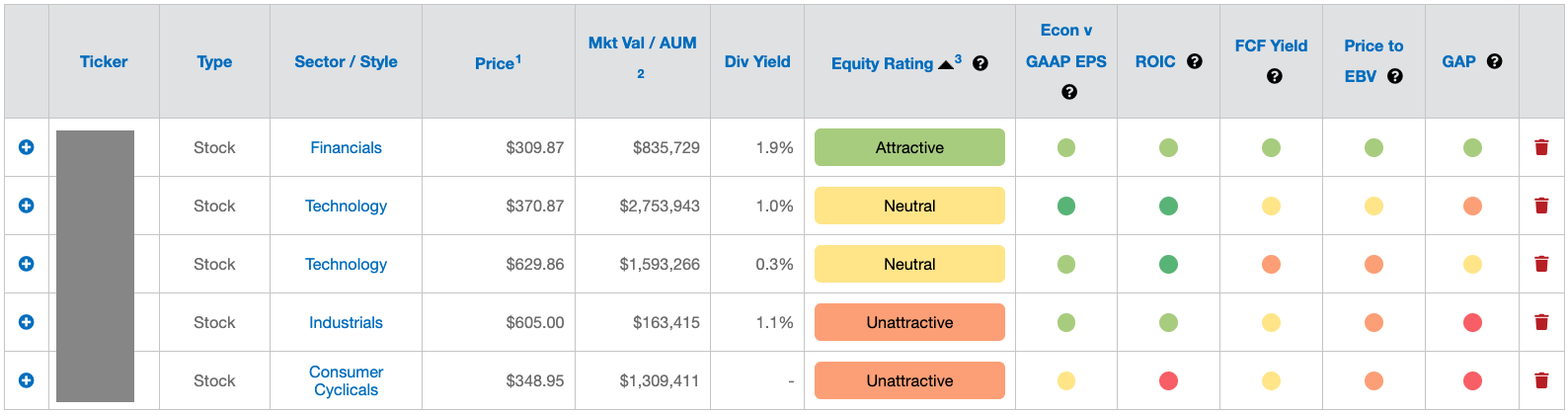
What if you could see a Red, Yellow, or Green light on every stock before you bought it?
Green means the fundamentals are real. Red means danger.
A 30-year Wall Street veteran built this tool. His Core Earnings system beat the S&P 500 by 9% in 2025.
Click here to check any stock.
Editor’s Note: Keep in mind, we only accept advertising from publishers we know to offer well-researched ideas vetted by a legal team, excellent customer service, and reasonable refund policies. New Constructs is one such partner. We do not, however, under any circumstances make any representations about their investment ideas or strategies, nor will we warrant them as equal to our own. We do recognize that the markets are tempestuous and, at times, ideas that we may not endorse prove valuable.
3 Things To Know Before We Go…
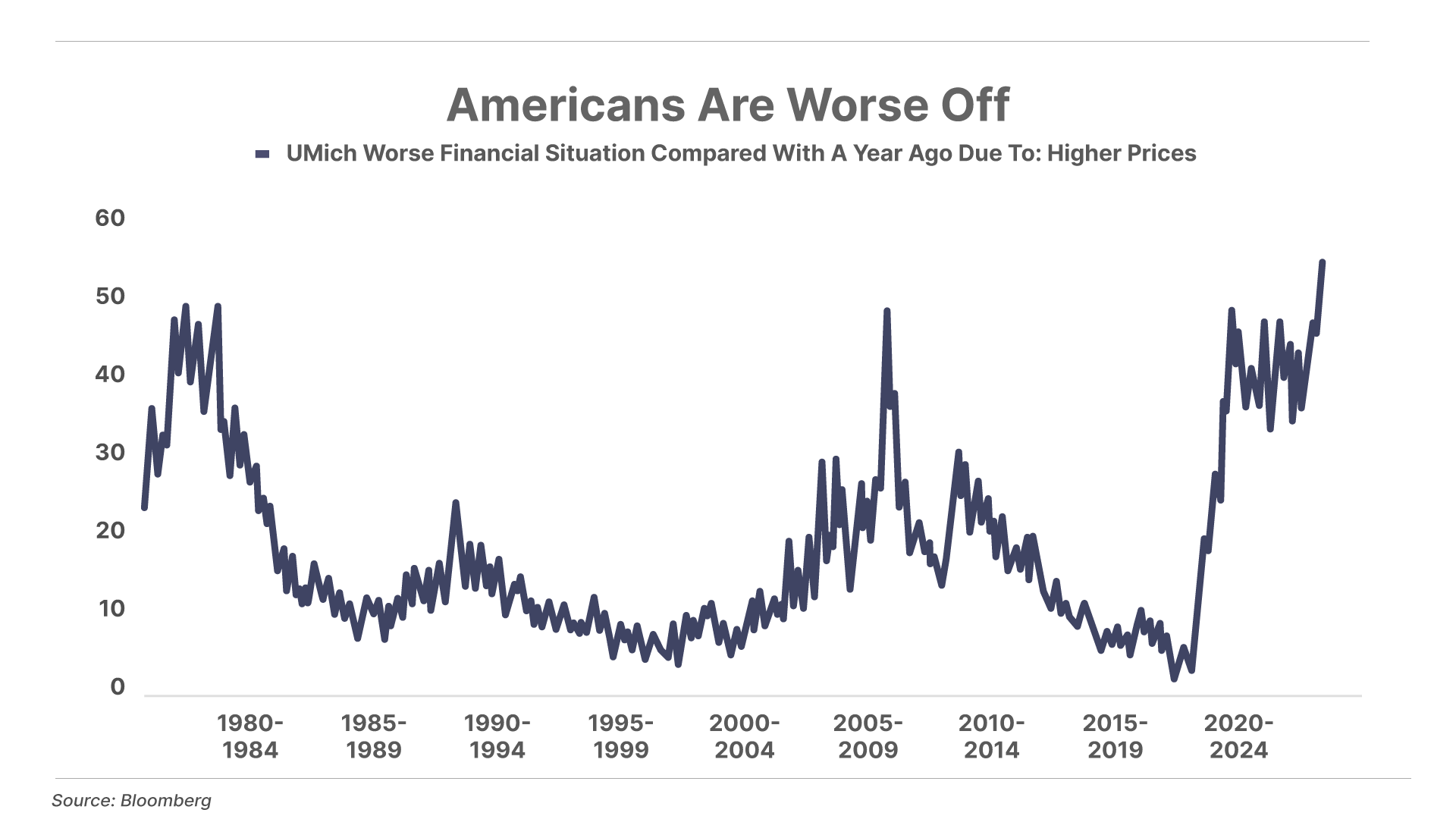
1. More than half of Americans now say higher prices have made them worse off. The University of Michigan's April survey puts that figure at a record 54%, up from 47% in March, surpassing any prior reading in the survey's seven-decade history. The broader headline index reinforces the dire outlook – consumer sentiment collapsed 11% to 47.6, the lowest level ever recorded – while one-year inflation expectations surged a full percentage point to 4.8%.
2. Tariffs lead directly to inflation. A new Federal Reserve study reveals that President Trump’s sweeping U.S. tariffs are entirely responsible for the recent surge in core goods inflation, hitting consumers with a direct, “dollar-for-dollar” price increase. According to the April 8 FEDS Note authored by economists Robert Minton, Madeleine Ray, and Mariano Somale, tariffs implemented through November 2025 raised core goods personal consumption expenditure (“PCE”) prices by a staggering 3.1% through February 2026.
3. AI is running out of the one thing it can't do without. Computing power – rather than capital – is now the binding constraint on the AI boom, and demand is outpacing supply at an alarming rate. Token usage (1 token = ~0.75 words) on OpenAI's API rose from 6 billion per minute in October to 15 billion in late March. Nvidia's (NVDA) most advanced chips now rent for $4.08 per hour, up 48% in just the last two months. Similar infrastructure bottlenecks have arisen in every great technology boom, from railroads to the internet. Historically, companies have raised prices to ease supply constraints, but AI firms can’t do so easily without risking losing users to competitors.
Chart Of The Day… Porter & Co. Energy Recommendations
With ceasefire talks failing over the weekend and no resolution in sight to restore global energy shipments through the Strait Of Hormuz, oil prices will likely remain higher for longer – to start off the year, we named energy as our theme for 2026, and the five “Energy & Commodities” recommendations then part of Porter & Co.’s Complete Investor are up on average 34% YTD versus a flat S&P 500 performance.
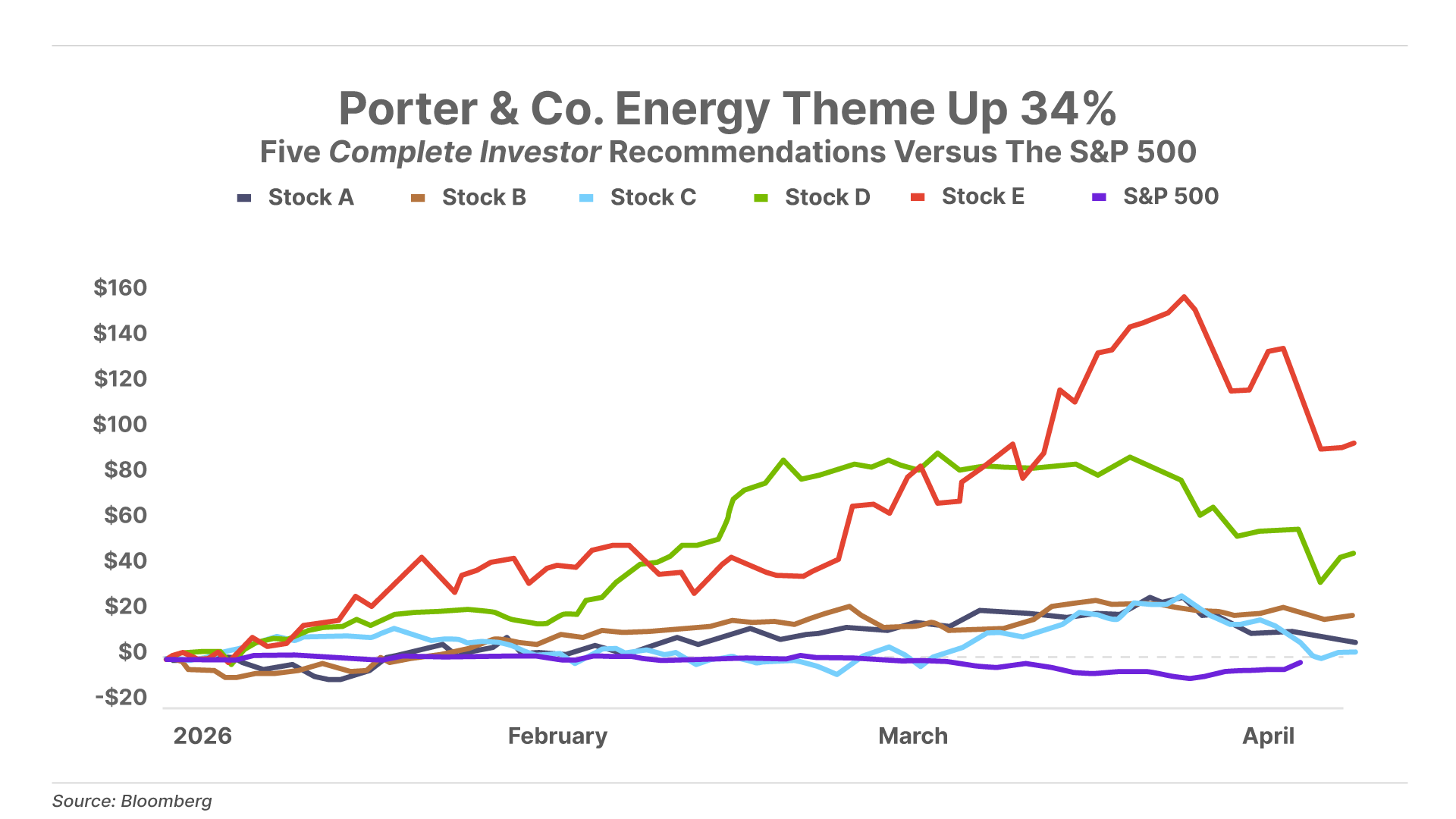
Complete Investor now holds nine energy recommendations and this week will be adding an exciting new gold royalty company – that few on Wall Street have even heard of. To be part of the 2026 energy theme and be the first to see the new gold recommendation, click here to learn how to become a member.
Poll Results… When The Strait Will Open
On Friday, we asked Journal readers when they thought the strategic Strait Of Hormuz will re-open to significant shipping traffic, having been closed for nearly six weeks because of the war in Iran. The vast majority of survey takers (87%) don’t see the strait opening any time soon… with 54% selecting the option “after April 30” and 33% selecting “beyond summer.” The remaining 13% optimistically believe the strait will open “before April 30.”
Mailbag
“Lies From Our Government”
Carl J. writes:
Friday’s Daily Journal was an excellent piece on one of the ways in which the U.S. government lies to us, Porter.
I invite you to explore ChapwoodIndex.com for a deeper look at the reality of real U.S. inflation, versus government fantasies.
The Chapwood Index is calculated and published semiannually by a So CA investment advisor. He has assembled a crew of several hundred volunteer reporters from most U.S. metro areas who report every six months regarding prices they or family members have paid for a broad range of goods and services most families use regularly, considered as “necessities” by most families.
Thank you again for all you do for us.
Porter Comment: I’ve followed the Chapwood Index for years and have recommended it to my audience several times. Twice a year, the Chapwood Index records prices on 150 separate items – everything from sweet peas to airline tickets. It records the price of the exact same items, twice a year. This index of actual prices reveals that inflation in urban areas has been increasing by 8%-12% a year.
“Your Take On EQT”
Leslie V. writes:
Hi Porter,
I have a little dilemma. I follow The Trading Club and the advice on EQT suddenly went from positive to negative because of the perceived domestic oversupply of LNG in the foreseeable future. This has me wondering what Porter’s view on stocks like EQT and Venture Global are? Not looking for direct financial advice – simply his view on how “he sees the LNG landscape” vis a vis slowing domestic sales versus export global opportunities, ability to off-set domestic slowing?
Porter Comment: I expect domestic demand for natural gas and global demand for LNG will be dramatically more than forecast for at least the next decade. EQT (EQT) is both America’s largest and lowest-cost provider and will be a big winner of this trend. Likewise, by 2030, Venture Global (VG) will be both the world’s largest supplier of LNG and its most efficient producer.
“The Most Dangerous Lie In Modern Economics”
Matt V. writes:
Terrific article, Shannon!
I've made this argument to my wife since we started having children just over 14 years ago. All the hidden costs and stress of having two breadwinners. My wife makes "easy money" for the federal government. I see it more like a hit of crack. Never enough. Keeping up with multiple vehicles. Outrageous taxes. Blowing money left and right on therapy, medications, and doodads to cover up the pain of separating from the family and role she is designed to be in. I cannot focus 100% on my job because I have to deal with minutiae that my wife could be handling if she were home full-time. We are both operating sub-optimally in our roles. It is so obvious to me. You nailed it in your article.
My wife was sucked into the "girl power" movement years ago. Got an engineering degree and was determined to become a boss babe, just like her miserable boomer aunt who influenced her. (Who happens to be childless – shocker). My wife works as a civilian on military vehicles with high-T army dudes. She's absolutely miserable to the point she can't sleep. But again... "easy money" and she is terrified how others will judge her if she "doesn't do her part to make money." Of course, I think that is horse shit. The mother, who can act 100% in her role, is bedrock to the family economy. I was praying DOGE would have done something and forced her out of the federal government because, frankly, her job adds almost no value to anything. No luck. Thanks, Elon.
I am encouraging my wife to read your article, Shannon. Perhaps it'll help convince her to finally give it up.
God bless you, Porter, and your daughter!
Paid up Lifetime Long-Armer.
Porter Comment: Thank you very much, Matt. We are very excited about our new family.
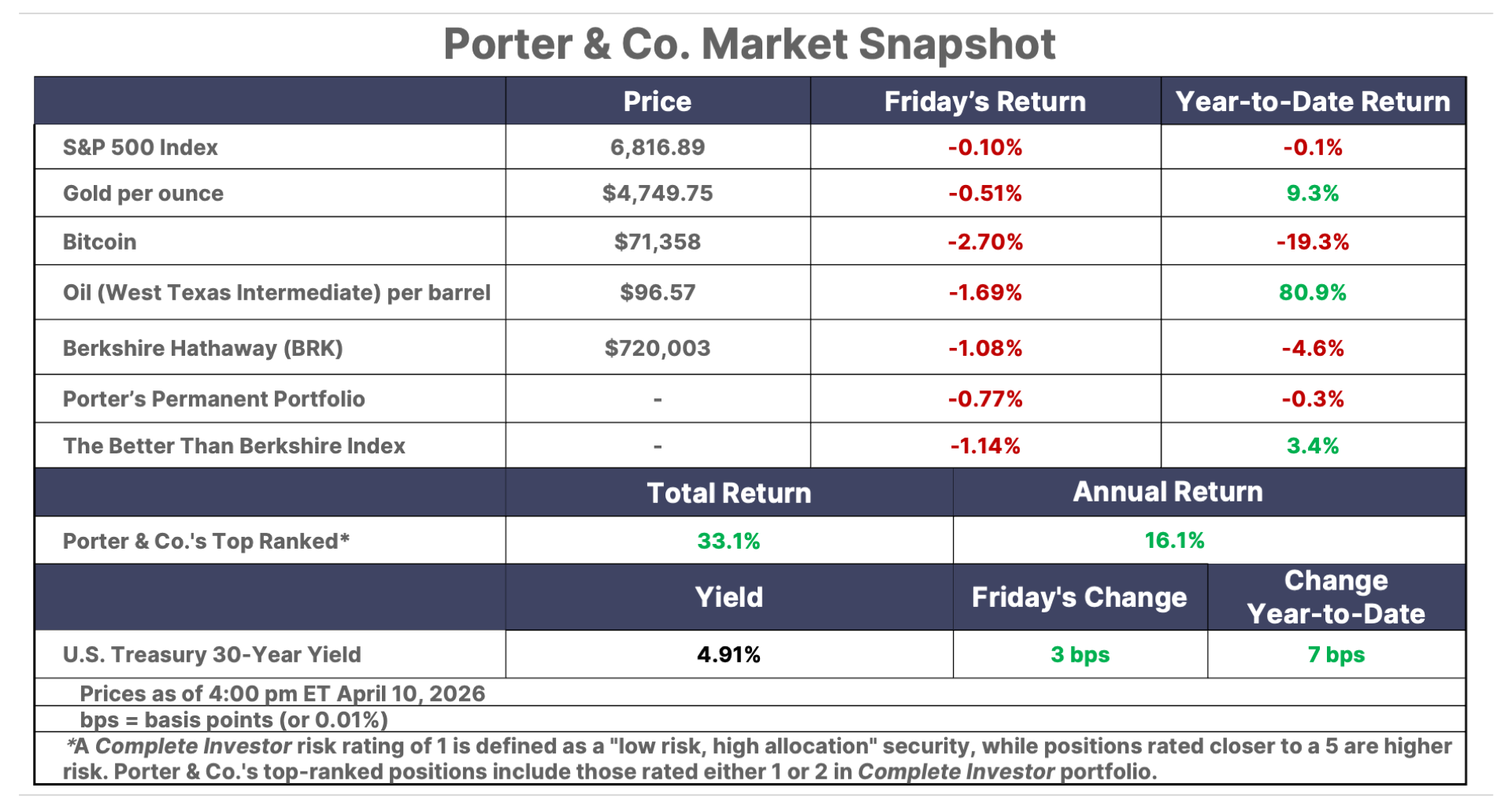
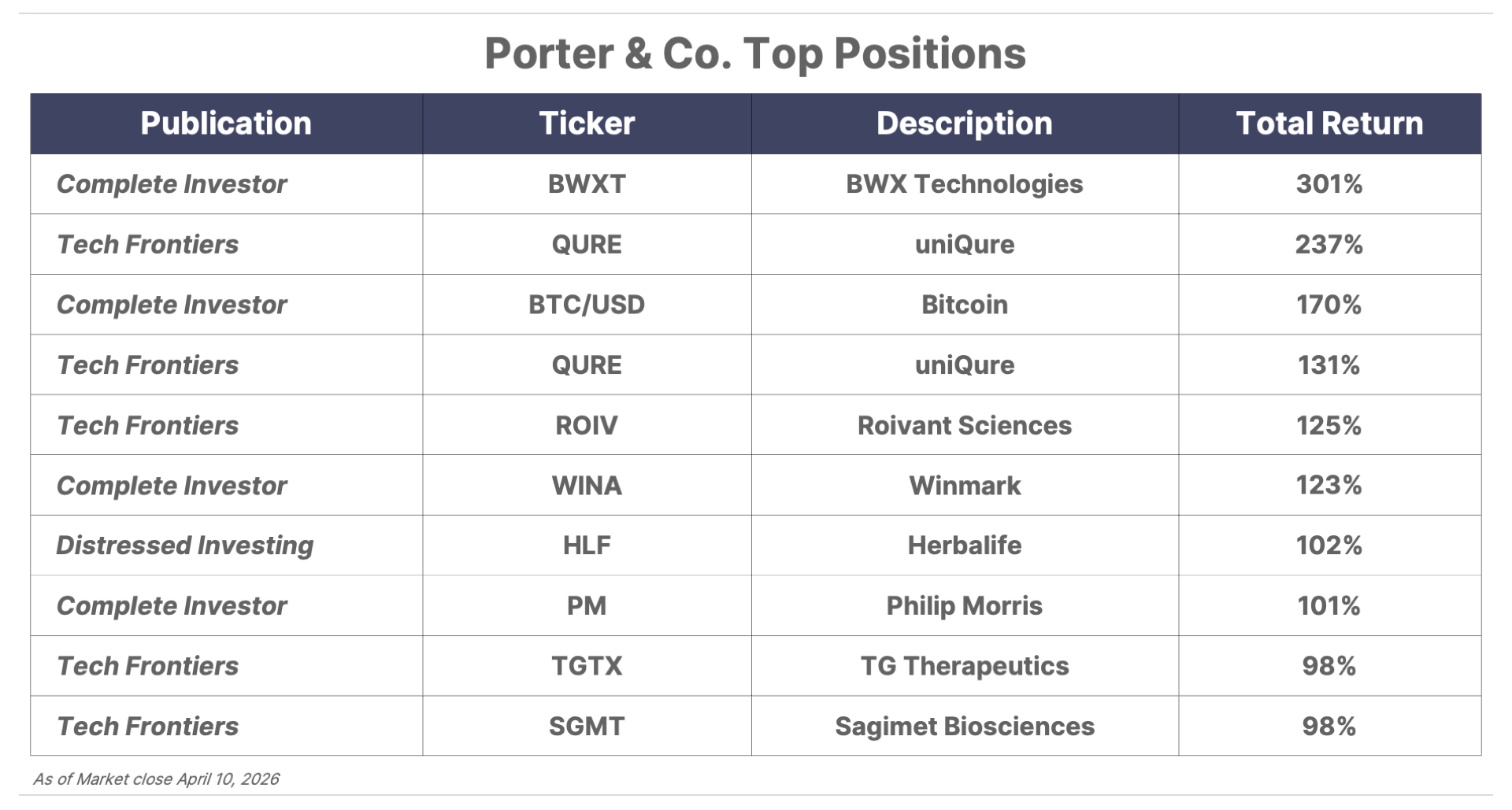
Please note: The investments in our “Porter & Co. Top Positions” should not be considered current recommendations. These positions are the best performers across our publications – and the securities listed may (or may not) be above the current buy-up-to price. To learn more, visit the current recommendations page of the relevant service, here. To gain access or to learn more about our current recommendations, call our Customer Care team at 888-610-8895 or internationally at +1 443-815-4447.