The Miracle Factory Is Shipping
Inside Today's Issue
The miracles have begun to land.
A few months ago (July 2), I explained the dangerous economics behind the artificial intelligence (“AI”) boom: a frontier chip becomes a discount item within 18 months.
Huge capital costs plus rapid depreciation is hard math for a business to overcome. Combine those rapidly depreciating, very expensive chips with zero switching costs (customers move from one AI model to another with a single click), and you’ve got a big problem.
Much like an airline, it doesn’t matter how complex or incredible the technology is: there’s no moat. A business must have a moat that allows it to charge more than its cost of capital and labor. And there’s no moat with data centers or large language models. Thus, there will be no profits.
Instead, I explained how profits from the AI revolution will accrue to businesses that use cheap intelligence to create better products that no competitor can copy – like patented drugs. And I told you about Roivant Sciences (ROIV), a “miracle factory” that’s using AI to find promising drug targets. (Porter & Co. Biotechnology first recommended the stock in March 2024 at $11.37 a share.)
Roivant uses huge amounts of data and AI power to sort through the new drug discard pile – compounds that other firms have abandoned. Roivant’s technology discovers what went wrong with the previous development and figures out how to fix it. The company then licenses these compounds very cheaply, and, to protect itself from risk, it puts each one into its own small company, usually partnering with another firm to provide the development capital.
Since we shared this story with Journal readers in July, Roivant’s miracle factory has produced four outstanding results: one Food And Drug Administration (“FDA”) drug approval, two winning Phase III trials, and one record-setting Phase II trial.
On August 27, the FDA approved brepocitinib, sold as Lisraya, for adults with dermatomyositis. Dermatomyositis is a rare disease in which the immune system attacks the muscles and skin, causing weakness and painful rashes. Lisraya is the first targeted drug ever approved for it. Roivant made it available to patients the same day, about five weeks ahead of its own schedule, at a list price of $35,000 a month, or $420,000 for a year of treatment.
Where did brepocitinib come from? Pfizer (PFE). The Big Pharma firm discovered the molecule and handed it over in 2022, along with a second drug, in exchange for about 25% of Priovant, the subsidiary Roivant built to develop both of them.
Eight weeks later, on October 21, the same pill won two Phase III trials in non-infectious uveitis, an inflammation inside the eye that can cause blindness. The trials measured how long patients went before their eye disease flared badly enough that the treatment counted as a failure: 12 weeks at the median on placebo, and more than 48 weeks on brepocitinib. Priovant plans to ask the FDA to add uveitis to the label in the first half of 2027. A Cantor Fitzgerald analyst estimates the eye disease alone could be worth $5 billion a year in peak sales.
Then there’s mosliciguat, an inhaled drug Roivant picked up from Bayer. It treats pulmonary hypertension caused by interstitial lung disease, a group of conditions that scar the lungs. Scarred lungs squeeze their own blood vessels, and the heart has to pump harder to push blood through them until, in many patients, it fails.
In September, mosliciguat’s Phase II trial in 135 patients cut the resistance in those blood vessels by 56% more than placebo after 16 weeks. Roivant says no randomized trial in pulmonary hypertension has ever reported a larger reduction. Patients on the drug also walked 35 meters farther in six minutes than patients on placebo at week 16, and 53 meters farther by week 24. A Phase III trial of about 375 patients is enrolling now, and analysts say the drug could sell more than $10 billion a year.
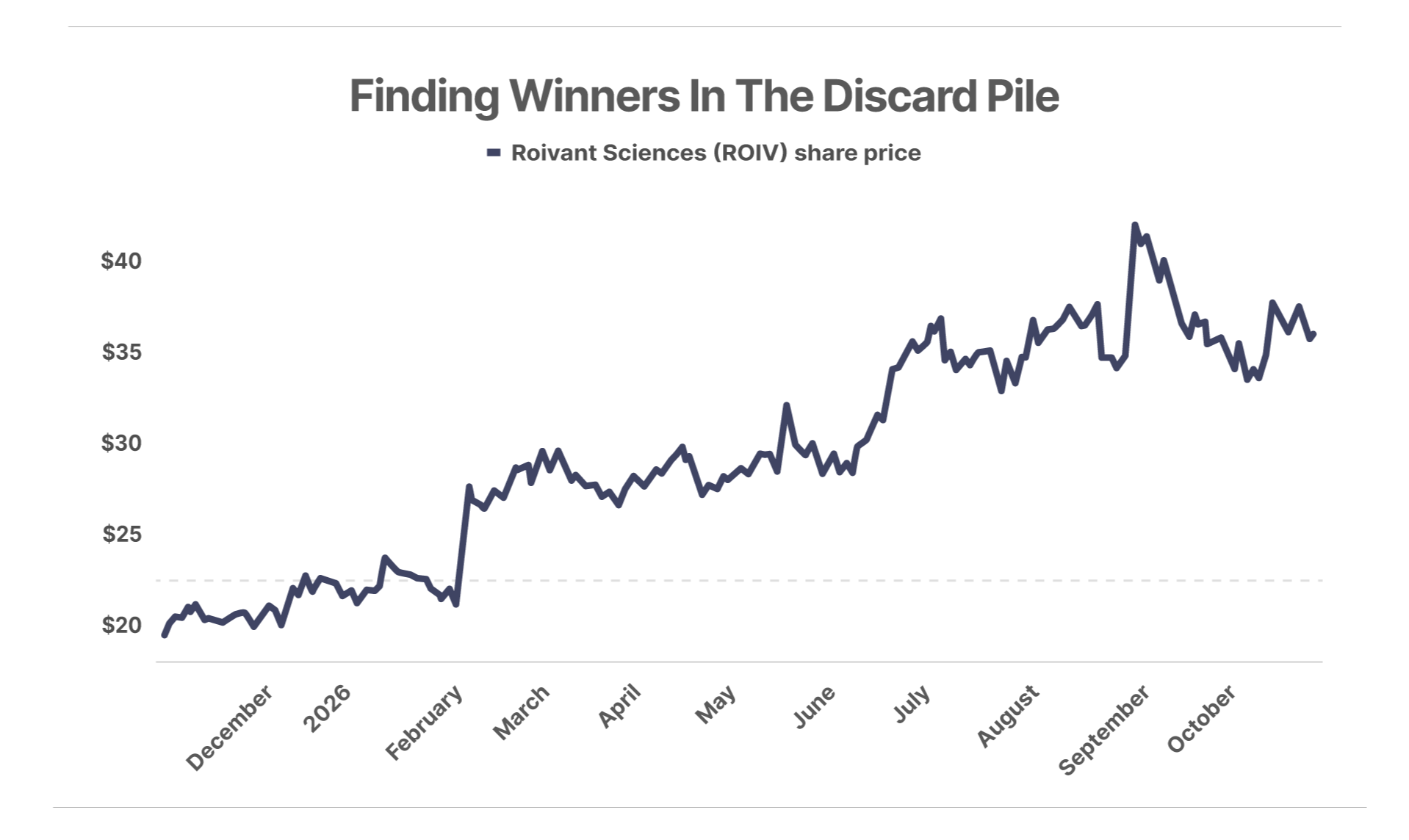
Roivant’s shares hit a record $42.50 on September 8, the day the lung data came out. They trade around $36 today, up roughly 220% since our recommendation.
Roivant has been a home run for us. But it’s only the beginning.
Roivant uses AI to pick candidates from previously abandoned trials. But the molecules Roivant buys were still designed the old way: by teams of chemists and biologists working through years of trial and error.
The next step is to have AI design the molecule itself, from scratch.
Consider a human antibody. It’s a Y-shaped protein your immune system builds to grab one specific target. Drug companies have learned to make antibodies that grab a disease-causing protein and switch it off. For decades, finding a good one meant injecting animals or screening enormous libraries of candidates, then spending years having humans tune the winner.
AI reverses this entire process. The software proposes the antibody’s structure first, a laboratory makes the most promising designs, and the test results go back into the software so the next round of designs gets better.
In Saturday’s Porter & Co. Biotechnology, we will recommend a small company that’s built one of the first such AI antibody factories. Its plan, as Fortune described it, pairs AI design with early clinical trials that run abroad at a fraction of U.S. costs.
The goal is to cut the cost of taking a new drug from a chosen target to a Phase II proof of concept from about $150 million to between $15 million and $20 million.
Its lead drug is an antibody designed by AI. It blocks a hormone receptor tied to two common conditions for which no antibody treatment has ever been approved. In its first human trial, the drug was well tolerated, and it stayed in the body long enough that patients may need a dose every six months.
In June, Eli Lilly (LLY), the company behind weight-loss drugs Mounjaro and Zepbound, put $40 million into this business. While it’s not unusual for a major pharma to provide capital to a start-up, it is unusual for the terms of the deal not to include any specific rights. And, in this case, the investment was simply an equity purchase: Lilly got no rights to any of the start-up company’s drugs, no right of first refusal, and no early look at the data. It even paid the same price per share as every other investor in the deal.
Why would Lilly write a $40 million check for no rights at all? The company’s CEO gave the answer in September:
Lilly “bought tickets to the game.”
What we don’t know yet is whether the drug works in patients. The first efficacy results are expected in December. If the antibody works, a molecule designed by software will have treated a condition that no approved antibody currently treats. That will be a major breakthrough.
Roivant proved that cheap intelligence can find miracles.
Our new recommendation will prove that cheap intelligence can build miracles from scratch.
If you subscribe to Porter & Co. Biotechnology, you’ll have the full report on Saturday morning.
If you’re not yet subscribed, you can sign up here before it’s too late.
Tell me what you think of today’s Daily Journal: porterstansberrydirect@gmail.com
Good investing,
F. Porter Stansberry
Stevenson, Maryland

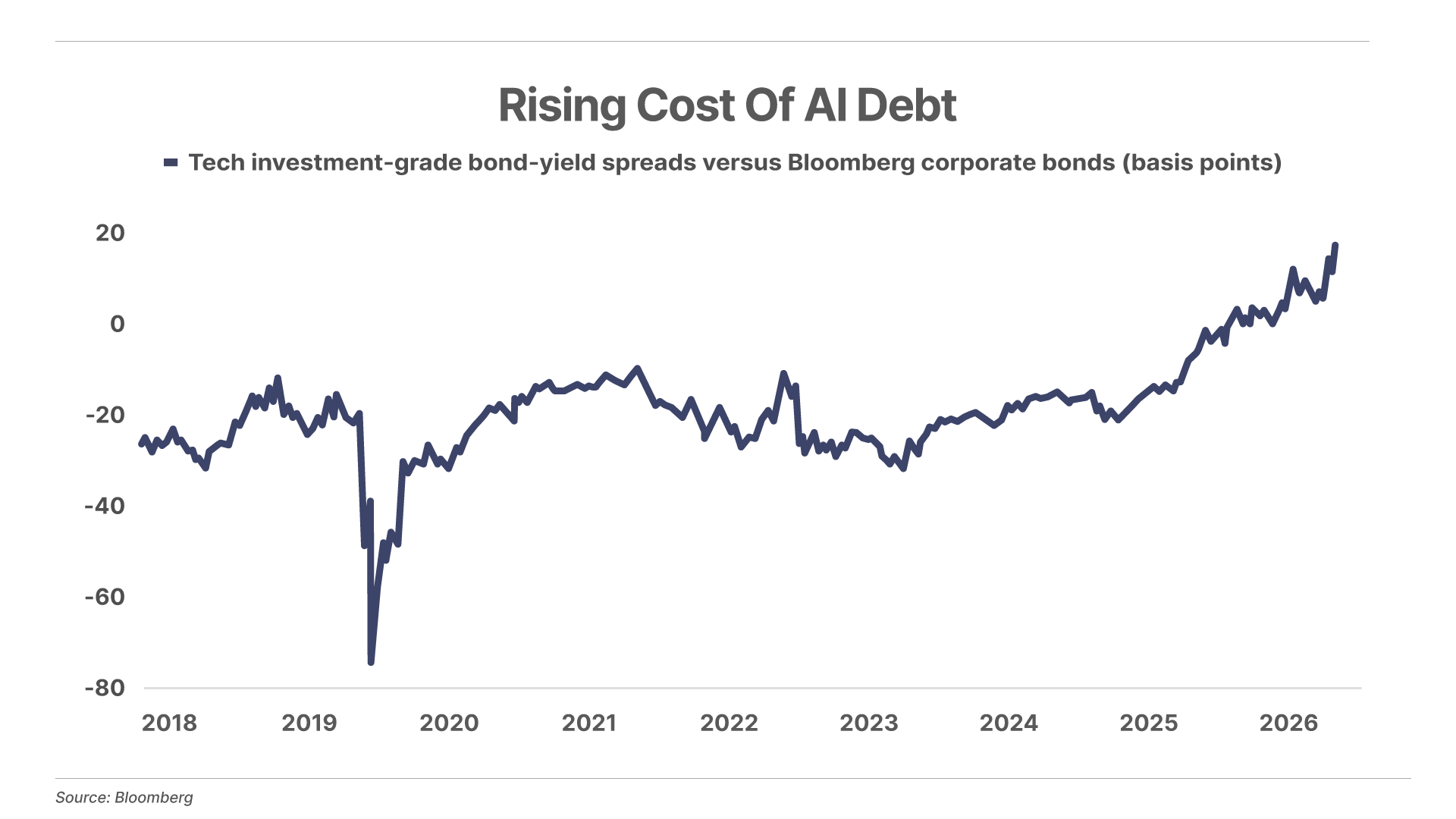
1. Bond investors want more from tech companies to borrow than the average blue-chip company. Investment-grade tech bonds trade at a spread 20 basis points wider than the Bloomberg U.S. Corporate Bond Index, the widest gap since 2003. From 2018 through 2024, the sector borrowed 20 to 30 basis points cheaper than the broader market. Hyperscalers are funding data centers with heavy bond issuance, and lenders want more yield to hold that much tech debt.
2. The tokenization of stocks is accelerating. Tokenized equities – blockchain-based tokens that track U.S. stocks – just hit a record $3.8 billion in value, up 590% this year. Compared to traditional shares, tokens can settle (the final exchange of cash for shares) in minutes rather than days, and they trade 24/7. On Solana-based trading platform Jupiter, about 63% of tokenized stock volume trades outside regular U.S. market hours. Amid this demand, New York Stock Exchange owner Intercontinental Exchange (“ICE”) is developing a 24/7 tokenized stock platform and a separate market for perpetual futures – contracts that track an asset’s price and never expire.
3. Stocks have historically done their best in the year after midterms. Since 1950, the S&P 500 has risen from November through April in all 19 midterm years, by an average of 14.8%. The full calendar year after the midterm has averaged 17.2%, with gains in 17 of 19. In the six midterm years when the S&P 500 was up 10% or more through October – like it is this year – the next six months averaged an even better 15.7% gain.
Shares of Roivant Sciences (ROIV) – recommended to both Complete Investor and Biotechnology subscribers – have risen 85% over the last year. Porter will add a new recommendation to Biotechnology this Saturday – what he calls a small company that’s built one of the first AI antibody miracle factories.
If you are not a Biotechnology subscriber and want to get access to Porter’s barbell portfolio and new recommendation, click here.
Yesterday in the Daily Journal, Porter told the story of friend and mentor Chris Weber, whose Max Yield strategy focuses on investing in the one country a year that's offering the highest yield on a one-year maturity government bond.
“Max Yield Strategy”
Kathy D. writes:
Yikes, one more investment idea that I may have trouble ignoring. Since I became a subscriber to Porter & Co., I have diversified my diversifications. I am glad I didn't have all this information when I was working full time – I wouldn't have had time to work full time.
And I never thought I wasn't a gambler… Great newsletter today!
Hank B. writes:
The table you present on the gains from foreign-rated BBB- minimum bonds does not include the annual taxes you have to pay. I prefer The Trading Club strategy.
Karl A. writes:
For most of us dealing with an out-of-country bank or broker feels like a big risk. I deal with Schwab and I don't like that much.
Porter Comment: Yep, this strategy isn’t for everyone.
But for people with overseas businesses or for people with overseas careers – people used to dealing with foreign bank accounts, etc. – this strategy is a good option.
There are also plenty of high-net worth subscribers with private banking services (Pictet, JPMorgan, etc.) where executing this strategy is simple and can even be done with substantial margin to create a lot of positive carry.
That’s how the rich get richer.
Jim V. writes:
Great article and very simple strategy. I would love to try this out but after researching it would appear much more difficult to participate in than I had hoped. Finding a foreign broker or engaging a foreign bank is difficult. Foreign/international banking laws are strict and likely prohibitive for the average retail investor. Even the Turkish bank Garanti BBVA offers "Expat banking" but still requires a local ID number and an in-person bank visit. Also, FATCA (Foreign Account Tax Compliance Act) reporting requirements result in many foreign retail banks actively turning away U.S. individual account holders. Additionally, if the foreign yield winner changes annually, you'd have to go through the process for each country, adding paperwork, wire fees, etc. Am I missing something?
Porter Comment: No, you’re not missing anything. International investing is a hassle, no doubt.
But I didn’t say it was easy. I said it is incredibly lucrative.
Hanzal G. writes:
Sounds remarkable and I need remarkable!
Mike B. writes:
Sounds like a great new ETF for the Tuttle group to add to PCPP and PCPC.
Tim P. writes:
Hi Porter,
The Max Yield strategy is intriguing. How about creating an ETF that follows the philosophy (like PCPP)? Tracking which safe countries offer the best yields and then navigating through their banks is a fairly complex activity for most investors.
Porter Comment: Love it!
Eric V. writes:
I’ve been a subscriber to Chris Weber’s work for several years, and he is the best. He’s not only a great investing mind, but also a historian and movie buff.
I am very familiar with the Max Yield strategy but haven’t applied it personally because of the timing of when I started following Chris. Thank you for reminding me of a great alternative to the overpriced market.
Porter & Co. Market Snapshot |
Through Monday, November 2, 2026 close |
| Markets |
| Index or asset | Last | 1-Day | YTD | 1-Year |
|---|---|---|---|---|
|
S&P 500
Total return
|
752.10 | −0.48% | +11.2% | +11.5% |
|
Gold
Front-month futures
|
$3,969.60 | +1.81% | −8.6% | −0.7% |
|
Bitcoin
4 pm ET print
|
$76,640.00 | −0.15% | −12.4% | −30.2% |
|
Crude oil
WTI, per barrel
|
$96.46 | −7.36% | +68.0% | +58.2% |
|
Berkshire Hathaway
NYSE: BRK-A
|
$834,641.00 | +2.33% | +10.6% | +16.6% |
| U.S. Treasury yields |
| Maturity | Yield | 1-Day | YTD | 1-Year |
|---|---|---|---|---|
|
2-Year
|
4.59% | +3 bps | +112 bps | +99 bps |
|
10-Year
|
4.91% | −3 bps | +73 bps | +80 bps |
|
30-Year
|
5.28% | −3 bps | +44 bps | +61 bps |
| Porter & Co. strategies |
| Strategy | 1-Day | YTD | Since start | Per year |
|---|---|---|---|---|
|
Porter's Permanent Portfolio
Since September 25, 2024
|
+0.85% | +6.5% | +34.3% | +15.1% |
|
Better Than Berkshire Index
Since May 16, 2025
|
−0.09% | +5.5% | +5.9% | +4.0% |
|
Porter & Co. Top Ranked*
Since July 14, 2022
|
−0.01% | +5.9% | +30.4% | +10.2% |
Porter & Co. Top Positions |
Through Monday, November 2, 2026 close |
| # | Position | Total return |
|---|---|---|
| 1 |
TG Therapeutics TGTX
Biotechnology
|
+219% |
| 2 |
Roivant Sciences ROIV
Biotechnology
|
+214% |
| 3 |
Roivant Sciences ROIV
Complete Investor
|
+210% |
| 4 |
Bitcoin BTC/USD
Complete Investor
|
+183% |
| 5 |
APA Corporation APA
Porter & Co. Asymmetry
|
+172% |
| 6 |
Philip Morris PM
Complete Investor
|
+158% |
| 7 |
Skyward Specialty Insurance SKWD
Complete Investor
|
+148% |
| 8 |
BWX Technologies BWXT
Complete Investor
|
+131% |
| 9 |
W.R. Berkley WRB
Complete Investor
|
+121% |
| 10 |
Chubb CB
Complete Investor
|
+99% |