Issue #105, Volume #3


A Look At Large, Steady-Eddy Commodity Stocks
Inside today’s Daily Journal…
|
Editor’s note: Porter turns today’s Journal over to Tom Dyson, investment director for Bonner Private Research, who steps back to share his perspective on The Big Picture…
Here’s Tom…
The U.S. government is broke and its finances are spiraling totally out of control.
There is no way out. We are hurtling toward a worldwide debt crisis. This cannot be anything but bearish for stocks, especially coming when valuations are as high as they’ve ever been on Wall Street.
But first the money. As my colleague Bill Bonner says, when the money goes, everything goes. Paper currencies are backed by Treasury debt. We are in the final act in our experiment with unbacked paper currency. We’ve been calling it the greatest financial experiment of all time.
I’ve spent my entire adult life studying this experiment. But at the end of my reading and thinking, I came to the humbling conclusion that the whole experiment simply rests on rising asset prices. Specifically, the credit markets only function – including the U.S. government, its $40 trillion debt and $2 trillion yearly deficits – as long as stock prices go up. Whenever stocks stop rising, the system starts correcting violently. Why?
Asset prices, especially the S&P 500, are the collateral backing the U.S. government’s credit and therefore the entire experiment itself. I didn’t make the rules. It’s just clear that the stock market is the pivotal asset, and when it falls enough, it triggers a doom loop of margin calls, defaults, profit warnings, bankruptcies, lay offs, and then more selling. If not addressed forcefully with massive inflation, workers lose their jobs, the tax base shrinks, the government’s obligations soar and the Treasury quickly starts to look insolvent, triggering even more doom loops.
Meanwhile, a rising stock market generates capital gains taxes for the government. The last time the U.S. government budget showed a surplus was 1998 through 2001.
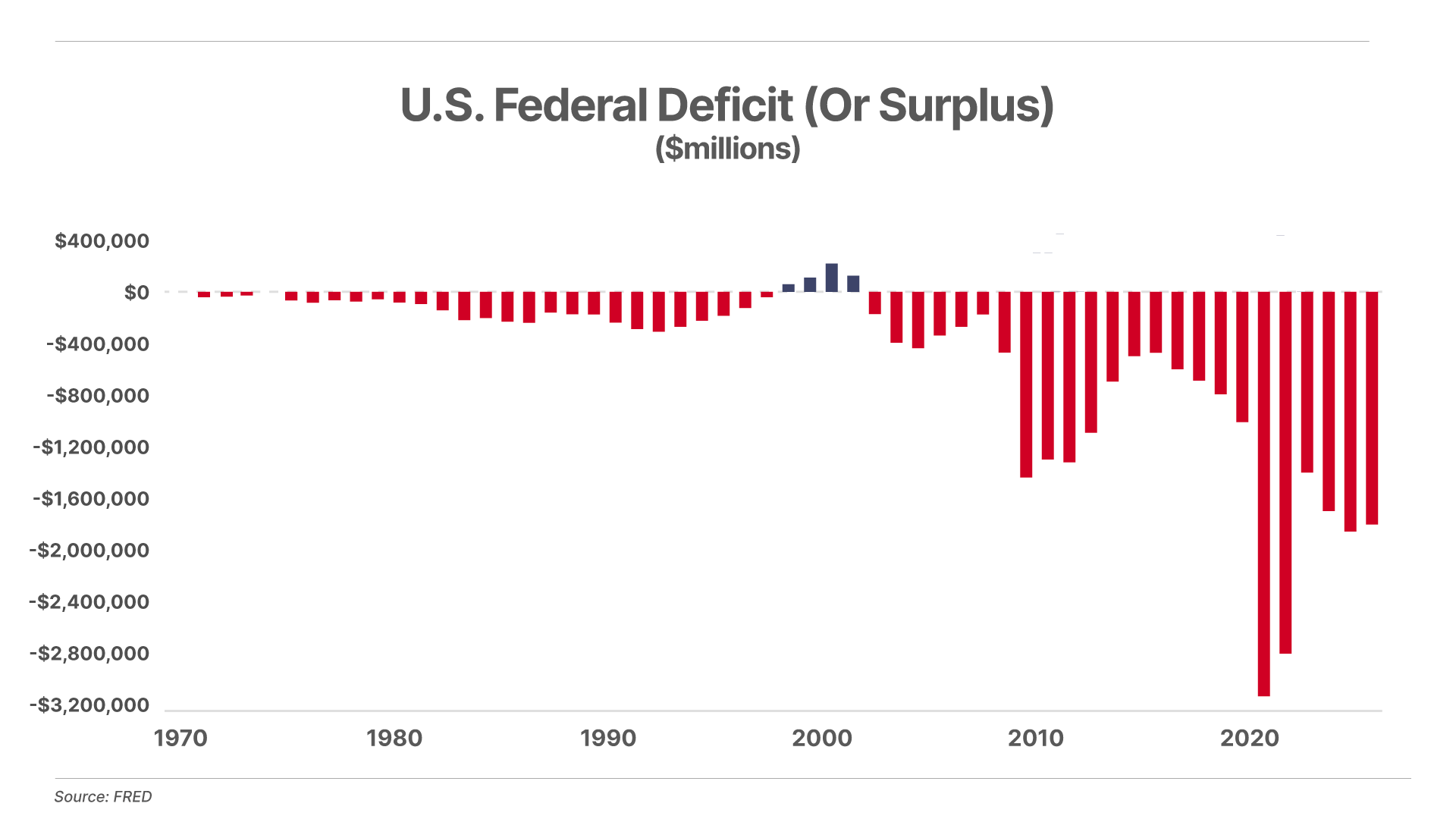
There were two reasons for this (not Bill and Hillary Clinton). First, Social Security actually ran a surplus in those years. Contributions from payroll taxes exceeded the cost of benefits going out the door. It was an unusual demographic “sweet spot” that accounted for most of the surplus. But the stock market helped. During that four-year period, capital gains taxes were roughly double their percentage of federal tax receipts. The dot-com boom generated big tax cash for the Feds. The stock market crash – when the major valuation metrics we follow at Bonner Private Research were last this high – wiped out capital gains taxes.
That will happen again. And when it does, you’ll get a double whammy. Falling asset prices will reduce demand for U.S. government debt, pushing up interest rates. And capital-gains tax receipts will plunge. The $2 trillion annual deficit will grow even wider – this time because Social Security is now running annual deficits, where the cost of benefits exceeds the income from payroll taxes.
Inflate or die.
It’s easy to get blinded by the flashing stock quotes, emergency headlines, and earnest news reports of modern speculative finance. But once you strip away all the complexity and pizzazz, you see our experience of the last fifty years has really just been a self-reinforcing cycle of rising asset prices and expanding debt, spiraling higher and higher, year after year.
Or said another way, it’s been an epic credit inflation (as described by the Austrian school of economics.)
The credit inflation must now deflate. The most rational investment strategy is to get as far away from overvalued markets as possible. We call this position Maximum Safety.
In the past, a super defensive investment position would have simply meant holding cash, especially the dollar, which you could always count on to be a store of value in a crisis or panic,
That’s no longer true today. To repeat: falling stocks mean a falling demand for the dollar and U.S. debt. Higher interest rates might make the dollar attractive to some foreign investors. But they will have to consider the risk of default/inflation by a U.S. government that simply cannot stop spending money.
The Feds understand the contagion risks. They have concluded that the only way to head off these Minsky Moments is to move fast… and go large. To prevent a massive asset sell-off, the Fed will become a big buyer of stocks and bonds again.
In fact, I bet they’re already prepping the next hero’s dose of stimulus. They simply cannot risk a chaotic collapse in asset prices. If the Fed is forced to choose between allowing a stock market crash – negative for all the reasons I’ve shown – or allowing a great inflation through the paper currency system, it’s not a mystery. They will use the currency as a release valve rather than let stocks crash. The resulting inflation and the increase in your cost of living… is just the price you’ll have to pay. It boils down to using the paper currency system as the release valve for losses… by debasing the currency.
All this means holding cash is no longer risk-free. In fact, it’s quite risky.
Our solution to this problem – which we call inflation volatility – is a portfolio that stands up in either scenario.
My inspiration in this is two great pioneers of portfolio construction, Harry Browne and Charles Gave, whose work I’ve studied for years. Both men start with the core insight that you don’t need to know the future to be a successful investor. Browne figured out you can hold a portfolio of 25% stocks, 25% bonds, 25% cash and 25% gold, rebalanced annually, and earn about 4% a year after inflation, with very little volatility. He called this strategy the Permanent Portfolio and presented the idea in his 1999 book, Fail Safe Investing.
Charles Gave then took Harry Browne’s core idea – the Permanent Portfolio — and refined it, with small tweaks to the four allocations. He calls his model the Four Quadrants Framework, which he’s been using since 1978 and recently presented in a wonderful little free pamphlet, titled The General Theory Of Portfolio Construction.
Based on the ideas of Browne and Gave, we’ve taken a big position in precious metals, to protect us against debasement of the money. We’re holding a large cash position, to protect us against crashing markets. And recently, we have started buying a new category.
We’ve been adding large, steady-eddy commodity stocks that deal in the boring but essential raw materials of civilization. Oil, gas, iron ore… if my analysis is correct, all our stocks have decades of reserve life in the ground and should be able to pay bigger and bigger dividends for decades to come.
The long dividend tails from these steady-eddy, long-life businesses look to me like the coupon payments of 30-year or 50-year bonds, except they’re indexed to inflation in the sense that the oil price, the iron ore price and the nominal values of reserves in the ground are also indexed to inflation. Due to their long duration, I’ve started calling them “hard asset long bonds.”
I’m not suggesting anyone goes all-in these steady-eddy commodity producers. I am suggesting they’re a great pairing for our big positions in cash and precious metals while we have the dial set to Maximum Defense. They’ll generate income and positive real returns, above inflation, preserving our purchasing power.
Luckily for us, few other investors seem to have any interest in these companies and their ultra-long income streams. They’re far too distracted by the Brave New World of AI… and the riches of space…
Good investing,
Tom Dyson
Bonner Private Research
P.S. At Bonner Private Research, we’re lucky that we have a clear image of the Big Picture to anchor our strategy. We are able to digest the news and the market swings without losing our bearings… or worse, going nuts. It’s served us well from the start.
To learn more about how we do that, click here to subscribe.
Keep in mind, we at Porter & Co. only publish guest essays from publishers we know to offer well-researched ideas vetted by a legal team, excellent customer service, and reasonable refund policies. Bonner Private Research is one such partner. We do not, however, under any circumstances, make any representations about their investment ideas or strategies, nor will we warrant them as equal to our own. We do recognize that the markets are tempestuous and, at times, ideas that we may not endorse prove valuable.
Tell us what you think of today’s Journal: porterstansberrydirect@gmail.com

3 Things To Know Before We Go…
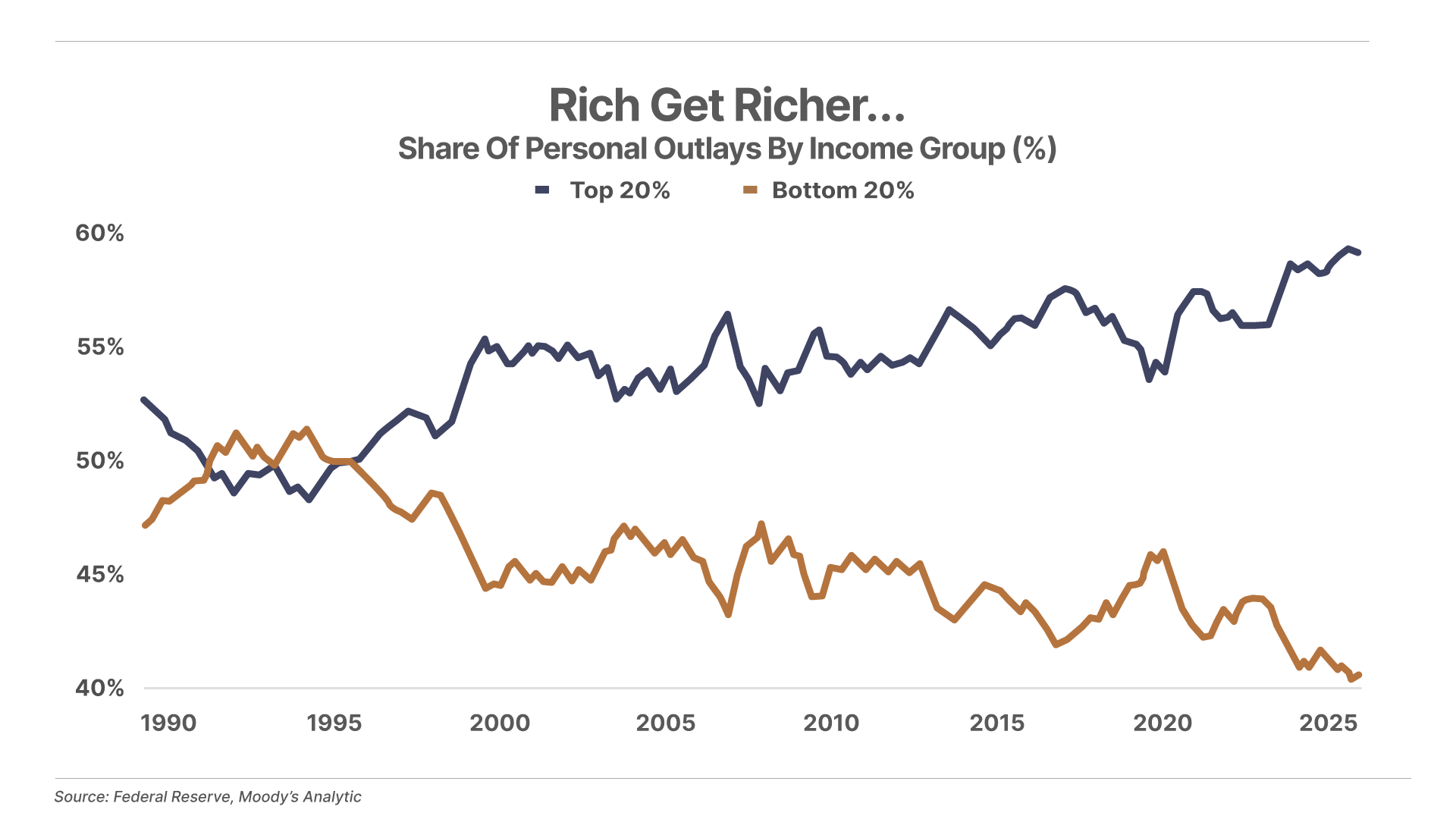
1. The K-shaped economy just hit a new extreme. The top 20% of U.S. earners now drive 58% of all personal spending – the highest share on record. Rewind to the 1990s, and the two groups split outlays roughly 50/50. The gap widened again last year: 6.5% versus 2.6% – that 2.6% trails the 2.7% consumer price index (“CPI”) rate, meaning real spending for 80% of the country is now contracting.
2. Micron crushes earnings. Memory chipmaker Micron Technology (MU) reported blowout fiscal Q3 results last night, including $41.5 billion in revenue, up 346% year-on-year and $6.2 billion ahead of analyst estimates. Net income soared to $28.2 billion, up from just $1.9 billion a year ago. Memory has emerged as the most critical supply chain bottleneck in the artificial intelligence infrastructure buildout, and only three companies can meet the demand, including Micron. Not a bad gig if you can get it.
3. The Trump administration is trying to ignite a nuclear renaissance. The Department Of Energy will offer $17.5 billion in low-interest loans to finance equipment for 10 Westinghouse AP1000 nuclear reactors – five two-unit projects – and seven utilities have already signed letters of intent. The pitch is that bulk equipment orders can supercharge a stalled supply chain, with new reactors potentially online by 2035, just as AI data centers push U.S. power demand higher. The obvious risk is cost: the only completed domestic AP1000 project, Georgia’s Vogtle plant, ran from $14 billion to over $30 billion and finished years late.
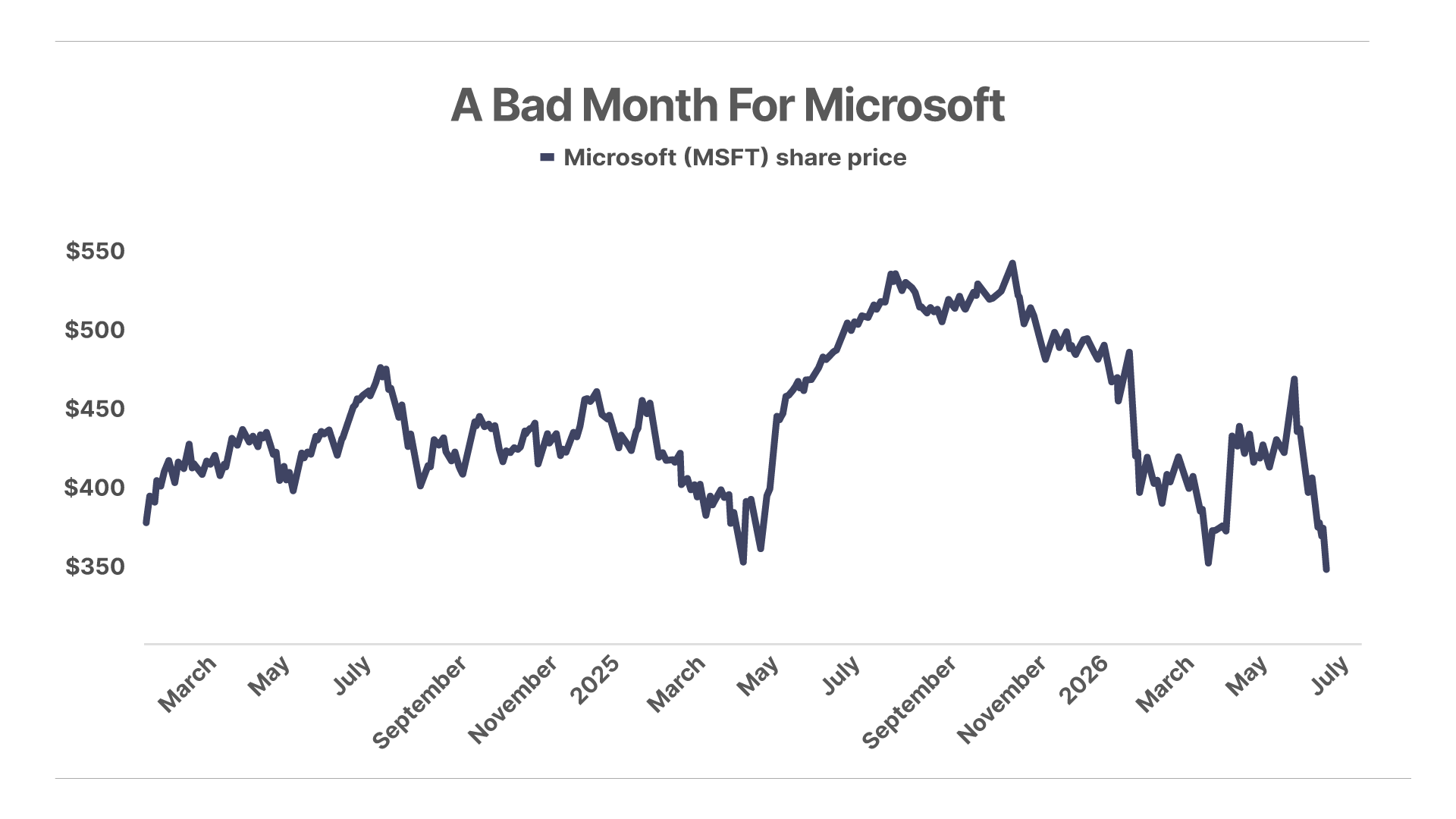
Chart Of The Day… Microsoft (MSFT)
Microsoft (MSFT) shares are down nearly 25% in June, on pace for their worst monthly decline since 2008. The Tech Frontiers’ short position on MSFT shares is up 15% since Erez Kalir recommended it to his subscribers in February.
Mailbag
Yesterday, Distressed Investing analyst Andy Lipman shared an essay outlining the limitations of artificial intelligence.
Jonathan L. writes:
I enjoyed reading the recent essay. I am surprised that the list of possible downsides of the “AI revolution” did not include these three considerations:
The rapid advance of the semiconductor components makes much of the inventory recently bought obsolete in short time frames like three years. How will such a model be profitable?
The Pentagon has disqualified Anthropic because it forbade use of its AI products to create autonomous killer weapons. This suggests that at a minimum, the U.S. armed forces want the capability to design and build such weapons without guardrails or any oversight. Indeed, they may already intend to build these weapons.
The onslaught of computerized voices already being implemented by most businesses is deeply frustrating to navigate. Banks, airlines, and insurance companies do not seem to care. The priority is cheap. I’d expect this to spread rapidly as AI deploys widely in our society. Perhaps our days are numbered before we no longer have the option to encounter a human in most of our transactions. My hope is that people all over will boycott companies that do so… even if it becomes inconvenient in the early days.
Michael S. writes:
Andy Lipman said: ‘AI models cannot grasp nuance, have power to reason, or express human empathy. (In fairness, some people can’t either.)”
In fairness, some people can’t either– I love it!
Debbie G. writes:
This article is so on-point! I really appreciate the topic and the way it is written. It works to provide context and data that helps quell the crazy emotions that can happen reading “AI” news. Thanks for the more objective viewpoint. Keep up the good work.
Porter & Co. Market Snapshot
| Price | Yesterday’s Return | Year-to-Date Return | |
|---|---|---|---|
| S&P 500 Index | $7,358.22 | -0.10% | 8.1% |
| Gold per ounce | $3,990.30 | -2.86% | -6.7% |
| Bitcoin | $60,995.13 | -2.44% | -30.2% |
| Oil (West Texas Intermediate) per barrel | $70.34 | -3.82% | 21.9% |
| Berkshire Hathaway (BRK) | $742,900.00 | 0.69% | -1.6% |
| Porter’s Permanent Portfolio | – | 0.03% | -1.9% |
| The Better Than Berkshire Index | – | 1.0% | 4.6% |
| Total Return | Annual Return | ||
| Porter & Co’s Top Ranked* | 34% | 13.7% | |
| Yield | Yesterday’s Change | Change Year-to-Date |
|
| U.S Treasury 30-Year Yield | 4.84% | -11 bps | 0 bps |
*A Complete Investor risk rating of 1 is defined as a “low risk, high allocation” security, while positions rated closer to a 5 are higher risk. Porter & Co.’s top-ranked positions include those rated either 1 or 2 in Complete Investor portfolio.
Porter & Co. Top Positions
| Publication | Ticker | Description | Total Return |
|---|---|---|---|
| Complete Investor | BWXT | BWX Technologies | 260% |
| Tech Frontiers | QURE | uniQure | 237% |
| Complete Investor | ARM | ARM Holdings | 160% |
| Tech Frontiers | NUVB | Nuvation Bio | 154% |
| Tech Frontiers | TGTX | TG Therapeutics | 151% |
| Tech Frontiers | ROIV | Roivant Sciences | 150% |
| Tech Frontiers | QURE | uniQure | 131% |
| Tech Frontiers | SGMT | Sagimet Biosciences | 128% |
| Complete Investor | BTC/USD | Bitcoin | 125% |
| Complete Investor | PM | Philip Morris | 122% |
Prices as of 4:00 pm ET June 24, 2026
Please note: The investments in our “Porter & Co. Top Positions” should not be considered current recommendations. These positions are the best performers across our publications – and the securities listed may (or may not) be above the current buy-up-to price. To learn more, visit the current recommendations page of the relevant service, here. To gain access or to learn more about our current recommendations, call our Customer Care team at 888-610-8895 or internationally at +1 443-815-4447.