Issue #94, Volume #3


Today’s Market Is A Bet On Low Interest Rates – And That’s A Bad Bet
Inside today’s Daily Journal…
|
I promised yesterday that I would tell you something most people don’t know about the Nifty Fifty.
But let’s start with what everyone “knows” about that incredible mania in the stock market.
Buying the Nifty Fifty – the market’s best and most expensive stocks in 1972 – was one of the worst possible financial decisions you could have made in the last 100 years. Your portfolio would have gone down 20% in 1973. And then another 38% in 1974. And the recovery did not come. The group’s price-to-earnings (P/E) ratios (that’s how much their shares cost expressed as a multiple of their earnings) declined from over 50x earnings to under 10x earnings by the early 1980s.
That’s the story I’m sure you’ve heard a dozen times before: the Nifty Fifty was a disaster for investors. But it’s not true. In fact, even if you bought those stocks at the absolute worst moment, right at their peak in December 1972, you still did pretty well, over the long term.
If you bought all those stocks at their peak, in December 1972, and you held for 25 years, you ended up compounding your capital at about 12.5% a year, which is more or less in line with the market’s average result. (See Financial Analysts Journal, “Valuing Growth Stocks: Revisiting The Nifty Fifty” published in 1998.)
How’s that possible? It’s simple. Inside those 50 stocks were some of the highest-quality businesses that have ever existed, companies that continued to compound capital at very high rates. Owning just a few of these stocks, for the long term, will make up for a lot of financial “sins.”
As you know, returns in the stock market have an extreme “power law” distribution, where only a few stocks earn virtually all the returns. In the Nifty Fifty, virtually all the returns accrued from 10 companies: Philip Morris International (PM), Merck (MRK), Coca-Cola (KO), Bristol-Myers Squibb (BMY), Pfizer (PFE), GE (GE), Schering, PepsiCo (PEP), Eli Lilly (LLY), and McDonald’s (MCD). The winners were all branded consumer products companies and pharma stocks. Why? Outstanding economics – very capital efficient businesses – and a moat against competition.
The other factor, and the one I want you to focus on today, was price.
The companies that performed the best for investors over the next 25 years were not trading at absurd multiples. The two best performers (Philip Morris: 18.8% annually, Pfizer: 18.1% annually) were trading around 25x earnings at their 1972 peaks. The disasters – Polaroid at 94.8x, MGIC Investment (MTG) at 68.5x, International Flavors & Fragrances (IFF) at 69.1x, Baxter International (BAX) at 71.4x – were the names with the absurd multiples in 1972.
Note: there was one exception – McDonald’s returned 12.1% annualized from December 1972 through August 1998 despite reaching 71.0x P/E in 1972. McDonald’s is probably the best business that’s been created in the last 80 years: even buying it at 70x earnings didn’t wreck future returns!
Throughout my career, I’ve consistently tried to explain that owning high-quality businesses is, hands down, the best way to protect yourself from economic downturns. Great businesses beat gold. They beat real estate. They even beat timber. When I try to explain why, most folks look at me like I have four eyes. That’s because they don’t understand what’s so exceptional about a Philip Morris, or a Coke, or a McDonald’s to an average business. They’re just not the same things – at all.
And, of course, price matters.
The thing that destroyed the Nifty Fifty in 1973 and 1974 was not a collapse in their businesses. Coca-Cola kept selling soda. Merck kept selling drugs. McDonald’s kept selling hamburgers. What killed the stocks was the high share price compared to earnings.
The group went into the bear market at 50x earnings and came out at 8x or 9x. That implies an 80% decline in share prices, assuming earnings remained flat.
That’s what you must understand about today’s market.
A high price compared to earnings (a high multiple) is a bet on low interest rates. When you pay 50x or 100x earnings for a company, you are saying that the cash flows in the distant future are worth a great deal in today’s dollars. But that is only true when the interest rate is low. Raise the interest rate, and the math justifying the higher multiple falls apart.
Let me show you the arithmetic, applied to real names at today’s real prices.
Here’s a sample list of 20 large-capitalization growth stocks, at their current prices and their current earnings multiples. Bring the P/E multiple down to 15x, which is roughly the long-run average for the S&P 500, then see what happens to the stock price.
This is not a worst case – 15x earnings is a normal, healthy multiple. It is what these stocks would be worth if the market simply stopped treating them as exceptions to the laws of finance.
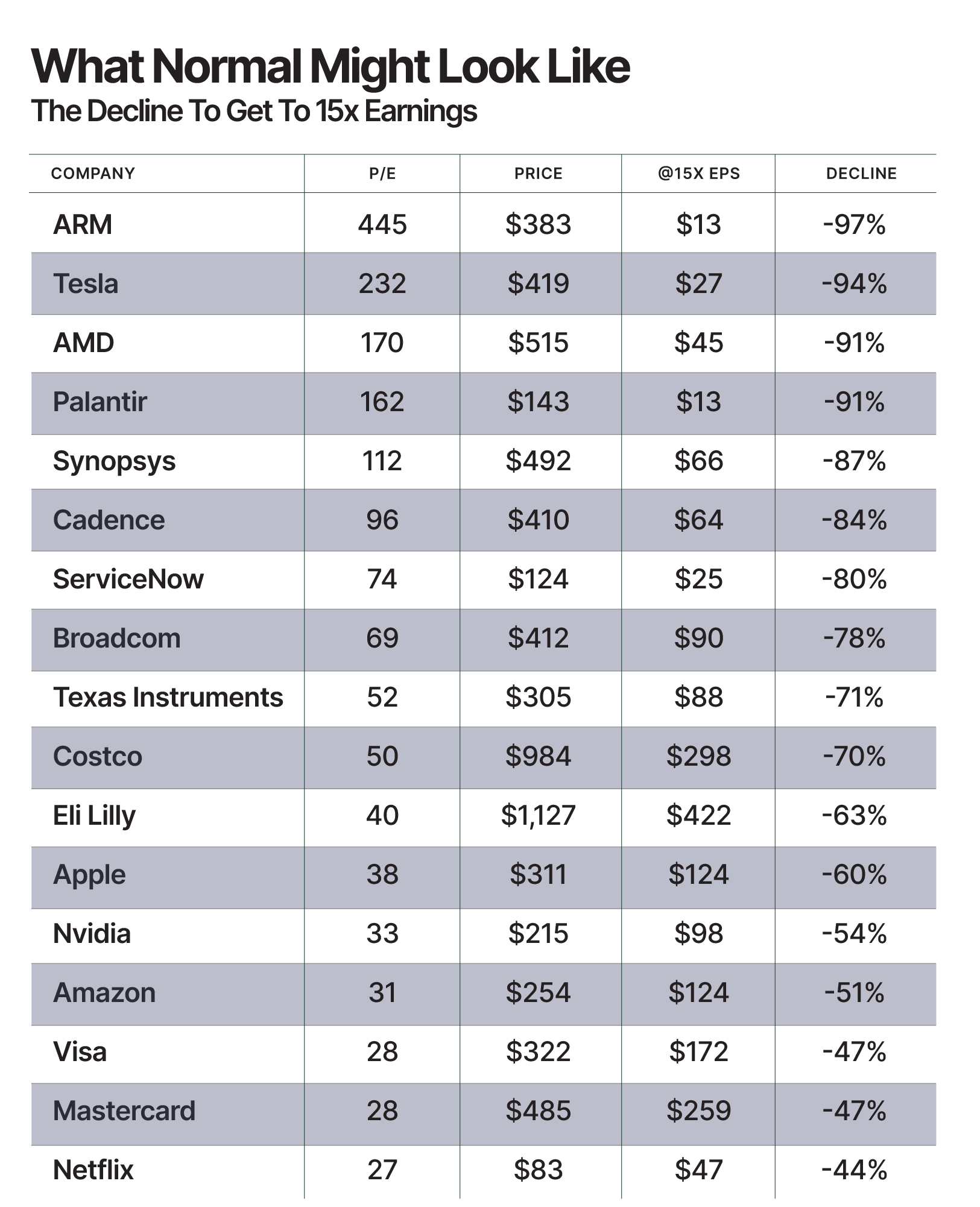
These are not bad companies. Nvidia (NVDA) builds the best chips in the world. Costco Wholesale (COST) is one of the finest retailers ever assembled. Visa (V) and Mastercard (MA) run the payment rails of the planet. Apple (AAPL) has the strongest brand in America. I am not predicting that any of them will fail as businesses. I am showing you that even if every one of them hits its earnings number exactly, a return to a normal multiple cuts the share price of the most expensive of them by 90% and the cheapest of them by more than 40%. The decline is in the multiple, not the company. And what will drive that decrease in multiples are interest rates.
That is precisely what happened to Polaroid, which fell 91%, and to Avon, which fell 86%, in 1974.
Over the past 40 years investors have only seen interest rates move lower. And lower. And lower. As a result, the earnings multiples on stocks have gone higher and higher and higher. But since COVID the bond market is down about 50%. Yields are moving higher. And higher. The Iran War isn’t going to reduce inflation. It’s going to make inflation go much higher. We will see the latest consumer price index (“CPI”) number tomorrow morning. It won’t be good news. And the yields will continue to move higher.
If you believe the economy is strong (4% growth) and you believe prices are going higher (CPI 6%) then you should see the 10-year yield at around 10%. That implies a market multiple of 10x – not 28x.
It is impossible to imagine that the bull market in stocks will survive any normalization of interest rates.
One important caveat. I am not saying this should lead you to sell any of the great businesses you own now. One of the things that has made Warren Buffett’s Berkshire Hathaway such an incredible compounder of capital is that, in the past, it has refused to sell its best businesses (Coke, American Express, Moody’s) despite prices on these stocks that would make purchasing them unattractive. There’s a huge difference between not buying a stock because it’s too expensive and selling a stock.
My advice: never, ever sell a great business. I suspect, in time, Berkshire’s decision to sell almost all its Apple shares will become the single biggest capital allocation error of all time.
You may decide to sell because your time horizon is short or because you do not want to sit through a big drawdown. But if you’re running permanent capital or if you’re managing a trust for your children, you don’t want to sell great businesses just because the market’s multiple is in decline. Look at how the best businesses in the Nifty Fifty performed over the next 25 years.
Given this warning, a fair question to ask me is: What are you doing with your personal portfolio?
This year has been very tough on my family’s portfolio. The portfolio was up 30% year-to-date by the end of February. But it has since given up all of its gains. The correction in gold has cost me dearly, as has the downturn in insurance companies. I’ve moved from a highly leveraged long position to being net short the market (via a short position in tech stocks), for the first time in many years. I believe interest rates are going higher. And I do not believe this bull market will survive 10-year Treasury yields in excess of 6%, which is where I believe rates are going.
As I’ve told you since the Iran War began, I will officially move our allocations in Porter’s Permanent Portfolio to 50% cash by selling our property and casualty (P&C) insurance stocks if (or when) interest rates on the 10-year Treasury breach the 5% level. For my own personal portfolio, I’ve begun to hedge against this risk
Tell me what you think of today’s Journal: porterstansberrydirect@gmail.com
Good investing,
F. Porter Stansberry
Stevenson, Maryland
3 Things To Know Before We Go…
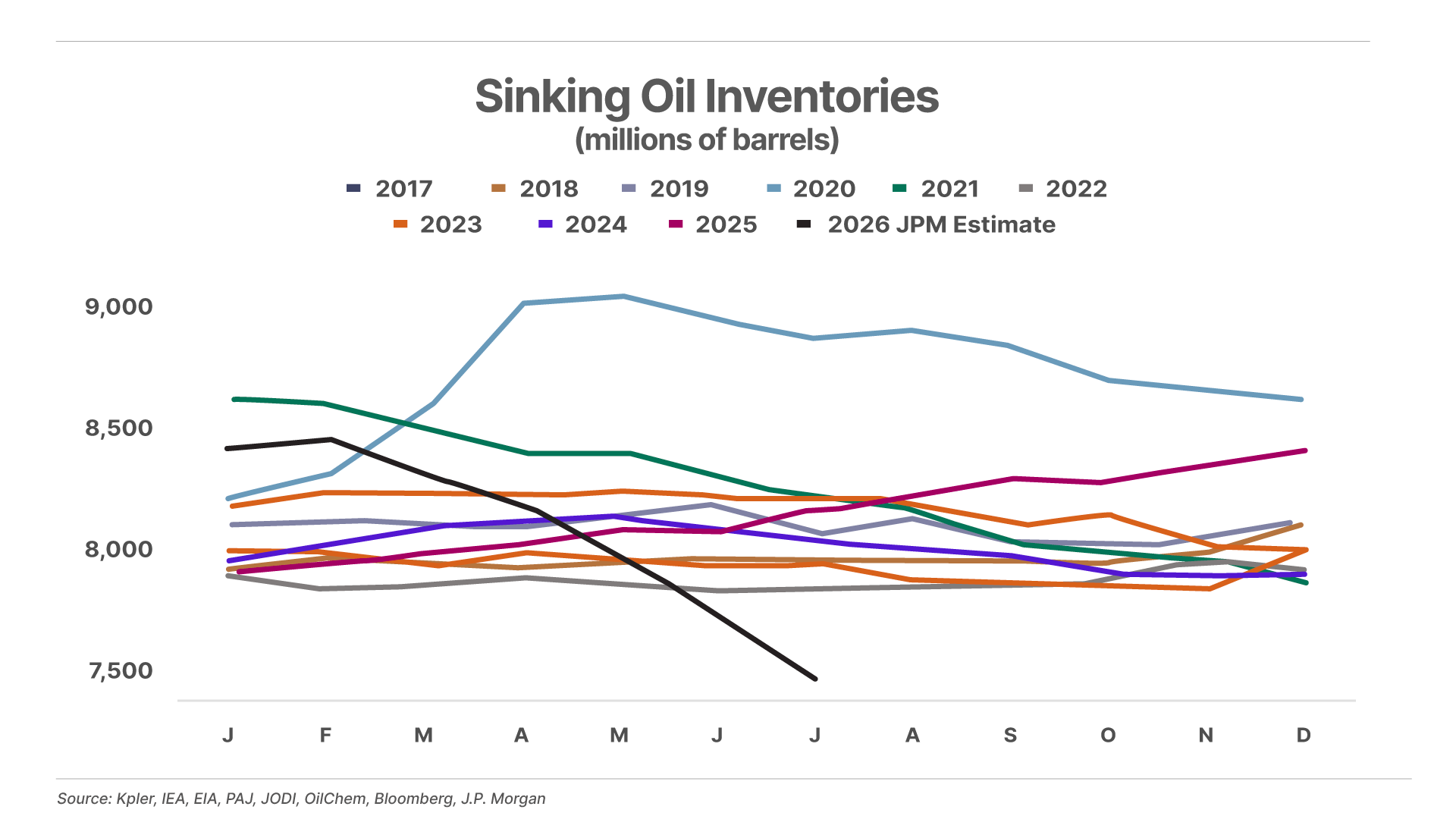
1. The big oil-supply squeeze. With the Strait of Hormuz shut for 101 days, global oil inventories are drawing down fast, to minimum operational limits – pipelines, terminals, and emergency reserves can only be drawn down so far before the system starts to ration supply. The squeeze isn’t behind us – it’s arriving.
2. Speculators bet on falling stock prices. The percentage of outstanding shares sold short in the median S&P 500 stock has risen to 3%, doubling from the recent low of 1.5% in 2020. This marks the highest level of short interest since 2009, during the depths of the Great Financial Crisis. The market’s over-valuation is becoming clearer for everyone to see now.
3. A concentrated labor market keeps the Fed on high alert… 60% of job gains over the last three months came from just two sectors: Healthcare & Social Assistance (198,000) and Leisure & Hospitality (144,000). This hyper-concentration highlights a bifurcated economy where service and care sectors remain highly resilient. If these sticky, hard-to-automate industries continue driving wage growth, broader service inflation will persist, forcing the Fed to keep interest rates higher for longer.
Chart Of The Day… The S&P 500
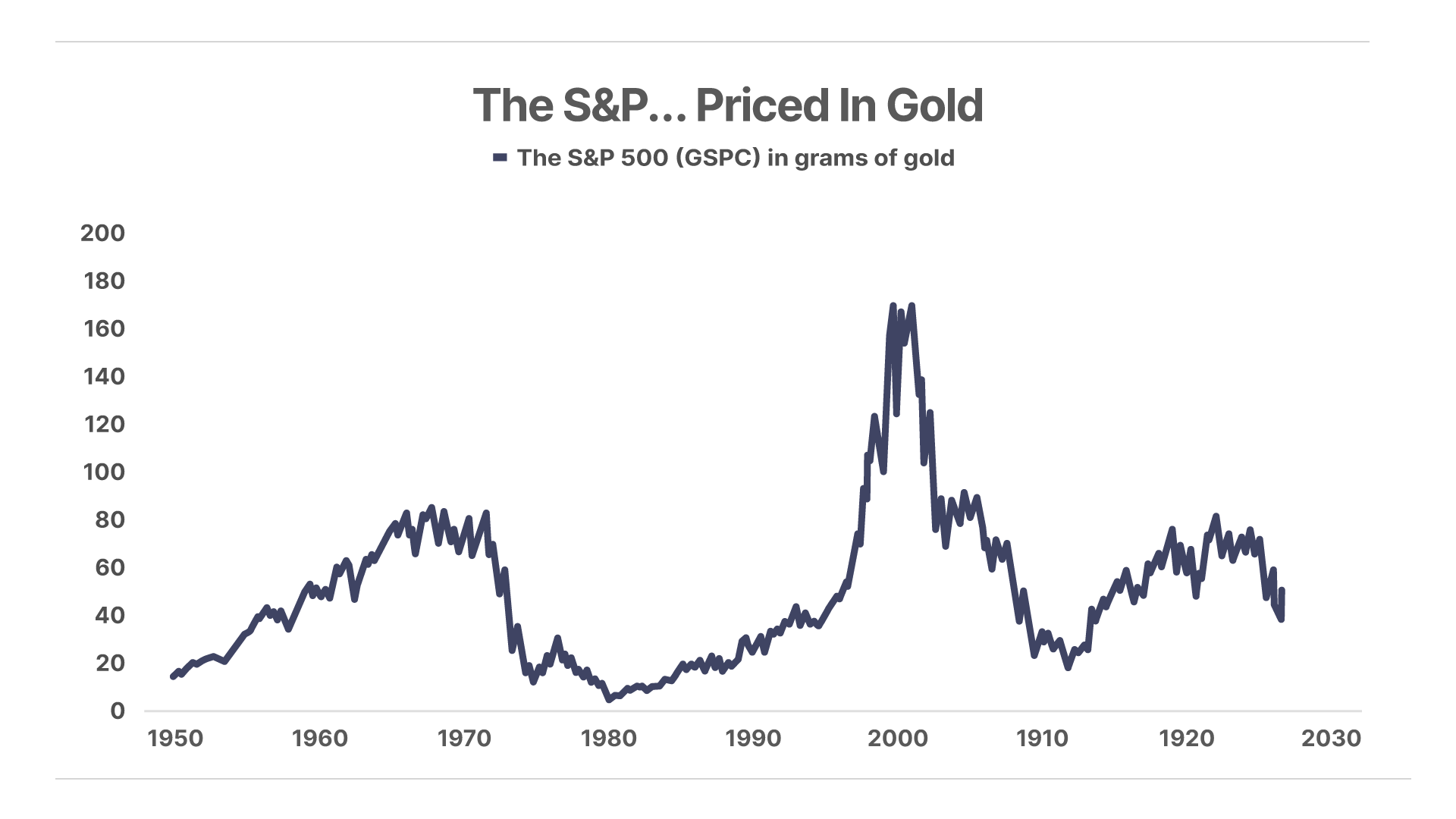
After another fantastic start to the year, the S&P 500 is now up 57% from its 2021 bull market peak, and well over 400% from its 2000 dot-com bubble peak. However, when priced in gold – real money that can’t be debased by the government – the index’s performance is downright dismal: it has lost 35% of its value since 2021, and nearly 70% since 2000.
Mailbag
“What No One Else Will Tell You About Trump, Iran, And The Next Crisis”
David C. writes:
Porter,
Monday’s Journal is absolutely brilliant. It puts a lot of today in the correct perspective. I will be very interested in what you say next.
But I think there is a missing ingredient you should consider. Taxes. Corporate taxes have been reduced to an absurdly low rate. I agree that we as a country spend more than our income. But it isn’t just the spending – the income is too low because of the tax rate. If I start a company and sell it five years later for a big sum, my tax rate is zero. And our 21% corporate rate was about 35% years ago.
I hope you take that into consideration.
Porter Comment: You’re saying, I think, that what we need to do, to improve our economy and our standard of living, is give more resources to an institution that’s already the largest in the country (by a factor of 10x), that doesn’t produce anything, that isn’t disciplined by the market, that hasn’t run a balanced budget in my lifetime, that has run up $40 trillion in debt, that continues to debase our money, that starts wars around the world, and that has mismanaged our retirement system so badly that it is another $100 trillion in the hole? Assuming I have understood you, I would love to see how you’ve made your other life decisions. It would be a remarkable memoir, I bet.
“The Average American Does Not See Your Work”
F. Major writes:
Porter, as usual, you nailed it, but I worry that the average American does not see your work and the hardest part is many do not seem to care. They are living in a dream world that will soon collapse around their ears.
Porter Comment: I’ll follow what JP Morgan said – “Don’t talk to me about appealing to the public. I am done with the public.”
“There Will Be Many Losers And Some Will Get Violent”
Carl H. writes:
Porter,
I was investing in the market from 1965 on. I remember the Nifty Fifty well though I never bought them. You stated only the facts, and they are the facts. Where it leads is certainly a big problem for us and a big question as to what will happen. There will be many losers and some of them will be angry and get violent. If anyone knows the whole problem and could have a solution it is Trump. Any other answer is almost certainly a collapsed economy and a partial civil war. Somehow Trump has to reduce spending to a cash positive level, keep the lid on violence, and make the losers think they will not lose much or they can handle it.
Porter Comment: I’ve met Trump. And I’m certain we’ve never had a president who is more economically delusional. Ronald Reagan understood the core concepts in economics better than any president since Calvin Coolidge. And Bill Clinton was a bona fide genius. He was probably the smartest president we’ve had in the modern period. The last 25 years has been a parade of dunces in the White House. Just when you thought it couldn’t possibly get any worse, yet another clown steps out of the car.
Porter & Co. Market Snapshot
| Price | Yesterday’s Return | Year-to-Date Return | |
|---|---|---|---|
| S&P 500 Index | $7,405.73 | 0.30% | 8.7% |
| Gold per ounce | $4,330.17 | -0.10% | 0.5% |
| Bitcoin | $63,470 | 2.62% | -28.9% |
| Oil (West Texas Intermediate) per barrel | $91.30 | -1.83% | 54.3% |
| Berkshire Hathaway (BRK) | $726,685.00 | -0.94% | -3.7% |
| Porter’s Permanent Portfolio | – | -0.33% | -3.2% |
| The Better Than Berkshire Index | – | -1.21% | 1.6% |
| Total Return | Annual Return | ||
| Porter & Co’s Top Ranked* | 30.4% | 13.6% | |
| Yield | Yesterday’s Change | Change Year-to-Date |
|
| U.S Treasury 30-Year Yield | 4.04% | 4 bps | 19 bps |
*A Complete Investor risk rating of 1 is defined as a “low risk, high allocation” security, while positions rated closer to a 5 are higher risk. Porter & Co.’s top-ranked positions include those rated either 1 or 2 in Complete Investor portfolio.
Porter & Co. Top Positions
| Publication | Ticker | Description | Total Return |
|---|---|---|---|
| Tech Frontiers | QURE | uniQure | 237% |
| Complete Investor | BWXT | BWX Technologies | 229% |
| Complete Investor | ARM | ARM Holdings | 150% |
| Complete Investor | BTC/USD | Bitcoin | 134% |
| Tech Frontiers | QURE | uniQure | 131% |
| Tech Frontiers | ROIV | Roivant Sciences | 126% |
| Tech Frontiers | SGMT | Sagimet Biosciences | 121% |
| Complete Investor | PM | Philip Morris | 119% |
| Tech Frontiers | TGTX | TG Therapeutics | 118% |
| Distressed Investing | PTON | Peloton Interactive | 103% |
Prices as of 4:00 pm ET June 8, 2026
Please note: The investments in our “Porter & Co. Top Positions” should not be considered current recommendations. These positions are the best performers across our publications – and the securities listed may (or may not) be above the current buy-up-to price. To learn more, visit the current recommendations page of the relevant service, here. To gain access or to learn more about our current recommendations, call our Customer Care team at 888-610-8895 or internationally at +1 443-815-4447.