Issue #111, Volume #3


Nothing Beats Buying A Great Business When No One Else Wants It
Inside today’s Daily Journal…
|
Editor’s note: Porter’s 2029: The End of America is now available as an Audible book here, or to read from Amazon here.
Today, all investors want is artificial intelligence (“AI”): Chips. Memory. Power.
But you’re paying a very high price for AI’s growth forecast. No, valuation isn’t destiny – growth investors can still outperform the market, even when they buy at high multiples. But valuation is a huge risk. When you’re buying at 50x earnings, or 100x revenue (in the case of SpaceX), there’s a long way to fall if anything goes wrong.
Call me old-fashioned, but I like proven business models. I like moats. And I like very steady, proven revenue streams that grow, year after year. I especially like these things when they’re wrapped around a great business with outstanding economics.
But today, nobody cares about that stuff. Investors just want more AI meme stocks.
Case in point: CoStar Group (CSGP).
CoStar’s core product is CoStar Suite – a subscription platform that commercial real estate professionals use to research, value, and transact on properties. This might not seem that important, at first glance. I mean, with the internet, isn’t all information essentially free…?
Not at all.
When a commercial real estate broker underwrites a building, he needs the actual lease comps: who signed, at what net effective rent, with how many months of free rent buried in the concession package. He needs the true vacancy, floor by floor, not the number on the marketing flyer. He needs the sale that closed off-market and never hit a public listing.
CoStar produces this market-critical data the only way it can be produced – with a small army of researchers on the phone, in the field, building and verifying a proprietary database that took 40 years to assemble. That’s why the product has 317,000 subscribers and a 92% renewal rate.
The stock market has come to believe that AI will kill this business model and also destroy the value of CoStar’s recent investments into residential real estate information services (Apartments.com, Homes.com). The stock is down 55% year-to-date. And it’s down 69% from its 2025 high, near $100 per share.
The sell-off has seen the company thrown out of the Nasdaq-100. And now the activist investors (Third Point) are circling. The stock chart looks like a falling knife.
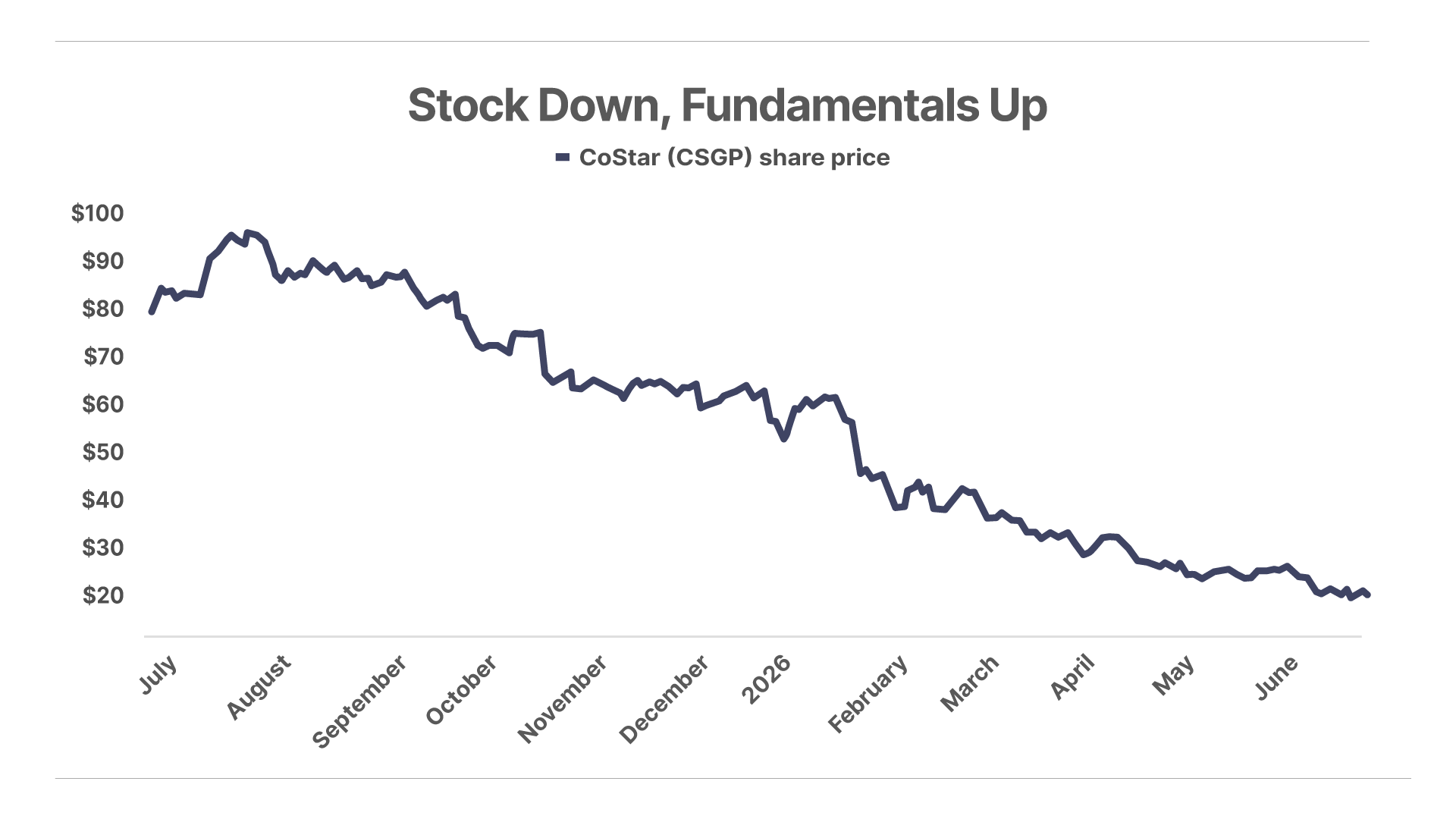 But… nothing has changed about the company’s actual business performance.
Adjusted EBITDA (earnings before interest, taxes, dividends, and amortization) grew 83% last year to $442 million. Consensus has it growing another 83% this year to roughly $807 million. Net income is projected to compound in the neighborhood of 62% a year through 2028. And free cash flow swung from negative $245 million last year to positive $41 million this year, as its investments into residential databases have begun to pay off.
What The Market’s Missing
The combination of proprietary data and AI makes CoStar a better business, not a dying model. The company put an AI search layer on Homes.com and saw traffic jump 119%, with its paying customer base growing to 35,000. Artificial intelligence turns a proprietary dataset into a more valuable product, because the data is the scarce input and the interface is the cheap one. CoStar owns the scarce half – the one that is hard to replicate. As AI gets cheaper and better, it will make CoStar’s database much more valuable.
If AI were destroying CoStar’s moat, you’d see declines in its core business. But CoStar’s core commercial customer count rose 22% to 317,000 over the last year.
That’s the 60th consecutive quarter – 15 straight years – of at least double-digit revenue growth.
AI won’t destroy CoStar. The company’s future really depends on the outcome of its recent large investments. CoStar is spending enormous sums to build consumer marketplaces: Homes.com, Apartments.com, and its latest – an $800 million acquisition of Zonda, which provides data on new home construction and related activities.
CoStar’s core business (commercial) threw off $127 million of profit last quarter. But residential lost $46 million, and those losses widened from $16 million the quarter before. Company-wide margins tell the same story. Adjusted EBITDA margin sits at 13% against 29% in 2021. CoStar is reinvesting half of its profits to build a new residential database business where there’s a lot more competition, like from online real-estate marketplace Zillow (Z).
Will it work? We can’t know. But the man running the strategy, Andrew Florance, founded the company in 1987. He’s been running the same playbook for nearly 40 years. He’s on the record saying that the residential losses will inflect to breakeven by year-end.
If you value CoStar on its commercial business alone (the 317,000 customers, the 15 years of double-digit growth), the residential platforms come nearly free. CoStar trades at about 22x forward earnings and under 15x forward EBITDA for a franchise growing its top line by double digits, year after year, with 80%-plus gross margins.
And if the company’s residential investments work, there’s a new, multi-decade growth path ahead.
Founder Florance bought $2.5 million worth of stock in February near $45 and then bought more as the stock fell – another $2.5 million worth of open-market purchases at around $35 in May.
Who’s right – the founder or the skeptics?
I’m betting on the founder. Ask me how I know… porterstansberrydirect@gmail.com
Good investing,
F. Porter Stansberry
Stevenson, Maryland

3 Things To Know Before We Go…
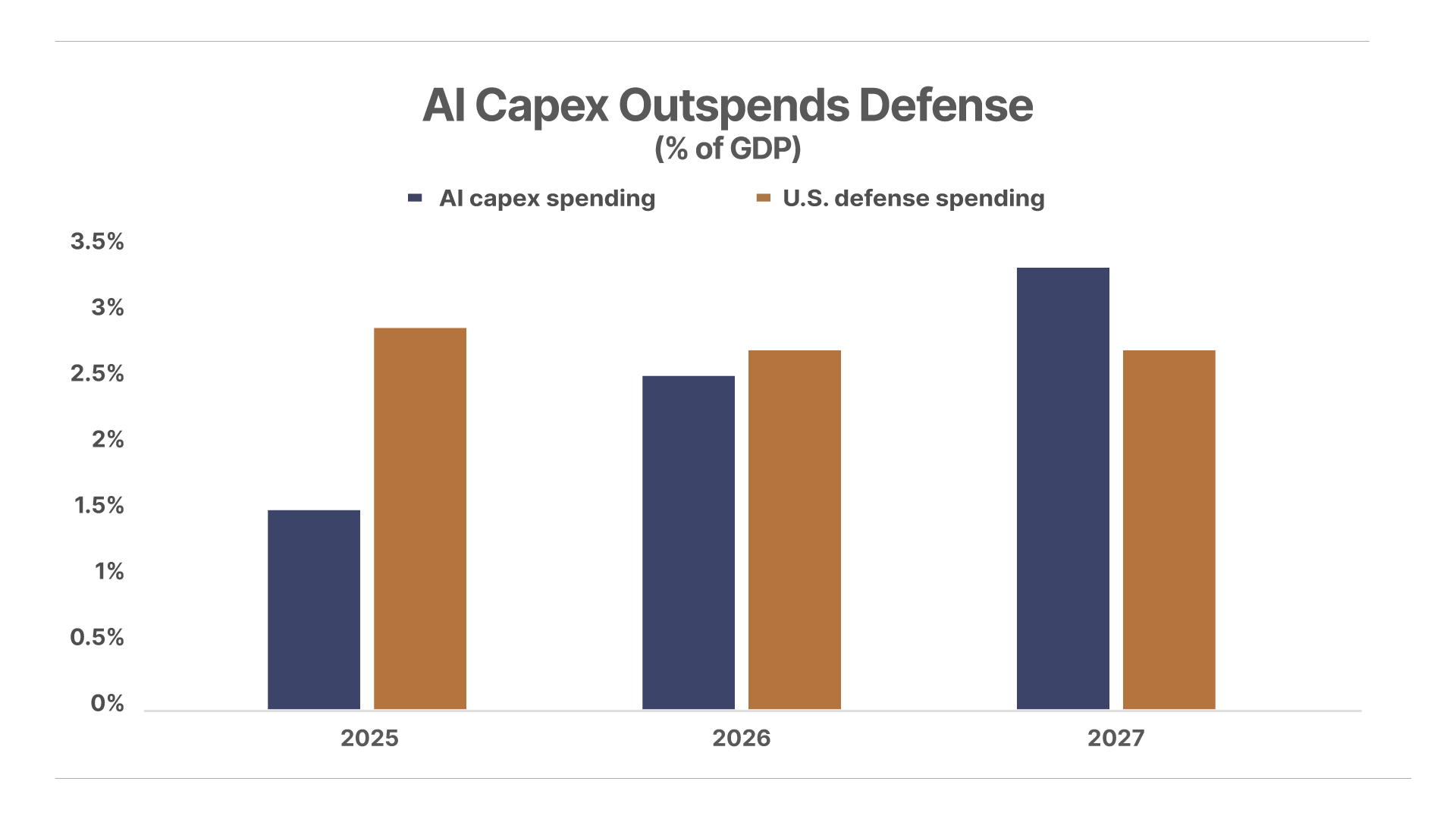
1. The AI capex boom is rewriting America’s spending priorities. Morgan Stanley projects AI capex across Alphabet (GOOG), Amazon (AMZN), Meta (META), Microsoft (MSFT), and Oracle (ORCL) will reach $805 billion this year – that’s 2.5% of U.S. GDP… If it reaches $1.1 trillion in 2027 (3.2% of GDP) as expected, the infrastructure budgets of five companies would exceed U.S. national defense spending. The capex has to flow somewhere, but investors will need to generate returns to sustain this build-out.
2. OPEC+ hikes output as crude prices sink to pre-war levels. The oil cartel’s seven core producers – Saudi Arabia, Russia, Iraq, Kuwait, Kazakhstan, Algeria, and Oman – agreed Sunday to add 188,000 barrels a day (“b/d”) to their August quota, the fifth straight monthly hike. Since the war in Iran began in February, cumulative quota increases now total 940,000 b/d – nearly 1% of global demand – and that no longer includes the UAE, which left the group in May and can now pump without a quota. West Texas Intermediate (“WTI”) crude is trading below $69 per barrel, down 25% over the past month and back near pre-war levels for the first time since the conflict began.
3. Central banks’ gold-buying streak continues. Central banks bought 41 tonnes of gold in May – the second-highest total this year – led by Poland (18 tonnes) and China (10 tonnes and its 20th consecutive monthly purchase). Central banks have scooped up roughly 1,000 tonnes annually for four years running, double the prior decade’s pace. And they aren’t flinching at price weakness: 45% of central bankers surveyed expect their own institution’s gold reserves to grow over the next 12 months.
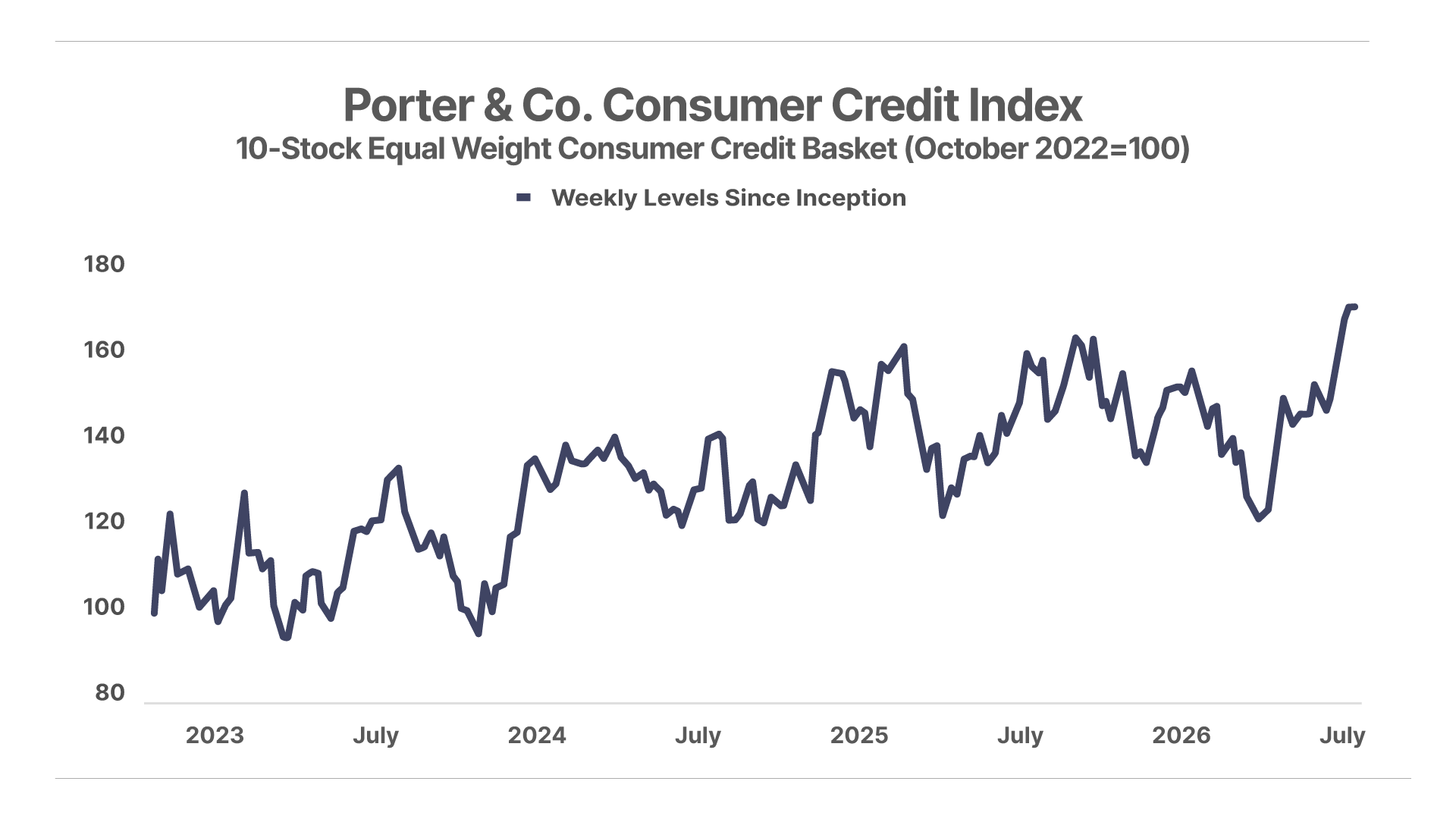
Chart Of The Day… Porter & Co. Consumer Credit Index
The Porter & Co. Consumer Credit Index is a 10-stock, equal-weight basket tracking U.S. consumer credit providers across buy now pay later (“BNPL”), subprime auto, subprime personal lending, and used auto retail, indexed to 100 as of October 2022. After plunging to multi-year lows this spring, the index has since rebounded sharply to a new high near 170, suggesting the near-term risk of a credit-default cycle is easing.
Mailbag
In Thursday’s Daily Journal, Porter wrote that Erez Kalir’s Biotech Frontiers recommendation, Roivant Sciences (ROIV), is likely to be a beneficiary of artificial intelligence, which will help the company’s drug selection significantly. A number of readers commented.
“It Was Magnificent”
Lou T. writes:
Regarding the communique on ROIV, it was magnificent. It’s been 30 years that I have been reading Porter’s writings. When he decided to open up the Porter & Co. operation I was already sold on his abilities. I became one of the earliest members of his new company. This article was the kind of writing I was expecting when I did that. Keep it up.
“Patience, Patience, Patience”
Gary D. writes:
Just dammit!
Sometimes, I’m too impatient. I followed Erez’s recommendation and bought 200 shares of ROIV and subsequently watched it languish.
I’m too much like my wife, the accredited Advanced Master Gardener with credentials from Michigan State University. When she plants something new, her expectation is for it to flourish. If after a period of time, which is rarely, there is a failure to thrive, she yanks it out and tries something else.
Well, with that setup you know what I did. So if you believe there is the potential for additional 10x from here with Roivant, I put in an after-hours order for 100 shares with a limit price of $34. We’ll see if it gets filled.
At the top of my tracking spreadsheet I had added the banner headline PATIENCE. I’m going to try to follow that advice from now on.
Yours in immeasurable patience.
“Giving It Another Try”
Ghassan K. writes:
I did purchase a small position of Roivant when it was around $10 on the assumption that it was closely connected to the Trump White House. I was not a strong believer in the efficacy of its model and so I liquidated when it was around $13. Maybe I should give it another try. Thanks for the update.
Porter & Co. Market Snapshot
| Price | Thursday’s Return | Year-to-Date Return | |
|---|---|---|---|
| S&P 500 Index | $7,483.24 | 0.00% | 10.0% |
| Gold per ounce | $4,176.94 | 1.32% | -4.1% |
| Bitcoin | $62,685 | -0.79% | -29.9% |
| Oil (West Texas Intermediate) per barrel | $68.69 | -10.78% | 19.3% |
| Berkshire Hathaway (BRK) | $761,579.98 | 1.41% | 0.9% |
| Porter’s Permanent Portfolio | – | 1.92% | 1.8% |
| The Better Than Berkshire Index | – | 1.93% | 9.9% |
| Total Return | Annual Return | ||
| Porter & Co’s Top Ranked* | 37% | 17.5% | |
| Yield | Thursday’s Change | Change Year-to-Date |
|
| U.S Treasury 30-Year Yield | 4.99% | 2 bps | 14 bps |
*A Complete Investor risk rating of 1 is defined as a “low risk, high allocation” security, while positions rated closer to a 5 are higher risk. Porter & Co.’s top-ranked positions include those rated either 1 or 2 in Complete Investor portfolio.
Porter & Co. Top Positions
| Publication | Ticker | Description | Total Return |
|---|---|---|---|
| Tech Frontiers | QURE | uniQure | 237% |
| Complete Investor | BWXT | BWX Technologies | 235% |
| Tech Frontiers | ROIV | Roivant Sciences | 155% |
| Tech Frontiers | TGTX | TG Therapeutics | 150% |
| Complete Investor | SKWD | Skyward Specialty Insurance | 149% |
| Tech Frontiers | SGMT | Sagimet Biosciences | 141% |
| Complete Investor | BTC/USD | Bitcoin | 135% |
| Tech Frontiers | QURE | uniQure | 131% |
| Complete Investor | ARM | ARM Holdings | 128% |
| Complete Investor | PM | Philip Morris | 127% |
Prices as of 4:00 pm ET July 2, 2026
Please note: The investments in our “Porter & Co. Top Positions” should not be considered current recommendations. These positions are the best performers across our publications – and the securities listed may (or may not) be above the current buy-up-to price. To learn more, visit the current recommendations page of the relevant service, here. To gain access or to learn more about our current recommendations, call our Customer Care team at 888-610-8895 or internationally at +1 443-815-4447.