Issue #96, Volume #3


Grabbing A Piece Of The New Money Order
Inside today’s Daily Journal…
|
Editor’s note: Porter has turned the Journal over to E.B. Tucker, publisher of The Tucker Letter – a biweekly financial newsletter that helps investors navigate today’s shifting modern economy.
There’s a New Fed in the works. Once you cozy up to it, you’ll definitely miss the old one.
It only took people about a hundred years to figure out the structure of the U.S. Federal Reserve – the one with the exclusive right to print money. The same money many people do unconscionable things to get.
Sure, there were people who tried to point it out. We called them kooks, or worse. Any truthful discussion about the Fed during its first century only landed with a fringe audience, with the few who really understood it.
That’s about to change. And it’s not good. In fact, when you hear people rant about the Fed, tell them they don’t know how good they have it…
Controlled Demolition
Think of the transformation of the Fed like a controlled demolition – one of those dramatic moments where they turn a seemingly healthy 10-story building into a neat pile of rubble in about 30 seconds.
Extensive planning is why those controlled demos go so well. Engineers spend days strapping blast packs to load-bearing pilings. They remove things like glass and shrapnel. They sort of turn the whole thing into a dramatic, yet choreographed show.
That’s how the Old Fed may go down. With mobs of citizens stomping outside the D.C. headquarters.
You’d see a 60 Minutes profile… “Who Stole Our Money?” They’d interview some lady in Shreveport, Louisiana, who can’t afford her blood-pressure meds anymore for some monetary reason.
Whip up the public rage and topple the old institution like that statue of Iraqi dictator Saddam Hussein they pre-strung a rope to and had cameras standing by ready to capture the moment.
Think back to any crisis event. There’s always a pre-cooked solution ready to go. There’s even unified talking points on how to sell it to the intelligentsia. You know, the kind of people who like to really study prison before they go, so they feel like it was their decision.
Every time though, it seems like the solution is worse than the problem.
For instance, the U.S. Patriot Act is something no patriot would tolerate. The 2008 financial reform legislation made it virtually impossible to build a large business without greasing up a thousand hands in Washington and New York. And the healthcare fix… well, just try going to an American doctor and see for yourself.
Yet in all those instances, people demanded these changes. They insisted on them… and it makes you wonder if whipping up the public mob is part of the plan.
Either way, there will be a New Fed. There has to be. The old one doesn’t work anymore.
Lost Its Effect
The first Fed had sort of spigot control on the U.S. economy.
To satisfy the public, the Fed organized the bank with regional branches. The idea was that the Atlanta branch watched over the South. The governor of that bank reported back to HQ.
HQ looked like it was in Washington, with all the “elected” leaders. But it wasn’t…
The New York branch of the Old Fed had all the power. Coincidentally, the key New York banks owned shares in that Fed branch.
That worked well for about a century. People completely ignored the arrangement… they sweated it out in factories for money created and controlled by New York banks. Totally unaware of the setup.
Behind the scenes, the bankers at first used interest rates and bank lending ratios to control commerce. Too hot, turn the spigot to the right. Too cold, turn it to the left.
Commerce is hard to contain. For a while, sure, but over time, it’s a living organism. We all collectively make it up. Millions of personal decisions, risks, avoidances, and steps we take in life all factor into it. It’s why, after a few decades, things got a little wonky.
The Fed of the 1970s pushed buttons like a teenage passenger being asked to emergency land a Boeing jetliner. Fed Chair Paul Volcker did the 1980s thing, and it was the first successful “managing” of things through Fed action.
Then they kept the levers going for a while, and things got insane. Fast-forward to today and we’re swimming in cash.
We all sort of know the state of money is not normal. Trillion-dollar IPOs, a family office for everyone, and many people at rock bottom on the happiness scale.
Something has to give. And it will. The issue is, we’ll panic our way right into a new chapter. A much darker one.
The New Fed needs new tools. Just try visiting a traditional bank branch… it’s like a city utility office in there.
A new business owner might never need a traditional bank. Modern borrowers rarely do either. And investors certainly have better options.
The ability to control commerce moved away from the Old Fed’s mechanisms. If you can’t steer the economy through bank reserves and rates anymore, you need a new steering wheel… one wired directly to the money itself.
The New Fed might include the largest banks. You know the names… but it’ll have a new class of owners. Stablecoin issuers. You watch.
I’ll admit, the first time I heard about a stablecoin I thought it was the dumbest idea ever. Digital dollars pegged at a value of $1.00 instead of just regular dollars… it made no sense to me.
Slowly, I watched these stablecoin issuers grow. They somehow had a regulatory pass. That made even less sense. People wrote about them harshly. Yet they got bigger… much bigger.
And it was only in the dollar system. Stablecoins are a U.S. thing… the Fed is a U.S. thing.
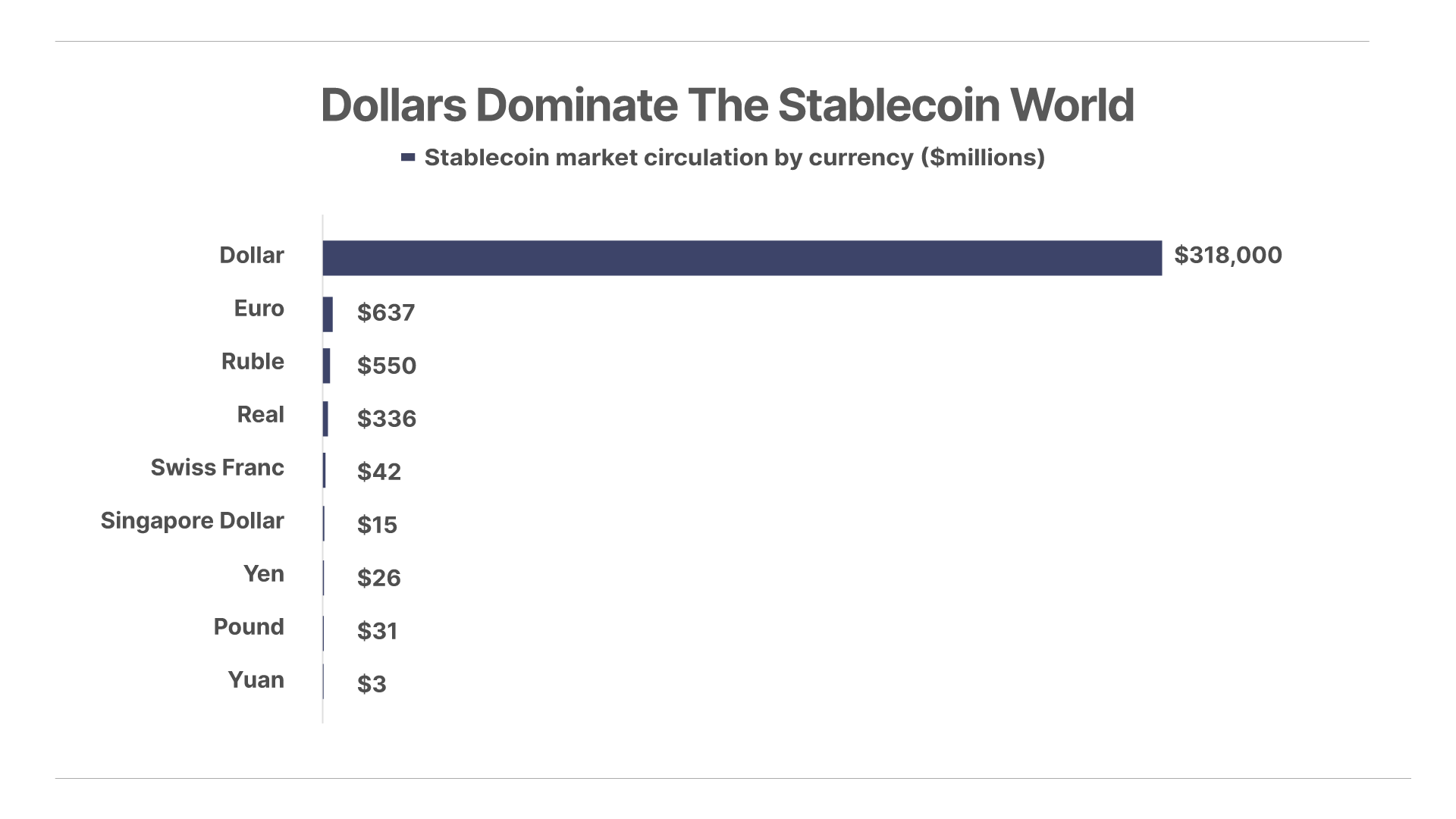
Plus, the business of issuing a stablecoin fascinated me.
People hand over large sums of old-fashioned dollars. The issuer in return gives them digital tokens worth $1.00 each.
Meanwhile, the issuer buys U.S. Treasuries, stocks, gold, whatever else, with the money. People apparently rarely want the dollars back.
That turns the stablecoin issuers into the world’s most enviable hedge funds.
Seat At The Table
The more you look, the more obvious the whole thing seems.
The regulatory pass was all about letting the private market develop this technology quickly. Regulators could hijack it later once perfected.
Governments love control, and they’ll have it at a level George Orwell never dreamed of in 1984. These closed-loop blockchains track, trace, and trap every single currency unit living on them. Once compliance is mandatory… you’ll be left trading baseball cards on the black market if you opt out.
The New Fed might have a mix of banks and stablecoin issuers. It looks like the savages at the top of the heap already see it coming. And they want a seat, and realize the cost of not having one.
You see, there’s a provision in the U.S. Senate’s proposed CLARITY Act that would allow crypto firms to offer yields on stablecoin holdings.
Coinbase CEO Brian Armstrong supports the CLARITY Act, arguing that allowing stablecoin yields is necessary to foster innovation, compete with traditional finance, and keep the U.S. at the forefront of digital assets. Banks, he says, oppose it simply because it threatens their historical lock on deposit yields.
Traditional bankers like JPMorgan CEO Jamie Dimon warn that unregulated stablecoin yields without federal protections could lead to systemic failures and deposit flight from traditional banks.
And the fight is getting nasty…
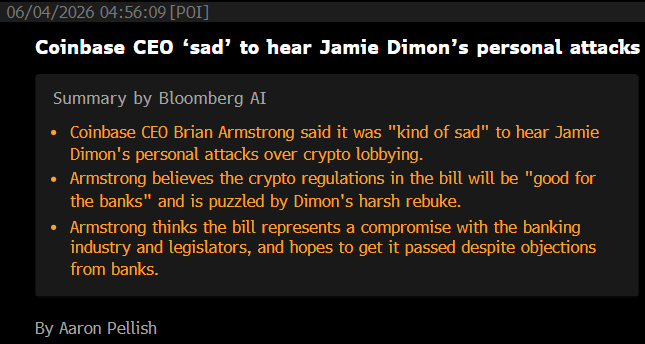
You see who’s lobbying whom and it’s clear this is coming down the pipe ASAP. The stakes are huge. While the stablecoins themselves are of little speculative use… there are a few companies behind them that might be.
We’ve Made The Bets
The world keeps turning. There are always winners in the next chapter, however radical it might seem on the cusp. At The Tucker Letter, we’ve made some key bets around this big change.
This isn’t the kind of thing that plays out in a week or a month. We’re talking life-altering changes. The battleship turns around slowly. When it slams into the dock, it only feels fast.
There’s one key stablecoin issuer already trading publicly. We like it. It trades on the NYSE and sits at 1/20th the valuation of a private peer trying to list soon. That feels like a lot of upside… time will tell.
There are other ways to play it. Some should work – others won’t. That’s how investing in tomorrow goes. You see the setup, but the play unfolds in its own time. Getting it close to right is usually profitable enough to outrun everyone else you know.
It worked out well on a big gold call years ago… But that’s sort of ancient history now. Gold has a value of $32 trillion today… Bitcoin for instance has a value of $1.22 trillion.
While it’s great to own some gold, the future is digital. The bets are already placed.
You can follow me at The Tucker Letter or use this special link exclusive to readers of Porter’s Daily Journal.

E.B. Tucker
The Tucker Letter
Keep in mind, we at Porter & Co. only publish guest essays from publishers we know to offer well-researched ideas vetted by a legal team, excellent customer service, and reasonable refund policies. The Tucker Letter is one such partner. We do not, however, under any circumstances, make any representations about their investment ideas or strategies, nor will we warrant them as equal to our own. We do recognize that the markets are tempestuous and, at times, ideas that we may not endorse prove valuable.
Tell us what you think of today’s Journal: porterstansberrydirect@gmail.com

3 Things To Know Before We Go…
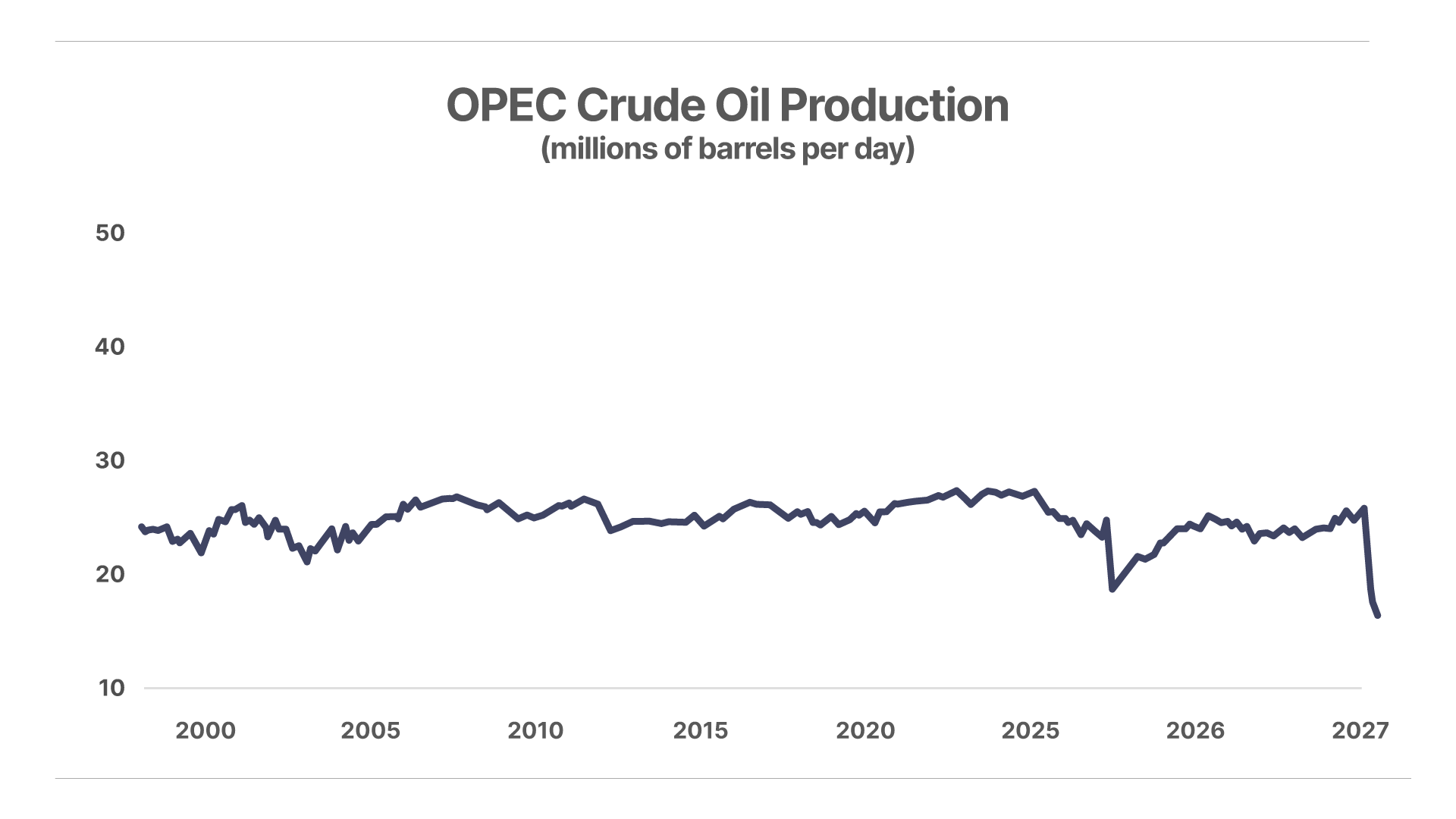
1. OPEC oil output just hit its lowest level since at least 2000. The 11-member Organization of the Petroleum Exporting Countries (“OPEC”) pumped 16.13 million barrels per day (“bpd”) in May, down 1.06 million bpd month-over-month and below even COVID-era lows, according to a Reuters survey. Eight members of the larger OPEC+ group, which includes Russia and 10 other allies, had planned to raise output in May, but the Iran War – and its resulting shutdown of the Strait of Hormuz – made that impossible.
2. OpenAI’s valuation questioned. Japanese conglomerate SoftBank, one of the largest investors in ChatGPT creator OpenAI, is having trouble securing a loan backed by its OpenAI stake. Lenders previously denied Softbank’s original request for a $10 billion loan, and more recently, reports indicate that Softbank is again having trouble even after cutting the loan value down to $6 billion. The lenders are reportedly uncomfortable with the collateral value of the underlying stake in OpenAI. This raises questions about how much value investors may assign to the artificial-intelligence (“AI”) startup ahead of a potential IPO later this year.
3. Google releases Gemini 3.5 Live Translate… Alphabet’s (GOOG) state-of-the-art speech-to-speech model covering more than 70 languages that translates continuously as you talk. It’s free in Google Translate today, live for developers in the Gemini Live API, and rolling into Google Meet for enterprise customers soon. And if Apple pushes Live Translate into iPhone calls, AirPods, and FaceTime – which seems likely – that could supercharge both Apple and Google, totally resetting user expectations around real‑time translation.
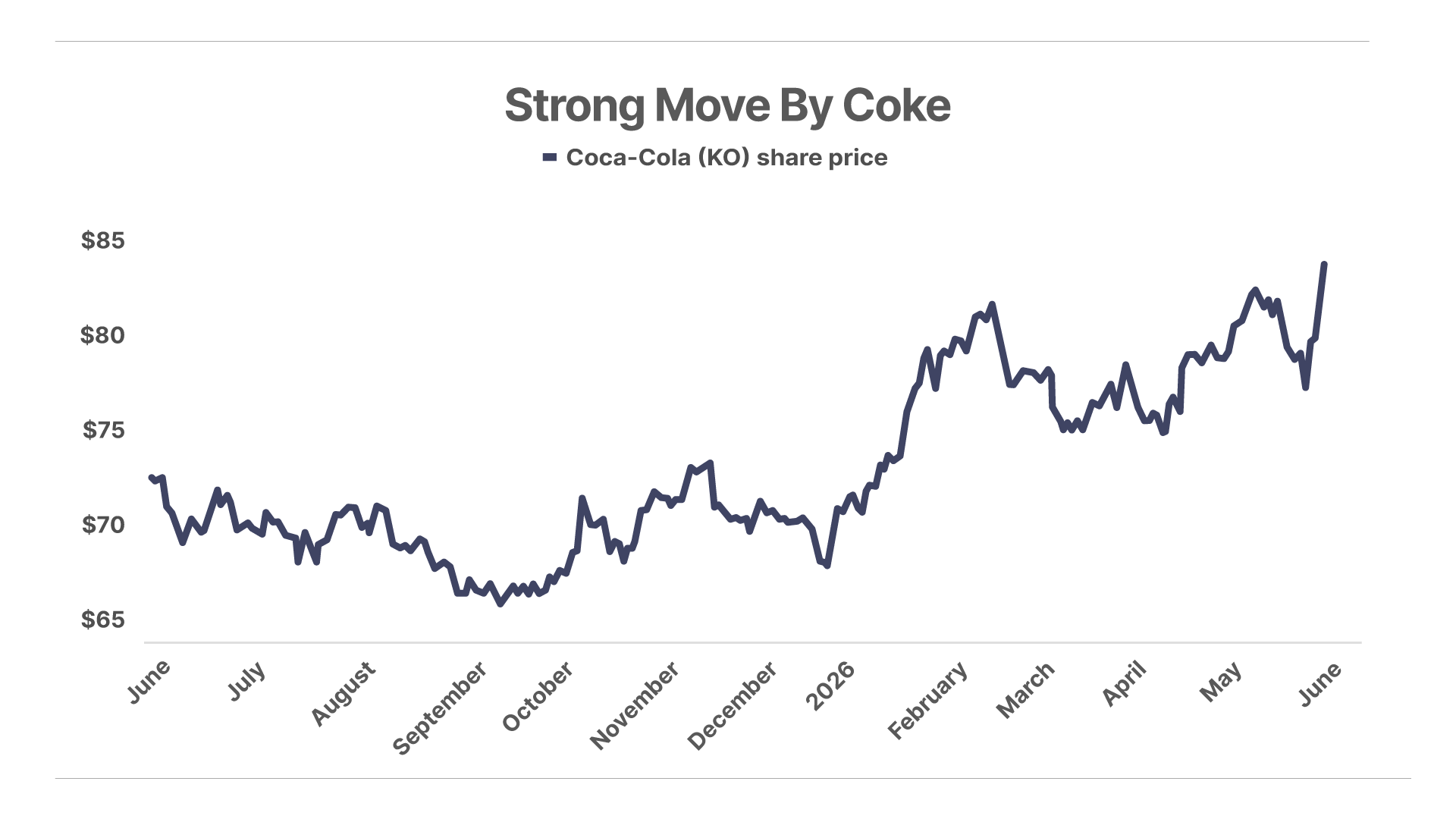
Chart Of The Day… Coca-Cola (KO)
Shares of global beverage leader – and Porter’s Permanent Portfolio holding – Coca-Cola (KO) reached an all-time high above $83 yesterday. The stock is up nearly 24% since Porter rebalanced the Permanent Portfolio in September.
Mailbag
“Sharing About Your Portfolio”
Howard M. writes:
Your candor and honesty about your own portfolio is so refreshing and encouraging. Especially the part about gold. I’ve been a Partner for several years now, and it never ceases to amaze me how much extra that you give.
“Yield Curve Control”
James V. writes:
Hi Porter,
Great article Tuesday, as per usual. You mentioned the 10-year yield is likely heading to 6%. Don’t you think the Fed/Treasury will engage in YCC before that happens by printing even more money and buying these bonds to create a “ceiling” under 5%? It feels as though the manipulation is at an ATH.
Porter Comment: Yield Curve Control (“YCC”) sounds simple in theory: the Fed caps long-term rates by printing money and buying bonds. In practice, it only works under very specific conditions – namely, when inflation is low and investors trust the currency.
That’s not the world we’re in today.
If the Fed tried to cap the 10-year at 5% while inflation remains structurally elevated, they’d be fighting the market directly. And markets are much larger – and faster – than any central bank. The result wouldn’t be control… it would be a loss of credibility.
We’ve seen this before. The Bank of England attempted a version of this in 2022. It ended with forced intervention, currency pressure, and a near-pension crisis. Japan has managed YCC longer – but only because it tolerated decades of stagnation and a structurally different savings base.
The U.S. doesn’t have that luxury.
Here’s the key point most investors miss:
YCC is not just a monetary policy tool – it’s a signal.
And the signal it sends is:
“We can’t let markets clear at the true cost of capital.”
That’s when investors start demanding higher risk premiums elsewhere – in the dollar, in equities, and across credit markets.
So yes, the Fed could attempt YCC before 6%.
But if they do, it likely won’t cap yields… it will accelerate the loss of confidence that’s pushing yields higher in the first place.
In other words: YCC doesn’t solve the problem – it changes where the pressure shows up.
Right now, the bond market is doing what it always does eventually… forcing reality back into the system.
And that’s not something the Fed has ever been able to control for long.
—Porter
“Feedback On Porter & Co. Services”
Doug D. writes:
You have really good insight and it is all helpful. Well thought out. To say that you have given back your 30% ytd is not what most money people want to admit. You shared that you are net short and the reason. It is all really good to see. It shows that you are down to earth with your subscribers.
I have been a subscriber to Porter & Co. One thing that you talk about is the money that can be made with distressed bonds. I have watched the presentation a number of times over the years from both Stansberry Research and Porter & Co. I am a chart reader, I look for patterns. It doesn’t seem that the distressed bonds are chartable. When Porter and Co. made a stock recommendation I never took it the day I saw it. I wait for the hype to die down and the orders are in and I look for support/resistance/channels etc. That is the main reason I do not subscribe to Distressed Investing. I cannot see a pictorial of the price and volume. I have only bought bonds in the form of an ETF. It is made to sound easy but without seeing a picture I must rely on the editor to tell me when to buy and sell and that puts a damper on it. There are ETFs and maybe Closed End Funds (not remembering at the moment) that deal with distressed debt but it hasn’t been something that has shown itself to be extremely profitable.
Porter & Co. Market Snapshot
| Price | Tuesday’s Return |
Year-to-Date Return | |
|---|---|---|---|
| S&P 500 Index | $7,386.65 | -0.26% | 8.5% |
| Gold per ounce | $4,260.00 | -1.58% | -3.6% |
| Bitcoin | $62,116 | -2.13% | -30.5% |
| Oil (West Texas Intermediate) per barrel | $88.20 | -3.37% | 55.6% |
| Berkshire Hathaway (BRK) | $729,862.00 | 0.44% | -3.3% |
| Porter’s Permanent Portfolio | – | 0.11% | -3.1% |
| The Better Than Berkshire Index | – | 0.66% | 2.3% |
| Total Return | Annual Return | ||
| Porter & Co’s Top Ranked* | 30.7% | 13.4% | |
| Yield | Tuesday’s Change | Change Year-to-Date |
|
| U.S Treasury 30-Year Yield | 5.00% | -4 bps | 15 bps |
*A Complete Investor risk rating of 1 is defined as a “low risk, high allocation” security, while positions rated closer to a 5 are higher risk. Porter & Co.’s top-ranked positions include those rated either 1 or 2 in Complete Investor portfolio.
Porter & Co. Top Positions
| Publication | Ticker | Description | Total Return |
|---|---|---|---|
| Tech Frontiers | QURE | uniQure | 237% |
| Complete Investor | BWXT | BWX Technologies | 231% |
| Complete Investor | ARM | ARM Holdings | 135% |
| Tech Frontiers | QURE | uniQure | 131% |
| Tech Frontiers | ROIV | Roivant Sciences | 129% |
| Complete Investor | BTC/USD | Bitcoin | 128% |
| Tech Frontiers | TGTX | TG Therapeutics | 124% |
| Complete Investor | PM | Philip Morris | 122% |
| Tech Frontiers | SGMT | Sagimet Biosciences | 121% |
| Distressed Investing | PTON | Peloton Interactive | 102% |
Prices as of 4:00 pm ET June 9, 2026
Please note: The investments in our “Porter & Co. Top Positions” should not be considered current recommendations. These positions are the best performers across our publications – and the securities listed may (or may not) be above the current buy-up-to price. To learn more, visit the current recommendations page of the relevant service, here. To gain access or to learn more about our current recommendations, call our Customer Care team at 888-610-8895 or internationally at +1 443-815-4447.