Throwing Up A Challenge To How Credit Cards Dominate
Inside Today's Issue
Editor’s note: Porter turns the Journal today over to Porter & Co. analyst Jared Simons. Jared took the lead in compiling September’s Complete Investor recommendation – a 14-year-old lending platform that is shaking up both the credit card and the retail industries.
In 1968, a mid-level banker in Seattle named Dee Hock was handed a mess.
Bank of America had licensed its BankAmericard – the first credit card you could use anywhere – to other banks, and the whole thing was coming apart. A dozen rival banks had to agree on how to approve and settle each other's transactions, and none of them trusted the others to run it.
Hock's answer was a consortium. He designed a network owned by no single bank, in which every member had a right to participate but no shares to sell. The banks would compete ferociously for customers and cooperate completely on the plumbing. He called it a system for the exchange of value. In 1976 it was renamed Visa.
The credit card might be the most successful piece of financial architecture of the last century. It's why you can hand a piece of plastic to a pub owner in London and have a bank in Ohio pay for the pint. And it has a flaw Hock spent the rest of his life warning about: he built it for its members, and it was eventually sold to shareholders. Visa (V) went public in 2008. The consortium became a landlord, collecting a toll on every purchase, at roughly the same rate, forever.
Two And A Half Seconds Is Not Very Long
Underneath that toll is a technical decision from Hock's era that almost nobody outside the industry knows about.
When Visa built the first electronic approval system in 1973, it had to work over the phone lines of the day, at a cash register, with a customer standing there waiting. So it was built around a time limit. To this day, the card networks give the store, the banks, and the network about two and a half seconds to agree on a transaction. If they can't, it fails.
Think about what that forced. For 50 years, every decision about whether you get credit at the register – how much, at what price – has had to fit inside two and a half seconds. There's no time to shop your purchase to other lenders. No time for the store to offer to cover your interest, or for the manufacturer to say it will eat the financing cost to make the sale. So the industry did the only thing it could: it decided everything in advance. Your credit limit and your interest rate were set months ago, by a bank that has never seen what you're buying. The two and a half seconds just check that you're still under the limit.
That is the logic of the 1958 credit card, and it has never changed. Apple Pay didn't change it. Apple just found a way to do some of the work before the clock starts.
What Happened Last Month
Then, on September 8, Meta (META) released Muse, a personal AI assistant that doesn't just answer questions – it goes off and does things for you. It will book your flights, argue with your cable company, and buy things on your behalf. Meta calls it an agent. Google, Amazon, Microsoft, and OpenAI all have one too. Visa and Mastercard announced two weeks ago that they're building the rules for how these agents will identify themselves at checkout. Agentic commerce – software shopping for people – is no longer a prediction. It's here.
The market spent the week arguing about which agent wins and whose checkout button gets skipped. That misses what matters.
An agent has no two-and-a-half-second clock. It can take 10 seconds, or 10 minutes, before it ever touches a payment. It can look at you, the store, and the item all at once. It can ask the store whether it wants to help close the sale. It can find out whether you'd rather pay in full or over three years. For the first time since 1973, the decision about your credit can be made at the moment of the purchase, with everyone at the table – instead of months earlier by a bank that knows nothing about you.
Who Sits In The New Seat
Once the clock stops, the question at every checkout becomes: who decides and who prices it?
Not the card networks. They're building the room where the decision happens, but they don't lend. Not Stripe, which holds the card details for Meta's agent – it's trusted by every bank precisely because it doesn't compete with them, and it can't start now. Not Shopify (SHOP), which owns the store but handed the credit decision to someone else. And not the agent. It's a shopper. Shoppers don't lend.
Think about how credit worked before cards. The general store owner knew you. He knew what you were buying, whether you were good for it, and when you'd be back. He could put it on your tab, cut you a deal, or pass along a discount the supplier was offering that week – on the spot, because he was the one making the call. And when the tab didn't get paid, it was his loss.
Card networks replaced him with a tollbooth. Everyone pays the same rate to pass through, and the person in the booth has no idea who you are.
Agents put the store owner back in the room – and back in charge. The seat that matters belongs to whoever can do what he did: know the customer, know the store, price the purchase to whoever wants the sale most, and carry the loss when the tab goes unpaid. That's not a bank. It's not a payment pipe. It's a new kind of network – one built to serve the customer and the merchant rather than the banks between them.
It is, almost exactly, what Dee Hock described in 1968. Before the clock and before Visa became a landlord.
Last month, the Complete Investor team showed subscribers the company we think is built for that seat – and why the people running it are the only ones who can actually pull it off.
To read that story and learn about getting access to the 40-plus Complete Investor recommendations, the editorial Roundtable, Porter’s Permanent Portfolio, and so much more, click here.
Tell us what you think of today’s Daily Journal: porterstansberrydirect@gmail.com
Good investing,
Jared Simons
Miami Beach, Florida
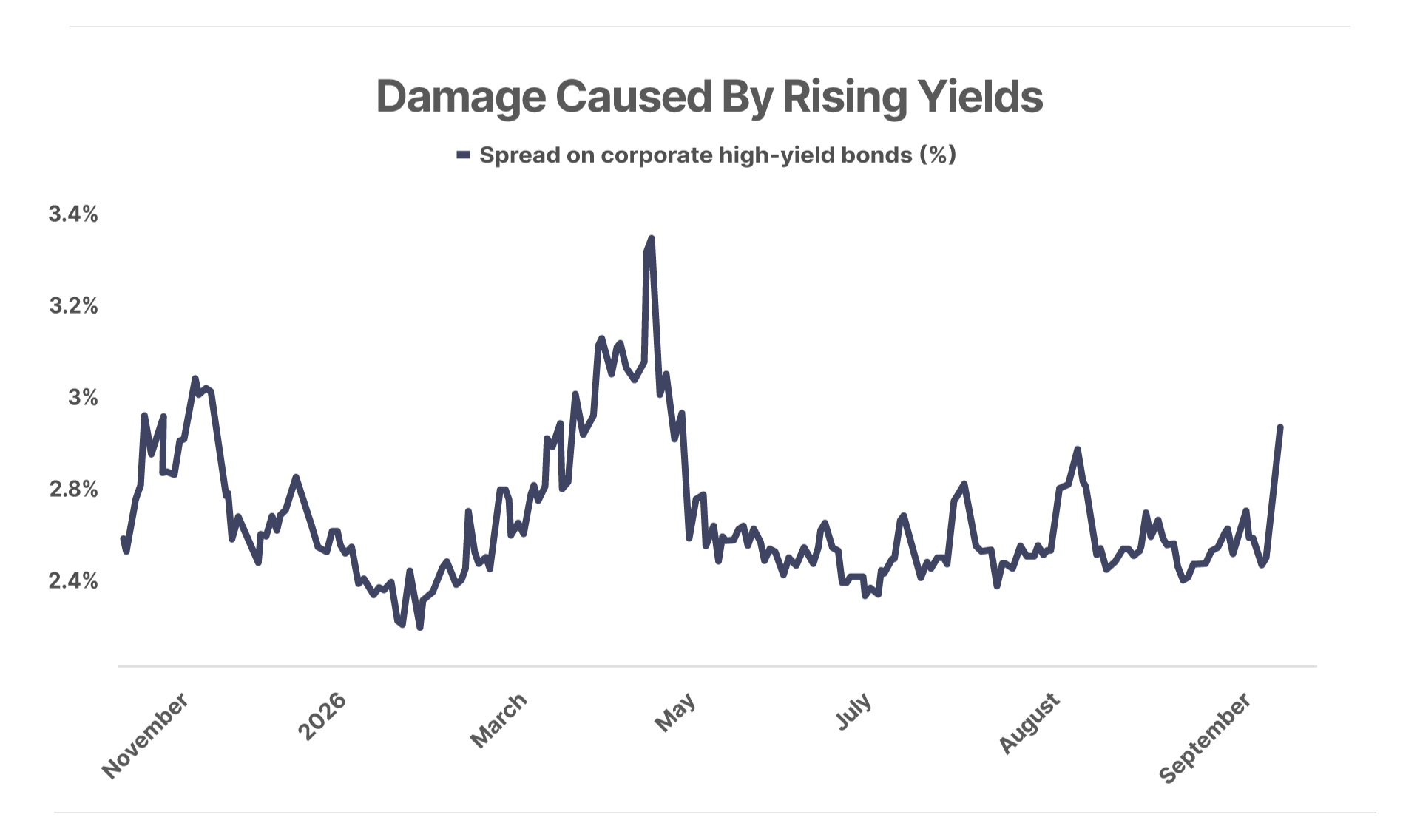
1. Higher Treasury yields are starting to hit riskier corporate borrowers. For most of September, the high-yield spread – the extra yield over Treasuries investors demand to hold high-yield (“junk”) bonds – held in a narrow range while the 10-year Treasury yield rose from 4.8% to about 5%. However, as the 10-year topped 5.2% last week – its highest level since 2007 – the spread on Bloomberg's high-yield index widened 28 basis points to 2.94% on Friday. That's the biggest three-day increase since March. The spread still remains low by historical standards, but the average junk bond now yields about 7.9% – the highest since April 2025 and up from roughly 6.6% before the war with Iran began in late February.
2. Who's paying for the AI boom? Capital spending at Oracle (ORCL), Microsoft (MSFT), Amazon (AMZN), Meta (META), and Alphabet (GOOG) is projected to top $800 billion this year, exceeding their combined operating cash flow for the first time. Borrowed money is filling the gap, and much of it is off the balance sheet. Moody's estimates about $660 billion of hyperscaler lease commitments aren't yet on anyone's books. And – here’s what’s key – to earn a 10% return, the build-out needs roughly $3.7 trillion in annual revenue by 2032. Debt-fueled booms that nobody can see rarely end well.
3. Meta plans to sell its AI tools to corporations. On Monday, Meta Platforms (META) launched Meta Enterprise Platform, which CEO Mark Zuckerberg called "the next major pillar of our business." It follows the success of its AI agent Muse, which became the top free iPhone app in the U.S. within two weeks of its September 8 launch. The unit will start by offering businesses and developers the Muse agent, access to the AI model behind it, the coding tool Muse Code, and Meta Business Agent, which more than 1 million businesses use each week to answer customers on WhatsApp and Messenger. In July, Zuckerberg told investors that serving large corporate customers is "a somewhat different muscle than we have historically had." To build it, Meta hired MongoDB (MDB) CEO Chirantan "CJ" Desai, who spent nearly eight years at business-software maker ServiceNow (NOW), rising to president and chief operating officer.
Porter recommended Japanese financial and infrastructure conglomerate Mitsui & Co. (MITSY) to Complete Investor subscribers less than one year ago – and shares are up 32% since then.
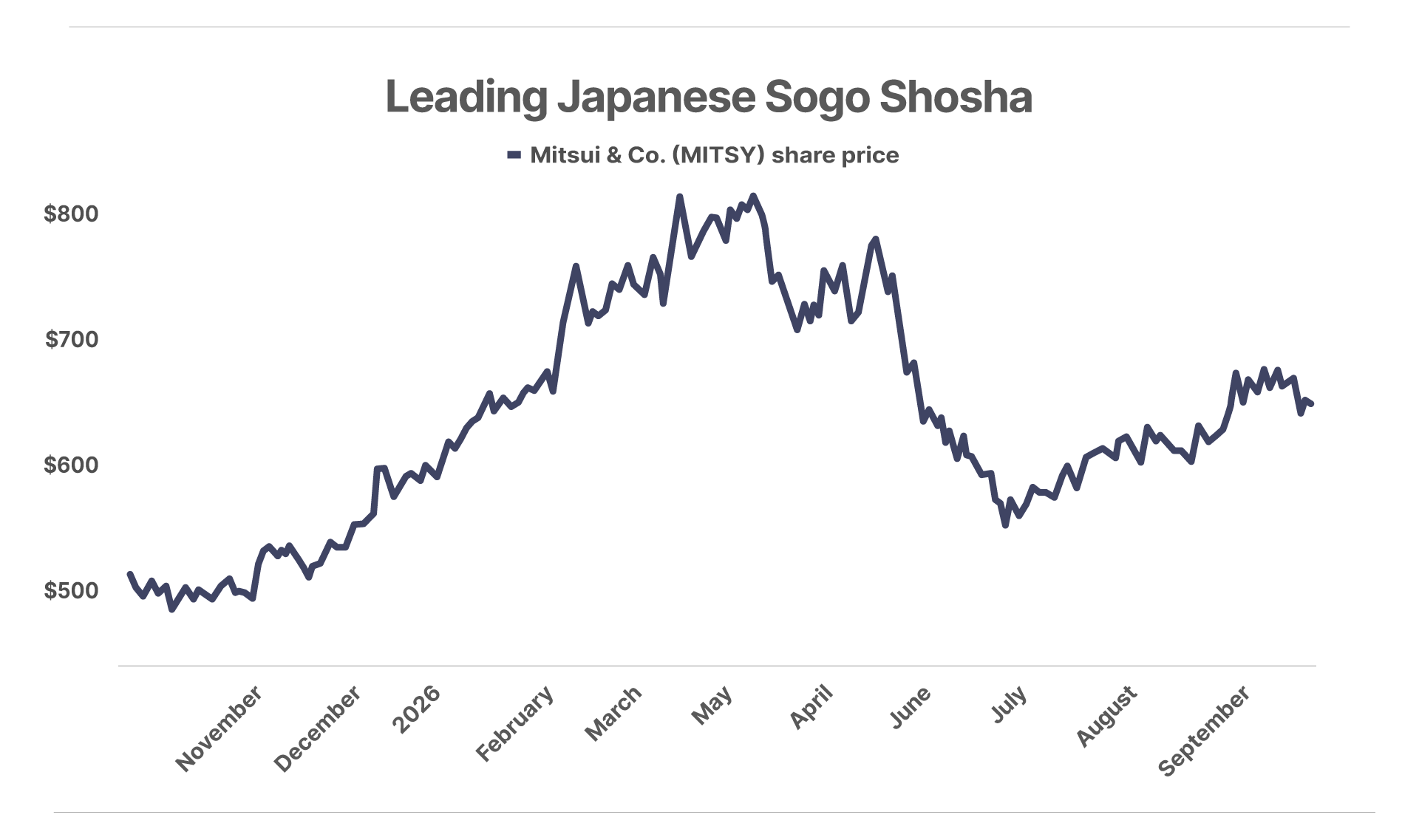
If you are not a paid-up subscriber and would like to see the Mitsui & Co. recommendation and all past stock picks, click here to learn more.
“It’s Working”
Michael G. writes:
It’s working! What you’ve been teaching me all these years is actually sinking in.
I took a look at your Partner Portfolio recently. This was shortly after I did a quarterly rebalance of my portfolio. Lo and behold, the sleeves and allocation percentages were identical.
Thanks for providing me with what you would want to know if our roles were switched.
Also… thanks so much for putting together another information-packed conference. Your live-feed came through flawlessly. My Clap-o-Meter vote goes to TLX.