Issue#131, Volume#3

Handing Over The Keys To The Grand Canyon
Inside Today’s Issue
Editor’s note: Today, Porter turns the Journal over to Distressed Investing analyst Martin Fridson. Marty spent years at leading firms like Salomon Brothers, Morgan Stanley, and Merrill Lynch – researching debt and how it’s collateralized.
Here’s Marty…
The U.S. doesn’t have a debt problem…
U.S. President Donald Trump recently tried to reassure the American public about the federal government’s fiscal health – but his message is likely to have the opposite effect on those who understand how sovereign borrowing works.
In an interview with Fortune, President Trump argued that the level of federal debt – currently $39 trillion – isn’t really as terrible as people are making it out to be. He said the total value of America and its natural assets, such as the Grand Canyon and the surrounding oceans, is “like hundreds of trillions of dollars.” According to his logic, the U.S. is “way under-levered.”
This reasoning would make sense if government finance worked like the real estate business, where Trump has spent most of his career. If the buyers of U.S. Treasury bonds lent against collateral, they’d escape financial ruin in the event of a default. They’d just sell off the Grand Canyon, a few national parks, and the Atlantic Ocean and recover at least a substantial portion of their principal. In reality, pledging assets in the manner of a real estate developer has historically occurred in the sovereign debt market only when a country was in dire financial straits.
The buyers of a government’s bonds must rely instead on the government’s ability and willingness to pay. If the country defaults, there’s no global bankruptcy court to go to for relief.
Ever since Alexander Hamilton did the financial engineering that made it possible for the United States to come into being (he got the national government to assume the states’ Revolutionary War debts), our nation has had an excellent reputation for the willingness-to-pay part. The U.S. has demonstrated a firm commitment to meet its obligations.
The ability-to-pay part, however, is showing some strain. It’s a question of whether, after deducting all the other costs of operating the government, there’s enough left over from tax revenue to cover interest on the Treasury’s debt.
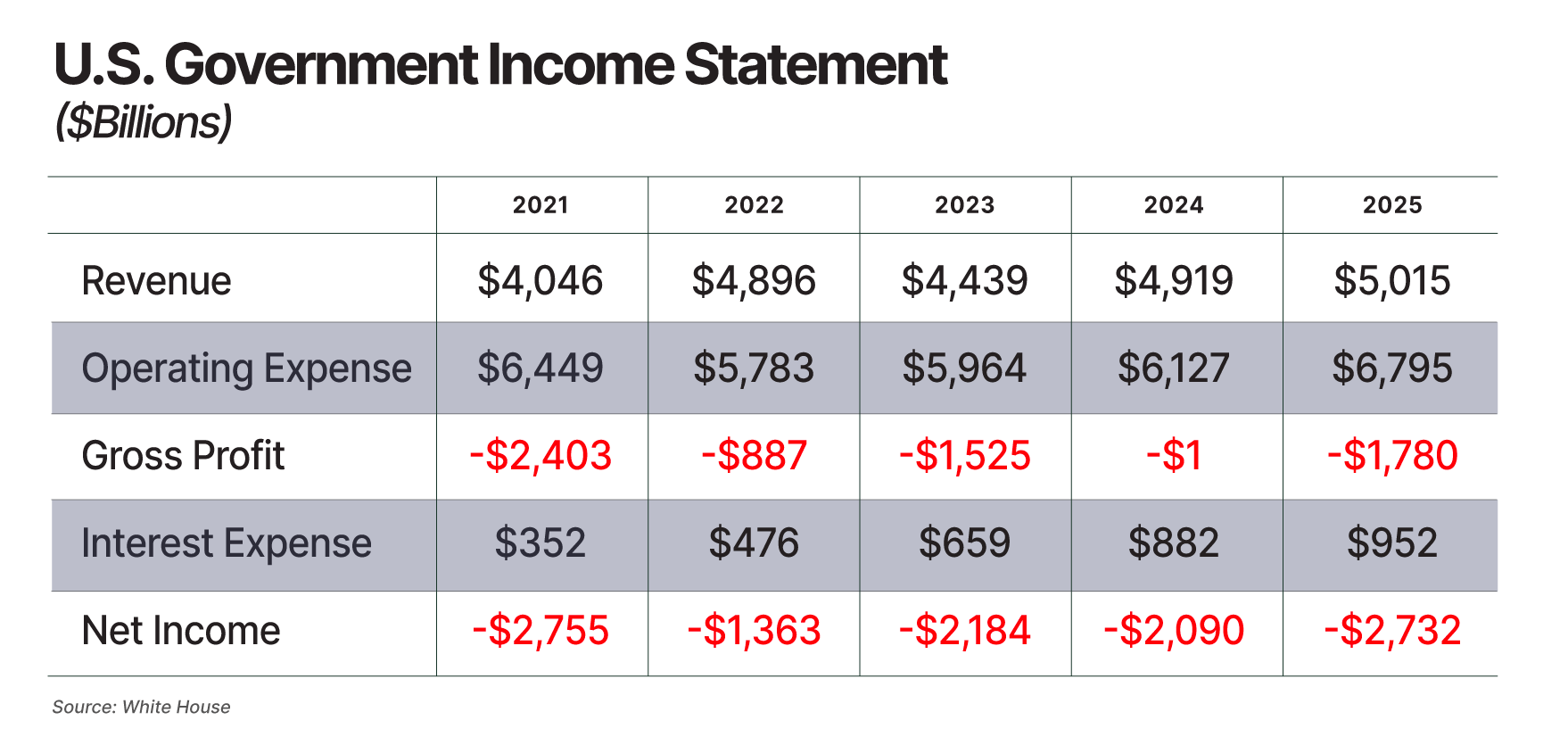
The table shows that over the last five years, money available to pay interest on Treasury debt has fallen short of interest expense by an average of $2.2 trillion per year.
“What’s the big deal?” some may ask. “Scaremongers have been ranting about federal deficits for as long as I can remember, but the Treasury hasn’t yet failed on a single dollar of interest.”
Well, here are some things that have changed. In an earlier period, 1996-2000, revenue at least covered operating expenses every year. In the subsequent 25 years, that has happened only twice, the last time being in 2007. Every time there isn’t enough in the till to cover interest expense, the Treasury makes up the difference by issuing more bonds. (Have you heard a personal financial expert warn against trying to borrow your way out of debt?) This problem has become more severe in recent years, with the national debt doubling from $18.2 trillion to $37.6 trillion in just the last 10 years. The more debt the government takes on, the higher the interest bill goes.
One way the government could ameliorate the widening gap between interest costs and the wherewithal to pay them is financial repression. This consists of keeping Treasury-bond yields below market levels by fiat – penalizing investors, who consequently receive a lower return than the risk warrants. As part of this strategy, the domestic banks would probably be forced to continue buying U.S. bonds, even though they constitute a bad investment. But the government doesn’t have that power over foreign buyers, who hold about one-third of U.S. sovereign debt.
Another possible solution would be to raise cash by selling off federally owned land for private development. Although the government owns about 28% of the country’s total land area, the acreage occupied by national parks, military bases, and wilderness areas is not realistically available for sale. The most generous estimate of the value of land that could actually be sold, including mineral rights, is $5 trillion. Based on the numbers shown in the above table, the cash that could be generated by selling all of it would cover the interest coverage shortfall for only a little more than two years.
In light of this arithmetic, it’s no wonder that the U.S. Treasury no longer carries AAA credit ratings from Moody’s or Standard & Poor’s. They consider Microsoft (MSFT) and Johnson & Johnson (JNJ) more certain than Uncle Sam to pay their interest and principal in full and on schedule. Of course, those private sector borrowers don’t have the option sometimes used by financially strapped governments, namely, a massive currency devaluation. Under that solution, bondholders get paid back fully in nominal terms but take a beating in real terms.
There’s one final, if improbable, way out of a government debt spiral – exercising fiscal responsibility. The U.S. could increase taxes and reduce spending, such that the income remaining after operating expenses would suffice to cover interest on the debt. Unfortunately, it’s hard to think of a proposal more politically unpopular or less likely to get through Congress than raising taxes or cutting services.
This picture would be discouraging enough if the head of the whole operation weren’t proceeding on the basis of a false analogy with the real estate industry. To make matters worse, the self-proclaimed King of Debt’s perceptions may be skewed by the fact that he personally managed to remain very well set financially despite racking up six corporate bankruptcies in the course of his wheeling and dealing in land and buildings. Perhaps in President Trump’s mind, suffering consequences when debt payments can’t be met is for losers. If the Treasury ever defaulted, the losers would be those who relied on the full faith and credit of the United States.
Tell us what you think of today’s Journal: porterstansberrydirect@gmail.com
Martin Fridson
New York, New York

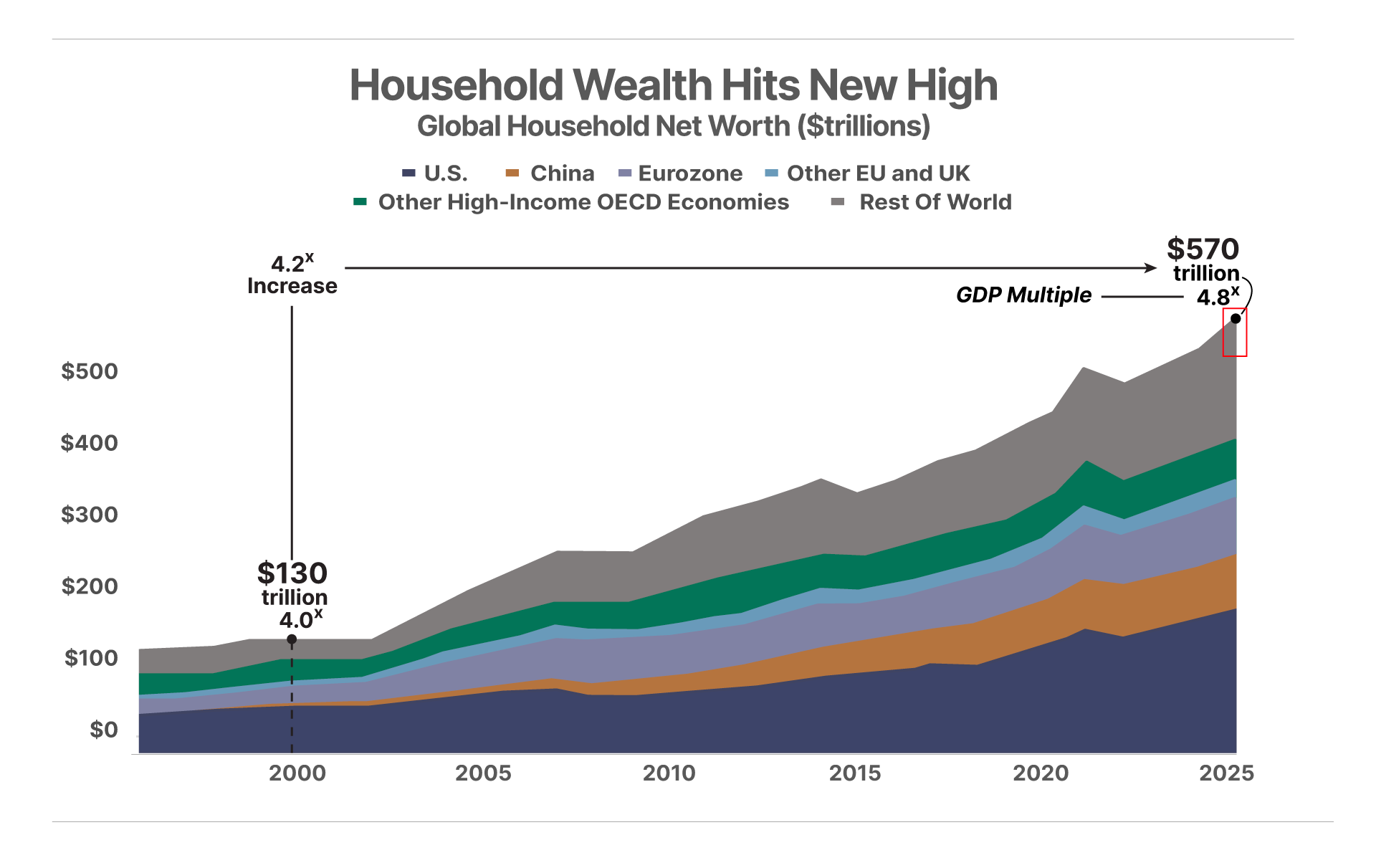
1. Paper assets lift household wealth. Global household net worth rose 7.3% in 2025 to a record $570 trillion, per McKinsey & Co. Equities drove 57% of the gain, while real estate, still roughly half the total stock of wealth, contributed just 15%. Household wealth now equals 4.8x world GDP, up from 4.0x in 2000. Asset values are compounding faster than the underlying economy – the signature of a world running on monetary debasement.
2. Hyperscaler off-balance-sheet liabilities balloon. With America’s largest cloud-computing giants investing heavily into AI data center capacity, their free cash flow is drying up. As a result, these companies are increasingly turning to the debt markets, including the wide-scale use of “off balance sheet” financing arrangements. These less-transparent liabilities are held off the books and include long-term purchase agreements for Nvidia GPUs and servers, as well as lease agreements with data center operators. A recent analysis from Bloomberg estimates that these off-balance sheet financing commitments of the hyperscalers now total a whopping $2.6 trillion.
3. The U.S. Treasury helped Japan buy yen on Friday. The two governments acted together on July 31, the first coordinated yen purchase since 1998. The yen had fallen to 163.73 per dollar on July 30, its weakest since 1986. A second announcement got less attention: Tokyo also said it will use the Fed’s Foreign and International Monetary Authorities (“FIMA”) repo facility, which lets a foreign government pledge Treasury bonds held at the New York Fed in exchange for overnight dollar loans, up to $60 billion a day. Japan owns more Treasuries ($1.14 trillion) than any other foreign holder. Defending the yen normally means selling some of those bonds to raise dollars. Washington would rather lend Japan the dollars than watch it sell the bonds and push long-term rates even higher.
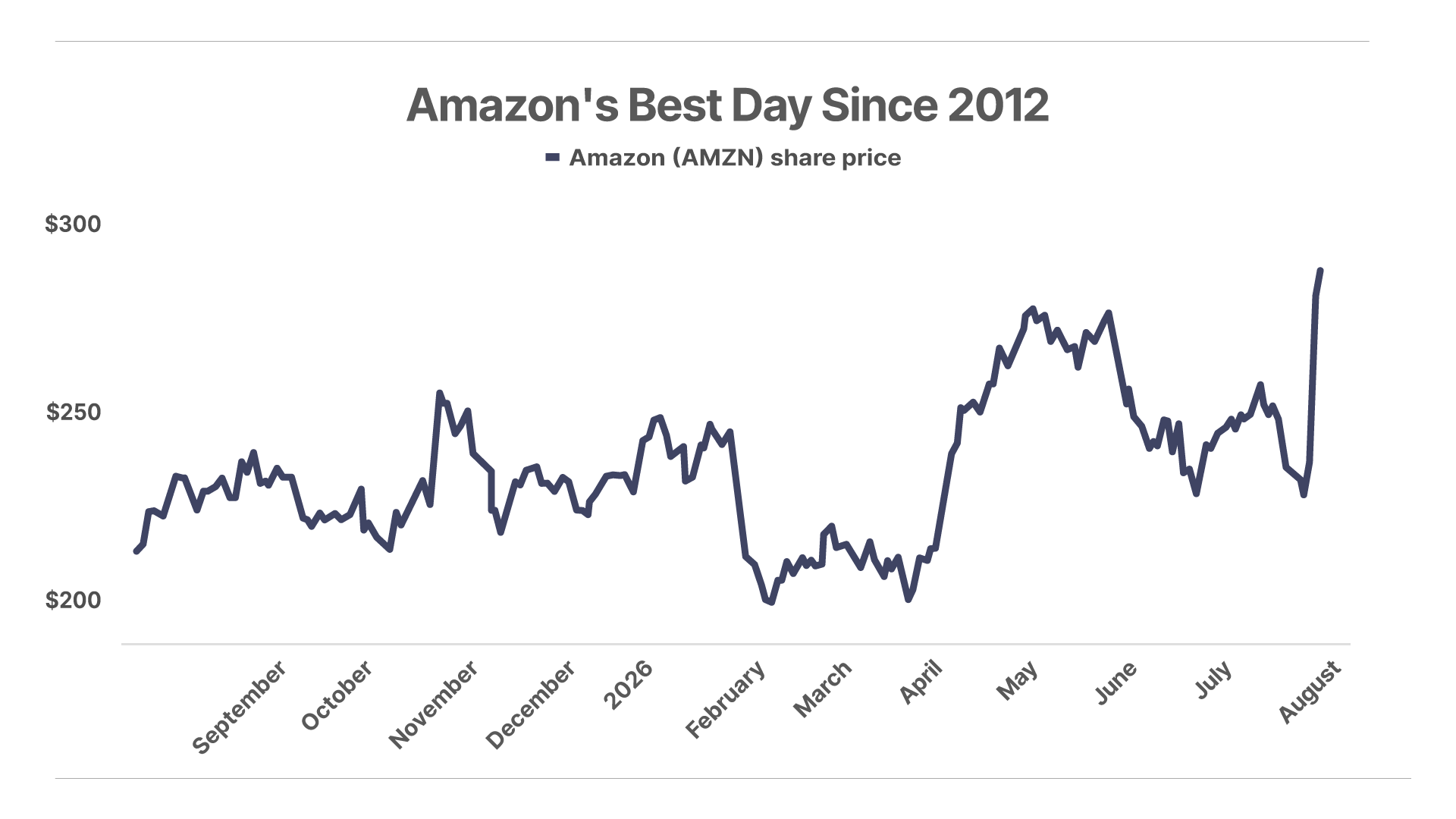
Amazon shares rallied 15.3% on Friday – the stock’s best day since 2012 – after the company reported Q2 cloud revenue grew 37% to $42.2 billion, its fastest growth rate in four and a half years.
Porter published the first revamped issue of Porter & Co. Biotechnology on Saturday – adding new recommendations and releasing a portfolio-selection strategy based on what he calls “The 11 Kingdoms Of Medicine.”
“Love The Kingdoms”
Cindy R. writes:
Love where you are going with the kingdoms. Would any of these topics be included in those kingdoms or worth addressing?
1. Longevity – improvement / regeneration of skin, hair, muscle, joints, other aging processes, and cells… a wrinkle cream that worked, everyone over 30 would want it.
2. Nutraceuticals – we have nutrient solutions like peptides and vitamins, what could AI replace or enhance, I’d love to see the end of statins and current heart medications.
3. Mechanical solutions – nerve, joint, body support, and interventions, not robots but maybe what might replace current hardware or surgeries for things like nerve pain and stimulators, back pain, red light therapies, mobility issues solved by crutches, scooters, or things like hearing aids…
Do you think that AI has any role here – these more common issues might have a bigger addressable market?
Porter Comment: Cindy —
Certainly all of the drugs we’re following will play a role in longevity and, perhaps none more so than gene silencing, which may be the best modality to tackle the root cause of neurological degeneration. The other two categories I don’t expect will lead to significant breakthroughs. I believe the solutions will be understanding and manipulating cellular biology.
Regards,
Porter
“Please Share The Source Of Your Knowledge”
Raymond H. writes:
Your knowledge of history, economics, and science on top of your business expertise is truly amazing. I taught college physics and in that time had only one student that impressed me the way you do. Please share the source of your eclectic knowledge.
“I Am Concerned”
Don P. writes:
I am impressed with your approach to biotech. However, I am concerned about investing in this sector with interest rates rising. As you know these stocks are long-duration securities very sensitive to interest rates.
I fear that your service is coming out at a bad time with interest rates rising, inflation rising, deficit spending climbing, etc. You have documented the risks in the market very clearly.
Porter & Co. Comment: Porter released the first issue of Porter & Co. Biotechnology on Saturday, August 1, with new recommendations. He also shared an introductory blueprint Special Report. Both issues are available to paid-up subscribers. If you would like to see the first issue of Porter & Co. Biotechnology Blueprint, click here.
Porter & Co. Market Snapshot
| Price | Friday’s Return | Year-to-Date Return | |
| S&P 500 Index | $7,489.72 | 0.70% | 10.1% |
| Gold per ounce | $4,049.10 | -1.40% | -6.4% |
| Bitcoin | $63,427 | 1.31% | -28.5% |
| Oil (West Texas Intermediate) per barrel | $84.67 | 0.89% | 37.3% |
| Berkshire Hathaway (BRK) | $766,600.01 | 0.21% | 1.6% |
| Porter’s Permanent Portfolio | – | -0.71% | 0.7% |
| The Better Than Berkshire Index | – | -0.71% | 8.3% |
| Total Return | Annual Return | ||
| Porter & Co’s Top Ranked* | 34.5% | 16.4% | |
| Yield | Friday’s Change | Change Year-to-Date |
|
| U.S Treasury 30-Year Yield | 5.27% | 6 bps | 43 bps |
| Prices as of 4:00 pm ET July 31, 2026 | bps = basis points (or 0.01%) | |||
| *A Complete Investor risk rating of 1 is defined as a “low risk, high allocation” security, while positions rated closer to a 5 are higher risk. Porter & Co.’s top-ranked positions include those rated either 1 or 2 in Complete Investor portfolio. | |||
Porter & Co. Top Positions
| Publication | Ticker | Description | Total Return |
| Biotechnology | QURE | uniQure | 237% |
| Complete Investor | BWXT | BWX Technologies | 197% |
| Biotechnology | ROIV | Roivant Sciences | 150% |
| Biotechnology | NUVB | Nuvation Bio | 149% |
| Biotechnology | TGTX | TG Therapeutics | 147% |
| Complete Investor | SKWD | Skyward Specialty Insurance | 143% |
| Complete Investor | PM | Philip Morris | 137% |
| Complete Investor | BTC/USD | Bitcoin | 135% |
| Biotechnology | SGMT | Sagimet Biosciences | 132% |
| Biotechnology | QURE | uniQure | 131% |
| Prices as of 4:00 pm ET July 31, 2026 | |||
Please note: The investments in our “Porter & Co. Top Positions” should not be considered current recommendations. These positions are the best performers across our publications – and the securities listed may (or may not) be above the current buy-up-to price. To learn more, visit the current recommendations page of the relevant service, here| New Window. To gain access or to learn more about our current recommendations, call our Customer Care team at 888-610-8895 or internationally at +1 443-815-4447.