Issue#143, Volume#3


For Those Who Aren’t Careful, It’s Total Amputation Without Anesthetics
Inside Today's Issue
Editor’s note: Today’s the final essay in a multi-part series on how the massive spending into the AI buildout will play out over the economy and for the companies involved. Please see the first essay here, the second essay here, the third essay here, the fourth essay here, and the fifth essay here.
Here’s Porter now…
How do I know the funding and the buildout won’t continue? Because this entire bubble was never about technology. The bubble around the artificial intelligence (“AI”) buildout was caused, like all financial bubbles, by a corruption of the money supply.
The railroad boom of 1865-1873 was fueled by the paper money of the Civil War. The telecom bubble of 2000 was fueled by the Federal Reserve’s response to the Russian default and fears about Y2K. And, of course, the mortgage bubble of 2008 was fueled by the Fed’s aggressive response to 9/11 and the “War on Terror.”
The AI bubble is a direct result of the Federal Reserve’s response to COVID. Our central bank created an unimaginable amount of new money – roughly $7 trillion.
By late 2021, the money market funds that received most of this cash couldn't find enough safe, short-term places to put it. So the Fed opened up what amounts to a giant parking lot for cash. It's called the reverse repo facility (“RRP”).
Don’t let the jargon fool you. This is simply the government printing money and handing it out to favored financial institutions.
Technically, it works by a money market fund depositing its cash to the Fed overnight. (Note: there’s no reason the Fed, which can create as much cash as it wants, would ever need to borrow money from a money market fund.) The Fed then gives the fund a Treasury security as collateral for the night. The next morning the Fed gives the cash back plus a tiny amount of interest. It's called "reverse repo" because from the Fed's point of view it's the reverse of a normal repo – the Fed is borrowing the cash rather than lending it. Once again – as with neocloud, which I wrote about on Monday – when something is called a made-up word that has no actual meaning in the English language, beware.
With the Fed handing out money for nothing, it was no surprise that the RRP “parking lot” filled up fast. At its peak in December 2022, the RRP held about $2.5 trillion in money market fund cash.
And that money is what has been powering the entire AI bubble.
Let me show you what happened.
Early in 2023, the interest rate on Treasury bills rose above the rate the Fed was paying on RRP cash. That happened because the Fed was responding, finally, to the massive inflation their policies and the government’s massive deficits had caused.
Money market funds are legally required to seek the best safe yield they can, so as interest rates rose, they pulled cash out of the RRP and bought T-bills instead. This happened continuously from mid-2023 through October 2025. Roughly $3 trillion of cash came out of the RRP over that period – from $2.5 trillion at peak down to essentially zero by October 2025.
As you’ll see below, what happened to this capital as it entered the private financial system is complicated. But all you have to know is that from mid-2023 until last October, trillions in capital flooded into our financial system. And that’s what’s driven equity valuations higher and higher, and that’s what’s funded the entire AI buildout.
The key thing to know is this: that money is now all spent.
Our private financial system works primarily on two tiers. Money market funds (when they can’t get a completely free ride from the Fed) lend cash to primary dealers (the biggest banks). The primary dealers relend cash to everybody else: hedge funds, private credit funds, real estate financing vehicles, and increasingly, the AI-capex financing engine.
When the RRP started draining in 2023, the money that came out went into T-bills at first. But it didn’t stay there. Through private repo lending, it funded the primary dealers (the big banks). And because the big banks now had an enormous amount of cheap short-term cash coming in, they lent out more and more to non-bank borrowers. Why? Because trillions in capital had to land somewhere in only about two years.
Non-bank is finance jargon for any lender or credit institution that isn't a chartered bank. It includes hedge funds, private credit funds, private equity firms, mortgage lenders that aren't banks, insurance companies, pension funds, real estate investment trusts, business development companies, structured product vehicles, and so on.
Collectively, they are called the "shadow banking system" because they perform banking functions – they extend credit – but they don't take insured deposits and don't have direct access to the Federal Reserve's liquidity facilities.
The shadow banking system has grown enormously over the last 15 years. It's where most private credit lending lives – Blue Owl Capital (OWL), Apollo Global Management (APO), Ares Management (ARES), Blackstone (BX), and KKR (KKR). It's also where most of the AI-capex financing sits. Not the equity – that's on the hyperscalers' balance sheets – but the debt behind the data centers, purchases of the high-speed GPU chips, and neocloud operators. That financing gets warehoused in the shadow banking system and eventually distributed as securitized paper, which, hey, why not, Moody’s says it’s AAA!
The shadow banking system funds itself largely through repo. It borrows short-term cash from the primary dealers, secured by whatever collateral it holds – Treasuries for the most part, but also mortgage bonds, corporate loans, structured products rated AAA. That’s what’s so valuable about that Moody’s rating.
As a result, from mid-2023 through October 2025, both sides of the plumbing grew at the same time.
The primary dealers' repo funding grew because money market funds pushed more and more cash into it as they pulled out of the RRP. Non-bank lending grew because the primary dealers, flush with all that new cheap cash, extended it out to the shadow banking system, which used it to fund private credit, hedge fund leverage, and – most importantly for our purposes – the entire ecosystem of data center loans, GPU-backed term loans, and neocloud financings.
Both grew because the same exogenous force – the RRP draining – was pushing money into both simultaneously. It looked like the private credit system was generating its own growth out of business demand. It wasn't. It was being lifted from underneath by the parking lot emptying.
By October 2025, the RRP was effectively empty. The parking lot was drained. The COVID “credit card” was tapped out.
From that point on, the financial system became zero-sum. Any new dollar of primary-dealer repo funding has to come from somewhere else in the system. It can't come from the RRP anymore because the RRP is empty.
Money market funds have a finite amount of cash to lend. If they lend more of it to primary dealers in repo, they have less to lend elsewhere. And the primary dealers, if they want to keep their own repo books growing, have to pay higher interest rates to attract that cash. Higher repo rates raise the shadow banking system's funding cost. Higher funding costs mean the shadow banking system can either extend less credit or charge borrowers more.
The mechanical result: if primary dealer repo grows, non-bank lending shrinks by approximately the same amount. The two lines that had been rising together for three years – bank repo and non-bank credit – now move inversely.
That’s what’s happening. The correlation flipped in October 2025 and has stayed flipped. Repo went from a rising tide that lifted both dealer and shadow-bank balance sheets to a zero-sum competition between them.
Nvidia (NVDA) saw this coming and raised $25 billion to survive what’s about to happen. CoreWeave’s (CRWV) most recent financing tanked because of the impact of a zero-sum financial world.
Shadow banking is being squeezed. The most-leveraged, weakest-collateral, most-concentrated shadow bank borrower – a neocloud with GPU collateral serving AI customers – gets repriced first.
But this is only the beginning.
The two-year Treasury to Fed Funds interest rate spread sits at +50 basis points – the same level reached in the second halves of 2001, 2008, and 2021. Emerging-market inflows just posted one of the largest sudden stops on record. Real U.S. personal income is falling at recession pace. Year-to-date household-survey employment losses exceed both 2001 and 2008. Prime-age labor-force dropouts are at ex-COVID records. Except for mortgages, credit delinquency rates are at crisis highs.
What ends a capex boom? It eventually runs out of money.
Jesse Livermore described what happens when a capex boom runs out of money in Edward Lefevre’s book Reminiscences Of A Stock Operator.
Finally there came the awful day of reckoning for the bulls and the optimists and the wishful thinkers and those vast hordes that, dreading the pain of small loss at the beginning, were now about to suffer total amputation – without anesthetics. A day I shall never forget, October 24, 1907… No money anywhere, and you can’t liquidate stocks because there is nobody to buy them. The whole Street is broke at this very moment.
Livermore made $1 million on that day. He saw his signal to start shorting when the railroads began advertising equity offerings that had earlier and earlier execution dates and accepted payment in installments.
He recognized a death struggle for capital.
Will you?
Tell us what you think of today’s Daily Journal:porterstansberrydirect@gmail.com
Good investing,
F. Porter Stansberry
Stevenson, Maryland

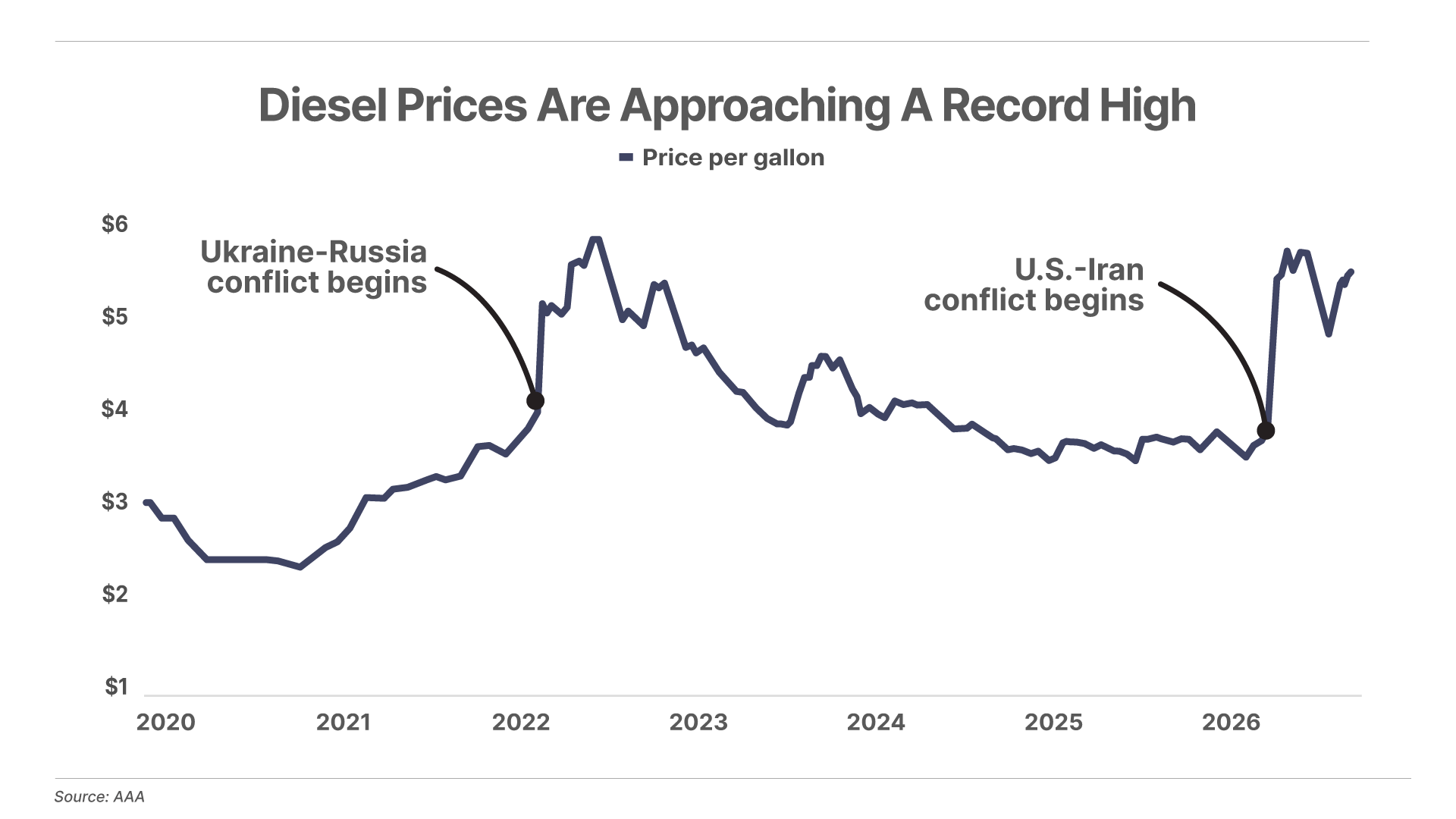
1. Diesel prices are surging. The pump price hit $5.47 a gallon Tuesday, up 8% in a month and just 35 cents below the June 2022 record, as the Iran war and Ukrainian drone strikes on Russian refineries pull supply offline. The premium diesel commands over crude – the refiner's margin – hit a record $100 a barrel, triple last year's average. Farmers, truckers, and heating-oil buyers have no substitute.
2. The cockroaches are coming for private credit. Loans on non-accrual status – meaning the borrower has stopped paying or is about to – hit 2.8% at the 20 largest publicly traded private-credit firms in Q2, the highest level in a decade. The riskiest lending migrated into the $2 trillion private-credit channel where nothing gets marked until someone is forced to mark it. Now the marks are being forced. Major funds are taking writedowns and selling loans at discounts. First came the redemption gates – investors trying to get out. Now come the non-accruals – borrowers failing to pay.
3. Three times as many stocks are hitting one-year lows as one-year highs. On Tuesday, 173 securities listed on the New York Stock Exchange closed at their lowest price in 52 weeks, versus just 57 closing at their highest. The S&P 500 finished the same session 1.4% below the record close it set on August 13. In the 15 prior cases since 1928 when the S&P 500 sat within a week and 2% of a record high while new lows ran three times new highs, the index averaged a 2.8% loss over the following 12 months and finished higher only a third of the time. At their worst point during those years, stocks were down an average of 16%.
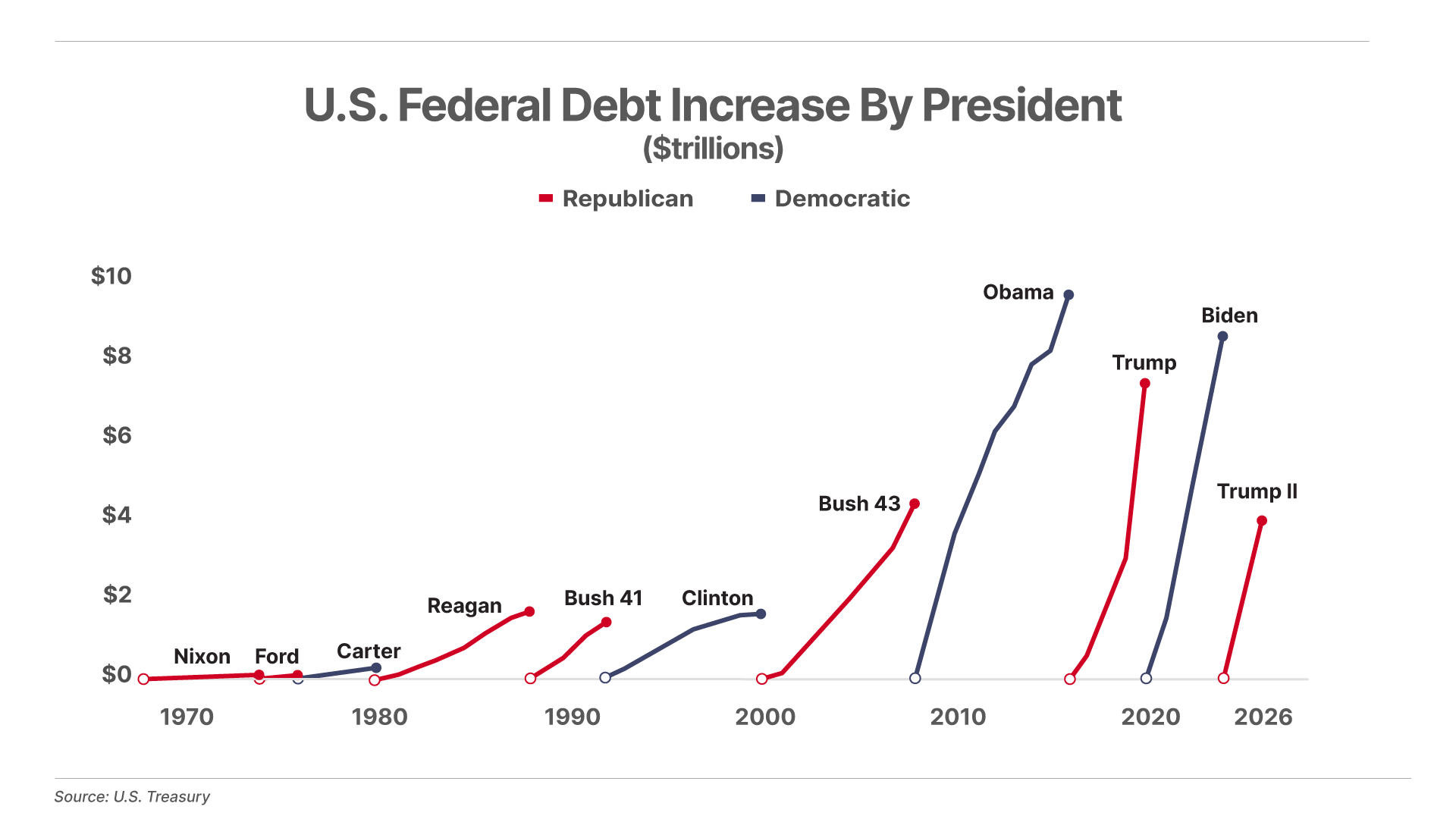
Federal debt crossed $40 trillion this week. Nearly three-quarters of that total was added by just four presidents: Bush 43 (+$4.4 trillion), Obama (+$9.6 trillion), Trump's first term (+$7.4 trillion), and Biden (+$8.3 trillion). Two Democrats, two Republicans – and Trump's second term has added roughly $4 trillion more in just 19 months. Both parties are responsible for our debt crisis.
In yesterday’s Daily Journal, Porter reported that the entire artificial-intelligence bubble will depend on credit by the end of this year…
“A Better Investor”
James B. writes:
Porter,
Enjoyed your essay, and I’m glad I got out of Hut 8 (HUT) and IREN (IREN) back in May.
I bought heavily into both in April 2025, knowing at the time it was a high-risk move. I knew I was playing with fire, so I sold out in May of this year.
It helps to be a little older and wiser and to recognize that it wasn’t necessarily because I was smart – I just got lucky and ended up on the right side of the trade. The timing happened to work in my favor. Years ago, I would have thought it was because I was brilliant and kept buying more.
Appreciate your work, Porter. You’re making me a better investor.
Pat B. writes:
Excellent analysis!
“Sick And Tired”
Jeff H. writes:
I am sick and tired of this “privatize the profits, socialize the losses” cycle. The ratings agencies are absolute crooks and investors who believe in their ratings are fools.
Thank you for the excellent analysis and writing.
Andy S. writes:
Unfortunately you are correct. I am trying to figure out how to protect my assets!
Porter & Co. Market Snapshot
Porter & Co. Top Positions
Please note: The investments in our “Porter & Co. Top Positions” should not be considered current recommendations. These positions are the best performers across our publications – and the securities listed may (or may not) be above the current buy-up-to price. To learn more, visit the current recommendations page of the relevant service, here| New Window. To gain access or to learn more about our current recommendations, call our Customer Care team at 888-610-8895 or internationally at +1 443-815-4447.