Issue#141, Volume#3


Why Nvidia’s Neoclouds Will Collapse
Inside Today’s Issue
Editor’s note: Today is Porter’s fourth in a series about the enormous financial risks of the ongoing AI bubble. Please see the first essay here, the second essay here, and the third essay here.
It’s no surprise, but investors must remember that when the financial plumbing goes zero-sum, the pain will not be meted out equally. It’s the weakest who will suffer the most.
As Jesus says in Matthew 25:
From him that hath not, even that which he hath is taken away.
Here’s one “hath not” that I’m certain will soon go to zero: CoreWeave (CRWV).
CoreWeave is a “neocloud.”
When a business model is described by a made-up word that has no actual meaning in the English language… buyer beware.
Neoclouds are companies that buy huge quantities of Nvidia fast graphics processing unit (“GPU”) chips, house them in data centers, and rent them out by the hour or the month, primarily to artificial intelligence (“AI”) companies. CoreWeave’s biggest customer (both directly and indirectly through Microsoft) is OpenAI. OpenAI isn’t funded from earnings. It’s funded by investors (who are taking losses) and Nvidia vendor financing.
CoreWeave has a business model only a sadistic mother would love. It is enormously capital-intensive because it must buy the Nvidia GPUs upfront – billions of dollars at a time. But the customer revenue comes in slowly over the following years. It is far from certain whether this future revenue will outpace the rapid depreciation of Nvidia’s GPUs.
And here’s the bigger problem: its collateral is also Nvidia GPUs. GPUs are physical hardware that Nvidia itself has said will be obsolete on a roughly two-year cycle. A GPU-backed loan is a claim on hardware that is losing value from the moment the loan is signed. And the price of these rapidly depreciating assets is likewise correlated to demand for CoreWeave’s services. It’s similar to how car-rental companies all go broke. When there’s a recession and no one is renting cars, the price of used cars likewise collapses.
The same will happen to CoreWeave’s data centers and its GPUs.
On July 29, 2026, CoreWeave came to the leveraged loan market to raise $2.6 billion of new debt secured by its GPUs. But the death scramble for capital had already begun. CoreWeave’s collateral looked shakier than it had 10 weeks earlier, because the market had started digesting the possibility that AI-application revenue wasn’t scaling as fast as the capex commitments.
The loan came to market with initial price talk of SOFR+425 to +450 at 99 OID. Translation: the interest rate would be the standard short-term rate (the Secured Overnight Financing Rate, currently around 4.3%) plus roughly 4.4% on top – so about 8.7% all in – and the buyer would pay 99 cents on the dollar and get repaid at 100, giving them a small extra return over the life of the loan. That’s “price talk” – where the underwriters expected the deal to clear based on pre-marketing to buyers.
The deal actually cleared at SOFR+550 at 97 OID. Translation: the interest rate rose to about 9.8%, and the buyer only paid 97 cents on the dollar and would get repaid at 100 – another chunk of return.
That’s a “125-basis-point flex” – the interest rate had to be widened by 1.25 percentage points from the initial guidance to get buyers to take the paper. The total yield to maturity ended up at 10.44%. And to get even that, CoreWeave had to accept a covenant requiring a 1.35x debt service coverage ratio, meaning if its EBITDA falls below 1.35 times its debt payments, the lenders can take action, aka, force the company into liquidation.
Only 10 weeks earlier, CoreWeave had raised $3.1 billion at SOFR+450, and the deal had actually tightened by 50 basis points during marketing – meaning demand was so strong the underwriters could offer worse terms to buyers. By late July, the same borrower had to offer 125 basis points more, plus a discount on the paper, plus a tighter covenant, just to get the deal done.
The borrower didn’t change materially in 10 weeks. But the credit environment did.
What kills capex booms isn’t poor earnings. Investors, seeing revenue soaring, will always put up more capital.
What kills capex booms is the money running out.
And the money is running out.
In the next essay, I’ll show you exactly what sparked the industry’s desperate scramble for capital, and I’ll show you why the AI buildout is on borrowed time.
Tell me what you think of today’s Daily Journal: porterstansberrydirect@gmail.com
Good investing,
F. Porter Stansberry
Stevenson, Maryland

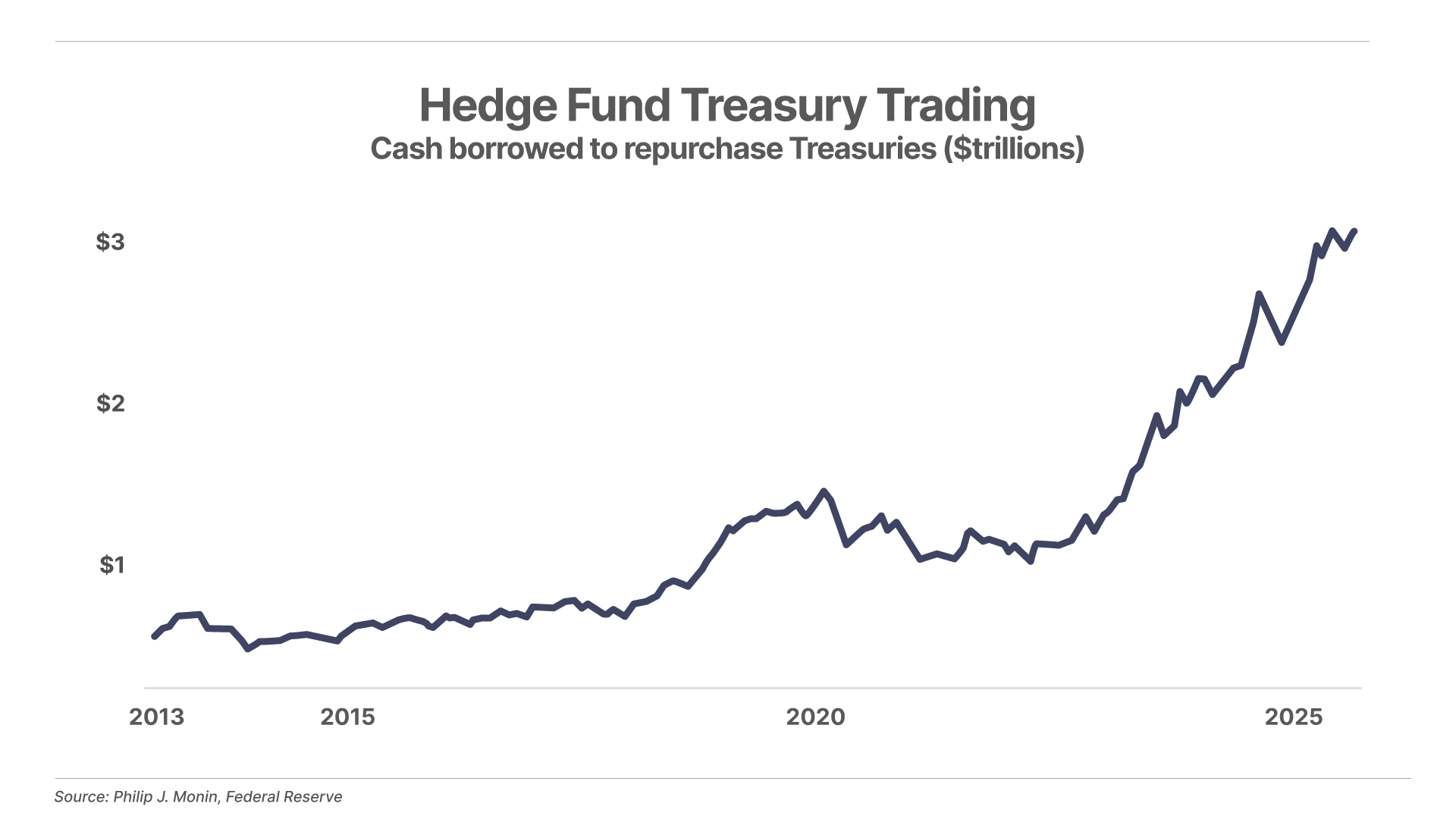
1. Money managers trade big on Treasuries. Hedge funds currently own $2.4 trillion in U.S. Treasury bonds, up from $600 million a decade ago. Part of that growth comes from the increasingly popular “basis trade” – buying Treasuries and simultaneously shorting Treasury futures, pocketing the small spread between the two. To make this worthwhile, funds can borrow money to use 15x leverage from the “repurchase” (repo) market, which now supplies over $3 trillion in overnight funding. It’s all good until the market goes against you.
2. Big tech’s AI bill is 4x bigger than it looks. Alphabet (GOOG), Amazon (AMZN), Meta (META), and Microsoft (MSFT) now carry $2.4 trillion in off-balance-sheet commitments – versus just $604 billion on the balance sheet, reports the Wall Street Journal. This is locked-in future spending on purchase commitments for chips, cloud capacity, energy, and leases. The inertia is bullish near term for the entire AI value chain – Nvidia, Broadcom, memory, power – but hinges on AI revenue actually materializing.
3. The AI build-out is now raising everyone’s borrowing costs. The highest-rated corporate borrowers have issued nearly $1.5 trillion of investment-grade bonds this year, up 36% from a year ago – and $200 billion of that came from the biggest tech companies. Treasury Secretary Scott Bessent has leaned on short-term bills to fund the deficit, which Barclays estimates will cut the supply of new Treasury notes and bonds by about $440 billion this year. Corporate supply is more than filling the gap – growing by $474 billion. Now, bond funds are selling Treasuries to buy the higher-yielding corporate debt. The AI trade was built on cheap capital. It is now making capital more expensive.
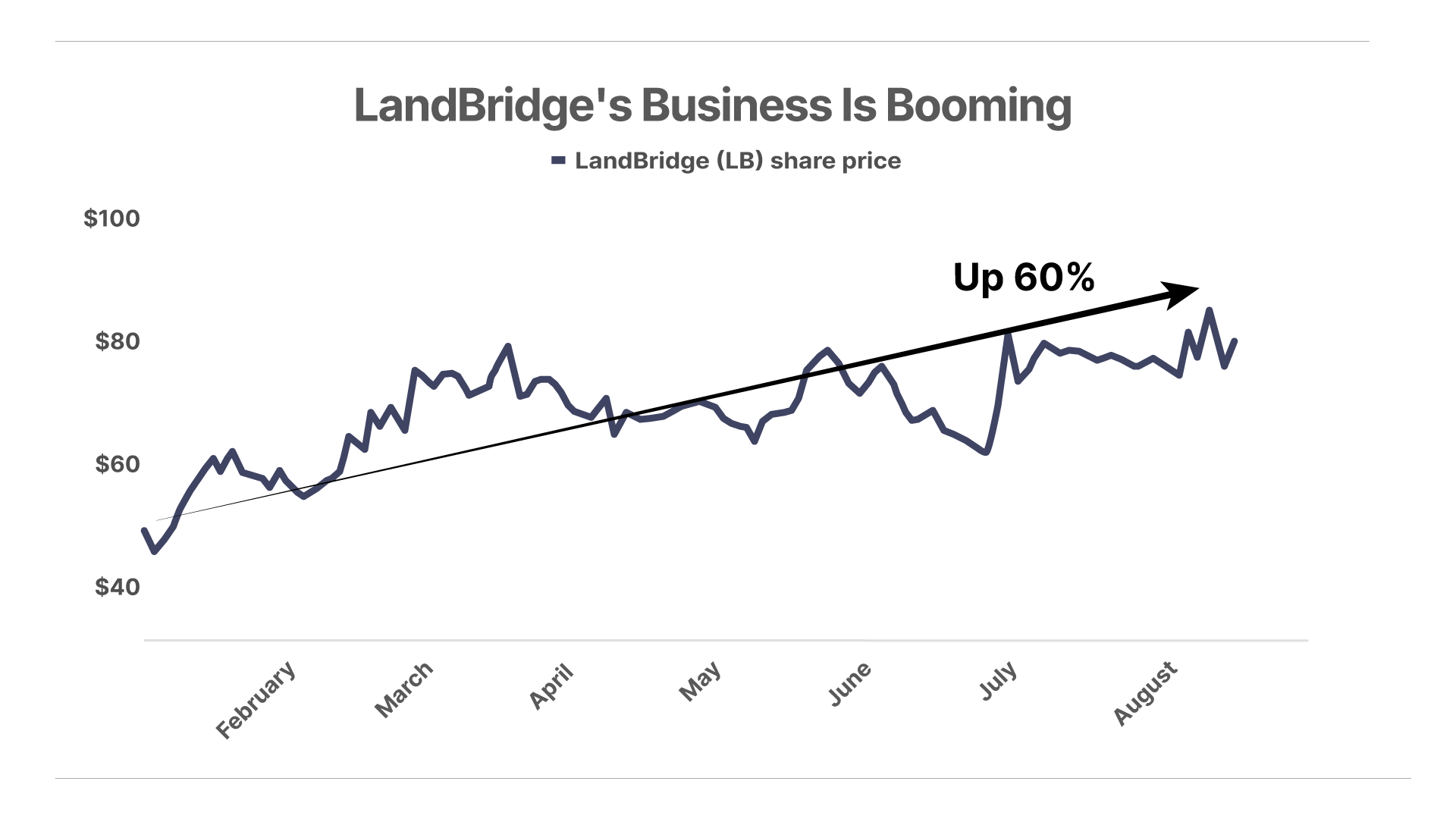
Shares of the West Texas land-leasing company (and Complete Investor recommendation) LandBridge (LB) are up 60% this year – with revenue up 41% year-on-year (“YOY”) and net income up 68% YOY. And it’s now further positioned to capitalize on the data center boom, with the company reporting advanced discussions with seven counterparties representing over 10 gigawatts of power and data center capacity in its latest quarterly.
“Incredibly Impressed”
Samuel B. writes:
Dear Porter,
I have been meaning to write to you for a few weeks, and on this quiet morning by the lake, I am finally taking the time to do so.
I am very pleased to hear that you are continuing Tech Frontiers (now Biotechnology) as a Partner service. Historically, biotechnology has been outside my comfort zone, even when backed by an analyst I deeply respect. Instead, my investment comfort zone leans toward sectors like oil, gold, commodities, and capital efficient businesses. However, I decided to step outside my usual lane when Erez Kalir’s newsletter first launched. I invested in every single one of his recommendations proportionately to my account size, and it proved to be an excellent decision.
I have been incredibly impressed with the product. Beyond the strong returns, the educational depth of Erez’s presentations was outstanding. I also thoroughly enjoyed listening to his sessions via your recorded conference archives on the website.
When the announcement came that Erez was leaving, I was naturally disappointed. My immediate thought was how difficult it would be to replace someone of his caliber. Coming from the construction industry, I know firsthand how painful it is to lose a key player, and how that heavy workload usually lands squarely back on leadership’s shoulders. I imagine you are navigating that exact burden right now.
That said, I have followed your work for a long time, and I have complete confidence that you will continue to do great things with this publication. After reading your first issue under the new transition, I just wanted to say: please keep up the excellent work. The Partner Pass at Porter & Co. has already delivered immense value to me, and I am incredibly happy to be a part of the team.
Best regards
In Friday’s Journal, Porter continued his series on the consequences of the massive amounts of capital being poured into the AI buildout.
“Trillion With A T”
Sherwin R. writes:
Porter, thank you for this extremely insightful article. The auditor note is a doozy. It’s also worth noting, although it was not part of your topic, that it’s possible that Meta will be facing a trillion – with a t – dollar judgment in connection with the trial that I believe began this week relating to its improper influence over children.
“Meta’s Vulnerabilities”
Edward B. writes:
Great article. It definitely shows Meta’s vulnerabilities.
Pravin M. writes:
Agree with you 100%. I am amazed at how Meta has gotten away with wasting so much money, with seemingly little impact on share price.
Bill W. writes:
Meta… whew!
Porter & Co. Market Snapshot
Porter & Co. Top Positions
Please note: The investments in our “Porter & Co. Top Positions” should not be considered current recommendations. These positions are the best performers across our publications – and the securities listed may (or may not) be above the current buy-up-to price. To learn more, visit the current recommendations page of the relevant service, here| New Window. To gain access or to learn more about our current recommendations, call our Customer Care team at 888-610-8895 or internationally at +1 443-815-4447.