Issue#142, Volume#3


Why There’s No More Cheap Capital For AI
Inside Today's Issue
Today is Porter’s fifth essay in a multi-part series about the enormous financial risks of the ongoing artificial intelligence (“AI”) bubble. Please see the first essay here, the second essay here, the third essay here, and the fourth essay here.
Hyperscaler free cash flow is on track to fall roughly 50% from its late-2024 peak through early 2026, and to turn negative for the first time in 2027.
That means the entire bubble will depend on credit by the end of this year.
Microsoft (MSFT), Alphabet (GOOG), Amazon (AMZN), Meta (META), and Oracle (ORCL) have added roughly $350 billion of on-balance-sheet debt in five years, plus $1.1 trillion of off-balance-sheet data-center lease commitments and GPU supply deals – $1.65 trillion of hidden obligations across five names.
Morgan Stanley estimates the sector faces a $1.5 trillion external financing gap against $2.9 trillion of capex through 2028.
Where will the money come from…? Some of it will come from Nvidia’s (NVDA) new $500 billion credit fund. And even more will come from the public.
Pay attention: This is where the artificial intelligence (“AI”) buildout goes from something that will threaten tech companies to something that will threaten our entire banking system and our entire economy.
Banks, ever ready to package dodgy debt for other people to hold, have begun operation “AI bag holder.”
Outstanding data-center debt securitization issuance grew from $4 billion in 2020 to $61 billion year-to-date 2026. Barclays projects $180 billion in securitizations by year-end 2028 (!).
How will so much AI data-center debt possibly be sold to investors? By regulatory arbitrage of course! How do you make dodgy debt attractive to the financial system? By “proving” to the regulators that it’s risk-free.
On February 11, 2026, $500 million of Compass Datacenters’ $830 million asset-backed security (“ABS”) became the first data-center securitization rated AAA by Moody’s. Pricing: +120 basis points over Treasuries.
Keep in mind, Moody’s only began rating the sector in September 2025.
Thus, on a credit channel that’s scaled 15x in six years, using a rating methodology that’s about a year old, Moody’s delivered its first AAA rating just as the bubble reaches its zenith.
Where have we seen this before? The AAA-rated collateralized debt obligation (“CDO”) of the AI era is here!
And regulators just gave the AI credit machine the same free pass that created the entire mortgage fraud bubble. On July 29, 2026 – the same day CoreWeave (see Friday’s Journal) paid an extra 125 basis points to force through its loans backed by fast-processing GPU chips – the Securities And Exchange Commission’s (“SEC”) Office of Structured Finance sent a letter to Latham & Watkins – the law firm representing the case – that will move a trillion dollars of debt.
The staff wrote:
Based on the representations in your letter, we agree that the fixed-income or other securities issued in data center securitizations of the type described in your letter are not asset-backed securities as defined in section 3(a)(79) of the Securities Exchange Act of 1934.
Translation: AI debt isn’t an ABS. So the rules Congress and the SEC wrote after 2008 specifically to prevent another AAA-rated credit blowup do not apply.
Regulation RR’s 5% risk retention – the Dodd-Frank rule (a federal law passed in 2010 to prevent another Global Financial Crisis) that was supposed to force the sponsor of a securitization to keep skin in the game – gone. Regulation AB’s loan-level disclosures – gone. Rule 192’s prohibition on conflicts of interest, the one written to stop the Abacus-style short-your-own-deal trades – gone. Rule 15Ga-2’s pre-sale disclosure of third-party due diligence findings – gone.
The $200 billion of data-center debt Barclays expects to be sold by 2028 will move without any of these investor protections. Put that together with the Moody’s AAA rating and you’ve got the makings of an epic financial bubble – and collapse.
The rating agency that stamped AAA on subprime CDOs is back with a rating methodology less than a year old, on a market that grew 15-fold in six years, issuing AAA on paper the SEC has just exempted from the risk-retention, disclosure, and conflict-of-interest rules that were written to prevent exactly this. This is not a bug in the system. This is the system moving $1 trillion of AI credit onto insurance-company, pension-fund, and bank balance sheets by pretending the risk isn’t there.
History rhymes because leverage rhymes.
Jay Cooke & Company financed the Northern Pacific Railway on the theory it could always sell more bonds to European investors. A Vienna real-estate bust froze European demand in mid-1873. Cooke was left holding 75% of the bonds himself. He declared bankruptcy on September 18, 1873. The New York Stock Exchange closed for 10 days. Eighty-nine of the country’s 364 railroads failed. Eighteen thousand businesses went under. Unemployment reached 14% nationally and 25% in New York City. Rail construction fell from 7,500 miles laid in 1872 to 1,600 miles in 1875.
The AI collapse will be similar. What’s the first domino? Oracle.
Its credit spreads will blow out when its $300 billion of committed revenue disappears and its equity will collapse.
Data-center ABS spreads will widen from 400 to 800 basis points within six months of the first hyperscaler cancellation.
Digital Realty Trust (DLR) and Equinix (EQIX) marks drop 50%.
Regional banks with data-center and office exposure will fail: Zions Bancorporation (ZION), Regions Financial (RF), KeyCorp (KEY), Truist Financial (TFC), and Fifth Third Bancorp (FITB).
Index fund concentration is worse today than it was in March 2000. The top seven S&P 500 stocks are 35% of the index today, versus 18% for Cisco Systems (CSCO), Microsoft, Intel (INTC), and General Electric (GE) at the 2000 top. A 50% to 60% Magnificent 7 drawdown takes the S&P 500 down 35% to 45%.
Treasuries rally… at first. Flight to quality will push the 10-year yield down 75 to 100 basis points. But then the fiscal deficit will soar as capital-gains tax receipts collapse, and unprecedented government borrowing demand will push yields to levels we haven’t seen in decades. Over 10% on the 10-year U.S. Treasury bond.
Unemployment will soar. Direct tech and hyperscaler layoffs of 300,000 to 500,000. Data-center construction workers, utility contractors, and second-order services take another million-plus. Prime-age labor-force participation will fall another 100 basis points.
Then the 2028 election will become a critical referendum on how we’re going to run our country. The Democrats will win. And they will choose socialism.
The CHIPS Act passed in 2022 shelled out $50 billion in federal money to support the semiconductor industry. Expect CHIPS Act 2.0, with federal grants converted to equity. Expect direct Fed liquidity facilities to backstop the data-center ABS and GPU-collateralized-loan markets, resembling the 2008 federal emergency lending programs. Total emergency fiscal envelope, 2026 through 2028: $500 billion to $800 billion, on top of existing deficits.
How to protect yourself?
- Gold, in the long run
- Cash, in the short run
- Regulated utilities that captured the AI power-purchase agreements before the mania
- Tobacco and energy majors with capital discipline
- Biotechnology, because compute cannot destroy a 20-year patent
What to short: Oracle. CoreWeave. Nebius Group N.V. (NBIS). IREN (IREN). Vertiv Holdings (VRT). Digital Realty. Equinix.
Tell me what you think of today’s Daily Journal: porterstansberrydirect@gmail.com
Good investing,
F. Porter Stansberry
Stevenson, Maryland
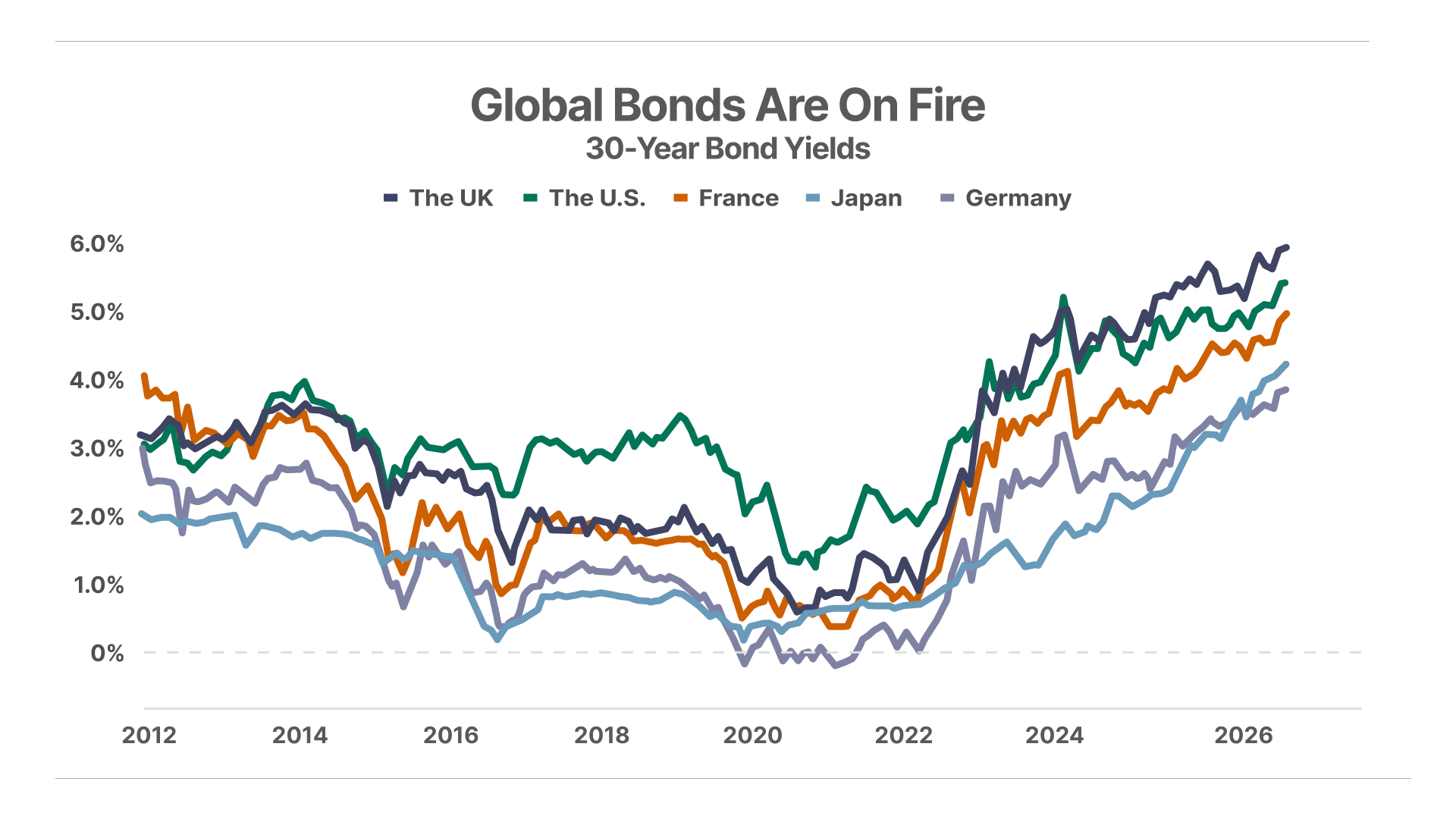
1. The global bond market is repricing the cost of government debt. Britain's 30-year gilt yields 5.85% – the highest since 1998. The U.S. 30-year Treasury hit 5.33%, a level last seen in 2007. France's is near 4.9%, an 18-year high. Germany's reached 3.78%, the highest in 15 years. Japan's is near a record just above 4%. This is not an inflation scare. All of it came from the real yield – reckless fiscal policy is driving investors to demand higher yields to lend to governments worldwide.
2. Traders are betting against tech while tech execs are buying. Hedge funds and asset managers have built their largest-net short position on record in Nasdaq 100 futures – contracts that pay off when the index falls – at nearly $20 billion. At the same time, corporate insiders at technology companies, the executives and directors with the clearest view of their own businesses, are buying their own shares at close to a 15-year high.
3. Home Depot (HD) shrugs off the frozen housing market. Home Depot reported fiscal Q2 2026 results (quarter ending August 2) that exceeded analyst estimates across the board this morning. Revenue grew 5.7% year-on-year (“YOY”) to $47.86 billion, while net income increased 4.7% YOY to $4.8 billion. Comparable sales rose 1.7% YOY, notching the strongest growth since Q3 2022, fueled by 11% growth in online sales. CFO Richard McPhail described the macro environment as challenging due to "frozen housing market conditions," but noted that the company is taking market share and reaffirmed full-year fiscal 2026 guidance.
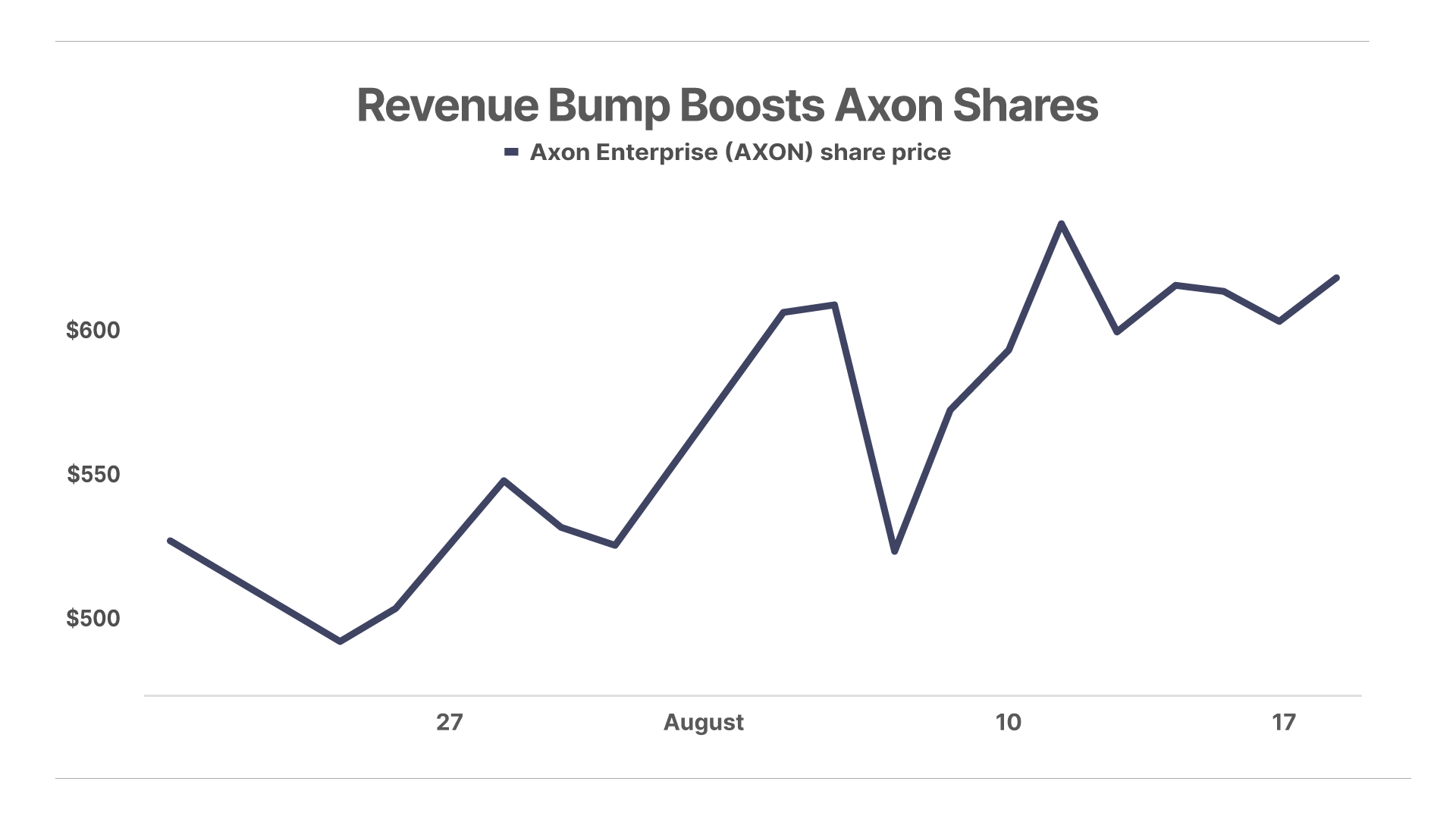
Shares of law-enforcement hardware and software supplier Axon Enterprise (Axon) have gained 20% since our July 18 Complete Investor recommendation. The gains have been fueled by Axon’s stellar Q2 earnings on August 5, which included a 35% YOY increase in revenue that marked Axon’s 10th consecutive quarter of 30% or better revenue growth.
Yesterday, Porter wrote about the questionable business model of CoreWeave in the Daily Journal titled “From Him Who Hath Not, Much Will Be Taken.”
George F. writes:
Hi, Porter:
While I like your investing acumen and your often deep thinking through many issues that affect investment decisions and world affairs, it’s quite disturbing when you reference Scripture and take the word of God out of context.
Your reference to the words of Jesus in Matthew 25 was from The Parable of the Talents: Matthew Chapter 25, Verse 29, "For to everyone who has will more be given, and he will have an abundance. But from the one who has not, even what he has will be taken away (ESV)."
This parable spoken by Jesus has nothing to do with earthly wealth, even though He used a landowner/master and his servants as an example for the story. The Parable of the Talents is actually about the spiritual gifts provided by the Holy Spirit (sent by Jesus) and how those gifts are used to advance the kingdom of God. Two of the slaves doubled the measure of their master’s trust (talent = a unit of measure), and the third slave did nothing with the trust given to him. Note that in this case the master leaving on the journey is representative of Christ. The third was cast as a worthless servant into the outer darkness (verse 30) where there will be "weeping and gnashing of teeth," which speaks of inconsolable grief and unrelenting torment. Jesus commonly used that phrase to describe hell.
Another reader writes:
Wow! What a damning message. I invested some money in CoreWeave – it sounded too good to be true. Well, I ended up with losses that I can deal with. My bad! What I see is other investors chasing the rainbow and losing much more. Good luck to them. Thanks for a great article. Keep them coming.
Porter & Co. Market Snapshot
Porter & Co. Top Positions
Please note: The investments in our “Porter & Co. Top Positions” should not be considered current recommendations. These positions are the best performers across our publications – and the securities listed may (or may not) be above the current buy-up-to price. To learn more, visit the current recommendations page of the relevant service, here| New Window. To gain access or to learn more about our current recommendations, call our Customer Care team at 888-610-8895 or internationally at +1 443-815-4447.